

|
Getting your Trinity Audio player ready...
|
✓ Medically reviewed by Dr. Ashutosh Shah, Plastic, Reconstructive & Cosmetic Surgeon (M.Ch., DNB)
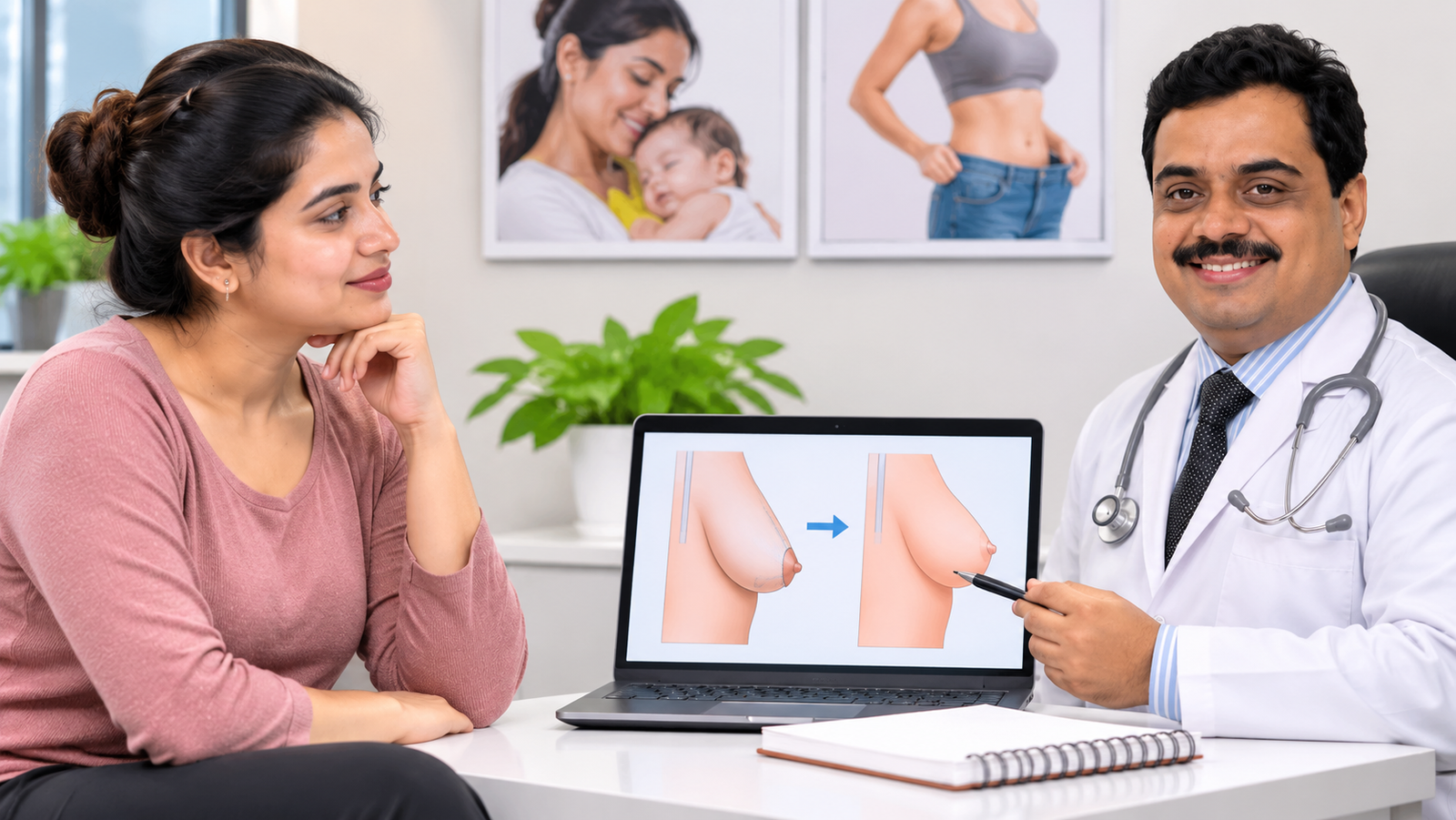
A breast lift after pregnancy may help women who notice sagging, stretched skin or changes in breast shape after childbirth. Pregnancy and breastfeeding can change breast volume and skin elasticity. Similarly, significant weight loss can leave the breasts looking lower or less full.
However, timing matters. Choosing surgery before your breast size and body weight stabilise may affect the final result.
A breast lift, also called mastopexy, reshapes breast tissue, removes excess skin and repositions the nipples when necessary. Nevertheless, it does not automatically increase breast size or prevent future sagging.
So, when should you consider surgery?
This guide explains the best time for a breast lift after pregnancy or weight loss, how breastfeeding affects the decision and what to discuss with your surgeon.
What Happens to Breast Shape After Pregnancy?
Pregnancy causes hormonal changes that prepare the breasts for milk production. As a result, breast tissue and skin may stretch.
After childbirth and breastfeeding, breast volume can change again.
Why Do Breasts Sag After Pregnancy?
Several factors influence breast shape, including skin elasticity, genetics, age and changes in breast volume.
For example, some women notice loose skin after their breasts return to a smaller size.
Others experience lower nipple position or reduced fullness in the upper breast.
However, not everyone develops noticeable sagging.
Does Breastfeeding Cause Sagging?
Breast changes involve several factors, including pregnancy-related stretching, ageing and weight fluctuations.
Therefore, it is inaccurate to assume that breastfeeding alone causes breast sagging.
Can Exercise Reverse Breast Sagging?
Exercise can strengthen the chest muscles beneath the breasts.
However, it cannot remove stretched breast skin or directly lift breast tissue.
A supportive bra may improve comfort and appearance under clothing, but it does not permanently reposition the breasts.
When Is the Best Time for a Breast Lift After Pregnancy?
The right time depends on breastfeeding, breast size stability, health and family plans.
There is no universal surgery date suitable for everyone.
Wait Until Breastfeeding Has Ended
Elective breast lift surgery generally takes place after breastfeeding has stopped.
During lactation, breast volume can change and milk production may continue.
Therefore, operating while the breasts are actively changing can make surgical planning more difficult.
Allow Breast Size to Stabilise
After breastfeeding ends, breast tissue needs time to settle.
Surgeons may recommend waiting several months, often around three to six months, depending on individual circumstances.
However, this is a planning guideline rather than a fixed rule.
Consider Your Overall Recovery After Childbirth
Your body also needs time to recover from pregnancy and delivery.
For example, anaemia, nutritional concerns or other medical conditions may require attention before elective surgery.
In addition, you should have enough support at home during postoperative recovery.
Breast Lift After Weight Loss: When Should You Consider Surgery?
A breast lift after weight loss may help when reduced breast volume leaves excess skin and noticeable sagging.
However, surgery is usually easier to plan once weight has stabilised.
Why Does Weight Loss Change Breast Shape?
Breasts contain glandular tissue, fat and supportive structures.
When body fat decreases, breast volume may also decrease.
However, stretched skin does not always tighten enough to match the new volume.
Consequently, the breasts may appear flatter or lower.
Why Is Stable Weight Important?
Further weight loss after surgery may reduce breast fullness.
In contrast, significant weight gain may stretch the skin again.
Therefore, many surgeons prefer a reasonably stable weight before planning mastopexy.
How Long Should Weight Remain Stable?
Some surgeons recommend maintaining a stable weight for several months, often around six months or longer after major weight loss.
However, the appropriate interval varies.
Patients recovering from bariatric surgery may need additional nutritional assessment and a longer period of stability.
Breast Lift Timing: Pregnancy vs Weight Loss
| Situation | When to consider surgery | Why timing matters |
|---|---|---|
| Recently gave birth | After appropriate postpartum recovery | Health and breast changes need assessment |
| Currently breastfeeding | Usually postpone elective surgery | Breast volume and milk production may still change |
| Recently stopped breastfeeding | After breast size stabilises | Helps the surgeon assess the final breast shape |
| Planning another pregnancy soon | Consider postponing | Pregnancy may alter surgical results |
| Actively losing weight | Usually wait | Further weight loss can change breast volume |
| Weight stable after major loss | Consider consultation | The surgeon can assess remaining skin and tissue |
| Recovering from bariatric surgery | After nutritional and medical optimisation | Deficiencies may affect healing |
The main principle: Plan surgery when your breast shape, body weight and health are sufficiently stable.
Should You Wait Until You Have Finished Having Children?
Not necessarily. However, future pregnancy can affect the results of a breast lift.
Can You Become Pregnant After a Breast Lift?
Yes. A breast lift does not prevent pregnancy.
However, pregnancy may enlarge the breasts and stretch the skin again.
As a result, some women notice renewed sagging after childbirth.
Will Another Pregnancy Ruin the Results?
Not always.
The degree of change depends on breast volume, skin elasticity, genetics and weight fluctuations.
However, no surgeon can guarantee that the original result will remain unchanged after another pregnancy.
When Might Waiting Be Better?
If you plan another pregnancy soon, postponing surgery may be reasonable.
On the other hand, some women choose surgery earlier because their current breast shape significantly affects their confidence.
The decision should reflect personal priorities and an informed discussion of future changes.
Can You Breastfeed After a Breast Lift?
Some women can breastfeed after mastopexy.
However, the procedure may affect milk ducts, nerves or glandular connections.
Therefore, breastfeeding ability cannot be guaranteed.
Does the Surgical Technique Matter?
Yes. Different breast lift techniques involve different degrees of tissue reshaping.
The surgeon should explain how the proposed operation may affect future breastfeeding.
Should You Tell Your Surgeon About Future Pregnancy Plans?
Absolutely.
Even if pregnancy is not planned immediately, discussing future breastfeeding goals helps the surgeon explain the relevant risks.
For additional information, read Breastfeeding After Breast Lift: Is It Possible?.
How Do You Know Whether You Need a Breast Lift?
Not every change in breast shape requires surgery.
A consultation helps determine whether a lift matches your goals.
Your Breasts Sit Lower Than Before
You may notice that the nipples sit lower or point downward.
A breast lift can reposition the nipples and reshape the breasts.
You Have Loose or Stretched Skin
Pregnancy and weight loss may leave excess skin.
A surgeon may remove some of this skin during mastopexy.
You Are Comfortable With Your Breast Size
If you like your current breast volume but want a higher position, a lift alone may be appropriate.
However, a breast lift does not significantly increase volume.
You Want More Upper Breast Fullness
If you have lost substantial volume, a lift alone may not achieve the fullness you want.
In selected cases, the surgeon may discuss implants or another approach.
Learn more in Who Is a Good Candidate for Breast Lift Surgery?.
Breast Lift Alone or Breast Lift With Implants?
The choice depends on whether you want to change breast position, volume or both.
Breast Lift Without Implants
A lift alone reshapes existing tissue.
Therefore, it may suit someone who wants less sagging without substantially larger breasts.
Breast Lift With Implants
A surgeon may discuss implants when the patient wants additional volume.
However, combining a lift with augmentation adds surgical complexity and implant-related risks.
Breast Reduction Instead of a Lift
If heavy breasts cause discomfort and you want a smaller size, breast reduction may be more suitable.
Reduction often includes reshaping and lifting the breast.
| Your main concern | Procedure to discuss |
|---|---|
| Sagging with satisfactory volume | Breast lift |
| Sagging with a desire for more volume | Breast lift with augmentation |
| Heavy breasts and desire for smaller size | Breast reduction |
| Unsure about size or shape | Personalised surgical consultation |
For a detailed comparison, explore Breast Lift vs Breast Augmentation.
What Should You Check Before Scheduling Surgery?
A successful consultation involves more than choosing a date.
Your Weight and Breast Size Are Stable
First, consider whether you expect major weight changes.
If your weight is still changing, the surgeon may recommend waiting.
You Have Recovered From Pregnancy
Next, discuss your postpartum health and breastfeeding history.
The surgeon may recommend additional recovery time if needed.
You Can Arrange Help at Home
After surgery, lifting heavy objects and strenuous activities may be restricted.
Therefore, parents of young children should arrange practical support.
You Understand the Scars
Every surgical breast lift leaves scars.
Their location depends on the incision pattern and the amount of reshaping required.
Although scars often become less noticeable, they do not disappear completely.
Your Medical Conditions Are Well Managed
Smoking, nicotine use, uncontrolled diabetes and certain medical conditions can increase complications.
The surgeon may recommend health optimisation before surgery.
What Is Recovery Like After a Breast Lift?
Recovery varies according to the technique, general health and whether the procedure includes implants or reduction.
The First Week
Swelling, bruising and discomfort are common.
The surgeon may recommend a support bra and temporary activity restrictions.
The Following Weeks
Most patients gradually return to routine activities.
However, strenuous exercise and heavy lifting may remain restricted until the surgeon confirms they are safe.
Looking After Young Children
Parents may need help lifting babies or toddlers.
Therefore, plan childcare support before the operation rather than waiting until recovery begins.
Long-Term Healing
Swelling continues to settle, and scars gradually mature.
Final breast shape may take months to become clearer.
However, results and recovery times vary.
What Are the Risks of Breast Lift Surgery?
A breast lift is an elective operation with recognised complications.
Therefore, understanding the risks is essential before consent.
Bleeding and Infection
Bleeding, hematoma and infection can occur after surgery.
Some complications require additional treatment.
Delayed Wound Healing
Incisions may heal slowly, particularly when blood supply or other health factors affect recovery.
Changes in Nipple Sensation
Nipple sensation may increase, decrease or change.
Some changes improve, while others may persist.
Scarring and Asymmetry
Scars are permanent, and perfect breast symmetry cannot be guaranteed.
Rare Tissue Circulation Problems
In uncommon cases, reduced blood supply can damage nipple or breast tissue.
Future Changes in Breast Shape
Ageing, weight fluctuations and pregnancy may cause renewed sagging.
Consequently, results are not permanent.
For more detail about the procedure and its limitations, visit Breast Lift Surgery: Procedure, Recovery and Benefits.
When Should You Postpone a Breast Lift?
Sometimes, waiting offers a better opportunity for safe surgery and more predictable results.
You Are Still Breastfeeding
Breast size and milk production may still change.
Therefore, discuss an appropriate waiting period with your surgeon.
You Plan Significant Weight Loss
Further weight changes may alter breast shape.
As a result, waiting until your weight stabilises may be sensible.
You Have an Unresolved Health Concern
A breast lump, unexplained nipple discharge or another new breast symptom needs medical evaluation before elective cosmetic surgery.
Similarly, uncontrolled medical conditions may require treatment first.
You Cannot Follow Recovery Restrictions
If you cannot arrange help with childcare or physically demanding work, consider scheduling surgery later.
Questions to Ask During Your Consultation
Before deciding on surgery, discuss your goals and circumstances.
Questions About Timing
Ask whether your breast size has stabilised enough for surgical planning.
Also, discuss whether another pregnancy or further weight loss could affect the result.
Questions About the Procedure
Ask whether a lift alone can achieve your goals.
Next, discuss scar placement, nipple sensation and possible breastfeeding effects.
Questions About Recovery
Find out when you may safely lift children, drive, exercise and return to work.
Additionally, ask what support you may need at home.
Questions About Risks
Ask how the surgeon manages infection, delayed healing or dissatisfaction with the result.
You can explore Breast Lift Consultation Information before your appointment.
Related Breast Surgery Information
If you are considering a breast lift after pregnancy or weight loss, reviewing related procedures can help you make an informed decision. At Elegance Clinic, you can explore Breast Lift (Mastopexy), Breast Lift Without Implants, Breast Lift With Implants and Types of Breast Surgery. These resources explain treatment differences, recovery considerations and realistic expectations.
Frequently Asked Questions
1. How long after pregnancy can I get a breast lift?
The appropriate timing depends on postpartum recovery, breastfeeding and breast size stability. Surgeons commonly recommend waiting until breastfeeding has ended and breast changes have settled. Your surgeon can advise on an individual timeline.
2. How long after breastfeeding should I wait for a breast lift?
Some surgeons suggest waiting around three to six months after breastfeeding stops. However, this is not a universal requirement. The main goal is to allow breast volume and tissue changes to stabilise.
3. Can I have a breast lift if I plan another pregnancy?
Yes, but future pregnancy may change your results. If you plan another pregnancy soon, postponing surgery may be reasonable. Discuss your priorities and breastfeeding goals with your surgeon.
4. Is a breast lift after weight loss effective?
A breast lift may improve sagging and breast position after significant weight loss. However, it does not automatically restore lost breast volume. Results depend on skin quality, existing tissue and the surgical technique.
5. How long should my weight be stable before surgery?
Surgeons often prefer several months of stable weight, particularly after major weight loss. Some recommend around six months or longer. The exact timing depends on your health and weight-loss history.
6. Will a breast lift make my breasts bigger?
No. A breast lift primarily improves shape and position. If you want additional volume, the surgeon may discuss augmentation. However, implants involve separate risks and long-term considerations.
7. Can I breastfeed after having a breast lift?
Some women can breastfeed after mastopexy, but breastfeeding ability cannot be guaranteed. Surgical technique and individual anatomy can affect milk production and nipple sensation.
8. Will my breasts sag again after another pregnancy?
They may. Pregnancy, weight changes and ageing can affect breast shape after surgery. However, the degree of change varies, and not every patient experiences the same amount of renewed sagging.
9. When is the best time to have a breast lift?
The best time is generally when breast size and body weight are stable, health is suitable and you can follow recovery restrictions. Future pregnancy plans and personal goals also influence timing.
10. Where can I get advice about breast lift after pregnancy?
If you are considering a breast lift after pregnancy, consult an appropriately qualified plastic surgeon. You can explore Elegance Clinic for information about breast lift procedures and consultation options.
Conclusion
A breast lift after pregnancy or major weight loss may improve breast position and shape, but choosing the right time is important.
First, allow breastfeeding-related changes to settle. Next, aim for a stable body weight and address any medical concerns.
Additionally, consider future pregnancy plans and arrange enough support for postoperative recovery.
Most importantly, remember that a breast lift cannot prevent natural ageing or future changes in breast shape.
A qualified plastic surgeon can assess your anatomy, explain the available options and help you decide whether surgery now or later better matches your goals.
