

|
Getting your Trinity Audio player ready...
|
✓ Medically reviewed by Dr. Ashutosh Shah, Plastic, Reconstructive & Cosmetic Surgeon (M.Ch., DNB)
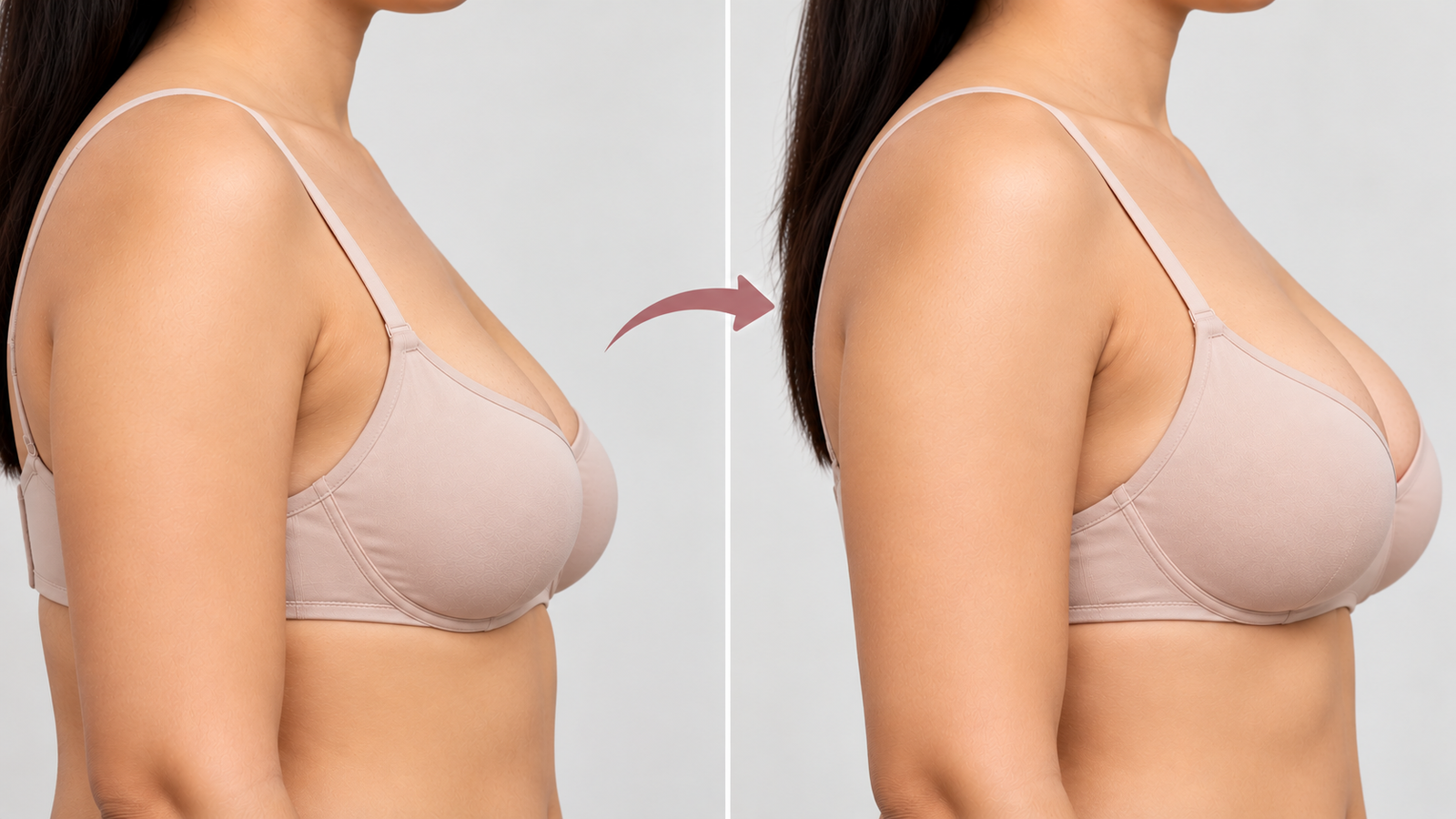
Breast lift surgery, medically called mastopexy, is a cosmetic operation that raises sagging breasts by removing excess skin, reshaping breast tissue, and repositioning the nipple and areola. It can improve breast position and contour without necessarily increasing breast size. The appropriate technique depends on the degree of sagging, breast volume, skin elasticity and individual goals.
Breasts naturally change throughout life. Pregnancy, breastfeeding, weight fluctuations, ageing and genetics can affect their shape and position.
Some women notice that their breasts sit lower than before or that their nipples point downward. Others experience a loss of upper-breast fullness or differences between their breasts.
A breast uplift surgery may help improve these concerns by reshaping and supporting existing breast tissue.
At Elegance Clinic, Dr. Ashutosh Shah, MS, MCh (Plastic Surgery), D.N.B., with 22+ years of experience, assesses breast shape, skin quality, nipple position, and individual expectations before discussing surgical options.
Understanding the procedure, recovery, and possible limitations helps patients decide whether mastopexy is appropriate.
What Is Breast Lift Surgery?
Breast lift surgery is a procedure that changes the position and shape of the breasts without necessarily adding volume.
During the operation, a plastic surgeon removes selected excess skin, reshapes the underlying breast tissue, and moves the nipple-areola complex to a higher position while preserving its blood supply.
The goal is to create a more elevated breast contour that suits the patient’s anatomy.
Mastopexy may improve:
- Sagging or downward-pointing breasts
- Low nipple position
- Stretched breast skin
- Enlarged or stretched areolas
- Uneven breast position
- Loss of breast shape after weight changes
However, a breast lift does not permanently prevent ageing or future sagging.
It also does not significantly increase breast volume unless combined with augmentation.
Patients exploring cosmetic breast procedures can review the available breast treatment options.
Why Do Breasts Begin to Sag?
Breast sagging is medically called breast ptosis.
It occurs when the skin and supporting tissues stretch or change over time.
Several factors contribute to this process.
Ageing
Skin gradually loses elasticity as collagen and elastin change with age.
Breast tissue may also become less firm, allowing the breasts to sit lower on the chest.
Pregnancy and breastfeeding
Pregnancy causes changes in breast size and glandular tissue.
After pregnancy or breastfeeding, breast volume may decrease while stretched skin remains.
These changes can contribute to sagging, although breastfeeding itself is not necessarily the main cause.
Weight fluctuations
Repeated weight gain and loss can stretch breast skin.
Significant weight loss may reduce breast volume and leave excess skin.
Genetics
Natural differences in breast size, skin elasticity, and connective tissue influence how breasts change over time.
Larger breast size
Heavier breasts may experience greater stretching of their supporting tissues.
However, women with smaller breasts can also develop sagging.
How Can You Tell Whether You May Need a Breast Lift?
One common sign is that the nipples sit at or below the natural breast fold.
Other possible signs include:
- Nipples pointing downward
- Excess skin beneath the breast
- A flattened or elongated breast shape
- Reduced upper-breast fullness
- Breasts sitting lower after weight loss
- Differences in nipple height
A mirror can help identify visible changes, but it cannot determine which operation is appropriate.
A plastic surgeon assesses breast measurements, nipple position, skin quality, and tissue distribution.
Understanding breast ptosis
Doctors may describe breast sagging according to the position of the nipple relative to the inframammary fold.
| Breast position | Typical finding | Possible treatment consideration |
|---|---|---|
| Mild ptosis | Nipple sits near the breast fold | Selected limited-incision lift techniques |
| Moderate ptosis | Nipple sits below the fold | Vertical or another suitable mastopexy technique |
| Severe ptosis | Nipple sits well below the fold | More extensive skin reshaping may be necessary |
| Pseudoptosis | Nipple remains relatively high, but lower breast tissue hangs below the fold | Individualised reshaping, sometimes with augmentation |
These descriptions are simplified. Surgical planning requires clinical measurements and examination.
How Does Breast Lift Surgery Work?
The surgeon selects the technique according to the amount of sagging, breast shape, and skin excess.
Although different incision patterns are available, the main steps follow a similar approach.
Step 1: Consultation and breast assessment
The surgeon discusses the patient’s goals and reviews their medical history.
The assessment includes:
- Breast size and shape
- Nipple and areola position
- Skin elasticity
- Degree of ptosis
- Breast asymmetry
- Previous surgery
- Pregnancy and breastfeeding plans
Patients may need appropriate breast imaging based on age, symptoms, risk factors, and clinical findings.
Step 2: Surgical planning and markings
Before surgery, the surgeon marks the intended nipple position and skin-removal pattern.
These markings guide breast reshaping.
The final plan depends on individual anatomy rather than a standard measurement for every patient.
Step 3: Anaesthesia
Surgeons commonly perform mastopexy under general anaesthesia.
The anaesthesia team evaluates the patient’s health and provides instructions about fasting, medication, and postoperative care.
Step 4: Incisions
The surgeon makes incisions according to the chosen mastopexy technique.
The incision pattern may surround the areola, extend vertically towards the breast fold, or include an additional incision along the fold.
Step 5: Breast tissue reshaping
The surgeon reshapes and repositions existing breast tissue to create a more elevated contour.
The amount of tissue adjustment depends on the patient’s breast volume and degree of sagging.
Step 6: Nipple and areola repositioning
The surgeon moves the nipple-areola complex to a more suitable position while aiming to preserve blood supply and sensation.
The areola may also be reduced when appropriate.
Step 7: Removing excess skin and closing incisions
The surgeon removes selected excess skin and closes the incisions.
Dressings and a supportive surgical bra may be applied.
What Are the Different Breast Lift Techniques?
Several mastopexy techniques are available.
The surgeon selects the incision pattern based on the degree of ptosis and the amount of skin reshaping required.
| Technique | Incision pattern | Common suitability | Main limitation |
|---|---|---|---|
| Crescent lift | Small crescent near the upper areola | Very limited repositioning in selected cases | Minimal lifting ability |
| Periareolar lift | Circular incision around the areola | Selected mild ptosis | May flatten the breast or stretch the areola |
| Vertical lift | Around the areola and vertically down to the fold | Many cases of moderate ptosis | Leaves a vertical scar |
| Anchor lift | Around the areola, vertically down and along the breast fold | Significant sagging or skin excess | Longer scar pattern |
The technique with the shortest scar is not always the most suitable.
Attempting to correct substantial sagging with an inadequate incision pattern may compromise breast shape or lead to recurrent stretching.
Breast Lift vs Breast Augmentation: What Is the Difference?
Patients sometimes confuse breast lift surgery with breast implant surgery.
Both procedures change breast appearance, but they address different concerns.
Breast lift surgery primarily improves breast position and shape.
Breast augmentation surgery primarily increases breast volume.
| Feature | Breast lift | Breast augmentation |
|---|---|---|
| Main goal | Raise and reshape sagging breasts | Increase breast volume |
| Removes excess skin | Usually yes | Not routinely |
| Repositions nipple | Commonly | Not routinely |
| Uses implants | Not necessarily | Usually, for implant-based augmentation |
| Increases breast size | Not significantly | Yes |
| Corrects major sagging | Often appropriate | Implants alone may not be sufficient |
| Scars | Depend on lift technique | Depends on augmentation incision |
Some patients need a lift, some need augmentation, and others may benefit from both.
For a broader comparison, see which breast surgery may suit different concerns.
Can a Breast Lift Be Combined With Implants?
Yes. Some patients have both breast sagging and reduced breast volume.
A combined breast lift and augmentation may improve position while adding fullness.
For example, a patient who has lost breast volume after pregnancy may want both a higher nipple position and greater upper-breast fullness.
However, combining procedures can increase complexity.
The surgeon must consider skin tension, implant size, tissue quality, and healing risks.
Some patients may benefit from staged procedures rather than performing everything during one operation.
Implants also introduce long-term considerations such as rupture, capsular contracture, and possible future replacement or removal.
A combined procedure should therefore be selected only after discussing its benefits and additional risks.
Who Is a Good Candidate for Breast Lift Surgery?
Suitable candidates are generally adults who are in good overall health and have realistic expectations.
A breast lift may be considered when:
- The breasts have noticeable sagging
- The nipples sit lower than desired
- Breast shape has changed after pregnancy
- Weight loss has left excess skin
- The patient wants improved breast position rather than substantial enlargement
- Body weight is reasonably stable
Patients should ideally avoid smoking and nicotine exposure around surgery because nicotine can impair blood flow and wound healing.
Medical conditions that affect healing should be evaluated and managed before elective surgery.
When should surgery be postponed?
A surgeon may recommend postponing mastopexy when:
- The patient is pregnant or breastfeeding
- Weight is changing significantly
- A major weight-loss programme is ongoing
- An untreated medical condition increases surgical risk
- The patient cannot follow postoperative restrictions
- Expectations are unrealistic
Patients planning pregnancy should understand that future breast changes may affect the result.
How Long Does Breast Lift Surgery Take?
A breast lift commonly takes approximately two to three hours, although operating time varies.
More complex procedures or combined augmentation may require additional time.
Some patients return home the same day, while others require observation or admission.
The surgeon and anaesthesia team determine the appropriate plan according to the procedure and the patient’s health.
What Is Recovery Like After Breast Lift Surgery?
Recovery varies depending on the technique, amount of tissue reshaping, and individual healing.
First 48 hours
Patients may experience swelling, tightness, bruising, and discomfort.
They should rest, take prescribed medication, and follow wound-care instructions.
Assistance with household tasks may be helpful.
First week
Discomfort usually begins to improve.
Some patients can return to light desk-based work within approximately one week, although others need longer.
Heavy lifting and strenuous activity should be avoided.
Weeks two to four
Swelling and bruising generally continue improving.
Patients may gradually resume activities according to their surgeon’s guidance.
The incisions still require protection during healing.
Weeks four to six
Some patients can return to additional physical activity after receiving medical clearance.
Recovery restrictions vary with the surgical technique and healing progress.
Following months
Breast shape continues settling.
Scars gradually mature, although they may remain visible.
The final appearance can take several months to become more stable.
Breast lift recovery timeline
| Recovery period | What patients may experience | General guidance |
|---|---|---|
| Days 1–3 | Swelling, tightness and discomfort | Rest and follow prescribed care |
| Week 1 | Gradually improving discomfort | Gentle activities as permitted |
| Weeks 2–3 | Reduced bruising and swelling | Continue incision care |
| Weeks 4–6 | Increasing comfort and mobility | Resume exercise only after clearance |
| Months 2–3 | Breast contour continues settling | Attend scheduled reviews |
| Months 6–12+ | Continued scar maturation | Monitor long-term healing |
These are approximate recovery stages, not guaranteed deadlines.
Will Breast Lift Surgery Leave Scars?
Yes.
All mastopexy techniques create surgical scars.
The location and length depend on the chosen incision pattern.
Common scar locations include:
- Around the areola
- Vertically from the areola towards the breast fold
- Along the natural fold beneath the breast
Scars often become less noticeable with time, but they do not disappear completely.
Individual healing, skin type, genetics, wound tension, and postoperative care influence scar appearance.
Patients with a history of hypertrophic scars or keloids should inform their surgeon before surgery.
What Are the Risks of Breast Lift Surgery?
Like every operation, breast lift surgery carries potential risks.
Bleeding and haematoma
Bleeding can occasionally collect beneath the skin and may require additional treatment.
Infection
Surgical wounds can become infected.
Symptoms may include increasing redness, warmth, pain, discharge or fever.
Delayed wound healing
Some incision areas may heal more slowly, particularly where several incision lines meet.
Smoking, diabetes and other medical factors can increase wound-healing concerns.
Changes in nipple sensation
Patients may experience temporary or permanent changes in nipple or breast sensation.
Nipple or areola blood-supply problems
Rarely, reduced blood supply can cause tissue injury or loss of part or all of the nipple-areola complex.
The risk depends on the technique and individual factors.
Breast asymmetry
Perfect symmetry cannot be guaranteed.
Differences in healing, existing anatomy and tissue behaviour may affect the final appearance.
Unfavourable scars
Some patients develop widened, thickened or prominent scars.
Need for revision surgery
A patient may require additional surgery because of healing problems, asymmetry, recurrent sagging or dissatisfaction with the result.
A detailed consultation should cover these possibilities before consent.
How Long Do Breast Lift Results Last?
Breast lift results can last for years, but they are not permanent.
The procedure reshapes and elevates the breasts at the time of surgery.
However, ageing, gravity, pregnancy, and weight changes continue to affect the tissues.
Maintaining a stable weight may help preserve the result.
Supportive bras may improve comfort during activity, but they cannot completely prevent natural breast changes.
Patients should avoid expecting a breast lift to stop the ageing process.
Can You Breastfeed After a Breast Lift?
Some women can breastfeed after mastopexy, but breastfeeding ability cannot be guaranteed.
The effect depends on the surgical technique, preservation of milk ducts, nerves, and blood supply, and individual anatomy.
More extensive tissue reshaping may affect milk production.
Patients who plan future pregnancies should discuss these goals before surgery.
Pregnancy can also change breast shape after a lift, potentially affecting the cosmetic result.
Can Breast Lift Surgery Reduce Breast Size?
A standard breast lift mainly changes breast position and contour.
It may remove a small amount of tissue during reshaping, but substantial breast reduction is not its primary purpose.
Patients with heavy breasts who want both lifting and reduced volume may be better suited to breast reduction surgery.
The surgeon should determine whether the patient’s main concern is sagging, excess volume, or both.
How Should You Prepare for Breast Lift Surgery?
Preparation begins with a medical consultation.
The surgeon may recommend:
- Reviewing medical history and current medicines.
- Completing appropriate laboratory tests or breast imaging.
- Stopping smoking and nicotine use according to medical advice.
- Discussing medicines and supplements that may affect bleeding.
- Arranging transport home after surgery.
- Preparing suitable clothing and postoperative support.
- Planning sufficient time away from strenuous activities.
- Attending scheduled follow-up appointments.
Patients should never stop prescribed medicines without consulting the relevant clinician.
Frequently Asked Questions
1. What is breast lift surgery?
Breast lift surgery, or mastopexy, raises and reshapes sagging breasts by removing excess skin and repositioning breast tissue and the nipple-areola complex. It improves breast position without necessarily increasing breast size.
2. Is breast lift surgery the same as breast augmentation?
No. A breast lift primarily improves breast position and shape, while augmentation increases breast volume. Some patients may benefit from combining both procedures.
3. Does breast lift surgery make breasts smaller?
A lift may slightly change breast volume because of tissue reshaping, but significant reduction is not its main purpose. Patients seeking smaller breasts may require reduction surgery.
4. Is breast uplift surgery painful?
Patients receive anaesthesia during surgery. Afterward, they may experience discomfort, swelling, and tightness. Prescribed medication usually helps manage symptoms, although recovery varies.
5. How long does recovery take after a breast lift?
Some patients return to light work within approximately one week, while strenuous activity may remain restricted for several weeks. Swelling and scar maturation can continue for months.
6. Will a breast lift leave visible scars?
Yes. Scar length and position depend on the technique. Scars generally mature and may become less noticeable over time, but they do not disappear completely.
7. Can breast lift surgery be performed without implants?
Yes. Many mastopexy procedures use the patient’s existing breast tissue without implants. Implants may be considered when additional volume is desired.
8. Can I breastfeed after mastopexy?
Breastfeeding may remain possible, but surgery can affect milk ducts, nerves, or milk production. Discuss future breastfeeding plans with the surgeon before treatment.
9. Can breasts sag again after a lift?
Yes. Ageing, weight changes, and pregnancy can contribute to recurrent sagging. A breast lift does not permanently prevent natural changes.
10. What is the best age for breast lift surgery?
There is no single ideal age. Suitability depends on physical maturity, breast changes, general health, pregnancy plans, and personal goals rather than age alone.
Key Takeaways
- Breast lift surgery is also called mastopexy.
- The procedure raises and reshapes sagging breasts.
- It can reposition the nipples and remove excess skin.
- A lift does not necessarily increase breast volume.
- Different incision patterns suit different degrees of sagging.
- Some patients may benefit from combining a lift with augmentation.
- Recovery generally requires several weeks of activity adjustments.
- Scars, sensation changes, and other surgical complications are possible.
- Results can last for years, but future sagging may occur.
- A qualified plastic surgeon should assess individual suitability.
Conclusion
Breast lift surgery can improve breast position, contour and nipple alignment in women experiencing sagging due to ageing, pregnancy, weight changes or natural anatomy.
The operation works by reshaping existing breast tissue and removing excess skin rather than simply increasing breast volume.
However, mastopexy involves scars, recovery requirements, and potential complications. Patients should understand these considerations before choosing surgery.
At Elegance Clinic, Dr. Ashutosh A Shah, MS, MCh (Plastic Surgery), D.N.B., with 22+ years of experience, evaluates breast shape, skin elasticity, nipple position, and individual goals to discuss appropriate surgical options.
Patients considering treatment can book a consultation to understand whether a breast lift, augmentation, reduction, or another procedure may be suitable.
