

|
Getting your Trinity Audio player ready...
|
✓ Medically reviewed by Dr. Ashutosh Shah, Plastic, Reconstructive & Cosmetic Surgeon (M.Ch., DNB)
What is a breast lift with implants?
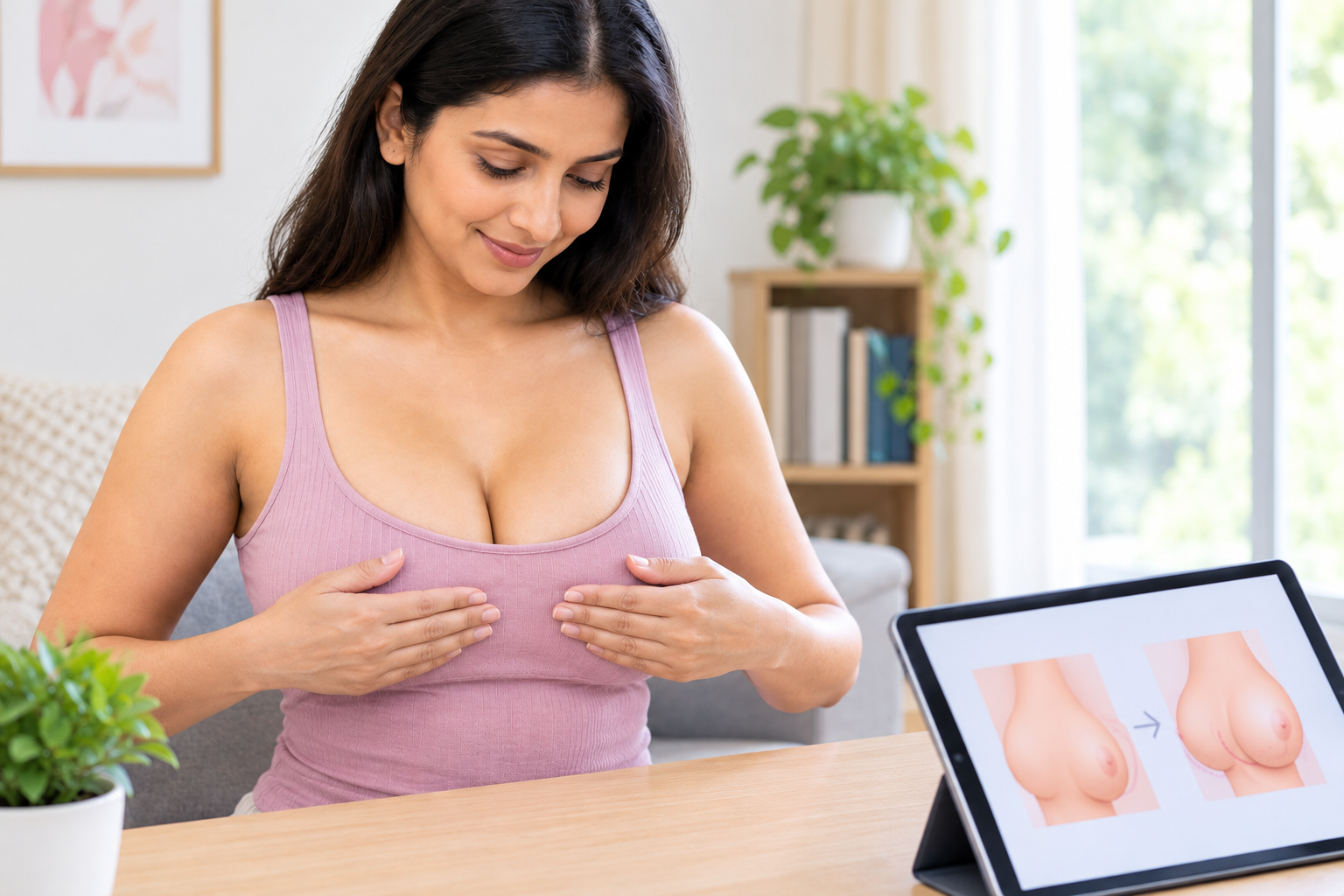
A breast lift with implants combines two procedures: a breast lift to raise and reshape sagging breasts, and breast augmentation to add volume. It may be considered when someone wants a higher breast position as well as more fullness, particularly in the upper breast. Whether both procedures are appropriate depends on breast anatomy, skin quality, health, personal goals and surgical risks.
When might a breast lift with implants be recommended?
A combined procedure, also called augmentation mastopexy, may be considered when breast sagging and loss of volume occur together. The aim is to improve breast position while adding fullness, rather than addressing only one concern.
A plastic surgeon may discuss this option if you:
- Have sagging breasts after pregnancy or breastfeeding.
- Have lost breast volume following significant weight loss.
- Notice that the upper part of the breasts looks less full than before.
- Want to improve breast position and increase size at the same time.
- Have changes in breast shape associated with ageing.
- Have some breast asymmetry that may be addressed as part of an individual surgical plan.
These factors do not automatically mean you need implants or a lift. An examination is needed to determine which procedure, if any, matches your goals.
Breast lift alone or breast lift with implants?
The main difference is whether the treatment needs to change breast position only or both position and volume.
| Concern | Breast lift alone | Breast lift with implants |
|---|---|---|
| Sagging breasts | Raises and reshapes the breasts | Raises and reshapes the breasts |
| Loss of breast volume | Does not usually add volume | Adds volume with implants |
| Upper breast fullness | May remain limited | May improve with appropriate implant selection |
| Implant-related risks | No implant-related risks | Includes implant-specific risks |
| Scarring | Depends on the lift technique | Depends on the combined surgical technique |
| Future procedures | Possible depending on healing and ageing | May include future implant monitoring or surgery |
A lift alone may be sufficient if your main concern is sagging and you are happy with your existing breast volume. If you want to understand the lifting procedure itself, read the breast lift surgery guide.
Who may be a suitable candidate?
Suitability is decided individually. A consultation may be appropriate if you are bothered by both breast sagging and reduced fullness and have realistic expectations about what surgery can achieve.
A surgeon will generally consider the following factors:
- Breast shape: The degree of sagging, nipple position and existing breast volume.
- Skin quality: Skin elasticity and the amount of excess skin.
- Body proportions: Chest width, breast dimensions and the size of implant that may suit your anatomy.
- General health: Medical conditions, medications, smoking or nicotine use, and factors that may affect healing.
- Personal goals: Whether you want a lifted shape, more volume or both.
- Future plans: Pregnancy and breastfeeding plans, as future changes may affect the result.
It is important to understand that surgery cannot stop natural ageing or guarantee permanent breast shape. Weight changes and pregnancy can alter the breasts after treatment.
When might implants not be necessary?
Implants are not essential for every breast lift. If your main concern is a lower breast position, excess skin or nipples that sit lower than you would like, a lift alone may address the concern without increasing breast size.
Some patients also prefer to maintain their existing volume. In selected cases, other approaches may be discussed, depending on the amount of available breast tissue and the desired result.
If increasing volume is a key goal, your surgeon can explain the available breast augmentation and implant options and whether they are suitable alongside a lift.
What should you know about the risks?
Combining a lift and augmentation can achieve two goals in one operation, but it is more complex than either procedure alone. The surgeon must balance the tension created by lifting the skin with the volume and weight of the implant.
Possible risks include:
- Bleeding or infection
- Scarring and delayed wound healing
- Changes in nipple or breast sensation
- Differences in breast shape or symmetry
- Changes in nipple or skin blood supply
- Implant displacement, rupture or capsular contracture
- The possibility of revision surgery
Breast implants are not lifetime devices. They may require monitoring and, in some circumstances, additional surgery in the future. The risks and follow-up requirements should be discussed before making a decision.
Can the lift and implant be performed together?
In selected patients, the lift and implant can be performed during the same operation. However, a combined procedure is not suitable for everyone.
Depending on breast anatomy, skin quality, implant size and healing risks, the surgeon may recommend performing the procedures in stages. This can allow the breast tissue to heal and settle before the next step is considered.
The decision should be based on clinical assessment rather than a preference to complete everything in one operation.
What is recovery like?
Recovery varies according to the surgical technique, the individual’s health and whether complications occur. Patients generally need time away from strenuous activity and should follow their surgeon’s instructions for wound care, sleeping position, supportive garments and follow-up visits.
During recovery, you may experience temporary swelling, bruising, tightness or discomfort. The final breast shape takes time to settle, and scars generally change in appearance as they heal.
Before surgery, ask your surgeon about:
- Expected time away from work.
- When driving and exercise can resume.
- How to care for incisions.
- Which supportive bra or garment is recommended.
- Warning signs that require prompt medical attention.
- The schedule for follow-up and long-term implant monitoring.
Do not resume strenuous activity simply because you feel better; follow your surgeon’s individual advice.
Questions to ask before choosing augmentation mastopexy
Use this checklist during your consultation:
- Do I need a lift, implants or both?
- What improvement is realistic for my breast shape?
- What implant size and placement may suit my anatomy?
- Would a staged procedure be safer for me?
- Where will the scars be, and how may they heal?
- What are the risks in my individual case?
- What future implant monitoring or surgery might be required?
- What is included in the surgical fee and follow-up plan?
You can also review the clinic’s information about breast lift with implants before discussing your individual needs with a qualified plastic surgeon.
How to make an informed decision
The right choice depends on what you want to change. A lift primarily addresses sagging and breast position, while implants add volume. Combining them may be appropriate when both concerns are present, but it also introduces additional risks and long-term implant considerations.
At a consultation, discuss your priorities openly and ask about alternatives, expected scars, recovery, complications and future follow-up. The aim is to choose an approach that is appropriate for your anatomy and health—not simply the procedure that promises the most fullness.
Frequently Asked Questions
When is a breast lift with implants recommended?
It may be recommended when a person has both breast sagging and loss of volume and wants to improve breast position while adding fullness. Suitability depends on breast anatomy, skin quality, overall health and personal goals. A qualified plastic surgeon can assess whether a combined or staged procedure is appropriate.
What is augmentation mastopexy?
Augmentation mastopexy is the medical term for combining breast augmentation with a breast lift. The lift reshapes and raises the breasts, while implants add volume. Combining the procedures may address both concerns, but it can be more complex than performing either procedure alone.
Can a breast lift improve upper breast fullness without implants?
A breast lift can reshape and reposition existing breast tissue, but it does not reliably add substantial volume to the upper breast. If significant additional fullness is desired, implants or another suitable option may be discussed after an individual assessment.
Is it better to have a breast lift and implants together or separately?
Neither approach is best for everyone. Some patients may be suitable for a combined operation, while others may benefit from staged procedures because of their anatomy, skin quality or healing risks. The surgeon should explain the advantages, limitations and risks of both approaches.
Do breast implants need to be replaced?
Breast implants are not lifetime devices. Replacement or removal is not automatically required at a fixed date for every person, but implants can develop problems and may require further surgery. Follow the recommended monitoring plan and seek assessment for new swelling, pain, a lump or a change in breast shape.
Will a breast lift with implants leave scars?
Yes. A breast lift requires incisions, so scars are expected. Their location and extent depend on the technique and the amount of lifting needed. Scars usually change over time, but their final appearance varies with individual healing and cannot be guaranteed.
How do I know whether I need a breast lift or implants?
A lift may be more appropriate when the main concern is sagging, while implants may be considered when the main goal is increased volume. If both concerns are present, a combination may be discussed. An examination is needed to determine which option is appropriate for you.
