

|
Getting your Trinity Audio player ready...
|
✓ Medically reviewed by Dr. Ashutosh Shah, Plastic, Reconstructive & Cosmetic Surgeon (M.Ch., DNB)
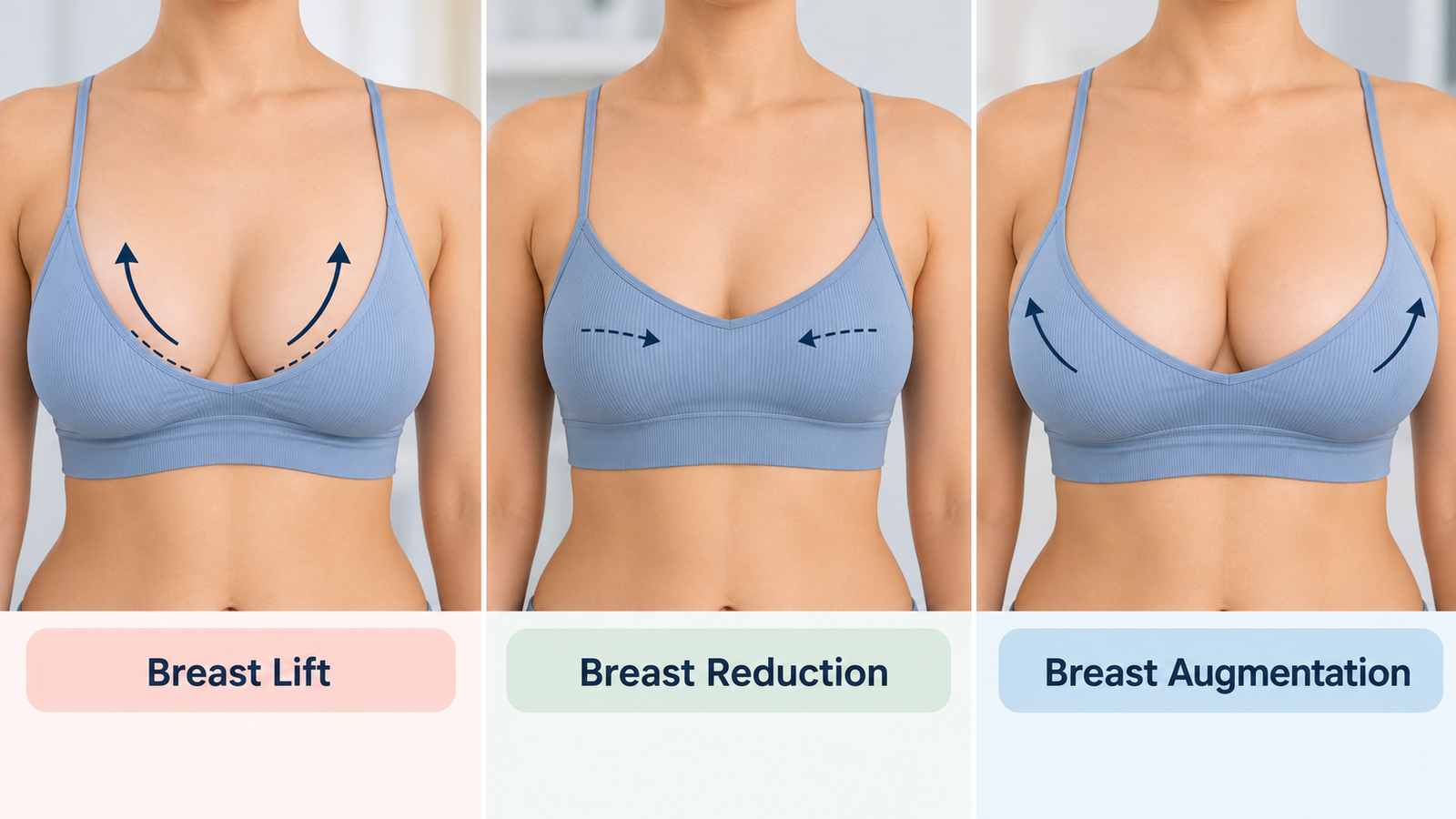
Breast lift, breast reduction, and breast augmentation serve different purposes. A breast lift raises and reshapes sagging breasts. Breast reduction removes excess tissue to make breasts smaller and lighter. Breast augmentation increases breast volume through implants or fat transfer. Your breast size, shape, skin elasticity, physical symptoms, and personal goals help determine which procedure may suit you. Understanding breast lift vs breast augmentation and the role of breast reduction can help you make an informed decision.
Many women struggle to choose between these procedures because they all change breast appearance. However, each surgery addresses a different concern.
At Elegance Clinic, plastic surgeon Dr. Ashutosh Shah evaluates breast size, nipple position, skin quality, and patient expectations during consultations. He considers these factors when discussing appropriate surgical options and realistic outcomes.
What Is the Difference Between Breast Lift, Reduction, and Augmentation?
Each procedure focuses on a different goal.
- Breast Lift (Mastopexy): Raises sagging breasts and improves their shape.
- Breast Reduction: Removes excess breast tissue, fat, and skin to reduce size and weight.
- Breast Augmentation: Adds volume through breast implants or fat transfer.
A breast lift changes breast position and shape. Reduction makes breasts smaller and lighter. Augmentation increases fullness and volume.
Some women benefit from combining procedures when they have more than one concern.
Breast Lift vs Reduction vs Augmentation: Comparison Table
| Feature | Breast Lift | Breast Reduction | Breast Augmentation |
|---|---|---|---|
| Main purpose | Raises sagging breasts | Reduces size and weight | Increases volume |
| Breast size | Usually stays similar | Becomes smaller | Becomes larger |
| Breast position | Raises breast and nipple | Usually raises breast and nipple | Does not reliably correct significant sagging |
| Excess skin | Surgeon removes it | Surgeon removes it | Usually remains |
| Breast tissue | Surgeon reshapes it | Surgeon removes and reshapes some tissue | Surgeon adds volume |
| Implants | Not necessary | Not necessary | Implant augmentation uses implants |
| Scars | Depend on lift technique | Depends on reduction technique | Depends on incision technique |
| Main concern | Sagging breasts | Large, heavy breasts | Small breasts or volume loss |
| Breastfeeding | Surgery may affect it | Surgery may affect it | Surgery may affect it |
| Long-term changes | Natural sagging may return | Weight changes may affect size | Implants require monitoring |
What Is Breast Lift Surgery?
A breast lift, or mastopexy, improves the position and shape of sagging breasts.
Over time, breast skin stretches and supporting tissues lose elasticity. Pregnancy, ageing, genetics, and weight fluctuations can contribute to these changes.
What Does a Breast Lift Correct?
A breast lift can help women who experience:
- Sagging or drooping breasts
- Downward-pointing nipples
- Nipples that sit below the breast crease
- Loose or stretched breast skin
- Changes in breast shape after pregnancy
- Breast asymmetry involving nipple position
During surgery, the plastic surgeon removes excess skin, reshapes existing breast tissue, and moves the nipple-areola complex higher when necessary.
Does a Breast Lift Increase Breast Size?
No. A breast lift does not significantly increase breast volume.
The procedure can create a firmer, higher, and more defined breast shape by redistributing existing tissue.
However, women who want noticeably larger breasts may need augmentation.
Explore breast sagging correction for more information.
What Is Breast Reduction Surgery?
Breast reduction surgery decreases breast size and weight.
During the procedure, the surgeon removes excess breast tissue, fat, and skin. The surgeon also reshapes the remaining tissue to improve breast contour.
Women with large or heavy breasts may experience:
- Neck and shoulder pain
- Upper-back discomfort
- Deep bra strap marks
- Skin irritation beneath the breasts
- Difficulty exercising
- Discomfort during daily activities
Does Breast Reduction Also Lift the Breasts?
Yes. Breast reduction usually lifts the breasts while making them smaller.
The surgeon removes excess tissue, reshapes the breasts, and raises the nipple position when necessary.
However, breast reduction differs from a standard breast lift because it also reduces breast weight and volume.
Who Should Consider Breast Reduction?
Women who experience physical discomfort from large breasts may consider reduction surgery.
The surgeon evaluates breast size, symptoms, medical history, and personal expectations before recommending treatment.
What Is Breast Augmentation Surgery?
Breast augmentation increases breast volume and fullness.
Surgeons commonly use breast implants, although selected patients may consider fat transfer.
Breast Augmentation With Implants
During implant augmentation, the surgeon creates a pocket beneath the breast tissue or chest muscle and places the implant inside it.
Implants vary in size, shape, filling, and surface characteristics.
The surgeon considers breast width, existing tissue, body proportions, and patient goals when discussing implant options.
Breast Augmentation With Fat Transfer
Fat transfer uses fat from another part of the patient’s body.
The surgeon removes fat through liposuction, processes it, and injects it into selected breast areas.
This technique usually offers a smaller volume increase than implants. The body may absorb some transferred fat, so patients may need additional sessions.
Can Breast Augmentation Fix Sagging?
Implants can improve breast fullness, but they cannot reliably correct significant sagging.
If the nipples sit too low, implants alone may increase breast size without improving nipple position.
In these cases, the surgeon may recommend a breast lift with augmentation.
Read more about breast size increase surgery.
Breast Lift vs Breast Augmentation: Which One Do You Need?
The difference between breast lift and implants becomes clearer when you identify your main concern.
Consider a Breast Lift if Your Breasts Sag
A breast lift may suit you if:
- You like your current breast size.
- Your breasts sit lower than before.
- Your nipples point downward.
- Your skin has lost elasticity.
- You want a higher breast position without adding significant volume.
Consider Breast Augmentation if You Want More Volume
Augmentation may suit you if:
- You have naturally small breasts.
- You want fuller breasts.
- You have lost volume after pregnancy.
- You want additional upper-breast fullness.
- You have limited sagging.
Consider Breast Reduction if Your Breasts Feel Heavy
Breast reduction may suit you if:
- You want smaller breasts.
- Breast weight causes discomfort.
- You experience shoulder or back pain.
- Heavy breasts interfere with exercise.
- You want a lighter breast shape.
Can You Combine a Breast Lift With Implants?
Yes. Surgeons can combine breast lift and augmentation in selected patients.
This procedure, called augmentation mastopexy, addresses both sagging and volume loss.
For example, pregnancy may stretch breast skin and reduce upper-breast fullness.
A lift can improve breast position, while implants add volume.
Combining the procedures may help address both concerns during one treatment plan.
However, combined surgery involves additional complexity. Patients may face wound-healing problems, changes in nipple blood supply, or the need for revision surgery.
In some cases, surgeons recommend separate procedures to manage these risks.
Which Breast Surgery Do I Need? A Simple Guide
If you keep asking, ” Which breast surgery do I need?”, start by identifying what bothers you most.
| Your Concern | Procedure to Discuss |
|---|---|
| Breasts sag, but size feels right | Breast lift |
| Breasts feel too large or heavy | Breast reduction |
| Breasts look too small | Breast augmentation |
| Breasts have lost fullness without major sagging | Breast augmentation |
| Breasts sag and lack fullness | Breast lift with possible augmentation |
| Breasts look large and sagging | Breast reduction |
| One breast differs noticeably from the other | Individualized asymmetry correction |
This guide helps you understand your options. A physical examination determines whether a procedure suits your anatomy and goals.
How Does a Surgeon Assess Breast Sagging?
Plastic surgeons call breast sagging breast ptosis.
During a consultation, the surgeon examines:
- Nipple position relative to the breast crease
- Breast volume
- Skin elasticity
- Degree of sagging
- Areola size and position
- Breast symmetry
- Chest proportions
Some women have low breast volume but little nipple drooping.
Others have adequate volume but significant sagging.
These differences influence surgical planning.
Breast Lift vs Reduction vs Augmentation: What About Scars?
Every breast surgery creates some scars.
The scar pattern depends on the procedure and the amount of correction.
Breast Lift Scars
The surgeon may use:
- An incision around the areola
- A vertical incision from the areola to the breast crease
- An anchor-shaped incision for more extensive correction
Breast Reduction Scars
Reduction often requires vertical or anchor-shaped incisions because the surgeon removes breast tissue and excess skin.
Breast Augmentation Scars
Implant augmentation often requires a shorter incision, commonly within the breast crease.
No surgeon can guarantee invisible scars. Skin characteristics, incision placement, healing, and individual factors influence their appearance.
Which Breast Surgery Has the Shortest Recovery?
Recovery depends on the procedure, surgical complexity, and individual healing.
| Recovery Factor | Breast Lift | Breast Reduction | Breast Augmentation |
|---|---|---|---|
| Initial discomfort | Common | Common | Common |
| Swelling | Common | Common | Common |
| Return to desk work | Often 1–2 weeks | Often 1–2 weeks | Often 1–2 weeks |
| Heavy exercise | Avoid for several weeks | Avoid for several weeks | Avoid for several weeks |
| Supportive bra | Usually recommended | Usually recommended | Usually recommended |
| Final breast settling | Several months | Several months | Several months |
These timelines provide general guidance. Your surgeon will recommend a recovery plan according to your procedure.
Breast Lift Recovery
Patients commonly experience swelling, tenderness, and tightness during early healing.
The surgeon may restrict heavy lifting and strenuous exercise.
Breast Reduction Recovery
Patients may need additional wound care because the surgeon removes more tissue.
Some procedures also require temporary surgical drains.
Breast Augmentation Recovery
Patients may experience chest tightness, particularly when the surgeon places implants beneath the muscle.
Implants and surrounding tissues gradually settle over the following months.
Can Breast Surgery Affect Breastfeeding?
Yes. Breast lift, reduction, and augmentation can affect breastfeeding, depending on the technique and individual anatomy.
Breast Lift
A lift may affect milk ducts or nerves, especially when surgery requires extensive tissue rearrangement.
Breast Reduction
Reduction removes breast tissue and may decrease future milk production.
Some women can breastfeed after reduction, while others experience limited milk supply.
Breast Augmentation
Many women can breastfeed after augmentation, but surgeons cannot guarantee normal milk production.
Incision placement, implant position, and existing breast anatomy may influence breastfeeding outcomes.
Discuss future pregnancy and breastfeeding plans before surgery.
What Are the Risks of These Breast Surgeries?
All three procedures involve surgical risks.
Common Risks
- Bleeding
- Infection
- Anaesthesia complications
- Poor wound healing
- Permanent scars
- Breast asymmetry
- Changes in nipple sensation
- Dissatisfaction with results
- Revision surgery
Breast Lift Risks
A breast lift may cause delayed healing, recurrent sagging, or problems with nipple blood supply.
Breast Reduction Risks
Breast reduction may affect breastfeeding, nipple sensation, and wound healing.
Rarely, reduced blood supply can cause tissue damage.
Breast Augmentation Risks
Implants introduce additional risks, including:
- Capsular contracture
- Implant rupture
- Implant displacement
- Rippling
- Future implant-related surgery
Breast implants do not last forever.
Certain implants, particularly textured implants, also carry an association with rare implant-related cancers, including BIA-ALCL.
Your surgeon should explain these risks before you make a decision.
How Long Do Breast Surgery Results Last?
Results can last for years, but surgery cannot stop natural ageing.
Breast Lift Results
A lift improves breast position, but gravity, pregnancy, and weight changes may cause future sagging.
Breast Reduction Results
Reduction decreases breast volume. However, hormonal changes and significant weight fluctuations may alter breast size later.
Breast Augmentation Results
Implants maintain added volume, but patients need ongoing monitoring.
Complications or changing preferences may lead to implant replacement or removal.
Can You Have Breast Surgery After Pregnancy?
Yes. Many women consider breast surgery after pregnancy and breastfeeding.
However, surgeons generally recommend waiting until breastfeeding ends and breast size stabilizes.
This allows a more accurate assessment of breast shape and volume.
If you plan another pregnancy soon, discuss whether postponing surgery makes sense.
Future pregnancy may change your surgical results.
How Much Do Breast Lift, Reduction, and Augmentation Cost?
Several factors influence breast surgery costs:
- Procedure type
- Surgical complexity
- Surgeon fees
- Hospital charges
- Anaesthesia
- Implant selection
- Hospital stay
- Postoperative garments
- Follow-up appointments
Combined breast lift and augmentation may cost more than either procedure alone.
Breast reduction costs also vary according to the extent of tissue removal and surgical complexity.
Request a written estimate that explains included services and possible additional charges.
How to Prepare for Your Consultation
Before your consultation, identify your main goal.
Do you want smaller breasts, fuller breasts, or a higher breast position?
Share your medical history, previous surgeries, medications, smoking habits, and pregnancy plans.
Your surgeon may recommend breast imaging based on your age, symptoms, examination, and screening history.
During your consultation, discuss:
- Your desired breast size and shape
- Surgical techniques
- Incision placement
- Scars
- Recovery time
- Potential complications
- Breastfeeding
- Long-term changes
- Possible revision surgery
You can also explore which breast surgery may suit your goals and breast treatment options.
Frequently Asked Questions
1. Is a breast lift the same as breast augmentation?
No. A breast lift raises and reshapes sagging breasts. Breast augmentation increases breast volume through implants or fat transfer. A lift does not significantly increase breast size, while augmentation alone cannot reliably correct significant sagging.
2. Does breast reduction also lift the breasts?
Yes. Breast reduction usually lifts the breasts while reducing their size and weight. The surgeon removes excess tissue and skin, reshapes the breasts, and raises the nipple position when necessary.
3. Can I have a breast lift without implants?
Yes. A breast lift uses existing breast tissue to improve shape and position. You do not need implants unless you also want additional breast volume.
4. Which procedure works better for sagging breasts: a lift or implants?
A breast lift generally addresses significant sagging more directly. Implants primarily increase volume. Some patients benefit from combining both procedures when they want improved position and fullness.
5. Which breast surgery has the fastest recovery?
Recovery varies by procedure and individual healing. Many patients return to light desk work within one to two weeks, but surgeons usually restrict strenuous exercise for several weeks.
Key Takeaways
- Breast lift raises and reshapes sagging breasts.
- Breast reduction decreases breast size and weight while usually lifting the breasts.
- Breast augmentation increases breast volume.
- Implants alone cannot reliably correct significant sagging.
- Some patients benefit from combining a lift with augmentation.
- Every procedure involves scars and surgical risks.
- Breastfeeding ability may change after surgery.
- A personal consultation helps identify suitable options.
Conclusion
When comparing breast lift vs breast augmentation, focus on the change you want.
A breast lift may suit you if your breasts sag, but you like their size. Breast reduction may help if your breasts feel too large or heavy. Augmentation may suit you if you want more fullness.
Some women benefit from combining procedures, while others may not need surgery.
A qualified plastic surgeon can evaluate your anatomy, explain the benefits and risks, and help you set realistic expectations.
For more information, explore the Breast Surgery FAQs or book a consultation.
