

|
Getting your Trinity Audio player ready...
|
✓ Medically reviewed by Dr. Ashutosh Shah, Plastic, Reconstructive & Cosmetic Surgeon (M.Ch., DNB)
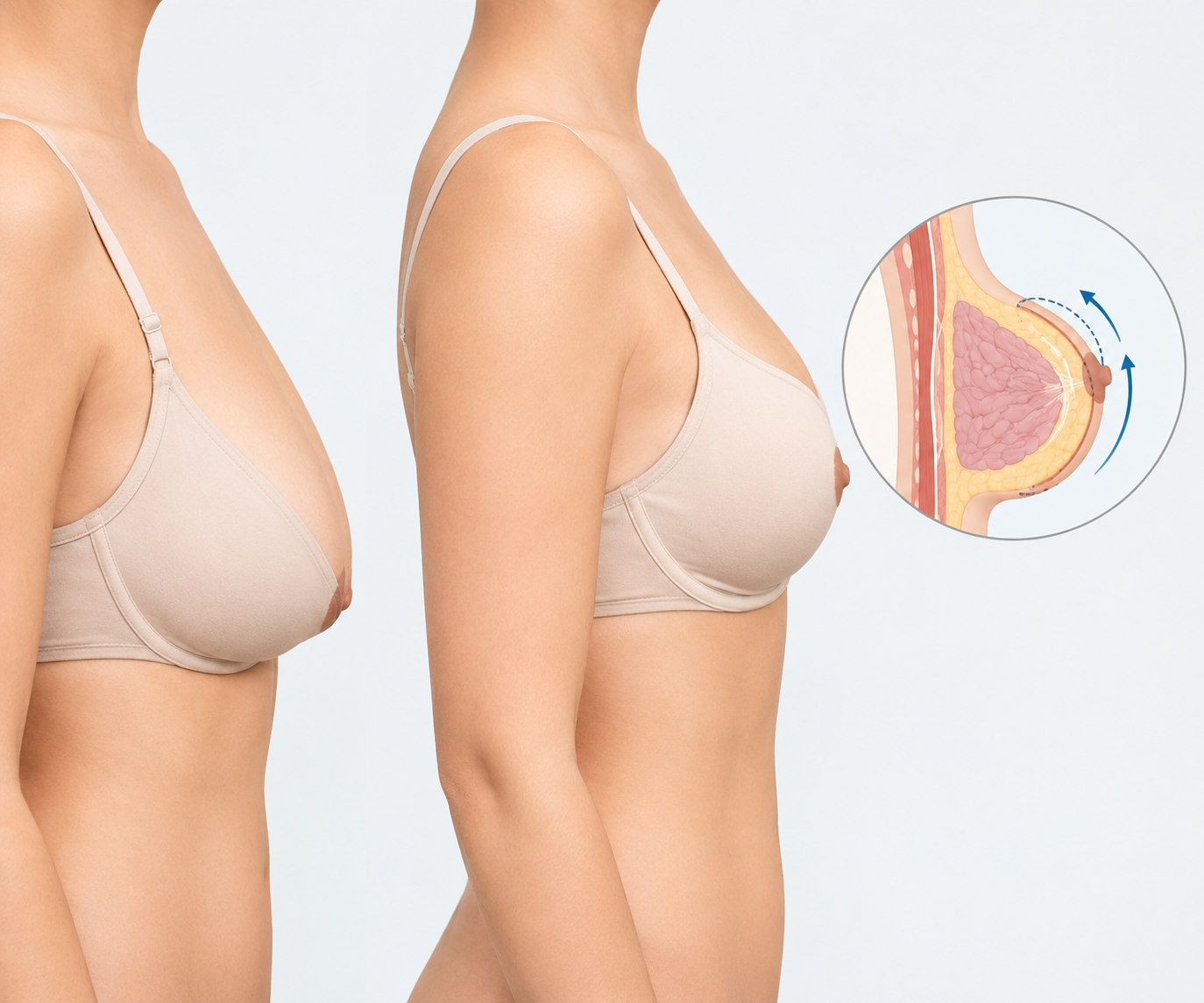
A breast lift without implants can raise and reshape sagging breasts using existing breast tissue. The procedure, called mastopexy, removes excess skin, reshapes the breast and repositions the nipple when necessary. It does not significantly increase breast volume. Whether your own tissue is enough depends on existing fullness, skin elasticity, breast shape and desired results.
Many women consider breast lift surgery after pregnancy, breastfeeding, weight loss or age-related changes in breast appearance.
However, not everyone wants breast implants.
Some patients are satisfied with their existing breast size but want improved shape, a higher breast position or less drooping.
For these women, mastopexy alone may be an appropriate option.
At Elegance Clinic, Dr. Ashutosh A Shah, MS, MCh (Plastic Surgery), DNB, discusses breast reshaping options based on individual anatomy, skin quality, nipple position and treatment goals. A consultation helps determine whether a lift alone can achieve the desired improvement or whether another procedure may be more suitable.
What Is a Breast Lift Without Implants?
A breast lift without implants is a surgical procedure that reshapes and elevates the breasts without placing silicone or saline implants.
The medical name for this procedure is mastopexy.
During surgery, the plastic surgeon may:
- Remove excess breast skin
- Reshape existing breast tissue
- Reposition the nipple and areola
- Improve breast contour
- Adjust the breast envelope
- Reduce certain differences in breast position
The main purpose is to improve breast shape and position rather than increase size.
Does a Breast Lift Add Volume?
No. A standard breast lift does not add new breast volume.
Instead, it redistributes and reshapes existing tissue.
Some women feel their breasts look fuller or more projected after lifting because the tissue is positioned differently.
However, the procedure cannot create the same volume increase as breast implants.
Patients interested in available surgical options can explore breast treatment services.
How Does Mastopexy Alone Work?
Mastopexy alone uses the patient’s existing breast tissue to create a more elevated and reshaped breast contour.
The exact technique depends on breast size, skin elasticity, nipple position and the degree of sagging.
Step 1: Assessing Breast Position
The surgeon examines the relationship between the nipple and the natural fold beneath the breast.
This helps determine the degree of breast ptosis.
Step 2: Planning the New Breast Shape
The surgeon marks the areas where skin may need to be removed and where the nipple should be repositioned.
Breast symmetry and overall proportions are considered during planning.
Step 3: Reshaping Existing Tissue
During surgery, the breast tissue is rearranged to improve projection and contour.
Different tissue-support techniques may be used depending on the patient’s anatomy.
Step 4: Removing Excess Skin
Loose or stretched skin is removed to create a better-fitting breast envelope.
Step 5: Repositioning the Nipple
When necessary, the nipple-areola complex is moved to a higher position while maintaining its tissue connections and blood supply.
Step 6: Closing the Incisions
The surgeon closes the incisions using appropriate sutures.
A postoperative support bra may be recommended during recovery.
Who Is a Good Candidate for a Breast Lift Without Implants?
A lift without implants may suit women who want to improve breast position while maintaining approximately their existing volume.
Suitable candidates often have enough natural breast tissue to create their preferred contour.
You May Be a Suitable Candidate If:
- Your breasts have noticeable sagging
- Your nipples have moved downward
- You have excess or stretched breast skin
- You are comfortable with your current breast size
- You want improved breast shape rather than enlargement
- You prefer not to have breast implants
- Your weight is relatively stable
- You understand that surgical scars are unavoidable
However, breast size alone does not determine suitability.
The surgeon must assess the amount and distribution of existing tissue.
Who May Need a Different Approach?
Women with very little breast tissue who want substantial upper breast fullness may not achieve their desired result through mastopexy alone.
Similarly, patients who want a significant increase in breast size may need to consider augmentation.
A detailed examination helps clarify what can realistically be achieved.
Is Your Own Breast Tissue Enough for a Lift?
This is one of the most important questions during consultation.
A breast lift using own tissue can create a more elevated shape, but the amount of existing breast volume affects the result.
When Existing Tissue May Be Enough
Mastopexy alone may be suitable when:
- Breast volume is already satisfactory
- The main concern is sagging
- There is enough tissue for reshaping
- The patient prefers a natural-tissue result
- Additional enlargement is not desired
When Existing Tissue May Be Limited
A lift alone may have limitations when:
- Breast volume has decreased substantially
- Upper breast fullness is minimal
- The patient wants a noticeably larger size
- Existing tissue is insufficient for the desired projection
- There is significant asymmetry involving volume
In these situations, the surgeon may discuss implants, fat transfer or other approaches.
Can Existing Tissue Be Rearranged to Create Fullness?
Yes, selected mastopexy techniques can rearrange existing tissue to improve breast projection.
Some surgeons use internal tissue reshaping techniques sometimes described as auto-augmentation.
However, auto-augmentation does not create new breast tissue.
The result remains limited by the amount of tissue already present.
What Breast Concerns Can Mastopexy Alone Correct?
A breast lift can address several changes related to breast position and skin laxity.
1. Sagging Breasts
Mastopexy is designed to correct breast ptosis by reshaping tissue and removing excess skin.
2. Low Nipple Position
When the nipple has moved downward, a breast lift can reposition it.
3. Loose Breast Skin
Excess skin may develop after pregnancy, ageing or weight loss.
A lift removes selected excess skin to improve the breast envelope.
4. Reduced Breast Projection
Tissue reshaping may improve the forward projection of the breast.
However, the degree of improvement depends on existing tissue.
5. Certain Breast Shape Differences
A lift may improve selected differences in breast contour or nipple position.
Perfect symmetry cannot be guaranteed.
6. Changes After Pregnancy
Pregnancy-related stretching and changes in breast volume can affect breast position.
Mastopexy may help when sagging is the main concern.
Patients can review breast sagging correction for more information about treatment considerations.
What Can a Breast Lift Without Implants Not Achieve?
Understanding the limitations of mastopexy is important before choosing surgery.
It Cannot Significantly Increase Breast Size
A lift reshapes existing tissue rather than adding volume.
It Cannot Guarantee Permanent Upper Fullness
The breast may appear fuller after reshaping, but upper pole fullness can change over time.
It Cannot Prevent Future Sagging
Ageing, pregnancy, gravity and weight changes continue to affect breast tissues.
It Cannot Guarantee Perfect Symmetry
Natural differences in tissue, skin and chest structure may remain.
It Cannot Eliminate Scarring
All surgical breast lifts involve incisions and permanent scars.
Although scars often become less noticeable over time, they do not disappear completely.
Breast Lift Without Implants vs Breast Lift With Implants
A breast lift and breast augmentation address different concerns.
A lift primarily changes breast position and shape, while implants add volume.
| Feature | Breast lift without implants | Breast lift with implants |
|---|---|---|
| Main goal | Improve position and shape | Improve position, shape and volume |
| Uses existing tissue | Yes | Yes, with an additional implant |
| Increases breast size | Not significantly | Usually yes |
| Removes excess skin | Yes | Yes |
| Repositions nipples | When required | When required |
| Adds upper breast fullness | Limited by existing tissue | May provide more fullness |
| Implant-related risks | None | Present |
| Surgical scars | Yes | Yes |
| Future changes | Ageing and weight changes may affect results | Tissue changes and implant complications may affect results |
| Possible future surgery | Sometimes | Sometimes |
Which Option Looks More Natural?
Both approaches can produce natural-looking results.
A lift without implants maintains a breast contour created from the patient’s own tissue.
A lift with implants may also appear natural when implant dimensions and placement suit the anatomy.
The preferred result depends on individual expectations rather than one technique being universally better.
Patients comparing surgical options can explore which breast surgery may suit different concerns.
Can a Breast Lift Without Implants Make Breasts Look Bigger?
A lift can sometimes make breasts appear fuller because the existing tissue is repositioned.
However, actual breast volume generally does not increase.
In some cases, the breasts may appear slightly smaller after excess skin is removed and tissue is reshaped.
Why Do Breasts Sometimes Look Fuller After a Lift?
The surgeon can improve projection by rearranging existing tissue.
This may create a rounder or more elevated contour.
The visual improvement should not be confused with adding new volume.
Can Mastopexy Increase Cup Size?
A predictable cup-size increase should not be expected from mastopexy alone.
Bra cup sizes also vary between manufacturers and depend on band measurements.
Patients who want a substantial size increase should discuss augmentation separately.
What Are the Different Breast Lift Techniques?
The incision pattern depends on the degree of sagging, breast size and amount of excess skin.
1. Crescent Lift
A crescent-shaped incision is made near the upper edge of the areola.
This approach may be considered for very limited adjustments in selected patients.
It is not suitable for substantial sagging.
2. Periareolar Lift
An incision is made around the areola.
This technique may suit certain patients requiring a limited lift.
However, it may not provide adequate correction for more significant ptosis.
3. Vertical Breast Lift
Also called a lollipop lift, this technique involves an incision around the areola and a vertical incision extending towards the breast fold.
It allows more extensive tissue reshaping.
4. Anchor Breast Lift
An anchor-shaped incision includes cuts around the areola, vertically down the breast and along the breast fold.
This technique may be suitable when significant excess skin or sagging requires correction.
Which Technique Is Best?
No single incision pattern is ideal for every patient.
The surgeon selects the approach according to anatomy, desired reshaping and the amount of skin removal required.
Breast Lift Using Own Tissue: What Is Auto-Augmentation?
Auto-augmentation is a surgical reshaping technique that uses existing breast tissue to improve projection or fullness.
Unlike implant-based augmentation, it does not introduce a breast implant.
The surgeon may reposition selected tissue to create a more supported breast contour.
What Are the Potential Benefits?
Possible advantages include:
- No breast implant required
- Use of existing tissue
- Improved projection in selected patients
- Correction of sagging
- Avoidance of implant-specific complications
What Are the Limitations?
Auto-augmentation cannot create volume that is not already present.
The degree of fullness depends on the available tissue.
Results can also change with ageing, weight fluctuations and pregnancy.
Not every patient is suitable for this technique.
Can Fat Transfer Be Combined With a Breast Lift?
Yes, fat transfer may be discussed in selected patients who want additional fullness without an implant.
The procedure involves collecting fat from another part of the body through liposuction and injecting it into the breast.
Why Might Fat Transfer Be Considered?
Fat grafting may help improve:
- Mild volume loss
- Selected contour irregularities
- Limited upper breast fullness
- Certain asymmetries
However, fat transfer adds surgical complexity.
Some transferred fat is naturally reabsorbed, and complications such as fat necrosis, oil cysts and calcifications can occur.
Additional sessions may be needed.
Is Fat Transfer the Same as Mastopexy Alone?
No.
Mastopexy alone reshapes existing breast tissue without adding volume from another area.
Fat transfer is an additional surgical procedure used to introduce fat into the breast.
Will a Breast Lift Without Implants Leave Scars?
Yes.
All breast lift techniques require incisions.
The scar pattern depends on the chosen surgical approach.
Possible scar locations include:
- Around the areola
- Vertically beneath the areola
- Along the breast fold
How Do Breast Lift Scars Change Over Time?
Scars commonly appear more noticeable during early healing.
Over several months, they may gradually soften and fade.
However, their final appearance varies.
Factors influencing scar healing include:
- Genetics
- Skin characteristics
- Incision tension
- Wound healing
- Smoking
- Infection
- Individual scar tendency
Can Scars Be Completely Removed?
No.
Surgical scars are permanent, although treatments may improve their appearance.
Patients should understand the likely scar pattern before choosing surgery.
How Long Does Recovery Take After Mastopexy Alone?
Recovery varies according to the technique used, overall health and individual healing.
Many patients can return to light daily activities within approximately one to two weeks.
However, some may need more time.
First Few Days
Common experiences include:
- Swelling
- Tenderness
- Mild to moderate discomfort
- Temporary tightness
- Bruising
Prescribed medicines and postoperative instructions help manage recovery.
First Two Weeks
Many patients gradually resume light activities.
A supportive surgical bra may be recommended.
Heavy lifting and strenuous upper-body activity are generally restricted.
Weeks Three to Six
Swelling usually continues to improve.
Activity restrictions may gradually be reduced according to the surgeon’s advice.
Following Months
Breast shape continues to settle.
Scars also change as healing progresses.
Final results should not be judged during the earliest recovery period.
What Are the Risks of a Breast Lift Without Implants?
Mastopexy is a surgical procedure and carries potential risks.
These may include:
- Bleeding
- Infection
- Scarring
- Delayed wound healing
- Breast asymmetry
- Changes in nipple sensation
- Changes in breast shape
- Fat necrosis
- Partial or complete loss of nipple-areola tissue, which is uncommon but serious
- Difficulty breastfeeding
- Anaesthesia-related complications
- Need for revision surgery
Although a lift without implants avoids implant-specific complications, it does not eliminate general surgical risks.
Smoking, certain medical conditions and poor wound healing can increase the chance of complications.
Patients should discuss individual risks before proceeding.
How Long Do Breast Lift Results Last?
Breast lift results can last for many years, but they are not permanent in the sense of preventing all future changes.
The breasts continue to respond to ageing, gravity, weight fluctuations and hormonal changes.
What Can Affect Long-Term Results?
Important factors include:
- Skin elasticity
- Breast size
- Weight changes
- Pregnancy
- Genetics
- Ageing
- Smoking
A stable weight and healthy lifestyle may help support long-term results.
However, some degree of recurrent sagging is possible.
Will You Need Another Breast Lift?
Not necessarily.
Many patients remain satisfied with their results for years.
Others may consider revision surgery if substantial changes occur or if they want further reshaping.
Future surgery is a possibility rather than a certainty.
Is a Breast Lift Without Implants Better After Pregnancy?
Mastopexy alone may be appropriate after pregnancy when the main concern is sagging rather than loss of volume.
However, breast changes vary between individuals.
Some women retain adequate breast tissue but develop stretched skin.
Others experience both sagging and substantial volume loss.
When Might a Lift Alone Be Enough?
A lift may be suitable when:
- Breast size is satisfactory
- Nipple position has changed
- Loose skin is the main concern
- Additional volume is not desired
When Might Implants Be Considered?
Implants may be discussed when the patient wants more fullness than existing tissue can provide.
Should Surgery Be Delayed Until After Breastfeeding?
Elective breast surgery is generally planned after breastfeeding has stopped and breast size has stabilised.
The appropriate timing varies and should be discussed with the surgeon.
Future pregnancy can alter the results of a breast lift.
Can You Breastfeed After a Breast Lift Without Implants?
Some women can breastfeed after mastopexy.
However, the ability to breastfeed may be affected by the surgical technique, extent of tissue rearrangement and individual anatomy.
The procedure may alter glandular tissue, ducts or nerve pathways involved in breastfeeding.
Does Avoiding Implants Protect Breastfeeding Ability?
Not necessarily.
Even without implants, mastopexy involves breast tissue and nipple repositioning.
Patients planning future pregnancies should discuss breastfeeding considerations before surgery.
No surgeon can guarantee preserved breastfeeding ability after every breast lift.
What Happens During a Breast Lift Consultation?
A consultation helps determine whether existing breast tissue can provide the desired shape.
Step 1: Discuss Your Goals
Explain whether your main concern is sagging, nipple position, reduced fullness or asymmetry.
Step 2: Review Medical History
The surgeon asks about previous pregnancies, breastfeeding, weight changes, medicines and relevant health conditions.
Step 3: Examine Breast Anatomy
Breast volume, skin elasticity, nipple position and tissue distribution are assessed.
Step 4: Review Surgical Options
The surgeon explains whether mastopexy alone, augmentation, fat transfer or a combined approach may be suitable.
Step 5: Discuss Scars and Risks
Patients should understand the likely incision pattern, recovery requirements and possible complications.
Step 6: Review Costs and Follow-Up
A treatment estimate should explain the procedure charges, postoperative care and any potential additional expenses.
For consultation arrangements, patients can book an appointment at Elegance Clinic.
Frequently Asked Questions
1. Can I Have a Breast Lift Without Implants?
Yes. A breast lift without implants reshapes existing breast tissue, removes excess skin and repositions the nipple when necessary. It may be suitable when you are comfortable with your current breast volume but want improved shape and position.
2. Will My Breasts Look Fuller After Mastopexy Alone?
They may appear fuller or more projected because the existing tissue is reshaped. However, mastopexy alone does not significantly increase breast volume, and the result depends on the amount of tissue available.
3. Is a Breast Lift Using Own Tissue Permanent?
The results can last for years, but ageing, pregnancy and weight changes may affect breast shape over time. A lift does not permanently prevent future sagging.
4. Does a Breast Lift Without Implants Leave Scars?
Yes. Every breast lift involves incisions and permanent scars. Their location depends on the technique, and their appearance often improves gradually as healing progresses.
5. How Do I Know Whether I Need a Breast Lift or Implants?
A breast lift mainly corrects sagging and nipple position, while implants increase volume. If both concerns are present, a combined approach may be discussed. A plastic surgeon can assess your anatomy and explain the most suitable options.
Key Takeaways
- A breast lift without implants uses existing breast tissue.
- Mastopexy primarily improves breast position and shape.
- The procedure does not significantly increase breast volume.
- Existing tissue can be reshaped to improve projection.
- Some patients may benefit from auto-augmentation techniques.
- Significant volume loss may limit the fullness achievable with a lift alone.
- Breast lift surgery involves permanent scars.
- Recovery commonly requires several weeks of activity modification.
- Implant-specific risks are avoided, but general surgical risks remain.
- Ageing, pregnancy and weight changes can affect long-term results.
- Breastfeeding ability may be affected by surgery.
- A detailed consultation helps determine whether mastopexy alone is appropriate.
Conclusion
A breast lift without implants can be an effective option for women who want to improve breast shape and position without increasing their breast size.
By removing excess skin and reshaping existing tissue, mastopexy can create a more elevated contour while avoiding implant-specific considerations.
However, the amount of natural breast tissue determines how much fullness and projection can be achieved.
Women with adequate existing volume may find that mastopexy alone meets their goals. Others may need to discuss augmentation or additional reshaping techniques.
A qualified plastic surgeon can assess breast anatomy, explain realistic results and help determine whether a breast lift using own tissue is the right approach.
