

|
Getting your Trinity Audio player ready...
|
✓ Medically reviewed by Dr. Ashutosh Shah, Plastic, Reconstructive & Cosmetic Surgeon (M.Ch., DNB)
Spider veins on the legs are usually treated with sclerotherapy injections, while surface laser can work well for very fine red vessels, veins that are difficult to inject, or selected patients who prefer to avoid needles. More than one treatment session may be required, and a vein scan is considered when symptoms or examination suggest underlying venous disease. If you are comparing spider veins laser vs injections, the right treatment depends on the size, colour, depth, and distribution of the vessels rather than simply choosing the newest technology. Larger feeding veins, swelling, previous vein problems, and other symptoms can also change the treatment plan.
Dr. Ashutosh Shah, MS, MCh (Plastic Surgery), D.N.B., with 22+ years of experience, evaluates the visible spider veins along with the surrounding vein pattern before recommending treatment. Depending on the findings, treatment may involve sclerotherapy, surface laser, or a combination approach. When symptoms or examination suggest deeper venous disease, further vascular assessment may be advised before cosmetic correction.
Spider veins are classified as telangiectasias within CEAP clinical class C1, along with reticular veins. They are different from larger varicose veins, which are classified as C2.
What Are Spider Veins and Why Do They Appear on the Legs?
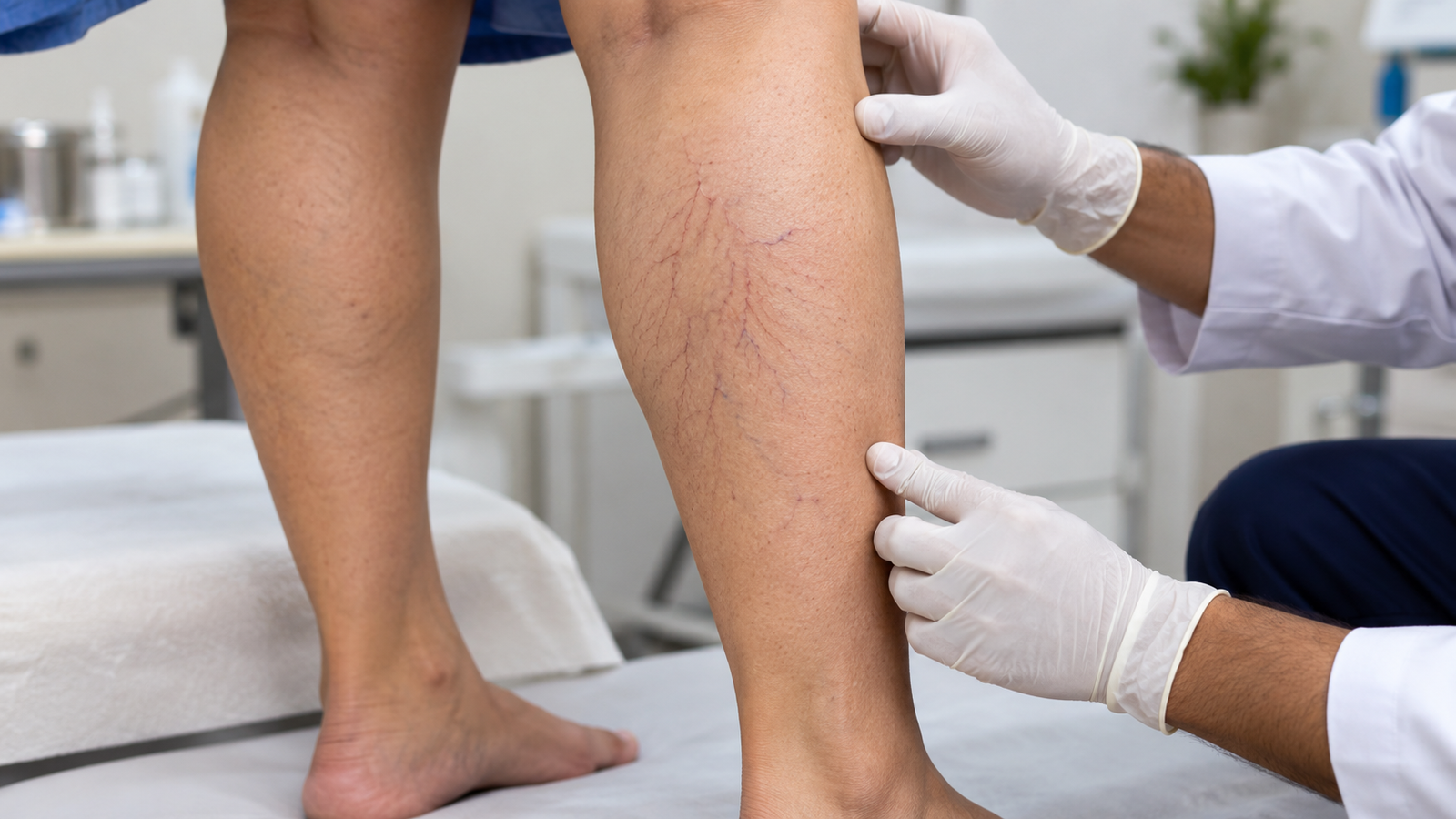
Spider veins are tiny visible blood vessels close to the skin. They commonly appear as thin red, blue, or purple lines and may form branches, webs, or small clusters on the thighs, calves, and around the ankles.
The medical term for these small vessels is telangiectasias. Slightly larger blue-green vessels beneath the skin may be reticular veins.
Spider veins can develop because of several factors, including genetics, ageing, hormonal influences, pregnancy and prolonged periods of standing. Some people have isolated cosmetic spider veins, while others have them alongside larger venous problems.
This distinction is important because treating a few superficial vessels is different from treating established varicose-vein disease.
If you are unsure which type of visible vein you have, read more about the difference between spider veins and varicose veins.
When Do Injections Work Better Than Laser?
For many spider veins on the legs, sclerotherapy is an established treatment.
During sclerotherapy, a small amount of sclerosant is carefully injected into the target vessel. It acts on the lining of the vein, causing the vessel to close. The body then gradually processes the treated vessel, and its visible appearance may fade over time.
The European Guidelines for Sclerotherapy in Chronic Venous Disorders describe sclerotherapy as an established treatment across appropriate venous indications, including telangiectatic and reticular veins.
Patients considering spider vein correction should therefore have the actual vessel pattern examined rather than assuming laser is automatically the better treatment.
When may sclerotherapy be preferred?
Liquid sclerotherapy is commonly considered for small injectable red, blue or purple veins.
It allows individual vessels and networks of vessels to be treated directly. More than one area may sometimes be treated during the same session depending on the extent of the veins and the treatment plan.
Foam sclerotherapy behaves differently from liquid sclerosant and may be considered for selected larger or feeding veins. It is not automatically the preferred treatment for every tiny spider vein.
Patients can learn more about sclerotherapy for vein treatment.
When may surface laser work better?
Surface vascular laser delivers energy through the skin without inserting a needle into each target vessel.
It can be particularly useful for selected very fine superficial red vessels or veins that are too small or technically difficult to inject.
Nd is one of the laser technologies used for vascular lesions. However, the appropriate wavelength and treatment settings depend on vessel size, depth, colour, and the patient’s skin characteristics.
A laser is therefore not automatically superior to injections, and sclerotherapy is not automatically better than laser.
The correct technique should match the vessel.
Spider Veins Laser vs Injections: Treatment Comparison
| Treatment option | Veins commonly suited | Typical sessions* | Typical interval* | Common temporary effects | May not be suitable for |
|---|---|---|---|---|---|
| Liquid sclerotherapy | Small injectable red, blue, or purple spider and reticular veins | Often 2–4 | About 4–6 weeks | Bruising, redness, tenderness, pigmentation | Patients with contraindications to the sclerosant |
| Foam microsclerotherapy | Selected larger reticular or feeding veins | Individualised | Several weeks | Bruising, inflammation, pigmentation | Some very tiny superficial vessels |
| Surface Nd laser | Selected fine superficial vessels | Often multiple | Several weeks | Redness, swelling, temporary colour change | Suitability varies with vessel and skin characteristics |
| Combined treatment | Mixed networks with different vessel sizes | Individualised | Staged | Depends on treatments used | Unnecessary when one treatment is sufficient |
*These are practical planning ranges rather than guaranteed treatment schedules. The exact number and interval should be determined after examination.
How Many Sessions Are Needed and How Far Apart?
Many patients expect spider veins to disappear after one appointment. Sometimes a small group of vessels responds well to one session, but extensive spider-vein networks often need additional treatment.
A practical estimate is often two to four sessions, usually separated by approximately four to six weeks, although some patients may need fewer or more.
The interval allows the treated vessels and surrounding skin to settle before the response is assessed.
The number of sessions depends on the number and size of vessels, their depth, whether feeding reticular veins are present, the chosen treatment technique, previous treatments, and how the vessels respond.
At Elegance Clinic, Dr. Ashutosh A Shah assesses these factors before planning subsequent sessions rather than promising a fixed number of treatments for every patient.
The goal is progressive improvement, not a guarantee that every visible vessel will disappear after a predetermined number of injections or laser sessions.
What Bruising or Marks Are Normal Afterwards?
Temporary skin changes can occur after either treatment.
After sclerotherapy, patients may notice mild redness, small injection marks, tenderness, or bruising. Some treated vessels can initially appear darker before gradually fading.
Temporary brown pigmentation can also develop along a treated vein. This does not necessarily mean treatment has failed.
After surface laser treatment, temporary redness, mild swelling or changes in skin colour can occur around the treated vessels.
These changes should gradually settle, but the expected recovery depends on the treatment performed.
You should contact the treating clinic if you experience severe pain, rapidly increasing swelling, significant skin injury, or another unexpected symptom.
Patients who want to understand the appearance of different vein conditions and treatments can also view the vein treatment gallery.
When Should a Duplex Scan Be Done Before Cosmetic Treatment?
A common misconception is that everyone with spider veins needs a vein scan before treatment.
That is not necessarily the case.
For uncomplicated, asymptomatic CEAP C1 spider veins, routine duplex ultrasound is not automatically required simply because visible telangiectasias are present.
The assessment changes if there are signs that suggest more extensive venous disease.
A doctor may consider duplex ultrasound when spider veins occur alongside findings such as larger bulging varicose veins, significant leg swelling, skin changes associated with chronic venous disease, troublesome venous symptoms, recurrent veins after previous treatment, or other clinical reasons to investigate the superficial and deep venous systems.
Duplex ultrasound can assess the direction of blood flow and identify venous reflux or obstruction.
This matters because if an underlying venous problem is contributing to the visible surface veins, repeatedly treating only the cosmetic vessels may not address the complete condition.
What Should a Spider Veins Doctor Near Vesu Check Before Treatment?
Before choosing injections or laser, a spider veins doctor near Vesu should determine whether the visible vessels are telangiectasias, reticular veins, or larger varicose veins and look for symptoms or signs suggesting underlying venous disease.
The consultation should also cover previous vein treatment, history of thrombosis, pregnancy status, allergies, medications, and other relevant medical factors.
At Elegance Clinic, Dr. Ashutosh A Shah uses this clinical assessment to decide whether straightforward cosmetic correction is appropriate or whether additional investigation should come first.
Treatment should not be selected only from a photograph or because a particular machine is available.
What Results Should You Expect?
Spider-vein treatment aims to make the targeted vessels progressively less visible.
Some vessels may respond noticeably after one session, while others require repeat treatment. Different areas of the same leg may also respond at different speeds.
A treated vessel can take time to fade, so the appearance immediately after treatment should not be considered the final result.
Neither laser nor sclerotherapy can guarantee that you will never develop another spider vein.
A successfully treated vessel may remain closed, but new spider veins can appear elsewhere because of genetics, hormonal influences, ageing, or underlying venous factors.
Follow-up therefore helps determine which vessels have responded and whether remaining vessels need another session or a different technique.
Frequently Asked Questions
Are spider veins dangerous?
Most isolated spider veins are primarily a cosmetic concern and are classified as CEAP C1. However, they should be considered alongside other symptoms. Significant swelling, larger bulging veins, skin changes, or persistent leg discomfort may justify further assessment to determine whether a more extensive venous condition is present.
Do spider veins come back after treatment?
Successfully treated vessels can fade considerably, but neither laser nor sclerotherapy prevents every future spider vein. Genetics, hormonal influences, ageing and venous factors can contribute to new vessels appearing. Follow-up can distinguish between untreated remaining vessels, newly developed veins and vessels that require additional treatment.
Is sclerotherapy painful?
Sclerotherapy uses small injections, so patients may feel a brief needle prick, stinging or mild burning during treatment. The sensation varies with the vessel, sclerosant, and individual sensitivity. Severe or persistent pain is not considered something to simply tolerate and should be reported to the treating clinician.
Can I wear shorts or a saree above the ankle soon after?
You can, but temporary bruising, redness, injection points, or pigmentation may remain visible after treatment. If you have a wedding, festival, or another important event coming up, discuss the timing beforehand so treatment can be scheduled with enough time for common temporary marks to settle.
Do I need stockings after spider vein injections?
Not every patient requires the same compression schedule. Recommendations depend on the vessels treated, technique, and individual clinical situation. A spider veins doctor near Vesu should provide specific instructions regarding compression stockings, walking, skin care, and follow-up rather than using one routine for every patient.
Can spider veins be treated during pregnancy?
Elective cosmetic treatment is generally postponed during pregnancy because veins can change significantly as pregnancy progresses. If a vein becomes painful or causes other concerning symptoms during pregnancy, obtain medical assessment rather than arranging cosmetic injections or laser treatment without appropriate obstetric and vascular advice.
Which Is Better for Spider Veins: Laser or Injections?
When comparing spider veins laser vs injections, neither treatment is universally better.
Sclerotherapy is an established option for many injectable spider and reticular veins of the legs. Surface laser can be particularly useful for selected fine superficial vessels, including vessels that are too small or difficult to inject.
Some patients have several types of vessels and may benefit from a combination approach.
The decision should therefore begin with identifying the vessels correctly rather than choosing between a syringe and a laser machine before examination.
At Elegance Clinic, Dr. Ashutosh A Shah, MS, MCh (Plastic Surgery), D.N.B., with 22+ years of experience, assesses the size and distribution of visible veins, associated symptoms, and relevant medical history before recommending an individual treatment plan. If examination raises concern about more extensive venous disease, further vascular investigation can be considered before cosmetic treatment.
For uncomplicated spider veins without symptoms or other concerning findings, however, a duplex scan should not be described as mandatory for every patient.
Key Takeaways
Spider veins are small superficial vessels classified as CEAP C1. They are different from larger varicose veins and do not automatically mean that significant venous disease is present.
For many leg spider veins, sclerotherapy is an established treatment. Surface laser can be useful for selected fine vessels, while mixed patterns may sometimes need more than one technique.
Two to four sessions separated by roughly four to six weeks can be a useful planning estimate, but the actual number depends on the vessels and response to treatment.
Temporary bruising, redness, tenderness, or pigmentation may occur after treatment and should be discussed before the first session.
Most importantly, the choice between spider veins laser vs injections should follow clinical assessment. When larger veins, swelling, skin changes, or other concerning findings are present, the doctor may recommend further venous assessment before treating the visible cosmetic vessels.

