

|
Getting your Trinity Audio player ready...
|
✓ Medically reviewed by Dr. Ashutosh Shah, Plastic, Reconstructive & Cosmetic Surgeon (M.Ch., DNB)
Written by Dr. Ashutosh A Shah, M.B.B.S., M.S., M.Ch., D.N.B., Board Certified Plastic and Reconstructive Surgeon, Elegance Clinic, Surat. Reg. no. [REG NO]. 22+ years in reconstructive and laser surgery.
Medically reviewed by Dr. Ashutosh A Shah · Published 22 September 2026 · Last reviewed 22 September 2026
Spider veins are small surface vessels that are a cosmetic concern only. Varicose veins are bulging, rope-like veins caused by failing valves, and they are progressive: untreated they can lead to swelling, skin changes and ulceration. Spider veins are treated with surface laser or sclerotherapy; varicose veins usually need endovenous laser ablation.
Most people looking at leg veins are asking the wrong question first. They ask how to get rid of them. The question that actually matters is which kind they are, because one is a cosmetic decision you can take or leave, and the other is a circulation problem that gets worse while you decide.
This post shows you how to tell them apart at home, which symptoms move it from cosmetic to medical, why a scan decides the treatment rather than a photograph, what each option actually involves, and the one situation that is a genuine emergency.
Spider veins or varicose veins: what is the actual difference?
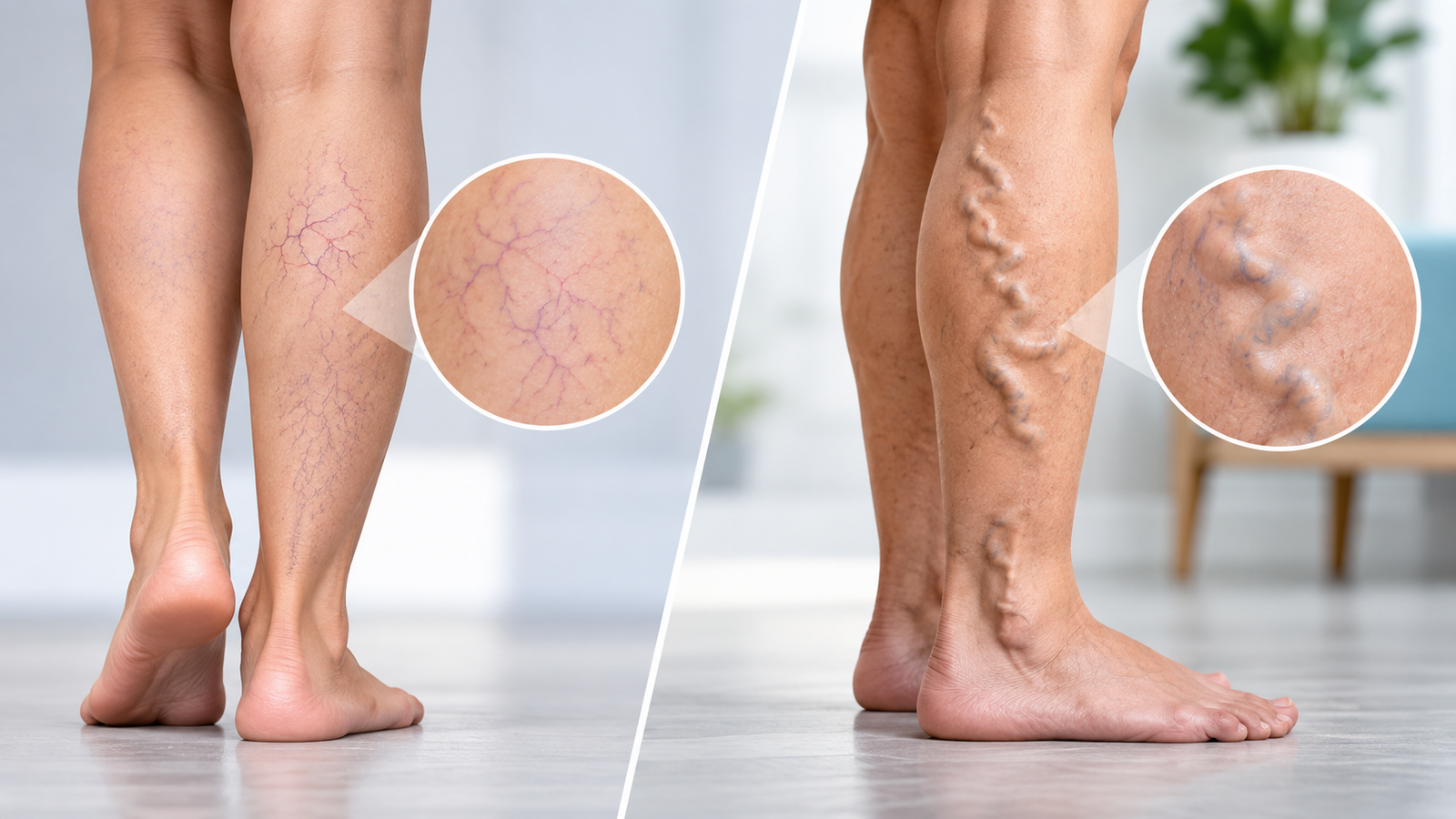
Size and depth. Spider veins are thin red, blue or purple lines sitting in the surface of the skin, usually under a millimetre wide and completely flat. Varicose veins are dilated, twisted veins more than three millimetres across that bulge above the skin and can be felt with a finger.
| Feature | Spider veins | Varicose veins |
|---|---|---|
| Size | Under about 1 mm, thread-like | Over 3 mm, rope-like |
| Appearance | Flat red, blue or purple lines, often in a web or branch pattern | Raised, twisted, bluish or skin-coloured bulges |
| Can you feel them? | No, completely flat | Yes, they stand proud of the skin |
| Symptoms | Usually none, occasionally mild burning | Aching, heaviness, throbbing, night cramps, itching, ankle swelling |
| Do they progress? | Cosmetically yes, medically no | Yes, and they can lead to skin damage and ulceration |
| Underlying cause | Surface vessel dilation, sometimes with deeper reflux behind it | Failing valves in the larger veins, causing blood to pool |
| Usual treatment | Surface laser, sclerotherapy | Endovenous laser or radiofrequency ablation |
| Insurance in India | Excluded, treated as cosmetic | Usually covered when symptomatic and documented |
There is a middle category worth knowing: reticular veins, the flat bluish-green veins roughly one to three millimetres wide that often sit beneath a patch of spider veins and feed them. Treating the spider veins without the reticular veins behind them is the commonest reason they come straight back.
Why do leg veins fail in the first place?
Leg veins carry blood upward against gravity, helped by one-way valves and the pumping action of the calf muscles. When those valves stop closing properly, blood flows backward and pools, the pressure inside the vein rises, and the vein stretches and twists. That backward flow is called reflux, and it is the root of the whole condition.
What makes it more likely:
- Family history. The strongest single predictor. If both parents had them, your risk is high.
- Pregnancy. Increased blood volume plus hormonal softening of vein walls plus pressure from the uterus. Veins that appear in pregnancy often improve in the months afterwards, which is why treatment is usually deferred.
- Prolonged standing or sitting. Teachers, surgeons, retail staff, security personnel and long-distance drivers are all over-represented.
- Age. Valves and vein walls lose elasticity over time.
- Being female, largely through hormonal effects on vein walls.
- Excess weight, which raises the pressure the leg veins work against.
- A previous deep vein thrombosis, which can damage valves permanently and produce a different, more serious pattern.
Two things are not on that list, despite being commonly blamed: crossing your legs does not cause varicose veins, and neither does wearing tight clothing.
Which symptoms mean this is medical, not cosmetic?
Symptoms are what move leg veins from a cosmetic question to a medical one. Aching, heaviness, throbbing, night cramps, itching around the veins and ankle swelling that is worse by evening all point to venous disease, whether or not the veins look dramatic.
The symptom list, roughly in order of how early it appears:
- Aching, heaviness or throbbing in the legs, worse after standing and better on elevation
- Ankle swelling that is mild in the morning and worse by evening
- Night cramps in the calves
- Restless legs or an urge to move them at night
- Itching or eczema in the skin over the veins or around the ankle
- Brown or reddish-brown skin darkening above the ankle, from iron leaking out of the vessels
- Hardened, tight, shiny skin around the lower leg
- An ulcer, typically just above the inner ankle, that is slow to heal
The last three are not early signs. Skin darkening, hardening and ulceration mean venous disease has been present and untreated for a long time, and at that point treatment is about limiting damage rather than preventing it. The NHS guidance on varicose veins lists the same progression.
One genuine emergency. A varicose vein that bursts through thinned skin can bleed heavily and surprisingly fast, often with no pain at all. If that happens: lie down, raise the leg as high as you can, press firmly on the bleeding point, and get to a hospital. Do not sit up, because sitting keeps the venous pressure high.
Which stage are your veins at?
Clinicians stage venous disease using the CEAP classification, which runs from C0 to C6. It is worth knowing your stage, because it is the honest answer to whether your veins are a cosmetic choice or a medical problem, and it decides how urgently anything needs doing.
| Stage | What is present | What it means for you |
|---|---|---|
| C0 | No visible or palpable vein disease | Symptoms, if any, are coming from something else |
| C1 | Spider veins or reticular veins only | Cosmetic. Treat if it bothers you, not because you must |
| C2 | Varicose veins | Medical condition. Worth assessing even without symptoms |
| C3 | Varicose veins with leg swelling | Progression has begun. Assess now |
| C4 | Skin changes: pigmentation, eczema, hardening | Long-standing disease. Treatment limits further damage |
| C5 | A healed venous ulcer | High risk of recurrence. Treatment is preventive |
| C6 | An active venous ulcer | Needs prompt specialist management |
Two practical takeaways. If you are C1, nobody should be pressuring you into a procedure. And if you are C4 or beyond, the conversation is no longer about appearance at all.
How is it diagnosed, and why does a duplex ultrasound decide the treatment?
By duplex ultrasound, which is a painless scan done standing up that shows both the structure of the veins and the direction the blood is flowing. It identifies which veins are refluxing and where the faulty valve sits, and without that map any treatment plan is guesswork.
Why it matters so much in practice:
- What you can see is not the problem. The bulging vein on your calf is usually the consequence. The failing valve is often higher up, at the groin or behind the knee.
- It decides which procedure is appropriate. Treating a surface vein while leaving the refluxing trunk above it untreated is why veins come back.
- It distinguishes superficial from deep disease. If the deep veins are the problem, usually after a previous clot, the treatment is completely different and ablating superficial veins can be the wrong move.
- It is done standing. Lying down empties the veins and hides the reflux, so a scan done on a couch can miss the diagnosis entirely.
If a clinic offers to treat visible leg veins without scanning them first, that is worth questioning. It is the single clearest marker of whether you are in a vein service or a cosmetic package.
How are spider veins treated?
With sclerotherapy, surface laser, or both. Sclerotherapy injects a solution that irritates the vessel lining so it seals and fades. Surface laser heats and closes the vessel through the skin. Neither is a single-session fix, and both need the feeding reticular veins treated first or the result will not last.
What to expect from each:
- Sclerotherapy remains the mainstay for leg spider veins and reticular veins. Very fine needles, several injections per session, compression stockings afterwards. Bruising and temporary brown staining along the treated vessel are normal and settle over weeks to months.
- Surface laser, typically an Nd:YAG at 1064 nm for leg vessels, suits very fine vessels, needle-phobic patients and areas where injection is awkward. On Indian skin it needs conservative settings, since the risk is temporary darkening or lightening of the treated skin.
- Sessions. Plan for a course rather than one appointment, usually spaced several weeks apart, and expect gradual fading rather than immediate clearance.
- Maintenance. New spider veins can appear over the years. Treatment clears what is there; it does not stop your veins from being the kind that form them.
The most useful thing to know here: if you have underlying reflux and you treat only the spider veins, they will come back. That is not a failed technique, it is an incomplete diagnosis, and it is why the scan comes first even for what looks purely cosmetic.
How are varicose veins treated, and what did laser replace?
Endovenous thermal ablation is the first-line treatment. A thin laser or radiofrequency fibre is passed inside the faulty vein under ultrasound guidance and local anaesthesia, and heat seals the vein closed from within. The body reroutes blood through healthy veins, and the sealed vein is gradually absorbed.
NICE guideline CG168 sets out the order clearly: endothermal ablation first, foam sclerotherapy if that is unsuitable, and open surgery only if neither is. That hierarchy is worth knowing before any consultation, because it tells you whether what is being offered is current practice.
- Endovenous laser ablation (EVLA or EVLT) and radiofrequency ablation (RFA) work on the same principle with different energy sources. Both are day-care, done under local anaesthesia, and you walk out.
- Foam sclerotherapy injects a foamed solution into the vein under ultrasound guidance. Used for tributaries, recurrent veins and where thermal ablation is not suitable.
- Phlebectomy, removing bulging surface tributaries through tiny punctures, often combined with ablation in the same sitting.
- Open surgery with vein stripping is what endovenous treatment largely replaced. It meant general anaesthesia, groin incisions, more bruising and a longer recovery. It still has a role in selected cases.
- Compression stockings alone relieve symptoms but do not correct reflux. They are appropriate when a procedure is unsuitable or while you wait, not as a substitute for treatment.
Details of the platform and protocol used here are on our laser varicose vein treatment page, alongside the wider laser treatment services.
What does recovery actually look like?
After endovenous ablation most people walk out the same day, return to desk work within one to three days, and wear compression stockings for one to two weeks. Bruising and a tight, pulling sensation along the treated vein are normal for two to four weeks as the vein is absorbed.
A realistic timeline:
- Day 0. Walk immediately after the procedure, and keep walking. Compression stocking applied before you leave.
- Days 1 to 3. Regular walking encouraged. Most people are back at desk work. Painkillers rarely needed beyond simple ones.
- Week 1 to 2. Compression as advised. Bruising appears and then fades. Avoid long periods of standing still.
- Weeks 2 to 4. A firm, tender cord along the treated vein is expected as it scars down. Gym and running usually resume in this window.
- Months 1 to 3. The cord softens, bruising clears, and symptoms such as aching and heaviness typically improve well before the appearance does.
- A follow-up scan confirms the vein has closed properly.
Walking is genuinely part of the treatment here, not just permission. The calf muscle pump is what moves blood after the faulty vein is closed, and early mobilisation also reduces clot risk.
Will they come back?
The treated vein does not reopen in most cases, but new varicose veins can develop over the years, because the tendency that produced the first set does not go away. Recurrence is described in every published series, and the honest framing is long-term management rather than a permanent fix.
Why recurrence happens:
- New valve failure in a vein that was healthy at the time of treatment
- Untreated tributaries that were not addressed at the first procedure
- Neovascularisation, where small new vessels form around a previously treated area
- Incomplete treatment of the refluxing segment, usually where a scan was not used to map it
What genuinely reduces the risk: wearing compression as advised afterwards, keeping weight stable, walking regularly, avoiding long unbroken periods of standing, and getting a new vein checked early rather than after another decade.
What does treatment cost in India, and does insurance cover it?
Endovenous laser ablation for varicose veins in India is commonly quoted in the range of about ₹60,000 to ₹1,50,000 per leg, depending on how many veins are treated, the technology used and the facility. Sclerotherapy for spider veins is priced per session and is considerably lower. The bigger difference is insurance.
This is the point most patients do not realise: varicose vein treatment is generally an admissible insurance claim in India, because it treats a medical condition. Spider vein treatment is not, because it is cosmetic. That distinction can be worth more than any discount.
What strengthens a claim:
- Documented symptoms over time, not a first-visit request
- A duplex ultrasound report demonstrating reflux
- Evidence that conservative measures such as compression were tried
- Photographs where there are skin changes
- Pre-authorisation arranged before admission, rather than a claim submitted afterwards
Waiting periods, sub-limits and pre-existing disease clauses still apply, and modern policies generally cover endovenous ablation as a day-care procedure, which matters because it involves no overnight stay. Check your policy wording and confirm with the hospital insurance desk in advance. Where there is a shortfall, EMI options are available.
Leg vein treatment at Elegance Clinic, Surat
Dr. Ashutosh A Shah is a board certified plastic and reconstructive surgeon with over 22 years of practice in Surat, Gujarat. Assessment here starts by establishing which category you are actually in, because a patient with C1 spider veins and a patient with C4 skin changes are having two completely different conversations, and being told which one you are having is the most useful thing a first appointment can give you.
Patients with purely cosmetic spider veins are told so plainly, including that treatment is optional and that new vessels can appear later. Patients with reflux are told that treating the surface without the source is the reason veins return. Nobody is quoted for a procedure before the veins have been mapped.
Next step
If your leg veins ache, swell or feel heavy by evening, the useful question is not how to hide them but whether there is reflux behind them, and that takes a scan rather than a photograph. Book an appointment with Dr. Ashutosh Shah at Elegance Clinic, Surat, or call +91 83205 00350.
Medical disclaimer: This article is for education only and is not a substitute for professional diagnosis or treatment. Bleeding from a varicose vein, a sudden painful swollen leg, or an ulcer that is not healing all need urgent medical attention. Please consult Dr. Ashutosh A Shah or a qualified specialist about your own legs.

