

|
Getting your Trinity Audio player ready...
|
✓ Medically reviewed by Dr. Ashutosh Shah, Plastic, Reconstructive & Cosmetic Surgeon (M.Ch., DNB)
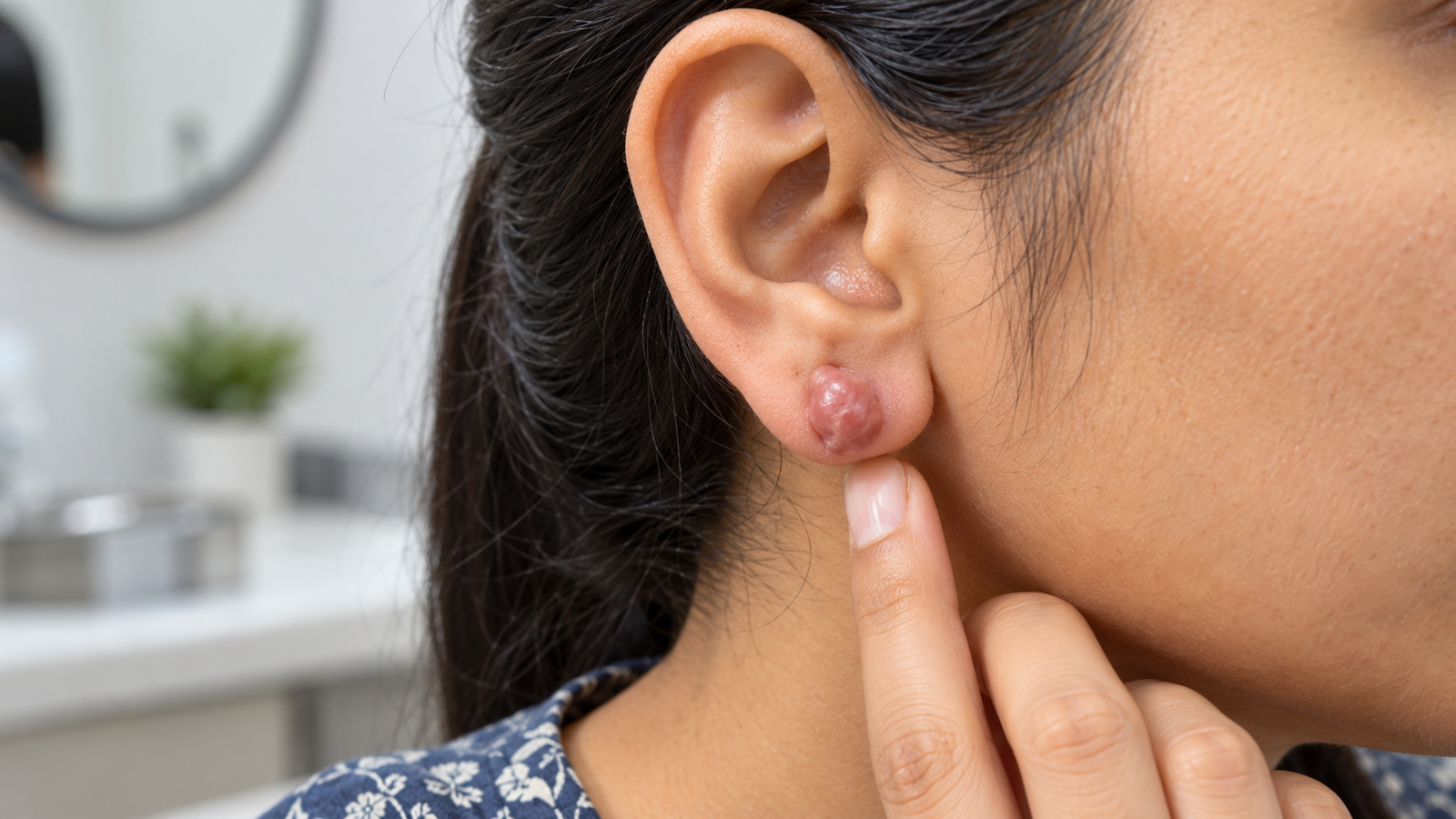
A keloid on ear after piercing is overgrown scar tissue that extends beyond the original piercing wound and may continue enlarging. Removing it surgically is possible, but excision alone has a significant risk of recurrence. Treatment therefore often combines removal with steroid injections, pressure therapy, or another scar-control strategy. Earrings or re-piercing should wait until healing is stable and your surgeon specifically clears it.
At Elegance Clinic, Dr. Ashutosh Shah, MS, MCh (Plastic Surgery), D.N.B., with 22+ years of experience, assesses the size, position, and previous treatment of an ear keloid before recommending a treatment plan. The aim is not simply to remove the lump but also to reduce the chance that abnormal scar tissue grows again.
Why Do Some Earlobes Form a Keloid After a Simple Piercing?
An ear piercing creates a controlled injury through the skin. Normally, the body produces collagen to repair the tiny wound and then gradually regulates the scar.
A keloid develops when scar tissue continues growing beyond the boundaries of the original injury.
It may begin as a firm bump around the piercing and progressively become larger. Some keloids itch, feel tender, or cause discomfort, while others mainly create a cosmetic concern.
Not everyone who has their ears pierced develops a keloid. Individual susceptibility is important, and a personal or family history of keloids can increase concern about future abnormal scarring.
Keloids can occur on the front or back of the earlobe and can also affect cartilage-bearing parts of the ear after piercing or trauma.
Patients who have already experienced recurrence can read more about why keloid scars keep growing back.
Is It a Keloid, a Hypertrophic Scar or a Piercing Bump?
Not every lump around an ear piercing is a keloid.
A keloid extends beyond the boundaries of the original wound and can continue growing.
A hypertrophic scar becomes raised and thick but generally remains within the boundaries of the original injury.
A so-called piercing bump can have several causes, including local irritation, inflammation, infection, or scar tissue. It should not automatically be labelled a keloid based on appearance alone.
This distinction matters because treatment is different.
For example, repeatedly treating an irritated piercing as a keloid without identifying the actual cause may not solve the problem. Similarly, a progressively enlarging firm scar should not simply be assumed to be temporary piercing irritation.
Clinical examination allows the doctor to assess the lesion’s size, texture, position, symptoms, growth history, and relationship to the original piercing.
What Does Excision Plus Steroid or Pressure Treatment Involve?
A common misconception is that an ear keloid can simply be cut away and forgotten.
Unfortunately, keloids have a tendency to recur after surgery. A classic review reported recurrence rates of 45–100% after surgery alone, illustrating why additional scar-control treatment is frequently considered.
For keloid treatment at Elegance Clinic, the approach should therefore be selected according to the individual scar rather than treating every earlobe lump in the same way.
Surgical excision
For an appropriate earlobe keloid, surgery removes the abnormal scar while trying to preserve the natural contour of the ear and minimise tension during closure.
The precise technique depends on the keloid’s size and location. Very large or recurrent lesions may require different planning from a small primary earlobe keloid.
Steroid injections
Intralesional corticosteroid treatment may be used before, during, or after surgery depending on the treatment protocol.
Corticosteroids can help suppress excessive scar activity. Several treatment protocols use repeated injections rather than relying on a single dose.
Evidence also supports combination treatment. A 2024 systematic review and meta-analysis found that excision combined with steroid therapy improved recurrence-free survival compared with excision alone.
Pressure therapy
Pressure earrings or another customised pressure device can apply sustained pressure to the healing earlobe.
They are not decorative earrings. They are part of scar management and must fit correctly to provide useful pressure without damaging the skin.
Learn more about pressure therapy for keloids.
Why combination treatment matters
The International Advisory Panel on Scar Management has supported evidence-based, multimodal approaches for pathological scars rather than relying on one treatment for every keloid.
For ear keloids in particular, the surgeon may combine excision with postoperative injections, pressure therapy, or another treatment based on recurrence risk and scar characteristics.
Ear Keloid Treatment in Athwa Surat: Which Option Fits the Scar?
Treatment should be based on the actual keloid rather than simply its presence.
| Finding | Possible first-line approach | Possible add-on to reduce recurrence | Follow-up |
|---|---|---|---|
| Small bump under 1 cm | Clinical assessment; selected lesions may be treated nonsurgically | Intralesional treatment or pressure where appropriate | Regular review for flattening or growth |
| Keloid over 1 cm | Excision may be considered depending on anatomy | Steroid injections and/or pressure therapy | Serial postoperative reviews |
| Recurrent keloid | Reassess previous surgery and scar behaviour | Multimodal recurrence-control plan | Longer-term surveillance |
| Both earlobes affected | Each ear assessed individually | Scar-control strategy for each treated side | Monitor both ears for recurrence |
These are general planning principles, not a prescription for every patient.
At Elegance Clinic assesses whether the lesion is a true keloid, how much normal earlobe tissue remains, whether it has previously been removed and whether reconstruction will be needed after excision.
For some patients, earlobe repair surgery may also be relevant when the piercing hole is enlarged, split, or distorted.
How Long Must Pressure Earrings Be Worn After Surgery?
Pressure therapy requires commitment.
There is no universal number of hours or months that is correct for every ear keloid. Published protocols vary.
For example, one study involving surgery with additional treatment instructed patients to use pressure earrings essentially continuously for at least six months. Another study combining steroid treatment, surgery, and pressure used postoperative pressure earrings for four months.
This variation is why patients should follow their own surgeon’s protocol rather than copying a schedule from another patient.
The pressure device also needs to be appropriately fitted. Excessive pressure can injure the skin, while inadequate pressure may fail to achieve the intended scar-control effect.
Post-excision checklist
Steroid/injection dates: Record every scheduled treatment and do not stop simply because the scar initially looks flat.
Pressure earring schedule: Follow the prescribed number of hours each day and the total duration advised by your surgeon.
Skin check: Look for excessive redness, ulceration, discharge or pain beneath the pressure device.
Scar check: Report renewed firmness, itching, thickening or growth early rather than waiting for a large keloid to redevelop.
Follow-up visits: Continue scheduled scar reviews even when the ear appears healed.
Re-piercing: Do not create a new piercing until the scar has remained flat, mature, and symptom-free for the period specified by your treating surgeon.
When Is It Safe to Wear Heavy Earrings or Re-Pierce the Ear?
This is often the most important practical question for patients.
There is no evidence-based universal month at which every patient can safely re-pierce an ear after keloid treatment. Because keloids represent abnormal scar behaviour, creating another piercing is another skin injury and therefore carries recurrence risk.
Re-piercing should only be considered after the treated scar is completely healed, flat, stable and symptom-free, and after the treating surgeon has reviewed it.
If re-piercing is eventually allowed, the new hole should not simply be placed through the previous keloid scar. The surgeon can advise whether another site on the lobe is appropriate or whether avoiding another piercing is safer.
Heavy earrings require additional caution because their weight can stretch the lobe and place mechanical stress on the scar.
A person who has recently completed keloid treatment should not use a festival or wedding date as the sole reason to restart heavy earrings.
The health and stability of the scar should decide the timing.
Can an Ear Keloid Be Removed Permanently?
An ear keloid can be removed, but “permanently” should not be guaranteed.
Recurrence is one of the central challenges of keloid treatment.
In the randomized study by Sclafani and colleagues, simple excision was already recognized as having a high recurrence risk. Their prospective trial compared postoperative corticosteroid injections with radiotherapy after earlobe keloid excision and found recurrence in both treatment groups, demonstrating why recurrence prevention is an important part of treatment planning.
More recent evidence similarly supports combination therapy rather than assuming surgery alone solves the problem.
This is why follow-up matters.
A small area of renewed firmness or thickening can be easier to manage when detected early than after it develops into another large keloid.
Frequently Asked Questions
Will the keloid come back if I only get it cut out?
It can. Keloids have a substantial recurrence risk after excision alone. Published literature has reported recurrence rates as high as 45–100% with surgery alone. For this reason, surgeons often combine excision with postoperative treatments such as corticosteroid injections, pressure therapy, or another appropriate scar-control strategy.
Can a keloid on the ear go away on its own?
Established keloids generally do not simply disappear like ordinary temporary swelling after a piercing. Some may remain stable, while others continue growing or become symptomatic. Treatment depends on size, location, symptoms, and progression, so a persistent or enlarging piercing scar should be clinically assessed before attempting home treatment.
Can I wear jhumkas for Diwali after keloid removal?
That depends on how long ago treatment was completed and whether the scar is fully healed and stable. After ear keloid treatment in Athwa Surat, ask your surgeon to examine the scar before returning to heavy jhumkas. Their weight can pull on the earlobe, so lighter earrings may be considered first if earrings are cleared.
Is keloid removal on the earlobe done under local anaesthesia?
Many earlobe keloid excisions can be performed under local anaesthesia, depending on the keloid’s size, location, reconstruction required, and individual patient factors. Published surgical techniques for earlobe keloids have been performed under local anaesthesia. Your surgeon should explain the planned anaesthesia before the procedure.
Does a keloid on the back of the ear need a different approach?
Potentially. Keloids can affect the earlobe, helix or other parts of the ear, and treatment depends on the amount of available skin, cartilage involvement, scar size and previous surgery. Larger or recurrent posterior ear keloids may require different excision, reconstruction, and postoperative scar-control planning.
Should my daughter avoid piercing if I have keloids?
A family tendency can increase concern, but individual risk cannot be predicted perfectly from a parent’s history alone. If there is a strong family history or your daughter has previously formed abnormal scars, discuss the risk with a qualified doctor before elective piercing rather than assuming a new piercing will be harmless.
What Should You Do if a Piercing Keloid Starts Growing Again?
Do not wait until the scar becomes very large.
Early signs of recurrence can include renewed firmness, thickening, itching, tenderness, or progressive elevation around the treated site.
Contact the treating surgeon when you notice these changes.
Early review may allow additional scar-control treatment before recurrence becomes more established.
At Elegance Clinic, follow-up with Dr. Ashutosh A Shah is an important part of the treatment plan because keloid management does not necessarily end when the lump is surgically removed.
The Bottom Line
A keloid on ear after piercing can be treated, but removing the visible lump is only one part of management.
Because keloids can recur after surgery, combination treatment is often considered. Evidence supports approaches involving excision with adjunctive treatment such as intralesional corticosteroids, and pressure therapy has also been used extensively for earlobe scars.
At Elegance Clinic, Dr. Ashutosh A Shah, MS, MCh (Plastic Surgery), D.N.B., with 22+ years of experience, evaluates whether the lesion is a true keloid, its size and position, previous recurrence, and the amount of healthy earlobe available before planning treatment.
Patients should also receive a clear follow-up plan covering injections where indicated, pressure therapy, scar monitoring, and future earrings.
Most importantly, do not re-pierce according to a fixed internet timeline. Wait until the scar is healed, flat, and symptom-free, and your surgeon confirms that another piercing is reasonable. Even then, someone with a history of keloids should understand that a new piercing can create another opportunity for abnormal scar formation.

