

|
Getting your Trinity Audio player ready...
|
✓ Medically reviewed by Dr. Ashutosh Shah, Plastic, Reconstructive & Cosmetic Surgeon (M.Ch., DNB)
For many varicose veins caused by an incompetent saphenous vein, varicose veins laser vs radiofrequency is preferred over traditional stripping when the anatomy is suitable. Glue closure avoids tumescent anaesthesia; foam sclerotherapy remains useful in selected veins, and surgery still has a role when minimally invasive treatment is unsuitable. A duplex ultrasound helps determine which option fits the vein.
At Elegance Clinic, Dr. Ashutosh Shah, MS, MCh (Plastic Surgery), D.N.B., with 22+ years of experience, assesses the pattern of abnormal veins, symptoms, skin changes, and duplex ultrasound findings before recommending treatment. The decision is therefore not simply about choosing the newest technology; it is about choosing a method that matches the patient’s venous anatomy and medical situation.
What Does the Duplex Scan Need to Show Before Any Procedure?
Visible varicose veins are only the part of the problem that can be seen from outside.
Before planning treatment for symptomatic varicose veins, a duplex ultrasound scan can map the superficial and deep venous systems and identify where abnormal backward blood flow, called venous reflux, is occurring.
The scan helps answer several important questions:
- Is the great saphenous vein incompetent?
- Is the small saphenous vein involved?
- Where does reflux begin and end?
- Are tributary veins also enlarged?
- Is the deep venous system patent?
- Is there evidence of previous or current thrombosis?
- Is the vein straight enough for catheter treatment?
- What is the diameter and course of the target vein?
A commonly used duplex definition of superficial venous reflux is reverse flow lasting more than 0.5 seconds in superficial truncal veins after an appropriate provocation manoeuvre.
However, a reflux duration should not be interpreted in isolation. Symptoms, physical examination, vein anatomy and the complete ultrasound map all contribute to treatment planning.
Patients unsure whether their veins require intervention can first read when varicose veins need treatment.
How Do Laser and Radiofrequency Ablation Differ in Practice?
The comparison of varicose veins laser vs radiofrequency is one of the most common questions patients ask.
Both EVLA and RFA are forms of endovenous thermal ablation.
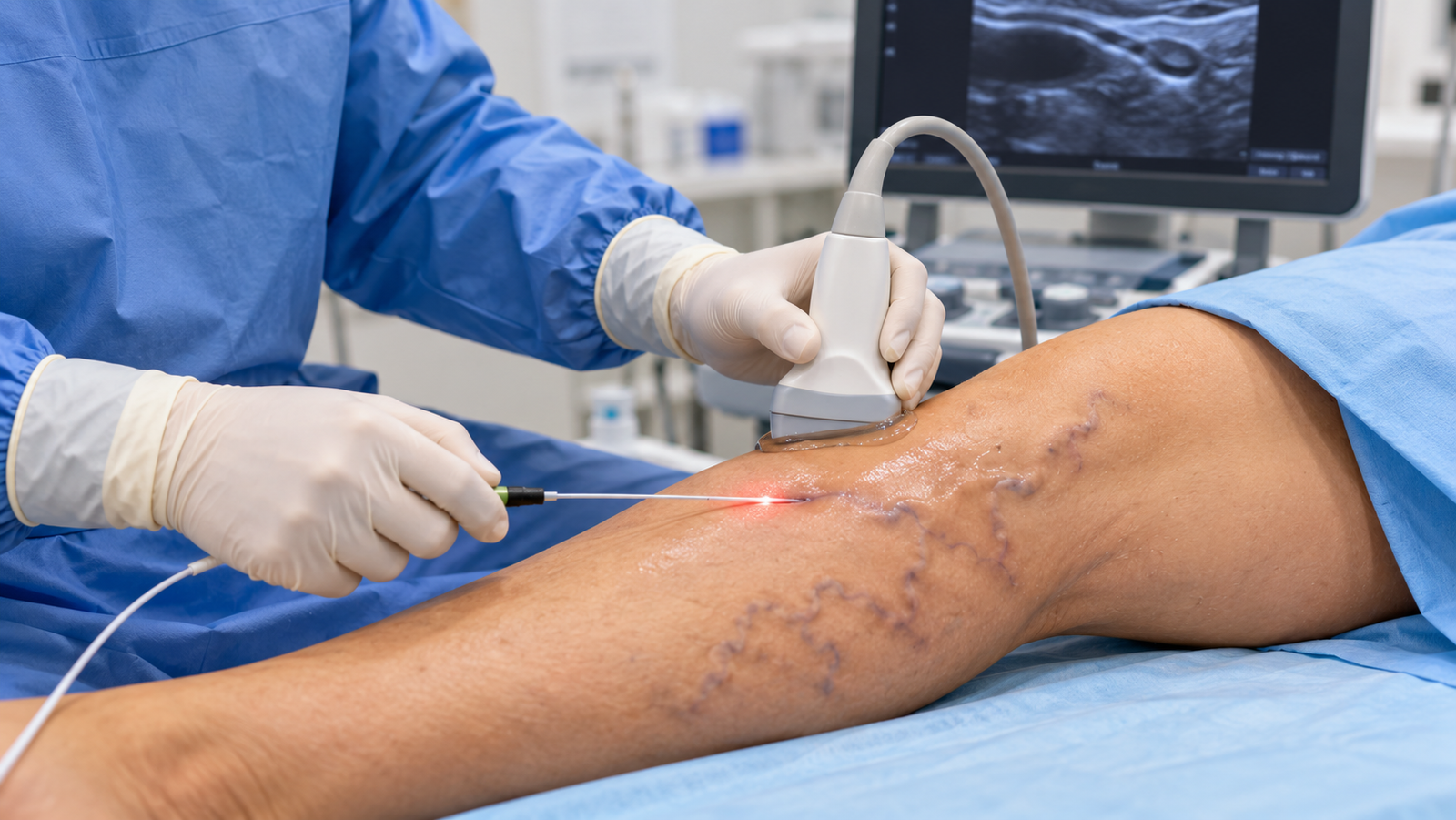
Instead of surgically stripping the abnormal saphenous vein from the leg, the surgeon places a thin catheter or fibre inside it under ultrasound guidance.
Energy is then delivered from within the vein.
The treated vein closes, and blood is naturally redirected through functioning veins.
Endovenous laser ablation
EVLA uses laser energy to heat and close the abnormal vein.
The procedure generally involves:
- Ultrasound mapping
- Needle access into the target vein
- Positioning a laser fibre inside the vein
- Injection of tumescent anaesthetic around the vein
- Controlled withdrawal of the fibre while delivering energy
- Ultrasound confirmation of treatment
You can learn more about laser treatment for varicose veins.
Radiofrequency ablation
RFA follows a similar principle but uses radiofrequency-generated heat rather than laser energy.
A catheter is positioned inside the incompetent vein under ultrasound guidance. Tumescent anaesthetic is placed around the vein before controlled thermal treatment.
Read more about radiofrequency ablation.
Is laser better than radiofrequency?
For many patients, the answer is not that simple.
Both are established endovenous thermal treatments, and both can achieve high rates of truncal vein closure when appropriately selected and performed.
The practical choice may depend on:
- Vein anatomy
- Vein diameter
- How straight the target segment is
- Previous procedures
- Available equipment
- Operator experience
- Individual risk factors
Some studies report differences in early postoperative pain or bruising between technologies, but these differences should not be exaggerated into a claim that one method is universally superior.
For many patients, correct patient selection and accurate ultrasound-guided treatment matter more than choosing between two effective thermal technologies.
When Is Glue Closure a Better Choice?
Cyanoacrylate closure, commonly discussed using terms such as VenaSeal glue for varicose veins, is a non-thermal method.
A catheter is inserted into the abnormal vein under ultrasound guidance, and small amounts of medical adhesive are delivered at selected points.
The adhesive closes the vein without using heat.
What is the main practical difference?
Thermal ablation usually requires tumescent anaesthesia along the course of the vein.
This involves placing diluted local anaesthetic around the target vein. It provides anaesthesia and creates a protective fluid layer around the vein during thermal treatment.
Glue closure does not use thermal energy, so this extensive tumescent anaesthesia is generally not required.
That may appeal to selected patients.
Is glue automatically better?
No.
Avoiding thermal energy and tumescent injections can be convenient, but glue introduces its own considerations.
These include:
- Cost and availability
- Vein anatomy
- Previous venous procedures
- Hypersensitivity concerns
- Local inflammatory or phlebitis-like reactions
- The presence of a permanent implanted adhesive material
Patients with a known significant hypersensitivity to cyanoacrylate products may not be appropriate candidates.
The decision should therefore be based on clinical suitability rather than simply choosing the method with the fewest injections.
Where Do Foam Sclerotherapy and Open Surgery Still Fit?
Modern treatment has reduced the need for traditional stripping, but it has not made every other technique obsolete.
Ultrasound-guided foam sclerotherapy
Foam sclerotherapy involves injecting a sclerosant into a target vein, usually under ultrasound guidance for larger veins.
The foam contacts the vein wall and causes the treated vein to close.
It can be particularly useful for:
- Selected tributary veins
- Residual veins after another treatment
- Recurrent varicose veins
- Anatomies where catheter treatment is difficult
- Patients for whom endothermal treatment is unsuitable
Patients can read more about sclerotherapy for varicose veins.
Foam is useful, but recurrence and recanalisation characteristics can differ from those of thermal ablation. It should therefore not automatically replace EVLA or RFA when truncal endothermal ablation is appropriate.
Open stripping and ligation
Traditional surgery usually involves ligating and removing an incompetent superficial vein.
It was once a standard approach for many patients with saphenous reflux.
Today, minimally invasive endovenous techniques have replaced stripping in many suitable cases.
However, surgery still has a role.
It may be considered when:
- Endovenous access is technically difficult
- Vein anatomy is unsuitable for catheter treatment
- Endothermal treatment is unsuitable
- Foam is also inappropriate
- Previous procedures have significantly altered the anatomy
- Another surgical procedure is required at the same time
NICE guidance places endothermal ablation first for suitable patients with confirmed truncal reflux. If endothermal treatment is unsuitable, ultrasound-guided foam sclerotherapy is considered; if that is also unsuitable, surgery can be offered.
So the comparison of varicose vein surgery vs laser is no longer simply a choice between two equivalent ways of doing the same thing. Modern guidelines generally favour minimally invasive endovenous treatment when anatomy and patient factors allow it.
Varicose Veins Doctor Near Kadodara: How Is the Right Method Selected?
Choosing treatment starts with identifying where the reflux originates and which veins need treatment.
At Elegance Clinic, Dr. Ashutosh Shah evaluates the clinical examination together with duplex ultrasound findings before deciding whether EVLA, RFA, foam treatment, glue closure, surgery, or a combination is appropriate.
A treatment plan may look very different in two patients whose legs appear similar from the outside.
One patient may have a straight incompetent great saphenous vein that is suitable for thermal ablation.
Another may have recurrent, tortuous tributaries after previous surgery that are better managed with another approach.
This is why the visible size of the veins alone should not decide the procedure.
Laser vs Radiofrequency vs Glue vs Foam vs Surgery
| Method | Veins commonly suited | Anaesthesia | Typical activity/work recovery* | Stockings | Main considerations/risks | May not suit |
|---|---|---|---|---|---|---|
| EVLA | Incompetent truncal superficial veins with suitable catheter anatomy | Local + tumescent | Often rapid, depending on work | Protocol varies | Bruising, discomfort, nerve irritation, thrombosis, skin injury uncommon | Anatomy preventing safe catheter/thermal treatment |
| RFA | Suitable for incompetent truncal veins | Local + tumescent | Often rapid | Protocol varies | Bruising, tenderness, nerve injury, thrombosis, thermal complications uncommon | Anatomy unsuitable for catheter/thermal treatment |
| Cyanoacrylate glue | Selected incompetent truncal veins | Usually local access anaesthesia; no tumescent along entire vein | Often rapid | May not always be required; protocol dependent | Inflammatory reaction, phlebitis-like reaction, hypersensitivity | Relevant adhesive hypersensitivity or unsuitable anatomy |
| Ultrasound-guided foam | Selected truncal, tributary, residual or recurrent veins | Usually no tumescent anaesthesia | Usually rapid | Often advised depending on protocol | Pigmentation, thrombophlebitis, recanalisation and rare systemic complications | Individual contraindications to sclerosant/foam |
| Stripping and ligation | Selected veins unsuitable for endovenous options | Regional or general/local depending on operation | Usually longer than catheter procedures | Often used | Wound problems, bruising, nerve injury, bleeding, infection, recurrence | Patients better served by minimally invasive treatment |
*Return-to-work timing varies with treatment extent, occupation, symptoms, and individual recovery. It should not be promised as a fixed number of days.
Who Should Not Have Each of These Procedures?
There is no single technique that is appropriate for every patient.
EVLA or RFA may not be suitable when:
- Safe catheter access cannot be obtained
- The target vein anatomy makes thermal treatment inappropriate
- The vein lies in a location where thermal injury risk cannot be acceptably managed
- There is relevant acute venous thrombosis or another contraindication
- The patient’s overall medical condition makes elective intervention inappropriate
Glue closure may not be suitable when:
- There is a relevant known hypersensitivity to cyanoacrylate adhesive
- Anatomy does not allow appropriate catheter treatment
- Other clinical factors favour another established method
Foam sclerotherapy may not be suitable when:
- There is a contraindication to the sclerosant
- There is acute venous thromboembolic disease
- Individual neurological, cardiopulmonary or thrombotic factors materially alter the risk
The exact contraindications should be assessed individually.
Open surgery may not be appropriate when:
A patient has significant anaesthetic or surgical risk, poor wound-healing potential or another condition making an elective operation unsafe.
In addition, there is little reason to choose a more invasive operation solely out of habit when a guideline-supported minimally invasive option is appropriate.
What Happens After Endovenous Treatment?
Most modern varicose-vein procedures are designed to allow early mobilisation.
Walking is generally encouraged after treatment because remaining active supports normal circulation.
The surgeon will provide instructions covering:
- Walking and activity
- Wound or puncture-site care
- Compression stockings where prescribed
- Exercise restrictions
- Medicines
- Warning signs
- Follow-up
A post-procedure ultrasound may be recommended depending on the procedure, individual risk, and clinic protocol.
At Elegance Clinic, follow-up planning with Dr. Ashutosh Shah is based on the treatment performed and the patient’s clinical situation rather than using one identical schedule for every case.
Frequently Asked Questions
Is laser treatment for varicose veins permanent?
EVLA is designed to permanently close the treated abnormal vein, and long-term closure rates are high. However, treating one incompetent vein does not prevent every future vein from becoming abnormal. New varicose veins or recurrent venous reflux can develop over time, so “permanent cure” should not be guaranteed.
Which method has the least pain and bruising?
Non-thermal glue closure avoids the multiple tumescent anaesthetic injections required for thermal ablation and may offer advantages in early discomfort for some patients. RFA and EVLA are also minimally invasive and generally allow relatively rapid recovery. The least painful option for one patient is not necessarily the best treatment for their anatomy.
Do I need to stay in hospital after laser or radiofrequency?
EVLA and RFA are commonly performed as day-care or outpatient procedures in suitable patients, meaning an overnight hospital stay is often unnecessary. Your surgeon will determine whether day-care treatment is appropriate based on the extent of treatment, medical history and anaesthetic plan.
Can both legs be treated on the same day?
Sometimes. Bilateral treatment can be performed in selected patients, but the decision depends on the extent of disease, procedure planned, medical fitness and the surgeon’s assessment. Treating both legs at once should be a clinical decision rather than simply a matter of convenience.
Will I still need stockings after the procedure?
It depends on the procedure and the surgeon’s protocol. Compression is commonly used after some thermal ablation and sclerotherapy procedures, while some non-thermal glue protocols may not require the same compression regimen. A varicose veins doctor near kadodara should give instructions based on the treatment actually performed rather than assuming stockings are identical for every method.
Is glue closure covered by health insurance?
Coverage varies between insurers and policies. Some policies may cover medically necessary varicose-vein treatment but have different conditions for specific technologies or devices. Patients should obtain written pre-authorisation or confirmation from their insurer rather than assuming glue closure will be reimbursed because another vein procedure is covered.
Is Laser or Radiofrequency the Better Choice?
For many suitable patients, there is no dramatic difference that makes one technology the automatic winner.
Both EVLA and RFA:
- Treat refluxing superficial truncal veins from inside
- Use ultrasound guidance
- Avoid traditional long surgical stripping
- Usually use tumescent anaesthesia
- Allow early mobilisation
- Have strong evidence supporting their use
The better choice is therefore usually the method that fits the patient’s vein anatomy and can be performed reliably by the treating team.
The more important question is often not:
“Is laser better than radiofrequency?”
It is:
“Where is my reflux, and which technique can treat it safely and effectively?”
The Bottom Line
When comparing varicose veins laser vs radiofrequency, both are established endovenous thermal treatments and can provide excellent results in appropriately selected patients.
Glue closure offers a non-thermal option without extensive tumescent anaesthesia. Foam sclerotherapy remains valuable for selected, residual and recurrent veins, while traditional surgery still has a place when less invasive options are unsuitable.
The duplex ultrasound scan is central to the decision because it maps the source and extent of venous reflux rather than simply showing what the veins look like on the skin.

