

|
Getting your Trinity Audio player ready...
|
✓ Medically reviewed by Dr. Ashutosh Shah, Plastic, Reconstructive & Cosmetic Surgeon (M.Ch., DNB)
Written by Dr. Ashutosh A Shah, M.B.B.S., M.S., M.Ch., D.N.B., Board Certified Plastic and Reconstructive Surgeon, Elegance Clinic, Surat. Reg. no. [REG NO]. 22+ years in plastic and reconstructive surgery.
Medically reviewed by Dr. Ashutosh A Shah · Published 21 September 2026 · Last reviewed 21 September 2026
A keloid is scar tissue that grows beyond the original wound and does not regress. Surgery alone regrows in most cases, because cutting the skin restarts the same overactive healing. Control comes from combining treatments: steroid injections, silicone and pressure, laser, and surgical excision only when it is paired with post-excision therapy.
The classic keloid story goes like this. Someone gets a small lump after an ear piercing or a chickenpox mark. A doctor removes it. Within a year it is back, and this time it is bigger than the original. That is not a surgical failure, it is the predictable result of treating a keloid with excision alone.
This post explains what a keloid actually is, why it behaves that way, which treatments have real evidence, what laser can and cannot do, the strict condition under which surgery is appropriate, and how to prevent one after a piercing or an operation if you already know you are prone.
What is a keloid, and how is it different from a hypertrophic scar?
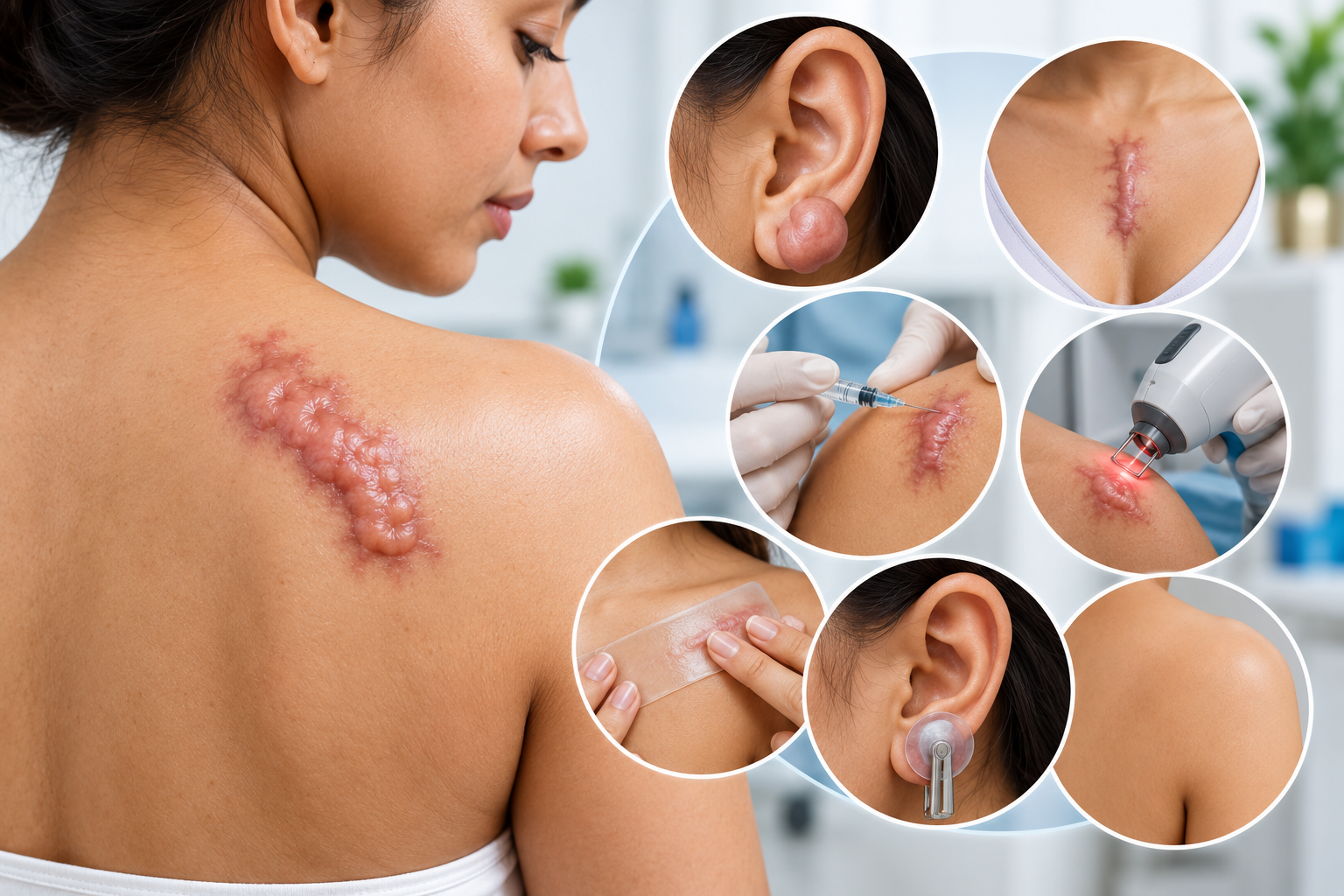
A keloid is a scar that grows beyond the boundaries of the original wound and does not shrink on its own. A hypertrophic scar is raised but stays within the wound edges and usually flattens over one to two years. That single difference, whether the scar respects the wound border, drives the entire treatment plan.
| Feature | Keloid | Hypertrophic scar |
|---|---|---|
| Extends past the original wound? | Yes, this is the defining feature | No, stays within the wound edges |
| Does it settle on its own? | No, it does not regress | Often flattens over 1 to 2 years |
| When does it appear? | Can appear months after the injury and keep growing | Usually within weeks, then plateaus |
| Typical sites | Earlobes, chest and sternum, shoulders, upper back, jawline | Anywhere, especially across joints and areas of tension |
| Symptoms | Itch, tenderness, a pulling or burning sensation | Usually less symptomatic |
| Recurrence after excision alone | High, and often larger than before | Low |
| Treatment approach | Combination therapy, long term | Often silicone and time alone |
This matters practically because the two are constantly confused, including by patients being told “it will settle down”. A hypertrophic scar often will. A keloid will not, and the months spent waiting are months in which it continues to grow. The NHS guidance on keloid scars describes the same distinction.
Why do keloids keep coming back after removal?
Because excision creates a brand new wound in exactly the person whose skin overreacts to wounds. The keloid was never a growth that needed removing, it was evidence of how that individual heals. Cut it out and the same process starts again along the new scar line, frequently producing a larger keloid than the original.
What is happening under the skin:
- The inflammatory phase does not switch off. In normal healing, inflammation resolves and collagen production slows. In keloid-prone skin it persists.
- Fibroblasts stay overactive. The cells that lay down collagen keep producing it long after the wound has closed.
- Collagen is deposited in excess and disorganised, which is why a keloid is firm, raised and rubbery rather than flat.
- Tension makes it worse. This is why the chest, shoulders and jawline, areas under constant movement and pull, are classic keloid sites.
Across published surgical series, excision alone recurs in the majority of cases, which is why no reputable plan offers it as a standalone procedure. Adding post-excision therapy, whether steroid injection, pressure, silicone or radiotherapy, changes the outcome substantially. Surgery without adjuvant treatment is the single most common reason people end up with a worse keloid than they started with.
Who gets keloids, and where on the body do they form most?
Keloids are far more common in people with darker skin, including Indian, African, Hispanic and East Asian skin types, and there is a strong family tendency. They occur most often between the ages of 10 and 30, and they favour specific sites: earlobes, the chest and breastbone, shoulders, upper back and the jawline.
The usual triggers:
- Ear and body piercings. The commonest cause of an earlobe keloid, and often the person’s first sign that they are keloid-prone.
- Acne, especially on the chest, shoulders and back. A major cause, and the reason treating acne early is also keloid prevention.
- Chickenpox and other pox scars.
- Surgery of any kind, including caesarean section, which is why a keloid history must be declared before any planned operation.
- Burns, cuts, insect bites, vaccination sites and tattoos.
- Folliculitis in the beard area or back of the neck, which can produce a particularly stubborn pattern.
Some keloids on the chest appear with no remembered injury at all. Keloids almost never occur on the eyelids, palms, soles or genitals, which is a useful clue when something on those sites is assumed to be one.
Which keloid scar treatments actually work?
Five approaches have genuine evidence: intralesional steroid injections, silicone gel or sheeting, pressure therapy, laser, and surgical excision with mandatory adjuvant treatment. Almost nobody is treated with one of these alone, because combination therapy consistently outperforms any single modality.
- Intralesional corticosteroid injection. The first-line treatment worldwide. Injected directly into the keloid to suppress the overactive collagen production, flatten it and relieve itch.
- Intralesional 5-fluorouracil, often combined with steroid, used particularly where steroid alone has stopped working or where skin thinning is a concern.
- Silicone gel or silicone sheeting. Non-invasive, well evidenced, and the mainstay of both treatment and prevention. Works by hydrating and occluding the scar.
- Pressure therapy. Sustained pressure reduces blood flow and collagen deposition. For earlobe keloids, pressure clips or earrings worn after excision are a key part of why the result holds.
- Cryotherapy, including intralesional cryotherapy, which freezes the keloid from within. Effective on smaller lesions, with a risk of permanent lightening of the treated skin.
- Laser, covered in its own section below.
- Surgical excision plus adjuvant therapy, and never excision alone.
- Post-excision radiotherapy, reserved for large, repeatedly recurrent keloids in selected patients, and requiring a radiation oncology partner.
The American Academy of Dermatology’s guidance on keloid treatment sets out the same options and the same combination principle.
Steroid injections: what to expect and how many are needed?
Intralesional steroid is injected directly into the body of the keloid, usually every four to six weeks, for a course that commonly runs to three to six sessions or more. Most people notice reduced itch and tenderness after the first one or two, with visible flattening developing over several months.
What patients should know before starting:
- It stings. The keloid is dense, so the injection takes pressure. A topical anaesthetic or a cooling device helps.
- Symptom relief comes before appearance change. Itch and tenderness usually settle first, which is often the change that matters most day to day.
- The interval is deliberate. Injecting more frequently than every four weeks increases side effects without improving the result.
- Side effects are real and worth knowing. Thinning of the surrounding skin, lightening of the skin colour, visible small blood vessels, and occasionally a dip in the treated area. These are more visible on Indian skin, which is why dose and technique matter.
- Maintenance is normal. Many people need occasional top-up injections after the main course. That is expected management, not failure.
If a keloid stops responding after several injections, the plan should change rather than repeat. Adding 5-fluorouracil, switching to a combined approach, or considering excision with adjuvant cover are all reasonable next steps.
What does laser do for keloids, and what does it not do?
Laser improves how a keloid looks and feels, but it does not remove one. Pulsed dye laser targets the blood vessels feeding the scar, reducing redness, itch and thickness over a course. Fractional lasers improve texture and can be used to drive medication deeper into the scar. Neither excises tissue.
Where laser genuinely helps:
- Redness and colour. Vascular laser is the most effective option for a keloid that is angry red or purple.
- Itch and discomfort. Often improves alongside the vascularity.
- Softening and flattening, gradually and over multiple sessions, particularly when combined with steroid.
- Laser-assisted drug delivery. A fractional laser creates microscopic channels that let a topical or injected medication reach the depth where it is needed, which is one of the more useful advances in this field.
- Texture and surface irregularity after the bulk has been reduced by other means.
Where it does not: a large, firm, established keloid will not be removed by laser sessions, and a course sold on that basis is a course sold wrongly. Laser is a component of a combination plan, not a substitute for one. The clinic’s platforms and protocols are described on our laser treatment for keloid page, alongside the wider laser treatment services.
How do silicone sheets, pressure therapy and earlobe clips work?
Silicone and pressure are the unglamorous parts of keloid treatment and they do a disproportionate amount of the work. Silicone hydrates and occludes the scar, signalling the skin to reduce collagen production. Pressure physically limits blood flow into the scar. Both need to be worn consistently for months to do anything at all.
Using them properly:
- Silicone gel or sheeting is worn 12 to 24 hours a day for at least two to three months, and often longer. Sheets are reusable and washed daily; gel suits the face and irregular areas. Intermittent use does not work.
- Pressure earrings or clips are the standard after earlobe keloid excision, worn for months. This is the main reason a properly managed earlobe keloid holds its result, and the main reason one treated by excision alone does not.
- Pressure garments are used over larger areas such as the chest and shoulders where a garment can maintain contact.
- Start early. After surgery or a piercing, silicone is typically begun once the wound has fully closed, at around two weeks, and that timing matters.
Be honest with yourself about compliance before you buy these. Silicone sheeting worn a few evenings a week will do nothing, and a pressure clip taken off because it is uncomfortable is the commonest reason an otherwise good earlobe result fails.
When is surgery appropriate, and what must follow it?
Surgery is appropriate for large, pedunculated or functionally limiting keloids, and for earlobe keloids where the bulk is too great for injection alone. It is only appropriate when adjuvant treatment is planned in advance, because excision alone recurs in the majority of cases and often produces a larger keloid.
A properly planned surgical case includes all of the following:
- Tension-free closure, with the scar line placed to minimise pull wherever the anatomy allows.
- Steroid injection started early, often at the time of surgery or within the first few weeks, and continued on a schedule.
- Silicone from around two weeks, once the wound is closed, continued for months.
- Pressure therapy where the site allows it, which for earlobes means a pressure clip worn for months.
- Post-excision radiotherapy in selected high-risk cases, typically large or repeatedly recurrent keloids, arranged with a radiation oncologist.
- A follow-up schedule, because the first sign of recurrence treated early is far easier to control than one discovered at a year.
If a surgeon offers to simply cut a keloid out with no mention of what happens afterwards, ask what the adjuvant plan is. If there is not one, that is the wrong operation.
Can keloids be prevented after surgery or a piercing?
Risk can be reduced substantially, though not eliminated. If you know you are keloid-prone, the most effective prevention is avoiding unnecessary skin trauma: no further piercings, no elective procedures on high-risk sites, and early treatment of acne before it scars.
Where a procedure is unavoidable:
- Tell the surgeon before, not after. A declared keloid history changes incision planning, closure technique and the aftercare plan.
- Start silicone once the wound has closed, around two weeks, and keep going for months.
- Consider early steroid injection at the first sign of thickening rather than waiting to see what happens.
- Protect the scar from sun for the first year, since ultraviolet exposure worsens both colour and thickening.
- Avoid tension on the healing scar. No stretching, heavy lifting or pulling across the wound in the early weeks.
- Do not smoke, which impairs every stage of wound healing.
- Treat acne properly and early, particularly chest and back acne in teenagers and young adults, which is one of the most preventable causes of chest keloids.
For earlobes specifically: if one ear has formed a keloid after piercing, the other is at high risk. Think carefully before piercing it, and if a keloid is removed, the pressure clip afterwards is not optional.
What does keloid scar treatment cost in India, and how long does it take?
Costs depend entirely on the approach. A single steroid injection session in India is commonly quoted in the range of about ₹1,000 to ₹3,000, a laser session considerably more, and surgical excision with adjuvant therapy higher again. The more useful number is the timeline: keloid treatment is measured in months to a year or more, not in one appointment.
What a realistic plan looks like on paper:
- Injection course: a session every four to six weeks, commonly three to six or more, so four to nine months for the main course.
- Laser course: several sessions spaced weeks apart, usually alongside injections rather than instead of them.
- Silicone and pressure: months of daily use running through the whole of the above.
- Surgery: one procedure, then the adjuvant programme for months afterwards, plus follow-up.
- Maintenance: occasional top-ups thereafter, and prompt treatment of any early recurrence.
Ask for a written plan covering the whole course, not a per-session price, and ask specifically what happens and what it costs if the keloid recurs. Insurance generally treats keloid treatment as cosmetic and excludes it, though a keloid causing genuine functional restriction or recurrent infection is worth discussing with your insurer. EMI options are available where the course is spread over months.
Keloid scar treatment at Elegance Clinic, Surat
Dr. Ashutosh A Shah is a board certified plastic and reconstructive surgeon with over 22 years of practice in Surat, Gujarat. Keloids sit at the intersection of dermatology and surgery, and the decisions that matter are which combination to use, in what order, and whether surgery belongs in the plan at all rather than as a first move.
Patients here are told two things plainly at the first consultation. First, that this is a course of treatment over months, not a single procedure. Second, that keloid treatment controls the scar rather than curing the tendency, so some monitoring and occasional maintenance is part of a good long-term result. Anyone promising permanent removal in one sitting is overselling.
Next step
If a keloid has already come back once, the useful question is not which single treatment removes it, but which combination controls it and in what order. Book an appointment with Dr. Ashutosh Shah at Elegance Clinic, Surat, or call +91 83205 00350.
Medical disclaimer: This article is for education only and is not a substitute for professional diagnosis or treatment. Keloid treatment controls the scar rather than curing the tendency to form one, and results vary. Any raised lesion that ulcerates, bleeds repeatedly or changes character should be examined promptly. Please consult Dr. Ashutosh A Shah or a qualified specialist about your own scar.

