

|
Getting your Trinity Audio player ready...
|
✓ Medically reviewed by Dr. Ashutosh Shah, Plastic, Reconstructive & Cosmetic Surgeon (M.Ch., DNB)
Low-level laser therapy (LLLT) uses red or near-infrared light to support hair growth in people with early-stage pattern hair loss. Laser for hair growth works best where living hair follicles remain, not on completely bald areas. Many devices require use three times weekly, with results assessed after 16–26 weeks.
Hair thinning can begin gradually. You may notice a wider hair parting, reduced density at the crown, or more scalp visibility under bright lighting.
Several treatments can slow hair loss or improve hair density. One option is low-level laser therapy, also called photobiomodulation.
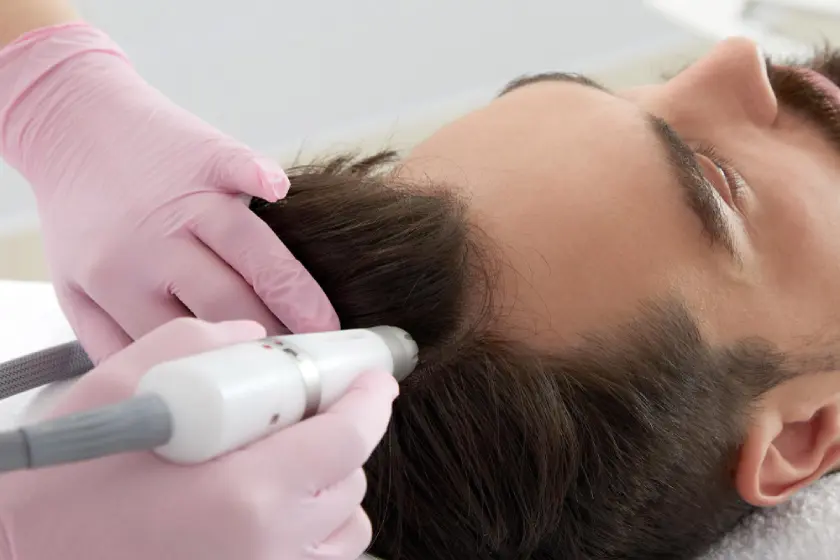
Unlike surgical hair restoration, LLLT does not move hair follicles. Instead, it delivers low-intensity light to the scalp.
However, laser treatment is not suitable for every type of hair loss, and results depend on the diagnosis, stage of thinning, and consistency of treatment.
How Does Low-Level Laser Therapy Work for Hair Growth?
Low-level laser therapy uses controlled light energy, commonly within the red-light spectrum.
Many hair-growth devices use wavelengths around 650 nm, although the exact wavelength varies by device.
The light reaches the scalp and may influence cellular processes associated with hair follicle activity.
Researchers have proposed several possible mechanisms, including effects on mitochondrial signalling and the hair-growth cycle.
However, the precise biological mechanism in human hair follicles remains incompletely established.
Does LLLT Create New Hair Follicles?
No.
LLLT does not create new follicles in areas where follicles have been permanently destroyed or lost.
Its potential benefit comes from supporting existing follicles that are still capable of producing hair.
This distinction explains why treatment may help thinning hair but cannot reliably restore a completely bald scalp.
Is Laser Hair Growth Therapy the Same as Laser Hair Removal?
No.
Laser hair removal uses energy intended to damage selected hair follicles and reduce unwanted hair.
LLLT uses much lower energy and aims to support follicle activity without deliberately destroying tissue.
The devices, treatment goals, and energy settings are different.
Who Can Benefit From Laser for Hair Growth?
The strongest clinical evidence for LLLT concerns androgenetic alopecia, also called male or female pattern hair loss.
This condition causes gradual follicle miniaturisation.
Affected follicles produce thinner, shorter hairs over time.
LLLT may improve hair density in some patients when these follicles remain active.
1. Early Male Pattern Hair Loss
Men with mild crown thinning or early patterned hair loss may be suitable candidates.
The treatment is more likely to help when visible hairs remain in the affected region.
2. Female Pattern Hair Loss
Women with gradual thinning over the central scalp or widening of the hair parting may also benefit.
However, a proper assessment is necessary because hair thinning in women can have several causes.
3. Patients Seeking Additional Treatment
Some patients already use medical treatments but want to discuss a non-invasive addition.
LLLT may be considered alongside established therapies, although combination treatment does not guarantee better results.
4. Patients Who Prefer a Non-Invasive Option
LLLT does not involve injections or surgical incisions.
This makes it appealing to some patients who want to avoid invasive procedures.
However, convenience should not replace an accurate diagnosis.
Hair Growth Laser Treatment in Bardoli: Who Is Suitable?
Patients considering LLLT should first confirm the cause of hair loss.
A clinical assessment helps determine whether the follicles remain active and whether laser treatment is likely to provide meaningful improvement.
| Hair Loss Condition | Is LLLT Suitable? | Reason |
|---|---|---|
| Early male pattern hair loss | May help | Miniaturised follicles may remain active |
| Early female pattern hair loss | May help | Evidence supports some improvement in hair density |
| Mild crown thinning | May help | Existing follicles may respond |
| Completely bald, smooth scalp | Unlikely to help | Functional follicles may be absent |
| Scarring alopecia | Not an established treatment | Follicles may be permanently destroyed |
| Nutritional deficiency-related shedding | Not first-line | The underlying deficiency requires assessment |
| Thyroid-related hair loss | Not first-line | The underlying condition needs treatment |
| Alopecia areata | Evidence remains limited | Different disease mechanism and treatment approach |
For patients with persistent hair thinning, a detailed hair loss assessment and treatment consultation can help identify suitable options.
Why Is Trichoscopy Important Before LLLT?
Trichoscopy is a non-invasive examination of the scalp and hair using magnification.
It can help the clinician assess:
- Hair shaft thickness
- Variation in hair diameter
- Follicular openings
- Miniaturised hairs
- Scalp inflammation
- Signs suggesting scarring
- Distribution of thinning
This examination helps distinguish pattern hair loss from other causes.
For the clinic’s proposed treatment protocol, the diagnosis should be confirmed through clinical examination and trichoscopy before recommending LLLT. This protocol should be verified with the treating team before publication.
How Often Should You Use Low-Level Laser Therapy?
Treatment frequency depends on the device.
Many established devices recommend approximately three sessions per week.
Some newer caps use daily or alternate-day schedules.
Patients should follow the manufacturer’s instructions for the specific device rather than assuming every laser helmet requires the same routine.
Typical Treatment Schedule
| Treatment Period | What to Expect |
|---|---|
| Weeks 1–4 | Establish consistent use; visible improvement is usually limited |
| Weeks 5–12 | Early changes may occur, but results remain difficult to judge |
| Weeks 16–20 | Review photographs and hair-density measurements |
| Weeks 20–26 | More useful period for assessing treatment response |
| After 6 months | Decide whether continued treatment is worthwhile |
Most clinical studies assess outcomes over several months.
Missing sessions frequently may reduce the likelihood of achieving the expected response.
How Long Does Each Session Take?
Session duration varies considerably.
Some devices recommend around 10 minutes, while others require longer treatment.
Patients should not increase exposure time without medical or manufacturer guidance.
More light does not automatically produce better hair growth.
When Will Laser Hair Growth Treatment Results Appear?
Laser hair growth treatment results usually develop gradually rather than immediately.
Some patients notice reduced scalp visibility or improved density after several months.
Others experience little or no visible improvement.
A realistic assessment generally requires 16–26 weeks of consistent use.
How Should Results Be Measured?
Patients should compare:
- Standardised scalp photographs
- Hair density
- Hair shaft thickness
- Width of the central parting
- Crown coverage
- Treatment consistency
Photographs should use similar lighting, camera angles, and hair positioning.
A clinician may also use trichoscopy to document changes.
Can LLLT Regrow Hair on a Completely Bald Crown?
Not reliably.
A smooth bald area with few or no functioning follicles is unlikely to respond meaningfully.
Patients with advanced hair loss may need a different treatment strategy.
LLLT should not be marketed as an alternative that reliably replaces hair transplantation in established bald areas.
Laser Cap vs Minoxidil, Finasteride and PRP
Different hair-loss treatments act through different mechanisms.
LLLT is one option, but it should not automatically be considered superior to established medical treatments.
| Treatment | Who It Suits | Typical Frequency | Time to Judge | Maintenance Needed? | Evidence Strength |
|---|---|---|---|---|---|
| Clinic LLLT | Selected early pattern hair loss | Often 2–3 times weekly, protocol-dependent | 4–6 months | Usually ongoing | Moderate for pattern hair loss |
| Home laser helmet | Suitable patients able to use it consistently | Device-specific; often 3 times weekly or daily | 4–6 months | Usually ongoing | Moderate for studied devices |
| Topical minoxidil | Many men and women with pattern hair loss | Usually daily | 4–6 months, sometimes longer | Yes | Strong |
| Finasteride | Primarily appropriate for adult men with pattern hair loss | Usually daily when prescribed | 6–12 months | Yes | Strong in indicated patients |
| PRP therapy | Selected patients with pattern hair loss | Initial treatment series followed by possible maintenance | 3–6 months | Often | Moderate, with variable protocols |
Evidence ratings are broad qualitative summaries, not direct head-to-head rankings. Treatment suitability and outcomes vary.
LLLT vs Minoxidil
Minoxidil is an established treatment for pattern hair loss.
It has a larger and longer clinical evidence base than most consumer laser devices.
LLLT may be an option for patients who cannot tolerate minoxidil or prefer a device-based approach.
Some studies suggest that combining the treatments may improve hair density, but findings across reviews are not fully consistent.
Therefore, patients should not assume that adding LLLT always produces better results.
LLLT vs Finasteride
Finasteride reduces the conversion of testosterone to dihydrotestosterone (DHT), a hormone involved in male pattern hair loss.
LLLT does not work through the same hormonal pathway.
Finasteride has strong evidence for appropriately selected men, but it also has potential adverse effects and prescribing restrictions.
Patients should discuss the benefits and risks of medication with a qualified clinician.
LLLT vs PRP
Platelet-rich plasma therapy uses components prepared from the patient’s blood and injected into selected scalp areas.
LLLT is non-invasive and does not require injections.
PRP treatment protocols vary, and clinical results are inconsistent across studies.
Neither treatment should be presented as guaranteed.
What About Exosome Therapy?
Exosome-based hair treatments are being investigated, but their clinical evidence and regulatory status differ from established therapies.
Patients comparing emerging approaches can read about exosome therapy for hair loss.
Clinic LLLT vs Home Laser Helmet: Which Makes Sense?
Patients may choose between clinic-based devices and home-use caps, helmets, or combs.
Clinic-Based LLLT
Clinic treatment may suit patients who prefer professional guidance.
Potential advantages include:
- Clinical assessment before treatment
- Assistance with device positioning
- Scheduled treatment visits
- Periodic scalp reviews
- Monitoring of progress
However, frequent appointments may be inconvenient.
Home Laser Helmet for Hair Growth
A home device offers greater flexibility.
Patients can use it according to the manufacturer’s instructions without repeated clinic visits.
However, they must choose an appropriate device and maintain consistent use.
Comparison
| Factor | Clinic LLLT | Home Laser Helmet |
|---|---|---|
| Convenience | Requires appointments | Can be used at home |
| Supervision | May include clinical monitoring | Usually self-administered |
| Initial expense | Depends on session or package pricing | Device purchase |
| Long-term cost | May involve repeated visits | Mainly upfront device cost |
| Treatment consistency | Scheduled visits may help | Depends on personal routine |
| Device verification | Ask clinic for model details | Buyer must verify exact model |
A home helmet is not automatically less effective than a clinic device.
The relevant factors include the actual device, evidence supporting it, suitability for the patient’s condition, and correct use.
What Does FDA Clearance Mean for Laser Hair Growth Devices?
The United States Food and Drug Administration first granted 510(k) clearance to the HairMax LaserComb for male androgenetic alopecia in January 2007.
The FDA record identifies the device as K060305, with a clearance decision dated 18 January 2007.
Subsequent devices received additional clearances, including devices intended for female pattern hair loss.
FDA Cleared vs FDA Approved
These terms are not interchangeable.
FDA 510(k) clearance generally means the device was found substantially equivalent to an appropriate legally marketed device for its intended use.
It is not the same regulatory pathway as FDA premarket approval.
Patients should therefore avoid assuming that every product advertised as FDA-approved has undergone that approval process.
Does FDA Clearance Guarantee Hair Regrowth?
No.
Clearance does not guarantee an individual patient’s outcome.
Results depend on diagnosis, treatment adherence, hair-loss stage, and device characteristics.
Also, one manufacturer’s clearance does not automatically apply to every laser cap sold online.
What Does Scientific Research Show?
Clinical trials and systematic reviews provide evidence that LLLT can improve hair density in some people with androgenetic alopecia.
A 2025 systematic review and meta-analysis published in Dermatologic Surgery included 38 studies involving 3,098 patients across several alopecia types.
Most participants had androgenetic alopecia.
The analysis found improvements in hair density compared with placebo in patients with pattern hair loss.
However, evidence for other hair-loss conditions remained insufficient.
What Are the Limitations of the Evidence?
Several issues make results difficult to generalise:
- Devices use different wavelengths and treatment schedules.
- Some studies have relatively small participant groups.
- Follow-up periods are often short.
- Clinical outcomes are measured differently.
- Not all devices have equally strong supporting research.
- Long-term maintenance requirements remain incompletely studied.
The evidence supports LLLT as a possible treatment option for selected patients, not as a guaranteed cure.
Is Laser Hair Growth Therapy Safe?
LLLT is generally well tolerated when an appropriate device is used according to instructions.
It does not involve surgical incisions or injections.
Reported problems are usually mild, but patients should still follow device precautions.
Possible concerns include temporary scalp discomfort, irritation, or headaches.
Patients should avoid using devices on irritated or infected scalp areas without medical advice.
People taking photosensitising medications or living with conditions that increase light sensitivity should seek medical guidance before treatment.
Eye-safety instructions must also be followed.
Can LLLT Be Used After a Hair Transplant?
Some clinicians use LLLT as an additional treatment during hair-transplant recovery.
However, evidence supporting routine postoperative use is less established than evidence for pattern hair loss.
Patients should not start treatment immediately after surgery without approval from their transplant surgeon.
The timing depends on scalp healing, graft stability, and the device being considered.
Patients concerned about postoperative shedding can read why hair fall occurs after a hair transplant.
When Should You Consider a Hair Loss Assessment?
Patients should seek an assessment when they notice progressive thinning, widening of the hair parting, crown hair loss, or increased shedding that continues without a clear explanation.
Sudden hair loss, painful scalp inflammation, patchy baldness or scarring requires particular attention because the cause may need different treatment.
At Elegance Clinic, Dr. Ashutosh Shah, MBBS, MS, MCh and DNB, a plastic and reconstructive surgeon practising since 2004, can assess hair-loss concerns and discuss suitable management options. A diagnosis based on history, scalp examination and trichoscopy where indicated should guide whether LLLT, medication or another treatment is appropriate. Patients can book a hair loss assessment to discuss their concerns.
Frequently Asked Questions
1. Does Laser Hair Growth Therapy Actually Work?
LLLT can improve hair density in some patients with androgenetic alopecia. Clinical studies support modest benefits in selected patients, but results vary. It is more suitable for thinning areas containing active follicles than for completely bald regions.
2. Is Laser Hair Growth Therapy Safe for Women?
Many women with female pattern hair loss may be suitable candidates. However, the cause of thinning should be assessed first. Patients should use devices appropriate for their condition and follow medical and manufacturer guidance.
3. Can Laser Therapy Regrow a Bald Crown?
It may improve thinning at the crown when functioning follicles remain. However, it cannot reliably restore hair to a completely bald area where follicles have been lost.
4. Do I Need to Continue Laser Therapy Forever?
Ongoing treatment is generally needed to maintain benefits because pattern hair loss is progressive. The exact maintenance schedule depends on the device and individual response. Long-term maintenance protocols are less well studied than initial treatment.
5. Can Laser Be Used After a Hair Transplant?
Sometimes, but patients should consult their transplant surgeon before starting. The timing and potential benefits depend on healing and the treatment plan.
6. Are Laser Helmets Sold Online Genuine?
Not all devices have equivalent evidence or regulatory clearance. Check the manufacturer, exact model, regulatory documentation, wavelength specifications and instructions. Avoid products promising guaranteed regrowth.
7. Does Laser Therapy Cause Shedding at First?
Temporary shedding can occur during changes in hair-growth cycles, but a predictable initial shedding phase is not firmly established for LLLT. Persistent or significant shedding should prompt reassessment rather than automatically being considered a sign of success.
8. How Long Does It Take to See Results From Low-Level Laser Therapy?
Most patients should allow approximately 16–26 weeks before judging results. Standardised photographs and hair-density measurements are more useful than checking the mirror daily.
9. Is a Laser Helmet Worth Buying for Hair Loss?
A laser helmet may be worthwhile for selected patients with early pattern hair loss who can use it consistently. The decision should consider the device’s evidence, cost, expected benefit and whether established treatments may be more appropriate.
10. Where Can I Get Hair Growth Laser Treatment in Bardoli?
If you are considering hair growth laser treatment in bardoli, first arrange a clinical hair-loss assessment. Confirm the diagnosis, check whether LLLT is suitable and ask which device and treatment schedule would be used before purchasing a package or home helmet.
Conclusion
Laser for hair growth can be a useful non-invasive option for selected patients with early-stage pattern hair loss.
Its strongest evidence concerns androgenetic alopecia, particularly when active follicles remain in thinning areas.
Most patients need consistent treatment over several months before results can be assessed.
However, LLLT does not create new follicles, cannot reliably restore completely bald areas, and should not automatically replace established medical treatments.
At Elegance Clinic, a personalised hair-loss assessment can help patients understand whether laser therapy, medication, or another approach best matches their condition.
