

|
Getting your Trinity Audio player ready...
|
✓ Medically reviewed by Dr. Ashutosh Shah, Plastic, Reconstructive & Cosmetic Surgeon (M.Ch., DNB)
Written by Dr. Ashutosh A Shah, M.B.B.S., M.S., M.Ch., D.N.B., Board Certified Plastic and Reconstructive Surgeon, Elegance Clinic, Surat. Reg. no. [REG NO]. 22+ years in hair restoration and reconstructive surgery.
Medically reviewed by Dr. Ashutosh A Shah · Published [DD Month 2026] · Last reviewed [DD Month 2026]
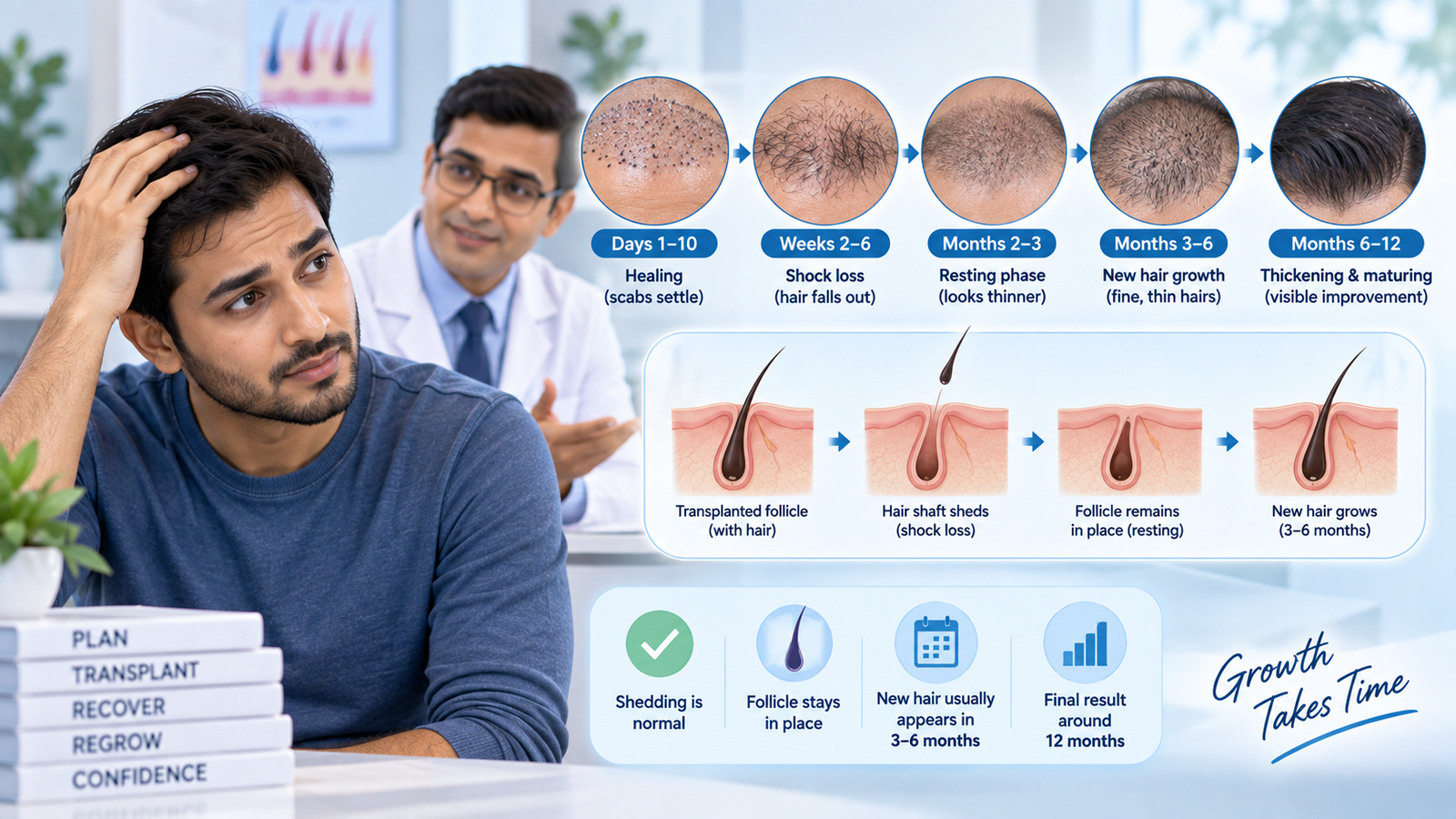
Hair fall after a hair transplant in the first weeks is expected and is called shock loss. The transplanted follicle stays in place and regrows; only the shaft is shed. New hairs typically appear after three to six months and continue maturing to twelve months. Surrounding native hair can also shed temporarily.
If you are three weeks post-operative and watching transplanted hairs come away in the shower, you are almost certainly looking at the normal course of events rather than a failure. It does not feel normal, because nobody prepared you for it properly, and because you have just spent a great deal of money.
Here is what is actually happening, what the honest timeline looks like month by month, and the specific signs that are worth a phone call rather than a wait.
Why does transplanted hair fall out after surgery?
Because the follicle responds to the stress of being moved by shutting down the hair it is currently growing and entering its resting phase. The shaft is pushed out and shed. The follicle itself stays in the scalp, intact, and starts a new growth cycle.
To see why that is expected rather than alarming, it helps to know how the hair cycle normally works. According to StatPearls on hair transplantation, the growing phase, anagen, lasts two to six years and accounts for roughly 90 to 95 percent of scalp hairs at any moment. A short transition phase, catagen, lasts two to three weeks. The resting phase, telogen, lasts two to three months and accounts for around 5 to 10 percent of hairs.
A transplanted follicle is lifted from one part of the scalp and placed into another. It survives, but the hair it was mid-way through growing does not. The same source notes that shedding of implanted hairs occurs after several days, with regrowth taking several months.
So the sequence is: transplant, shed, pause, regrow. The pause is the part nobody warns people about, and it is the part that feels like failure.
What is shock loss, and why does the follicle survive?
Shock loss is the shedding of hair after the shock of surgery, affecting both transplanted hairs and existing native hairs around the treated area. The follicle survives because what is shed is the shaft, not the root. The structure that produces hair remains in place and resumes.
The mechanism has a name in dermatology: telogen effluvium. DermNet describes it as temporary hair loss caused by excessive shedding of resting hairs after some shock to the system, and lists surgical operation among the triggers. The key word in that description is temporary, and DermNet states plainly that telogen effluvium is self-correcting.
Three things follow from this, and they are the three things most worth understanding:
- Shedding is not loss. A hair that falls out of a living follicle is replaced by that follicle. A follicle that has died does not shed, because there is nothing there to shed.
- The amount you see is not a measure of damage. Heavy shedding at week three looks much worse than light shedding and means the same thing.
- The timing is the reassuring part. Shedding in the first weeks after surgery is the expected pattern. Shedding that starts for the first time at month eight is a different conversation.
In our practice in Surat, the calls we get about this cluster almost exactly at weeks two to four, and almost none of them turn out to be a problem with the graft.
What does the growth timeline actually look like?
Shedding in the first weeks, then a quiet period with little visible change, then new hairs typically appearing after three to six months, then progressive thickening through to around twelve months. StatPearls notes that patients are followed for six to twelve months until the implanted grafts have fully matured.
| Period | What is happening | What you see |
|---|---|---|
| Days 1 to 10 | Healing. Crusting around grafts settles | Redness, small scabs, the transplanted hairs still present |
| Weeks 2 to 6 | Shedding. Follicles enter the resting phase | Transplanted hairs falling out. This is the phase that alarms people |
| Months 2 to 3 | The quiet period. Follicles resting before the new cycle begins | Very little visible change. Often the lowest point psychologically |
| Months 3 to 6 | New growth begins. StatPearls puts first appearance at 3 to 6 months | Fine, sometimes wispy or lighter hairs emerging. Uneven at first, which is normal |
| Months 6 to 9 | Thickening. Hairs increase in diameter and pigment | Visible change month to month. This is when most people relax |
| Months 9 to 12 | Maturation. Density and texture continue improving | Close to the final result |
| Beyond 12 months | Final maturation, particularly in denser or larger sessions | Refinement rather than transformation |
Two things about that table matter more than the rest of it. Months two to three are the hardest, because the transplanted hair has gone and the new hair has not arrived, so the area can look worse than before surgery. And growth is uneven. Follicles do not restart in unison, so a patchy appearance at month four is the normal pattern, not a sign that some grafts failed.
Why does the hair around the grafts fall out too?
Because the surgery is a shock to the whole treated area, not only to the follicles that were moved. Native hairs nearby, particularly ones already weakened by pattern hair loss, can shed in response. StatPearls describes this shock loss at the donor or recipient sites as transient.
This is the part that genuinely distresses people, because it can make the area look thinner at month two than it did before the operation. Understanding why helps:
- Miniaturised hairs are the most vulnerable. Native hairs already thinning from pattern hair loss are closest to the end of their cycle and are the first to shed under stress.
- The donor area can be affected too, not only the recipient area.
- It is usually temporary. DermNet notes that after several months the shedding peaks and tapers back to normal over six to nine months in most cases.
- Some of it may not return. A native hair that was already almost finished may not come back, and it would probably have gone within a year or two anyway. That is pattern hair loss continuing, not damage from surgery.
That last point is uncomfortable and worth being honest about, because it is the bridge to the section below on why hair you did not transplant keeps thinning.
What is normal shedding, and what is not?
Normal shedding is painless, starts in the first weeks, affects hair rather than skin, and is accompanied by a healthy-looking scalp. What is not normal involves pain, pus, spreading redness, or a complete absence of any growth by twelve months.
| Expected | Needs a clinical review | |
|---|---|---|
| Timing | Shedding begins in the first weeks after surgery | Shedding that begins for the first time many months later |
| Sensation | Painless. Some itching as healing progresses | Increasing pain, tenderness or throbbing |
| The scalp | Settling redness, small scabs resolving in the first ten days | Spreading redness, pus, warmth, or persistent pustules |
| Pattern | Diffuse shedding across the treated area and nearby | One sharply defined bald patch where grafts were placed |
| Growth | Uneven at first, thickening progressively from months 3 to 6 onward | No growth of any kind anywhere by twelve months |
| General health | You feel well | Fever, or feeling unwell |
Nearly everything in the left column is what people phone about. Nearly nothing in the right column is.
Which signs suggest a genuine problem rather than shock loss?
A small number, and they are reasonably distinct. StatPearls lists the recognised complications of hair transplantation as infection, scarring, graft failure, bleeding, folliculitis, and temporary or permanent numbness of the scalp.
Contact your surgeon promptly if you notice:
- Increasing pain after the first few days rather than steadily reducing discomfort
- Pus, or spreading redness and warmth across the treated area
- Fever, or feeling generally unwell
- Persistent pustules or inflamed spots around the grafts, which can be folliculitis
- Bleeding that does not settle with gentle pressure
- A raised, thickened or spreading scar in the donor area
Arrange a review, without urgency, if:
- There is no growth at all anywhere in the treated area by twelve months. Not patchy growth, not thin growth. None.
- A defined area remains completely bare while the rest has grown in
- Numbness persists well beyond the expected settling period
Note how specific the twelve-month test is. Thin growth at month six is the normal course. Patchy growth at month four is the normal course. No growth anywhere at month twelve is a different matter and deserves an assessment.
Why does the hair you did not transplant keep thinning?
Because a transplant relocates hair that resists the hormone driving your hair loss, but it does not change the hair that does not. Transplanted follicles keep their original character, and the rest of your scalp carries on doing what it was doing.
This is the principle of donor dominance. StatPearls explains that transplanted grafts retain donor characteristics because occipital hairs, the ones taken from the back of the head, are resistant to androgens. Relocated follicles keep their original growth pattern regardless of where they are placed.
The other half of that sentence is the one that catches people out. Your native hair is not androgen-resistant, and pattern hair loss is progressive. The NHS describes male and female pattern baldness as permanent, and as something that usually runs in the family.
So a transplant at 28 can look excellent at 29 and disappointing at 35, not because the grafts failed but because everything around them continued to thin. The transplanted hair is still there. The context changed.
This is exactly why a good surgeon plans for where your hair loss is going rather than where it is today, and why a hairline designed for a 25-year-old’s current pattern can look wrong at 40. Our approach to planning is described on the hair transplant pages.
Why does stopping maintenance treatment change the result?
Because medical treatment for pattern hair loss works only while you are taking it. The NHS states plainly that the main medicines only work for as long as they are used, and also notes that no treatment is 100 percent effective.
StatPearls is explicit that medical therapy should continue through the perioperative period and indefinitely afterward, naming options including finasteride and minoxidil alongside other approaches. These are prescription decisions with their own effects and considerations, and they need discussing with a doctor rather than starting or stopping on your own judgement. This page does not recommend any medicine, dose or duration.
What is worth understanding is the logic of why surgeons ask about it at all:
- Surgery moves resistant hair. It does nothing for the native hair between and around the grafts.
- Medical treatment slows the loss of that native hair. That is what it is for.
- Together they preserve the result. The transplant provides coverage, the medication defends the background.
- Stopping removes the defence. The native hair resumes thinning, and the transplanted hair becomes an island.
- So the decision is long term, not procedural. If you do not intend to continue treatment indefinitely, say so before surgery, because it affects planning.
A surgeon who does not raise this before operating has skipped a conversation that determines how your result looks in five years.
When should you judge the final result?
At twelve months. Not at three, not at six, and not during the shedding phase. StatPearls describes following patients for six to twelve months until the implanted grafts have fully matured, with photographic documentation at around six to twelve months postoperatively.
Why each earlier point misleads:
- Month one. You are looking at shedding. There is nothing to judge.
- Months two to three. The transplanted hair has gone and the new hair has not arrived. Often the worst it will look.
- Month four. Early, uneven, fine growth. Judging density here underestimates the result substantially.
- Month six. A reasonable checkpoint for progress, not for the result. Hairs are still thickening.
- Month nine. Close, but texture and density continue improving.
- Month twelve. The honest point at which to assess. Larger or denser sessions can continue refining beyond this.
The most useful practical step is to take a photograph in consistent lighting, from the same angles, once a month, and not to compare day to day. Progress at this pace is invisible in a mirror and obvious in a photograph taken eight weeks apart.
What should you do if you are worried at month four?
Get reviewed rather than sit with it, but understand before you go that month four is early and that thin, uneven growth at that stage is the expected picture rather than a sign of failure.
What a useful review at that point involves:
- Bring your photographs. Monthly images from the same angles are worth more than any description.
- Ask whether the pattern is consistent with your surgery. Graft numbers, areas treated and technique all affect what month four should look like.
- Have the scalp examined for anything active, such as folliculitis, which is treatable and worth catching.
- Discuss your maintenance treatment, including whether you are actually taking it, which is a more common issue than anyone admits.
- Agree a review date rather than a verdict. The right output of a month four appointment is usually a plan to reassess at month eight or nine.
And if you had surgery elsewhere and cannot get a straight answer, a second opinion is entirely reasonable. Bring your operative details if you have them, including the number of grafts and the areas treated. More general guidance is in our guide to hair transplant.
What does hair restoration at Elegance Clinic, Surat involve?
Dr. Ashutosh A Shah is a board certified plastic and reconstructive surgeon with over 22 years of practice in Surat, Gujarat. Details of the techniques used are on our BIO-FUE hair transplantation page, and profile details on the team page.
Two things are covered here before surgery rather than after, because both determine how a result looks years later. The first is the shedding phase, explained with the timeline above, so that week three is an expected event rather than an emergency. The second is the trajectory of your own hair loss, and whether you intend to continue medical treatment, because a transplant planned without that conversation can look right at one year and wrong at five.
Patients are also told plainly when surgery is not the right answer yet, which for younger patients with rapidly progressing loss is sometimes the case. Payment options for a procedure of this size are set out under EMI.
Next step
If you are in the shedding phase, the most useful things you can do are take a monthly photograph from consistent angles, resist judging the result before twelve months, and keep your review appointments.
- Note when the shedding started and whether it is settling
- Photograph the same areas in the same light each month
- Contact your surgeon promptly for pain, pus, spreading redness or fever, which are different from shedding
- If you had surgery elsewhere and cannot get a clear answer, bring your operative details to a second opinion
Book a consultation at Elegance Clinic, Surat
Medical disclaimer. This article is general health information and is not a substitute for examination, diagnosis or treatment by a qualified doctor. Recovery after a hair transplant varies between individuals and depends on the technique used, the number of grafts and your own pattern of hair loss. Contact your surgeon promptly if you develop increasing pain, pus, spreading redness, fever or bleeding that does not settle. Do not start or stop prescription medication for hair loss without medical advice.

