

|
Getting your Trinity Audio player ready...
|
✓ Medically reviewed by Dr. Ashutosh Shah, Plastic, Reconstructive & Cosmetic Surgeon (M.Ch., DNB)
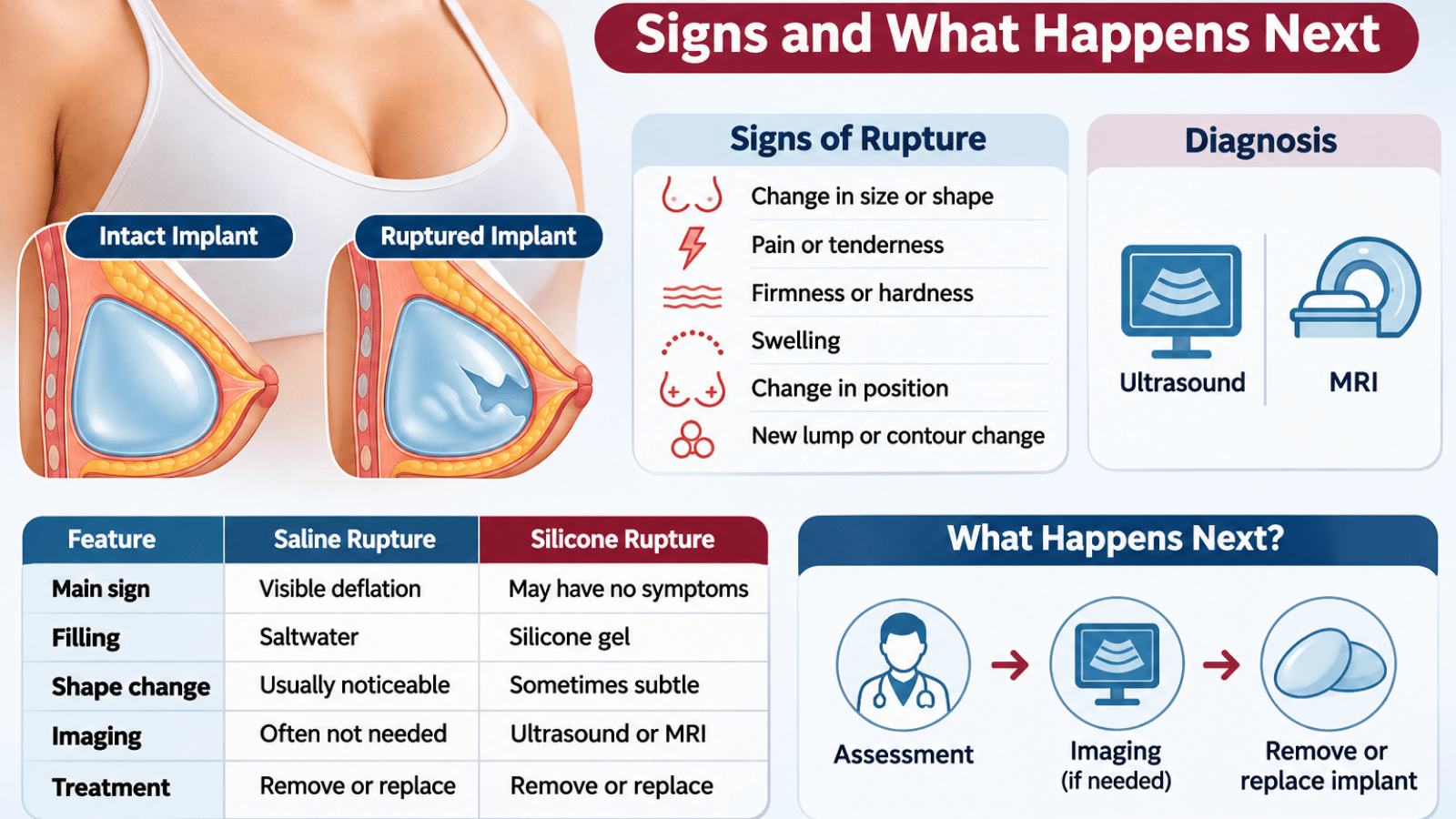
Breast implant rupture occurs when the outer shell of a breast implant develops a tear or hole. A saline implant usually loses volume and causes visible breast deflation. However, a silicone implant can rupture without noticeable changes, a condition known as a silent rupture.
A ruptured implant does not always cause immediate pain or a medical emergency. Nevertheless, patients should arrange a clinical assessment because the implant may need removal or replacement.
Breast implants are durable medical devices, but they are not designed to last indefinitely. Over time, the risk of complications increases, including shell damage, rupture and changes in the surrounding scar tissue.
Understanding the warning signs, differences between saline and silicone implants, and available treatment options can help patients make informed decisions.
What Is Breast Implant Rupture?
A breast implant contains an outer silicone shell filled with either saline solution or silicone gel.
Rupture occurs when this shell breaks.
The consequences depend on the implant’s filling material.
In saline implants, the sterile saltwater escapes and the body absorbs it. Consequently, the affected breast usually becomes smaller or changes shape.
In silicone implants, the gel may remain within the scar capsule surrounding the implant or extend beyond it.
Therefore, a silicone implant rupture may be difficult to recognise without imaging.
Patients considering breast augmentation surgery should understand that rupture is a recognised long-term implant complication.
What Are the Early Signs of Breast Implant Rupture?
The symptoms of breast implant rupture vary considerably.
Some patients notice obvious changes, while others experience no symptoms.
Possible warning signs include:
- Sudden or gradual changes in breast size
- Breast asymmetry
- Changes in breast shape
- New firmness or hardness
- Breast pain or tenderness
- Swelling
- A change in implant position
- New lumps or unusual contour changes
However, these symptoms are not specific to rupture.
Capsular contracture, fluid collections, infection, and other breast conditions can cause similar changes.
Therefore, clinical examination and appropriate imaging may be necessary.
Does Implant Rupture Always Cause Pain?
No.
A ruptured implant may cause discomfort, but pain is not always present.
In particular, silicone implant rupture can occur without noticeable symptoms.
Patients should not assume their implants are intact simply because they feel comfortable.
Silent Rupture of Silicone Implant: Why It Happens
A silent rupture of silicone implant refers to a rupture that produces no obvious symptoms or visible breast changes.
Unlike saline solution, silicone gel does not rapidly disappear from the implant pocket.
Therefore, the breast may retain a similar shape even when the implant shell has torn.
Why Is Silent Rupture Difficult to Detect?
The surrounding scar capsule may contain the silicone gel.
Consequently, the implant may continue to feel relatively normal.
A patient may have no pain, swelling, or visible distortion.
This is why imaging plays an important role in monitoring silicone implants.
Can Silent Rupture Happen After Many Years?
Yes.
Silicone implants can rupture years after placement.
Although some implants remain intact for many years, the risk of rupture generally increases as implants age.
There is no universal date at which every implant must be replaced.
Instead, implant condition, symptoms, and examination findings should guide management.
Saline vs Silicone Implant Rupture
The two implant types behave differently when their shells break.
| Feature | Saline Implant | Silicone Implant |
|---|---|---|
| Filling | Sterile saltwater | Silicone gel |
| Main rupture sign | Noticeable deflation | May have no symptoms |
| Breast size change | Usually visible | May be subtle or absent |
| Escaped filling | Absorbed by the body | May remain within or extend beyond the capsule |
| Imaging | Often unnecessary for obvious deflation | Ultrasound or MRI commonly used |
| Treatment | Removal or replacement | Surgical evaluation for removal or replacement |
What Happens When a Saline Implant Ruptures?
When a saline implant ruptures, its filling leaks into the surrounding tissues.
The body absorbs the sterile saltwater.
However, the empty implant shell remains and generally requires surgical removal.
The breast may appear smaller, flatter, or asymmetrical.
What Happens When a Silicone Implant Ruptures?
Silicone gel may remain contained within the surrounding scar capsule.
This is called an intracapsular rupture.
Alternatively, silicone may extend beyond the capsule into surrounding tissues.
This is called an extracapsular rupture.
Extracapsular silicone can sometimes cause inflammation or silicone-related lumps.
Therefore, the surgeon must assess the extent of rupture before planning treatment.
What Causes Breast Implant Rupture?
Several factors may contribute to implant shell damage.
1. Implant Ageing
Implants experience wear over time.
Consequently, the likelihood of rupture generally increases with implant age.
However, age alone does not confirm rupture.
2. Damage During Surgery
Rarely, surgical instruments or manipulation may damage an implant shell.
Such damage may not always become apparent immediately.
3. Excessive Mechanical Stress
Significant trauma or pressure can occasionally contribute to implant damage.
However, normal daily activities do not usually cause a properly functioning implant to rupture.
4. Capsular Contracture
Capsular contracture occurs when scar tissue around an implant becomes unusually tight.
Severe contracture can alter implant shape and may coexist with rupture.
However, a hard implant does not automatically indicate a rupture.
5. Implant Shell Deterioration
Manufacturing factors and gradual shell deterioration can contribute to implant failure.
The risk varies according to implant characteristics and duration of implantation.
Can a Breast Implant Rupture Without Pain?
Yes. A patient may have a ruptured implant without pain.
This is particularly relevant to silicone implants.
Some patients discover a rupture during routine ultrasound or MRI despite having no symptoms.
Others notice only subtle changes in breast shape or firmness.
Therefore, relying on pain alone is not a reliable way to assess implant integrity.
Does a Normal Breast Appearance Rule Out Rupture?
No.
A silicone implant may maintain its general shape even after shell damage.
Imaging may be needed to identify a silent rupture.
However, not every breast change indicates an implant problem.
A qualified surgeon can determine which investigations are appropriate.
How Is Breast Implant Rupture Diagnosed?
Diagnosis usually begins with a review of symptoms, implant history, and physical examination.
The surgeon may ask:
- When were the implants placed?
- Are they saline or silicone?
- Has breast size or shape changed?
- Is there pain or swelling?
- Have previous scans identified any abnormalities?
- Has the patient undergone revision surgery?
The examination may identify asymmetry, firmness, tenderness, or changes in implant position.
However, physical examination alone cannot reliably exclude silicone rupture.
Ultrasound for Breast Implant Rupture
Ultrasound is commonly used to evaluate silicone implant integrity.
It can identify findings suggestive of rupture and may detect fluid collections.
Ultrasound is relatively accessible and does not involve ionising radiation.
However, findings may occasionally be inconclusive.
MRI for Breast Implant Rupture
MRI is a highly effective method for assessing silicone implant rupture.
It can help identify implant shell abnormalities and silicone outside the expected implant boundaries.
MRI performed specifically to evaluate implant integrity generally does not require intravenous contrast.
However, contrast-enhanced MRI may be needed when investigating a separate concern, such as a suspicious mass.
Ultrasound vs MRI for Detecting Implant Rupture
| Feature | Ultrasound | MRI |
|---|---|---|
| Main purpose | Initial implant assessment | Detailed implant integrity assessment |
| Silicone rupture detection | Useful | Highly accurate |
| Radiation exposure | None | None |
| Cost | Generally lower | Generally higher |
| Availability | Often widely available | May be more limited |
| Best use | Screening or initial evaluation | Clarifying uncertain findings |
The appropriate investigation depends on symptoms, implant type, clinical findings, and local availability.
When Should Silicone Implants Be Screened?
The US Food and Drug Administration recommends ultrasound or MRI screening for asymptomatic patients with silicone gel-filled breast implants.
The suggested schedule is:
- First screening: Five to six years after implant placement.
- Subsequent screening: Every two to three years afterward.
Patients who develop symptoms or have uncertain ultrasound findings may need MRI or other appropriate investigations sooner.
These recommendations apply to silicone implant integrity screening.
They do not replace routine breast cancer screening.
Patients should continue age-appropriate mammography and other recommended breast assessments.
For additional information, see the FDA guidance on breast implants.
What Happens If a Breast Implant Ruptures?
The next step depends on the implant type, symptoms, and imaging findings.
Step 1: Confirm the Diagnosis
The surgeon reviews symptoms and available imaging.
Additional investigations may be necessary if the diagnosis remains uncertain.
Step 2: Assess Implant and Tissue Condition
The assessment considers:
- Type of implant
- Location and extent of rupture
- Capsular contracture
- Pain or swelling
- Silicone outside the capsule
- Surrounding tissue changes
Step 3: Discuss Treatment Options
Confirmed silicone implant rupture generally leads to a discussion about surgical removal.
Patients may choose replacement or removal without another implant.
A ruptured saline implant also generally requires removal of the damaged shell, although the saline itself is absorbed by the body.
Step 4: Plan Follow-Up
The surgeon explains treatment timing, possible complications, recovery, and future monitoring.
Not every confirmed rupture requires emergency surgery.
However, treatment should not be indefinitely postponed without medical assessment.
Breast Implant Rupture Treatment: Remove or Replace?
Treatment is individualised.
Some patients prefer to maintain breast volume, while others decide not to have implants again.
Option 1: Implant Removal
The surgeon removes the damaged implant.
For silicone rupture, the procedure may also involve removing accessible leaked silicone.
The extent of surgery depends on the rupture and surrounding tissues.
Option 2: Implant Replacement
Patients who want to maintain breast augmentation may choose a new implant.
The surgeon assesses the existing pocket, capsule, and breast tissues before replacement.
However, new implants also carry future risks of rupture and other complications.
Option 3: Capsule Surgery
Capsulectomy involves removing part or all of the scar capsule surrounding the implant.
It may be appropriate in selected cases, especially when the capsule is abnormal or contains silicone.
However, complete capsule removal is not automatically required for every rupture.
The surgeon must consider potential risks, including bleeding and injury to nearby structures.
Option 4: Implant Removal With Breast Lift
Some patients prefer implant removal without replacement.
However, removing an implant can leave changes in breast shape or skin laxity.
A breast lift may be considered when appropriate.
The need for a lift depends on breast anatomy, skin quality, and patient preferences.
Breast Implant Removal vs Replacement
| Treatment | Main Goal | Important Consideration |
|---|---|---|
| Implant removal | Remove damaged implant | Breast volume may decrease |
| Implant replacement | Maintain or restore volume | New implant-related risks remain |
| Capsulectomy | Remove selected scar capsule tissue | Not always necessary |
| Removal with breast lift | Improve shape after removal | Additional scars and recovery |
| Observation pending treatment | Allow appropriate planning | Requires surgeon-guided assessment |
The best option depends on the patient’s clinical findings and long-term goals.
Is a Ruptured Breast Implant Dangerous?
A ruptured breast implant does not automatically create an immediate life-threatening emergency.
For example, the saline from a ruptured saline implant is absorbed by the body.
However, the empty implant shell still requires appropriate management.
Silicone rupture can sometimes cause local inflammation, discomfort, or silicone-related lumps.
Some patients remain asymptomatic.
Nevertheless, confirmed rupture should be evaluated because the extent of silicone leakage and surrounding tissue changes can influence treatment.
Does Implant Rupture Cause Breast Cancer?
Current evidence does not establish that silicone implant rupture itself causes breast cancer.
However, breast implants are associated with certain rare implant-related malignancies, including breast implant-associated anaplastic large cell lymphoma (BIA-ALCL), which is more strongly associated with textured implants.
BIA-ALCL is distinct from ordinary implant rupture.
Persistent late swelling, a new mass, or unexplained fluid around an implant requires evaluation rather than assuming rupture is the cause.
When Should You Contact Your Surgeon?
Arrange an assessment if you notice:
- Sudden breast deflation
- New breast asymmetry
- Persistent breast pain
- Increasing firmness
- Unexplained swelling
- Changes in implant position
- New lumps or unusual contour changes
When Is Urgent Medical Attention Needed?
Seek urgent assessment for rapidly increasing swelling, severe pain, fever, significant redness or warmth.
These symptoms may indicate infection, bleeding, or another complication.
A sudden breast change should not be ignored simply because implant rupture is not always an emergency.
Can Breast Implant Rupture Be Prevented?
No method can completely prevent implant rupture.
However, patients can follow recommended monitoring and postoperative care.
Attend Regular Follow-Up
Clinical review helps identify changes in breast shape, implant position, and symptoms.
Follow Silicone Implant Screening Recommendations
Ultrasound or MRI screening can help detect silent rupture.
Keep Implant Records
Patients should keep records of implant type, manufacturer, placement date, and previous procedures.
These details can help during future assessments.
Report New Symptoms
Early evaluation can identify implant-related problems and other breast conditions.
Understand That Implants Are Not Lifetime Devices
Breast implants may remain intact for many years, but future surgery may become necessary.
Patients comparing breast enhancement methods can also review breast implants versus fat transfer to understand differences between implant-based and non-implant approaches.
Breast Implant Assessment and Revision Consultation
Patients with suspected implant rupture need an assessment that considers both implant integrity and surrounding breast tissues.
At Elegance Clinic, Dr. Ashutosh Shah, MBBS, MS, MCh, DNB, a plastic, reconstructive, and cosmetic surgeon with more than 22 years of experience, can evaluate implant-related concerns and discuss appropriate treatment options.
A consultation may include a review of previous surgery, examination of breast shape and firmness, and imaging when indicated.
The goal is to determine whether implant removal, replacement, or another procedure is suitable.
Patients should receive a clear explanation of the expected benefits, risks, and recovery before deciding on revision surgery.
Frequently Asked Questions
1. How Do I Know If My Breast Implant Has Ruptured?
A saline implant usually causes noticeable breast deflation after rupture. However, silicone implant rupture may cause pain, firmness or shape changes, or it may produce no symptoms. Ultrasound or MRI can help detect silicone rupture. A qualified surgeon should assess new breast changes and recommend appropriate investigations.
2. Can Silicone Implants Rupture Without Symptoms?
Yes. Silicone implants can rupture without pain, swelling or visible changes. This is known as silent rupture. The silicone gel may remain within the surrounding scar capsule, making the problem difficult to detect through examination alone. Recommended ultrasound or MRI screening helps identify some otherwise unnoticed ruptures.
3. Is a Ruptured Breast Implant Dangerous?
A ruptured implant is not always an immediate emergency, but it requires clinical assessment. Saline is absorbed by the body, while leaked silicone may remain in surrounding tissues and sometimes cause inflammation or lumps. Treatment depends on the implant type, symptoms and extent of rupture.
4. Can Ultrasound Detect Breast Implant Rupture?
Yes. Ultrasound can identify findings associated with silicone implant rupture and is commonly used for screening or initial assessment. However, some results may be inconclusive. MRI can provide additional information when necessary. The choice of imaging depends on symptoms, implant characteristics and the surgeon’s clinical assessment.
5. Does a Ruptured Implant Need Immediate Surgery?
Not every ruptured implant requires emergency surgery. However, confirmed rupture should be evaluated promptly so the surgeon can discuss removal or replacement and appropriate timing. Severe pain, rapid swelling, fever or signs of infection require urgent assessment. Patients should not indefinitely delay treatment without medical guidance.
6. Can a Ruptured Breast Implant Be Replaced?
Yes. A ruptured breast implant can often be removed and replaced during revision surgery. However, the surgeon must assess the surrounding capsule, tissue condition and any silicone leakage before recommending replacement. Patients may also choose implant removal without replacement, depending on their preferences and clinical circumstances.
Conclusion
Breast implant rupture is a recognised complication that can occur years after augmentation.
Saline implants usually produce visible deflation, while silicone implants may rupture without noticeable symptoms.
Ultrasound and MRI can help identify silicone implant rupture and guide further management.
Treatment may involve implant removal, replacement, or additional capsule surgery when appropriate.
Most importantly, new pain, swelling, firmness, or changes in breast shape should prompt clinical evaluation.
