

|
Getting your Trinity Audio player ready...
|
✓ Medically reviewed by Dr. Ashutosh Shah, Plastic, Reconstructive & Cosmetic Surgeon (M.Ch., DNB)
Introduction
Implants for sagging breasts can restore volume and fullness, but they do not always correct drooping. Whether you need a breast lift, implants, or both depends on nipple position, skin elasticity, existing breast tissue, and your desired results. A plastic surgeon can assess these factors to recommend an appropriate treatment plan.
Can Breast Implants Correct Sagging Breasts?
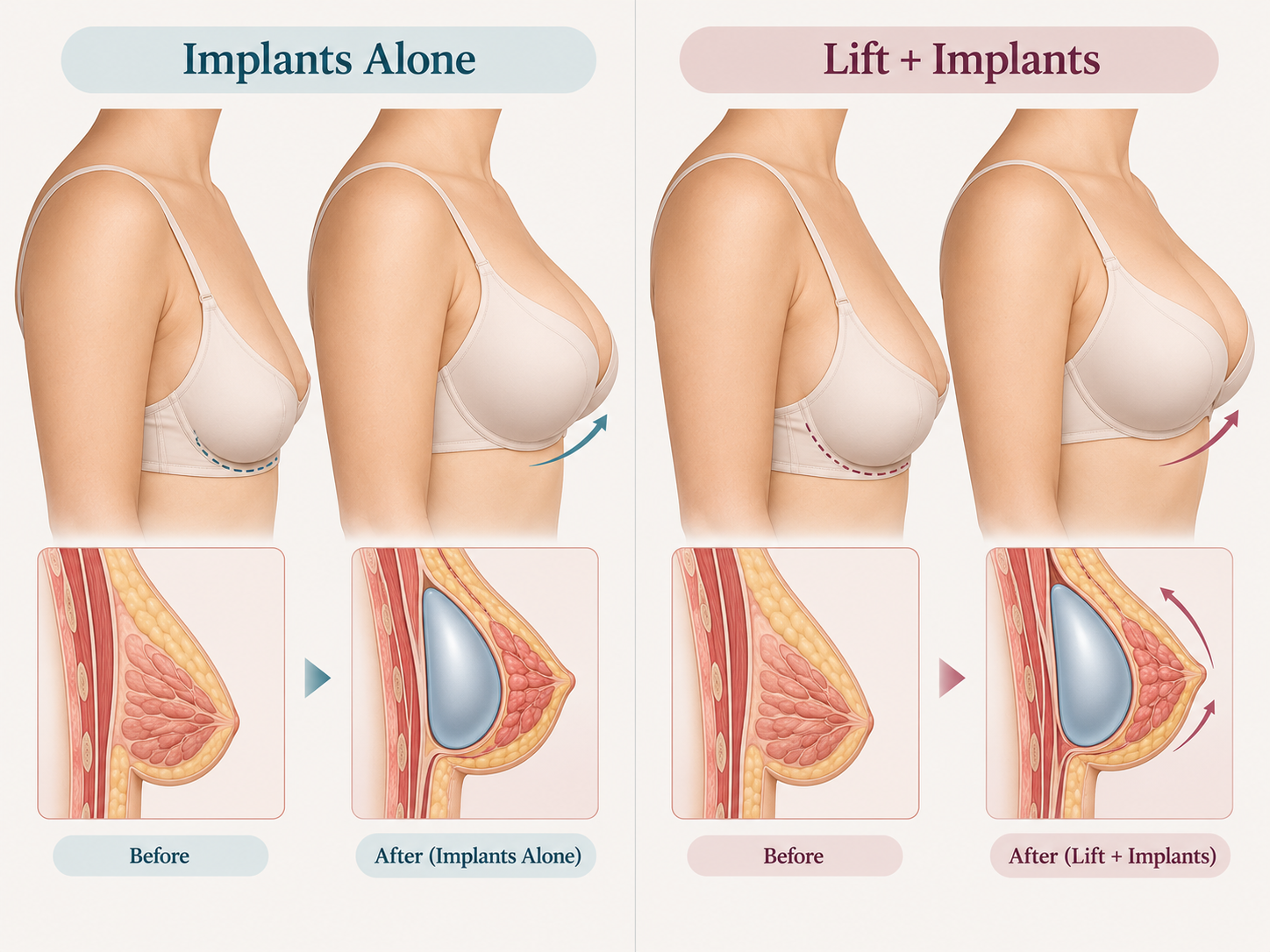
Breast implants primarily increase breast volume, improve fullness, and change breast projection. They may improve the appearance of mild sagging in selected patients by adding volume to the breast.
However, implants do not remove excess skin or reliably reposition nipples that have moved significantly downward. If the breast tissue hangs low or the nipples point toward the floor, augmentation alone may not provide the desired contour.
The correct approach depends on the degree of sagging, the quality of the skin, and the amount of natural breast tissue available. You can learn more about breast implant surgery and its intended benefits before discussing your options with a surgeon.
Breast Lift or Implants: What Is the Difference?
A breast lift and breast augmentation address different concerns. Understanding these differences can help you decide which questions to ask during your consultation.
| Feature | Breast lift | Breast implants |
|---|---|---|
| Main purpose | Raises and reshapes sagging breasts | Increases breast volume and fullness |
| Removes excess skin | Usually yes | Not routinely |
| Repositions nipples | Often, when needed | Not routinely |
| Adds significant volume | No, not by itself | Yes |
| Helps with loose skin | Removes selected excess skin | Does not directly remove excess skin |
| Scars | Depends on the lift technique | Depends on implant placement and incision |
| Suitable when | Breast position is the main concern | Increasing volume is the main concern |
A lift can improve breast position without significantly increasing size. Implants can add volume without necessarily correcting substantial sagging. Some patients need both procedures to address these concerns.
Do I Need a Lift With Implants?
You may need a breast lift with implants if you have both breast volume loss and noticeable sagging. A surgeon evaluates the relationship between the nipple, breast tissue, and the natural crease beneath the breast to help determine the appropriate procedure.
Signs that a lift may be worth discussing include:
- Your nipples sit at or below the natural breast crease.
- Your nipples point downward rather than forward.
- Your breasts have loose or stretched skin.
- Your breasts appear deflated after pregnancy, breastfeeding, or weight loss.
- You want more fullness but also want the breast and nipple position raised.
These signs do not automatically mean you need surgery. The final recommendation depends on a physical examination, your health, and your treatment goals.
When Are Implants Alone Enough?
Implants alone may be suitable when your main concern is insufficient volume rather than significant sagging.
You may be a candidate for augmentation alone if:
- Your nipples are positioned appropriately on the breasts.
- Your skin has sufficient elasticity.
- You want to restore fullness after pregnancy or weight changes.
- You have limited sagging and adequate breast tissue to accommodate the implant.
- You understand the potential risks and long-term care requirements of implants.
The implant size and shape should be selected in relation to your chest dimensions, existing breast tissue, and skin characteristics. Choosing a larger implant does not guarantee better lifting and may increase the strain on breast tissues over time.
When Is a Breast Lift Alone a Better Choice?
A breast lift, also called mastopexy, may be more appropriate when sagging is your primary concern and you are satisfied with your existing breast volume.
During a lift, the surgeon removes selected excess skin, reshapes breast tissue, and repositions the nipple and areola when required. This can improve breast contour and position without relying on an implant to create additional fullness.
A lift may be worth considering if your breasts have dropped after pregnancy, breastfeeding, ageing, or weight loss but you do not want a substantial increase in size.
Read more about breast lift surgery to understand the procedure, expected changes, and important considerations.
When Are Breast Lift and Implants Combined?
A combined breast lift and implant procedure may be considered when both sagging and loss of volume affect the breast shape.
The lift addresses excess skin and breast position, while the implant adds volume and fullness. Combining these procedures can address both concerns in a single treatment plan for selected patients.
However, the combination is more complex than augmentation alone because the surgeon must balance the tension of the lifted skin with the volume and weight of the implant.
Depending on your anatomy and surgical risks, the surgeon may recommend performing both procedures together or staging them as separate operations. The choice should be individualised rather than based on a standard rule.
Explore mastopexy with implant for more information about combining breast lifting and augmentation.
What Factors Determine the Right Procedure?
Several factors influence whether you need implants, a lift, or both.
1. Nipple Position
Nipple position is an important part of assessing breast sagging. If the nipple sits low relative to the breast crease, a lift may be needed to reposition it.
2. Skin Elasticity
Stretched skin may not adequately support a new implant shape. A lift can remove selected excess skin, while implant choice must account for the quality and capacity of the remaining tissue.
3. Existing Breast Volume
If you have enough natural volume and want to improve breast position, a lift alone may be suitable. If you also want fuller breasts, augmentation may be considered.
4. Desired Breast Size
Your preferred size, chest dimensions, and existing tissue help guide implant selection. An implant that is too large for your tissues may increase the risk of stretching, sagging, or other complications.
5. General Health and Future Plans
Medical history, smoking or nicotine use, weight stability, pregnancy plans, and breastfeeding goals may affect surgical timing and suitability.
For a broader overview, read the guide on which breast surgery may suit your concerns.
What Are the Risks of Combining a Lift With Implants?
Breast lift and augmentation surgery carries risks that should be discussed before treatment. Combining procedures can increase complexity and may affect healing.
Possible risks include:
- Bleeding, infection, or problems with wound healing.
- Visible or thickened scars.
- Changes in nipple or breast sensation.
- Differences in breast shape or symmetry.
- Implant displacement, rupture, or capsular contracture.
- The possibility of additional surgery in the future.
Breast implants are not lifetime devices. They require ongoing awareness and follow-up, and some patients may eventually need revision, replacement, or removal. A surgeon should explain the benefits, limitations, alternatives, and implant-specific risks before you make a decision.
What Should You Expect During a Consultation?
A consultation helps determine whether implants, a breast lift, or a combined procedure is suitable for your anatomy and goals.
Your surgeon may assess:
- Breast size, shape, and symmetry.
- Nipple position and degree of sagging.
- Skin elasticity and existing breast tissue.
- Medical history, medications, and previous breast procedures.
- Desired breast size and expectations.
- Potential scars, recovery requirements, and surgical risks.
The surgeon can then explain the available techniques and whether a single-stage or staged approach may be appropriate. The final plan should prioritise safety, realistic expectations, and a result suited to your body.
Frequently Asked Questions
1. Can implants lift sagging breasts without surgery to remove skin?
Implants may improve fullness and the appearance of mild sagging in selected patients. However, they do not remove excess skin or reliably reposition significantly drooping nipples. If sagging is more pronounced, a breast lift may be needed to achieve the desired shape.
2. Do I need a lift with implants if my nipples point downward?
Downward-pointing nipples can indicate breast sagging, but nipple direction alone does not determine the procedure. A surgeon evaluates nipple position, skin elasticity, breast volume, and your goals to decide whether augmentation alone or a combined lift and implant procedure may be appropriate.
3. Is a breast lift or implants better after pregnancy?
The choice depends on the changes that occurred. If you have lost fullness but your breast position remains suitable, implants may help restore volume. If loose skin and sagging are the main concerns, a lift may be more appropriate. Some patients may benefit from both.
4. Can I have a breast lift without implants?
Yes. A breast lift reshapes existing breast tissue and removes selected excess skin to improve breast position. It does not usually provide the same volume increase as implants. Patients who are happy with their breast size may prefer to discuss a lift alone.
5. Is it better to combine a breast lift and implants in one operation?
Some patients can safely undergo both procedures together, while others may benefit from staged surgery. The decision depends on skin quality, the degree of sagging, implant size, tissue characteristics, and individual risks. Your surgeon should explain the advantages and limitations of each approach.
6. Will breasts sag again after implants or a lift?
Yes, breast shape can change over time due to ageing, gravity, pregnancy, weight fluctuations, and changes in skin elasticity. Implants do not prevent natural sagging, and a lift cannot guarantee permanent results. Appropriate implant selection and follow-up can help manage long-term considerations.
Conclusion
Choosing implants for sagging breasts depends on whether you need more volume, improved breast position, or both. Implants may be enough for selected patients with limited sagging, while a breast lift may be needed when excess skin and low nipple position are the main concerns. A combined procedure may suit patients with both volume loss and significant sagging.
Discuss your anatomy, expectations, potential risks, and future plans with a qualified plastic surgeon before deciding which procedure is right for you.
