

|
Getting your Trinity Audio player ready...
|
✓ Medically reviewed by Dr. Ashutosh Shah, Plastic, Reconstructive & Cosmetic Surgeon (M.Ch., DNB)
Introduction
Breast lift scars usually fade gradually, but they do not disappear completely. After surgery, scars may initially appear red, firm, or raised before becoming softer and less noticeable over several months. The final appearance depends on the incision technique, skin type, genetics, wound healing, and aftercare. Understanding the healing timeline helps you set realistic expectations.
Why Do Breast Lift Scars Form?
A breast lift, also called mastopexy, removes selected excess skin and reshapes breast tissue to improve breast position. Incisions are necessary to reposition the nipple and areola when needed and create the desired contour.
As the incisions heal, the body produces collagen to repair the skin. This process creates scar tissue. Although scars are a normal part of healing, their appearance varies from person to person.
Common breast lift incision patterns include:
- Around the areola: A scar follows the border of the areola.
- Vertical or lollipop pattern: A scar circles the areola and extends vertically toward the breast crease.
- Anchor or inverted-T pattern: Scars form around the areola, vertically downward, and horizontally along the breast crease.
The technique depends on breast shape, skin laxity, and the amount of reshaping required. Learn more about breast lift surgery to understand the procedure and its incision patterns.
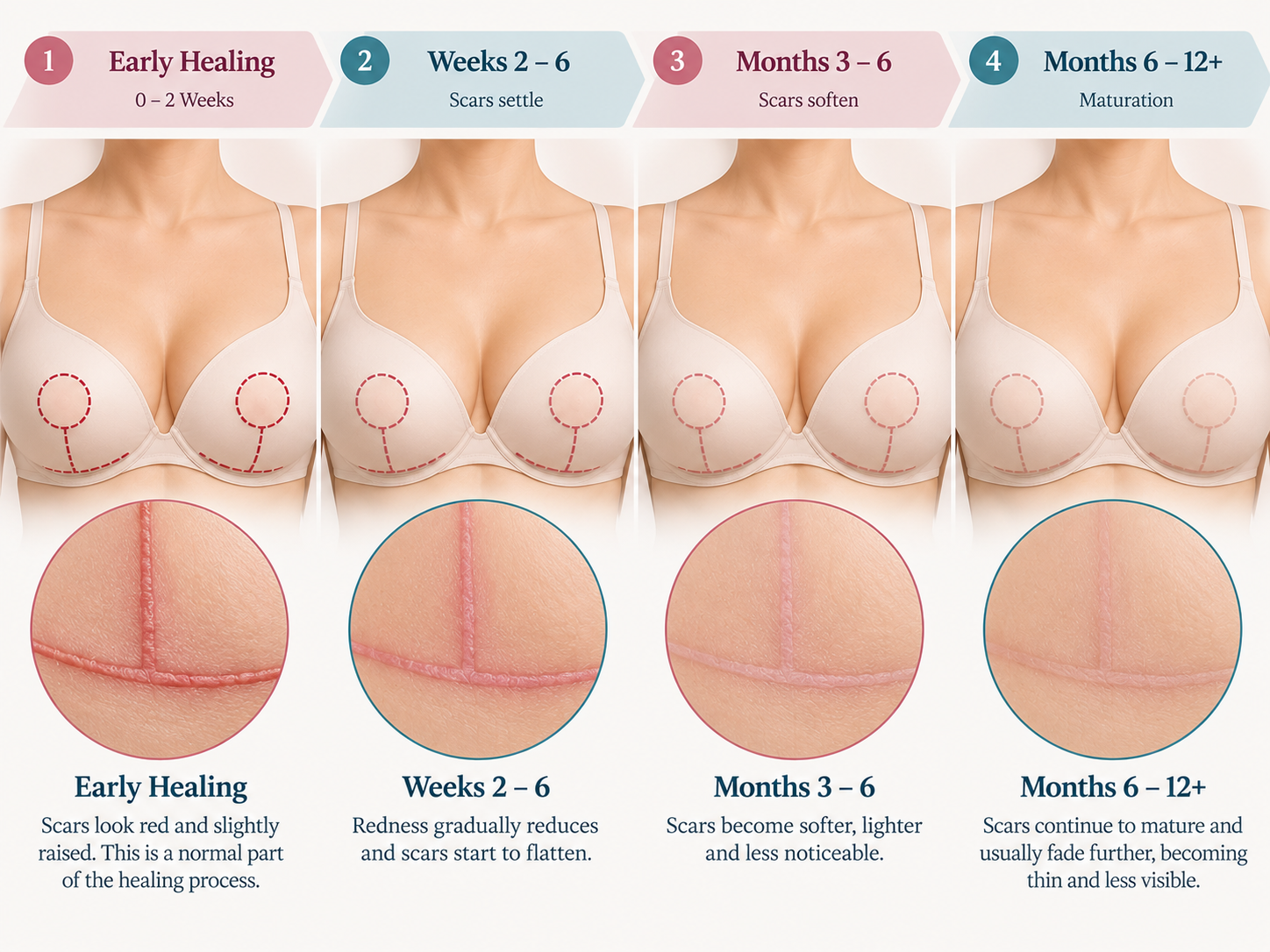
Breast Lift Scar Healing Timeline
Scar healing occurs in stages. The exact timeline differs for each patient, and the surface of the incision may heal before the deeper tissues have fully recovered.
| Time after surgery | What you may notice | Recommended care |
|---|---|---|
| First 1–2 weeks | Incisions begin closing; swelling, tenderness, and early redness may occur | Follow wound-care instructions and avoid unnecessary tension |
| Weeks 2–6 | Incisions continue healing; scars may look pink or red | Attend follow-up visits and follow activity restrictions |
| Months 2–3 | Scars may remain firm, red, or slightly raised | Ask your surgeon whether scar treatments are appropriate |
| Months 3–6 | Scars may gradually soften and become less noticeable | Continue recommended scar care and protect healed skin from sunlight |
| Months 6–12 | Scar colour and texture may continue to change | Maintain follow-up if scars remain uncomfortable or concerning |
| After 12 months | Scars may be more mature, although further changes can occur | Discuss persistent thickening, widening, or discomfort with your surgeon |
These timeframes are approximate. Complications, individual healing differences, and the type of incision can affect progress.
What Happens During the First Two Weeks?
During the early recovery period, the incisions begin to close and the body starts repairing the affected tissue. Mild redness, swelling, tenderness, and bruising may occur.
Your surgeon may recommend dressings, a supportive surgical bra, and temporary restrictions on lifting or strenuous activity. Follow the instructions provided for bathing and changing dressings.
Avoid picking at scabs or applying unapproved creams, oils, or scar products to fresh incisions. Contact your surgical team if you develop increasing pain, spreading redness, fever, unusual discharge, or wound separation.
What Changes Between Weeks Two and Six?
As healing progresses, the skin may close while the underlying tissue continues recovering. Breast lift scars can appear pink, red, firm, or more noticeable during this period. This does not necessarily mean that the final result will look the same.
Continue following your surgeon’s activity and wound-care guidance. Do not start massage, silicone sheets, or scar creams until the incision has healed sufficiently and your surgical team confirms that these products are suitable.
Healing can differ between incision sites, so one scar may appear more mature than another.
How Do Breast Lift Scars Change Between Three and Six Months?
During this stage, scars may gradually become softer and less prominent. However, some redness, firmness, itching, or mild thickening may persist.
Mastopexy scar healing depends on several factors, including skin characteristics, genetics, wound tension, and whether complications occurred. Scars may also mature at different rates along the same incision.
If a scar becomes increasingly raised, painful, itchy, or wide, seek professional assessment rather than assuming the change is part of normal healing.
What Can You Expect After Six to Twelve Months?
Many breast lift scars become less red and more settled over this period. Their texture may soften, and the colour may become closer to the surrounding skin. However, some scars remain visible even after a year.
Scar maturation can take 12 months or longer. The final appearance depends on the individual and cannot be predicted precisely before surgery.
Your surgeon can assess whether the scars are progressing as expected and advise you about further treatment if needed.
How Can You Care for Breast Lift Scars?
Appropriate scar care after breast lift surgery can support healing and may improve scar appearance, although it cannot guarantee an invisible scar.
- Follow your surgeon’s instructions: Keep the incision sites clean and use dressings as directed.
- Avoid excess tension: Return to exercise and lifting gradually according to medical advice.
- Protect healed scars from sunlight: Cover the area or use suitable sun protection once the skin has healed.
- Ask about silicone products: Silicone gel or sheets may help some scars when used on fully healed skin.
- Avoid smoking and nicotine: These can impair wound healing.
- Attend follow-up appointments: Your surgeon can identify healing concerns and recommend suitable treatment.
Do not use scar products on open incisions or start massage without clearance from your surgical team.
What Factors Affect Breast Lift Scar Healing?
Several factors influence how scars develop and mature.
Skin type and genetics: Some people are more prone to raised scars or keloids.
Incision technique: The location and length of scars depend on the surgical approach and amount of reshaping needed.
Wound tension: Excessive tension on healing skin can contribute to wider scars.
Smoking and nicotine: These can reduce blood flow and interfere with tissue repair.
Infection or delayed healing: Complications can affect the appearance and maturation of scars.
Aftercare: Following wound-care instructions and attending follow-up appointments can help identify problems early.
Your surgeon should discuss these factors and explain what can realistically be expected for your skin and procedure.
Can Breast Lift Scars Be Treated If They Remain Visible?
If scars remain raised, thick, wide, itchy, or uncomfortable after sufficient healing, a surgeon or dermatologist may recommend an assessment.
Depending on the scar, treatment options may include silicone products, selected injections for raised scars, laser treatments, or surgical scar revision. These treatments have different benefits and limitations, and not every scar requires intervention.
Scar revision creates a new healing process and cannot guarantee complete scar removal. Learn more about scar revision treatment to understand possible approaches to improving certain scars.
People who develop unusually thick, raised scars can also ask a specialist about keloid scar treatment.
Frequently Asked Questions
1. Do breast lift scars disappear completely?
No. Breast lift scars are permanent, but they usually become less noticeable as they mature. Their final appearance depends on skin type, genetics, incision placement, and healing. Appropriate aftercare may help improve their appearance, but no treatment can guarantee that scars will disappear completely.
2. How long does mastopexy scar healing take?
The incisions often close within the first few weeks, but scar maturation takes much longer. Scars may continue to soften and fade for 12 months or longer. Your recovery timeline may differ depending on the surgical technique, individual healing, and whether any complications develop.
3. What is the best scar care after breast lift surgery?
Follow your surgeon’s wound-care instructions, avoid tension on the incisions, protect healed scars from sunlight, and avoid smoking or nicotine. Silicone gel or sheets may help some scars after the skin has fully healed. Ask your surgeon before beginning any scar treatment.
4. Are breast lift scars red for several months?
Yes. Breast lift scars may remain pink or red for several months as collagen forms and remodels. They often become less noticeable over time, but the pace varies. Increasing redness, warmth, pain, discharge, or fever should be assessed promptly because these can indicate a complication.
5. Can breast lift scars become raised or thick?
Yes. Some scars become raised or thickened, including hypertrophic scars and, less commonly, keloids. Genetics, skin characteristics, and wound tension can influence this process. If a scar becomes persistently raised, itchy, painful, or extends beyond the original incision, consult a qualified professional.
6. When should I seek treatment for breast lift scars?
Seek medical advice if scars are worsening, unusually raised, painful, itchy, widening, or affecting your comfort. Early assessment can help identify the type of scar and determine whether treatment is appropriate. New wound separation, spreading redness, fever, or unusual discharge requires prompt contact with your surgical team.
Conclusion
Breast lift scars usually become softer and less noticeable over several months, although they rarely disappear completely. Healing continues for a year or longer, and the final result depends on incision placement, skin characteristics, and aftercare. Following your surgeon’s instructions and seeking advice about persistent scar changes can help you manage recovery and maintain realistic expectations.
