

|
Getting your Trinity Audio player ready...
|
✓ Medically reviewed by Dr. Ashutosh Shah, Plastic, Reconstructive & Cosmetic Surgeon (M.Ch., DNB)
What Are the Common Breast Lift Scar Types?
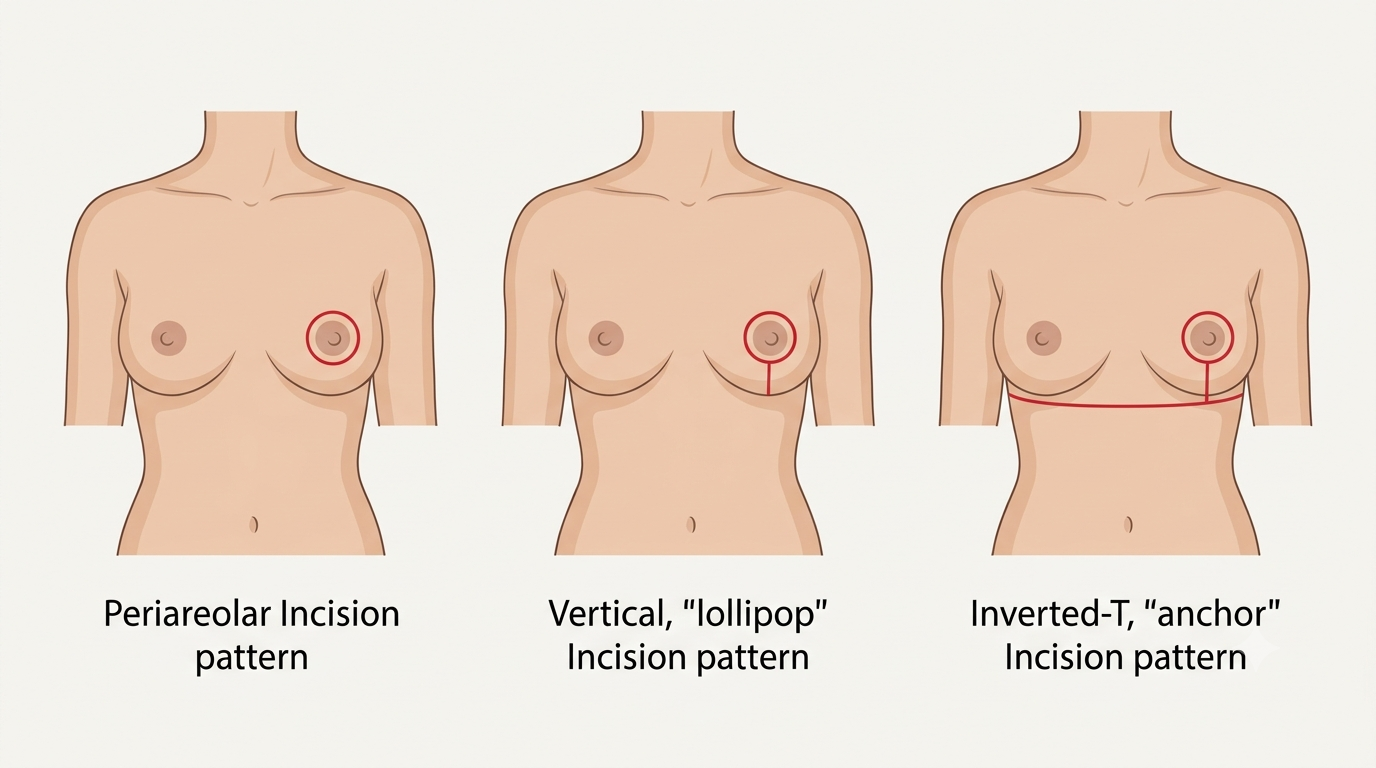
Breast lift scar types depend on how much lifting and excess-skin removal a patient needs. The three commonly discussed patterns are the periareolar lift, with an incision around the areola; the lollipop lift, with an additional vertical incision; and the anchor lift, which adds a horizontal incision along the breast fold. The right pattern depends on individual anatomy and the amount of correction required.
Breast lift surgery, also called mastopexy, reshapes the breast and repositions the nipple when sagging has developed. Every surgical incision leaves a scar, but the length, location and appearance vary by technique and individual healing.
For an overview of the procedure, read Elegance Clinic’s Breast Lift Surgery guide.
1. Around-the-Areola Breast Lift Scar
The periareolar technique uses an incision around the edge of the areola, the darker skin surrounding the nipple. It is sometimes called a donut lift.
Who may be suitable?
This approach may be considered for selected patients with mild sagging who need limited lifting or areola adjustment. It is not suitable for every breast shape or degree of ptosis.
What does the scar look like?
The scar follows the circular border of the areola. Its visibility depends on healing, skin characteristics and the difference in colour between the areola and surrounding skin.
What are its limitations?
The amount of lifting is limited compared with more extensive patterns. In some cases, the areola may stretch or the breast contour may flatten. A surgeon must determine whether this approach can achieve a suitable result.
2. Lollipop Breast Lift Scar
The lollipop breast lift uses an incision around the areola and a vertical incision extending down to the breast fold. Together, these incisions resemble a lollipop.
Who may be suitable?
A vertical or lollipop pattern may be appropriate for patients who need more correction than an around-the-areola lift can provide. It allows the surgeon to remove more excess skin and reshape the breast.
What does the scar look like?
There are two main parts:
- A circular scar around the areola.
- A vertical scar from the lower edge of the areola towards the breast crease.
The vertical line may look more noticeable early in recovery. It generally changes as the scar matures.
What are its limitations?
The lollipop pattern may not provide enough skin removal for some patients with substantial sagging or excess skin along the breast fold. The surgeon may recommend a different approach if greater reshaping is needed.
3. Anchor Breast Lift Scar
The anchor lift, also known as the inverted-T or Wise-pattern lift, includes an incision around the areola, a vertical incision down to the breast fold, and a horizontal incision along the fold.
Who may be suitable?
This technique may be considered for more pronounced sagging or when a greater amount of excess skin needs to be removed. It gives the surgeon more control over reshaping the breast envelope.
What does the scar look like?
The scar has three components:
- Around the areola.
- Vertically between the areola and breast fold.
- Horizontally along the natural crease beneath the breast.
The horizontal scar is often positioned in the breast fold, where it may be concealed by a bra or clothing, although visibility varies.
What are its limitations?
The anchor pattern creates a longer overall scar and may have a higher risk of delayed healing where the incision lines meet. This does not mean it is the wrong choice: for some patients, the additional incision is necessary to achieve appropriate reshaping.
Breast Lift Scar Types: Quick Comparison
| Scar type | Incision pattern | Common use | Main consideration |
|---|---|---|---|
| Around the areola | Circle around the areola | Selected cases of mild sagging | Limited lifting |
| Lollipop | Around the areola plus vertical line | Selected mild-to-moderate or moderate sagging | Adds a vertical scar |
| Anchor | Around the areola, vertical line and breast-fold incision | More significant sagging or excess skin | Longer scar pattern |
No single technique is best for everyone. The surgeon selects the pattern according to skin quality, breast shape, nipple position, excess skin and the intended correction.
Patients considering other breast procedures can also read about breast reduction surgery, which may involve similar incision patterns but has a different goal: reducing breast volume as well as reshaping the breast.
Do Breast Lift Scars Fade Completely?
Breast lift scars usually become less noticeable over time, but they do not disappear completely. Initially, scars may appear pink, red, firm or raised. They can gradually soften and change colour over several months, with maturation often continuing for a year or longer.
The final appearance varies from person to person. Factors that can influence healing include:
- Genetics and natural skin characteristics.
- Incision tension and wound healing.
- Smoking or nicotine exposure.
- Infection or delayed healing.
- A personal history of hypertrophic scars or keloids.
People who have previously developed raised scars should tell their surgeon before surgery so that their risk and aftercare can be discussed.
How Can You Care for Breast Lift Scars?
Follow the operating surgeon’s wound-care instructions rather than starting scar products too early. General measures may include:
- Keep the incisions clean and follow dressing instructions.
- Avoid pulling or placing unnecessary tension on healing incisions.
- Attend follow-up appointments so the surgeon can assess healing.
- Avoid smoking and nicotine, which can impair wound healing.
- Use silicone gel or sheets only when the surgeon confirms that the incisions are sufficiently healed.
- Protect healed scars from direct sun exposure as advised.
Do not massage, apply creams to, or cover an open or unhealed incision unless the treating team specifically advises it.
Contact the surgical team if you notice worsening redness, increasing pain, wound separation, unusual discharge or fever.
How Does a Surgeon Choose the Right Scar Pattern?
The choice is based on the amount of lifting required, not simply on which scar looks shortest.
During a consultation, the surgeon may assess:
- Degree of sagging: How far the breast tissue and nipple have descended.
- Skin excess: How much loose skin needs to be removed.
- Breast volume and shape: Whether reshaping alone is appropriate or another procedure should be considered.
- Nipple and areola position: How much repositioning is needed.
- Healing history: Whether the patient has risk factors for wound complications or prominent scars.
- Personal goals: The patient’s priorities and understanding of permanent scars.
You can read the Breast Lift (Mastopexy) service page at Elegance Clinic to learn more about the procedure and consultation.
Frequently Asked Questions
1. Which breast lift scar type is the smallest?
The around-the-areola pattern generally uses the most limited incision pattern of these three options. However, it provides less lifting, so it may not be appropriate for more pronounced sagging. The shortest scar is not automatically the best surgical choice.
2. Is a lollipop breast lift better than an anchor lift?
Neither is universally better. A lollipop lift may suit selected patients who need moderate reshaping, while an anchor lift may be more suitable when there is substantial excess skin. The decision depends on anatomy and the degree of correction required.
3. How long do breast lift scars take to fade?
Scars change gradually over several months and may continue maturing for a year or longer. Their final appearance depends on skin characteristics, genetics, wound healing and postoperative care. Scars usually become less noticeable but remain permanent.
4. Can breast lift scars become thick or raised?
Yes. Some people develop hypertrophic scars or keloids, while others heal with flatter, finer lines. Tell your surgeon about any personal or family history of raised scars before surgery, and seek advice if a scar becomes increasingly thick, itchy or uncomfortable.
5. Can breast lift scars be hidden by a bra?
Some scars, particularly the horizontal scar along the breast fold, may be covered by a bra or swimwear. The around-areola and vertical scars may remain visible depending on clothing and individual anatomy. Exact scar placement varies with the surgical plan.
Conclusion
The three common breast lift scar types are around-the-areola, lollipop and anchor. Each offers a different balance between incision length and the amount of lifting and reshaping possible. A smaller scar pattern may be suitable for mild sagging, while a more extensive pattern may be necessary when there is greater excess skin.
A consultation with a qualified plastic surgeon can help determine which technique best matches the patient’s anatomy and goals. It is important to understand that all surgical options leave scars, and their final appearance cannot be guaranteed.
