

|
Getting your Trinity Audio player ready...
|
✓ Medically reviewed by Dr. Ashutosh Shah, Plastic, Reconstructive & Cosmetic Surgeon (M.Ch., DNB)
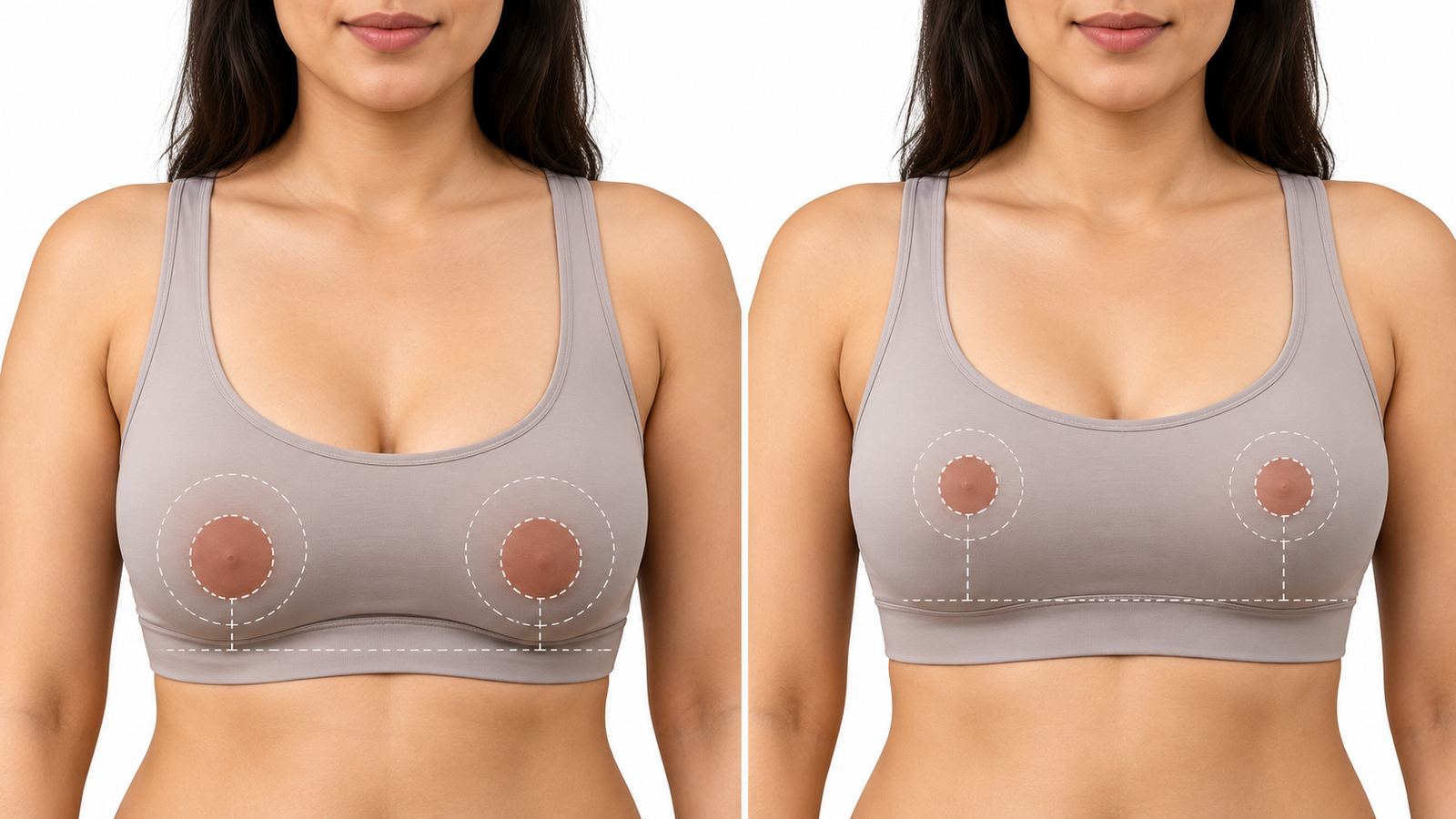
Areola reduction surgery can make enlarged or stretched areolas smaller. It may be performed as a separate procedure or combined with a breast lift when the breasts also have sagging or a low nipple position.
The areola is the pigmented skin surrounding the nipple. Its size varies naturally from person to person. Some people have larger areolas from puberty, while others notice stretching after pregnancy, breastfeeding or weight changes.
Having large areolas is usually a normal anatomical variation. Surgery is an option when someone wishes to change their appearance, not a medical necessity in most cases.
If you are considering areola reduction with breast lift, it helps to understand how the procedures differ, what scars they leave and how recovery works.
Can Areola Size Be Reduced?
Yes. A plastic surgeon can reduce the diameter of an areola by removing a planned ring of skin around its outer edge.
The remaining pigmented skin is then brought together with the surrounding breast skin using sutures.
The aim is to create a smaller areola while maintaining a natural circular or slightly oval shape.
However, there are limits to how much reduction can be achieved safely.
The surgeon must consider skin tension, healing, nipple blood supply and the risk of stretching after surgery.
What Is a Normal Areola Size?
There is no single ideal areola diameter.
Areola size differs with genetics, breast size, hormonal changes and individual anatomy.
Therefore, an areola should not be considered abnormal simply because it is larger than someone else’s.
During consultation, the surgeon can explain what size may look proportionate to your breasts.
Why Do Areolas Become Larger?
Several factors can affect areola size and shape.
Pregnancy and Breastfeeding
Hormonal changes during pregnancy can make the areolas larger and darker.
Breast enlargement may also stretch the surrounding skin.
Some changes reverse after pregnancy or breastfeeding. Others remain.
Weight Changes
Significant changes in breast volume may stretch the skin.
As a result, the areolas can appear wider or less circular.
Ageing and Skin Elasticity
Skin gradually loses elasticity with age.
When breast tissue descends, the areolas may stretch or change position.
Natural Development
Some people naturally have larger areolas from adolescence.
This is not necessarily related to breast sagging.
Large areola correction should therefore begin with an assessment of the actual concern: diameter, shape, nipple position or a combination of these factors.
How Does Areola Reduction Surgery Work?
Areola reduction is usually performed using a circular incision technique.
The exact approach depends on the amount of skin to be removed and whether breast lifting is also planned.
Step 1: Consultation and Measurements
The surgeon examines breast shape, areola diameter, nipple position and skin elasticity.
They also review your medical history and discuss the result you hope to achieve.
Photographs and measurements may be used for planning with your consent.
Step 2: Marking the New Areola
The surgeon marks the desired smaller diameter.
The design considers breast proportions and any existing asymmetry.
However, an exact final measurement cannot be guaranteed because skin can stretch during healing.
Step 3: Removing Excess Skin
A ring of skin around the areola is removed.
The nipple itself is generally preserved in a straightforward areola reduction.
The surgeon then brings the skin edges together.
Step 4: Closing the Incision
Sutures are placed around the new areola boundary.
The closure must balance the desired reduction against excessive skin tension.
Too much tension can increase the risk of widened scars, stretching or contour changes.
Step 5: Recovery and Follow-Up
Dressings protect the incision during early healing.
The surgeon provides instructions about wound care, supportive clothing and activity restrictions.
Follow-up appointments allow the team to assess healing and identify complications.
Can Areola Reduction Be Combined With a Breast Lift?
Yes. Areola reduction with breast lift is a common consideration when a patient has both enlarged areolas and breast sagging.
A breast lift, also called mastopexy, raises and reshapes the breasts by removing excess skin and adjusting breast tissue.
During the same operation, the surgeon may reposition the nipple–areola complex and reduce areola diameter.
This can improve both breast position and areola proportions.
However, the appropriate incision pattern depends on how much lifting is required.
For more detail, read Breast Lift Surgery: Procedure, Recovery and Benefits.
Areola Reduction Alone vs Areola Reduction With Breast Lift
| Feature | Areola reduction alone | Areola reduction with breast lift |
|---|---|---|
| Main goal | Reduce areola diameter | Reduce areola size and improve breast position |
| Corrects breast sagging | No significant correction | Yes, depending on technique |
| Changes breast volume | Usually minimal | Usually little change with a lift alone |
| Nipple repositioning | Usually limited | Often included |
| Scar pattern | Around the areola | Around the areola, sometimes with additional scars |
| Recovery | Depends on the limited procedure | Often more extensive |
| Best suited for | Enlarged areolas without significant sagging | Enlarged areolas with breast ptosis |
The surgeon should recommend the smallest appropriate procedure that can realistically address your goals.
Which Breast Lift Technique Is Used?
Not every breast lift uses the same incision pattern.
Periareolar or Donut Lift
A periareolar lift uses an incision around the areola.
It may be suitable for selected patients with mild sagging and limited skin excess.
Because the incision surrounds the areola, size reduction can sometimes be incorporated.
However, this approach has limitations.
It may not lift a significantly drooping breast enough. Excessive tension can also cause the areola to stretch or the breast to appear flattened.
Vertical or Lollipop Lift
A vertical lift involves an incision around the areola and another extending downward towards the breast crease.
This approach allows more reshaping than a limited periareolar lift.
It may be appropriate for moderate sagging.
Anchor Lift
An anchor lift adds an incision along the breast crease.
It provides greater access for reshaping when significant skin excess or sagging is present.
However, it leaves a longer scar pattern.
For a detailed comparison, see Breast Lift Scar Types: Areola, Lollipop and Anchor.
Will Areola Reduction Surgery Leave Scars?
Yes. All surgical areola reduction techniques leave a permanent scar.
The scar usually follows the border between the pigmented areola and surrounding breast skin.
This position can help it blend with the natural colour transition.
However, scars do not disappear completely.
Their visibility depends on individual healing, skin tone, tension, wound care and scar formation.
Can the Areola Stretch Again?
Yes.
Some widening may occur during healing, especially when the surrounding skin places tension on the closure.
Future pregnancy, breast enlargement, weight changes and ageing can also affect the result.
Therefore, the surgeon should avoid promising an exact permanent diameter.
Can Scars Become Raised or Dark?
Some patients develop darker, wider or raised scars.
People with a personal history of hypertrophic or keloid scarring should mention this during consultation.
The surgeon can explain appropriate scar management options.
Does Areola Reduction Affect Nipple Sensation?
Changes in nipple or areola sensation are possible.
Some patients experience temporary numbness or increased sensitivity.
Sensation may improve as healing progresses.
However, permanent changes can occur.
The risk depends on the surgical technique, amount of tissue manipulation and individual anatomy.
A combined breast lift may involve more extensive repositioning than a limited areola reduction.
Therefore, discuss sensation risks before surgery.
Can You Breastfeed After Areola Reduction?
Breastfeeding may still be possible after some areola reduction procedures.
However, it cannot be guaranteed.
The effect depends on whether milk ducts, nerves and supporting tissues are preserved.
A limited skin-only procedure may affect these structures less than a more extensive breast operation.
Nevertheless, individual risks vary.
If you are planning pregnancy or breastfeeding, tell your surgeon before choosing a procedure.
In some cases, delaying elective surgery may be worth considering.
What Is Recovery Like After Areola Reduction?
Recovery depends on whether the surgery is performed alone or with a breast lift.
First Few Days
Mild swelling, tenderness and bruising are common.
Dressings protect the incision.
The surgeon may recommend a supportive bra and provide pain management instructions.
First Few Weeks
Swelling gradually improves.
Patients are usually advised to avoid heavy lifting, strenuous exercise and activities that place tension on the chest until cleared by their surgeon.
Follow-up appointments help monitor healing.
Following Months
The areola shape continues to settle.
Scars may initially look pink, dark or firm before gradually changing.
Final scar appearance can take many months to mature.
A combined breast lift may require a longer recovery period than limited areola reduction alone.
What Are the Risks of Areola Reduction Surgery?
Although areola reduction is generally a planned cosmetic procedure, it still carries surgical risks.
Possible complications include:
- Bleeding or haematoma
- Infection
- Delayed wound healing
- Widened or raised scars
- Uneven areola size or shape
- Stretching after surgery
- Changes in nipple sensation
- Pigmentation changes
- Unsatisfactory cosmetic results
- Rare problems affecting nipple–areola blood supply
The risk profile can be different when areola reduction is combined with a more extensive breast lift.
Smoking, nicotine exposure, certain medical conditions and poor wound healing can increase complications.
Therefore, a medical assessment is essential.
Who May Be Suitable for Large Areola Correction?
You may wish to discuss surgery if:
- You feel your areolas are disproportionately large for your breasts.
- The areolas have stretched after pregnancy or weight changes.
- One areola is noticeably larger than the other.
- You want smaller areolas during a planned breast lift.
- You understand that scars and asymmetry are possible.
- You have realistic expectations about the final result.
However, surgery may need to be postponed if you have an active infection, uncontrolled medical condition or other factors that increase surgical risk.
Importantly, new nipple discharge, a breast lump, unexplained skin changes or rapidly changing breast appearance should receive appropriate medical evaluation rather than being treated as a purely cosmetic concern.
Is Areola Reduction the Same as Breast Reduction?
No.
Areola reduction changes the diameter of the pigmented skin around the nipple.
Breast reduction removes breast tissue, fat and skin to decrease breast size and weight.
A breast lift mainly improves breast position and contour.
These procedures can sometimes be combined, but they serve different purposes.
If your main concern is heavy or excessively large breasts, read Breast Reduction vs Breast Lift: What Is the Difference?.
Questions to Ask Before Surgery
A consultation should help you understand the expected outcome and limitations.
| Question | Why it matters |
|---|---|
| Can areola reduction be done alone? | Determines whether a breast lift is necessary |
| What diameter is realistic? | Helps avoid unrealistic expectations |
| Which incision pattern will be used? | Clarifies the likely scar |
| Can the areola stretch again? | Explains long-term limitations |
| Will nipple sensation change? | Addresses an important surgical risk |
| Could breastfeeding be affected? | Important for future family plans |
| How much time is needed for recovery? | Helps with work and activity planning |
| What happens if the result is uneven? | Clarifies revision possibilities |
You can also review Natural Looking Breast Lift: Shape, Symmetry and Results to understand how surgeons approach breast proportions.
Frequently Asked Questions
Can areola size be reduced without a breast lift?
Yes. Areola reduction surgery can be performed alone when the main concern is areola diameter and there is little or no significant breast sagging.
Can areola reduction and breast lift be done together?
Yes. A surgeon may reduce the areola diameter while lifting and reshaping the breasts. The technique depends on breast anatomy and the amount of sagging.
Is areola reduction surgery painful?
Anaesthesia is used during surgery. Afterwards, patients may experience swelling, tenderness and discomfort. The degree of pain varies with the procedure and individual healing.
Will the areolas look perfectly symmetrical?
Perfect symmetry cannot be guaranteed. The surgeon aims for balanced size and shape, but natural differences and healing may affect the final result.
Are areola reduction results permanent?
The reduction can be long lasting. However, stretching, pregnancy, weight changes and ageing may change the areolas over time.
Can areola reduction make my breasts smaller?
Not significantly. Areola reduction changes the pigmented area around the nipple, not overall breast volume. Breast reduction surgery is a different procedure.
Will I have a scar around the areola?
Yes. A circular scar is expected. It may become less noticeable as it matures, but it will remain permanent.
Can large areolas return after surgery?
Some stretching can occur, particularly when skin tension is high or breast size changes. A repeat procedure may be considered in selected cases, although revision is not always necessary or appropriate.
Can areola reduction affect breastfeeding?
It may. The risk depends on the surgical technique and whether milk ducts and nerves are affected. Discuss future breastfeeding plans before surgery.
How do I know if I need areola reduction or a breast lift?
If the areolas are enlarged but breast position is satisfactory, reduction alone may be considered. If the breasts also sag, a lift may be more appropriate. A surgeon must examine your anatomy to advise you.
Conclusion
Areola reduction surgery can reduce enlarged or stretched areolas and improve their proportions.
For patients without significant breast sagging, a limited procedure may be enough.
However, when enlarged areolas occur alongside drooping breasts, areola reduction with breast lift may address both concerns during one operation.
The right choice depends on breast shape, skin quality, nipple position and personal goals.
All options involve permanent scars and possible changes in sensation. In addition, exact symmetry and permanent areola diameter cannot be guaranteed.
A consultation with a qualified plastic surgeon can help you understand the procedure, recovery and realistic results.
To discuss treatment options, visit Elegance Clinic or use the clinic contact page.
