

|
Getting your Trinity Audio player ready...
|
✓ Medically reviewed by Dr. Ashutosh Shah, Plastic, Reconstructive & Cosmetic Surgeon (M.Ch., DNB)
Written by Dr. Ashutosh A Shah, M.B.B.S., M.S., M.Ch., D.N.B., Board Certified Plastic Surgeon, Surat. Reg. no. [REG NO]. 22+ years in plastic and reconstructive surgery.
Medically reviewed by Dr. Ashutosh A Shah · Published 30 September 2026 · Last reviewed 30 September 2026
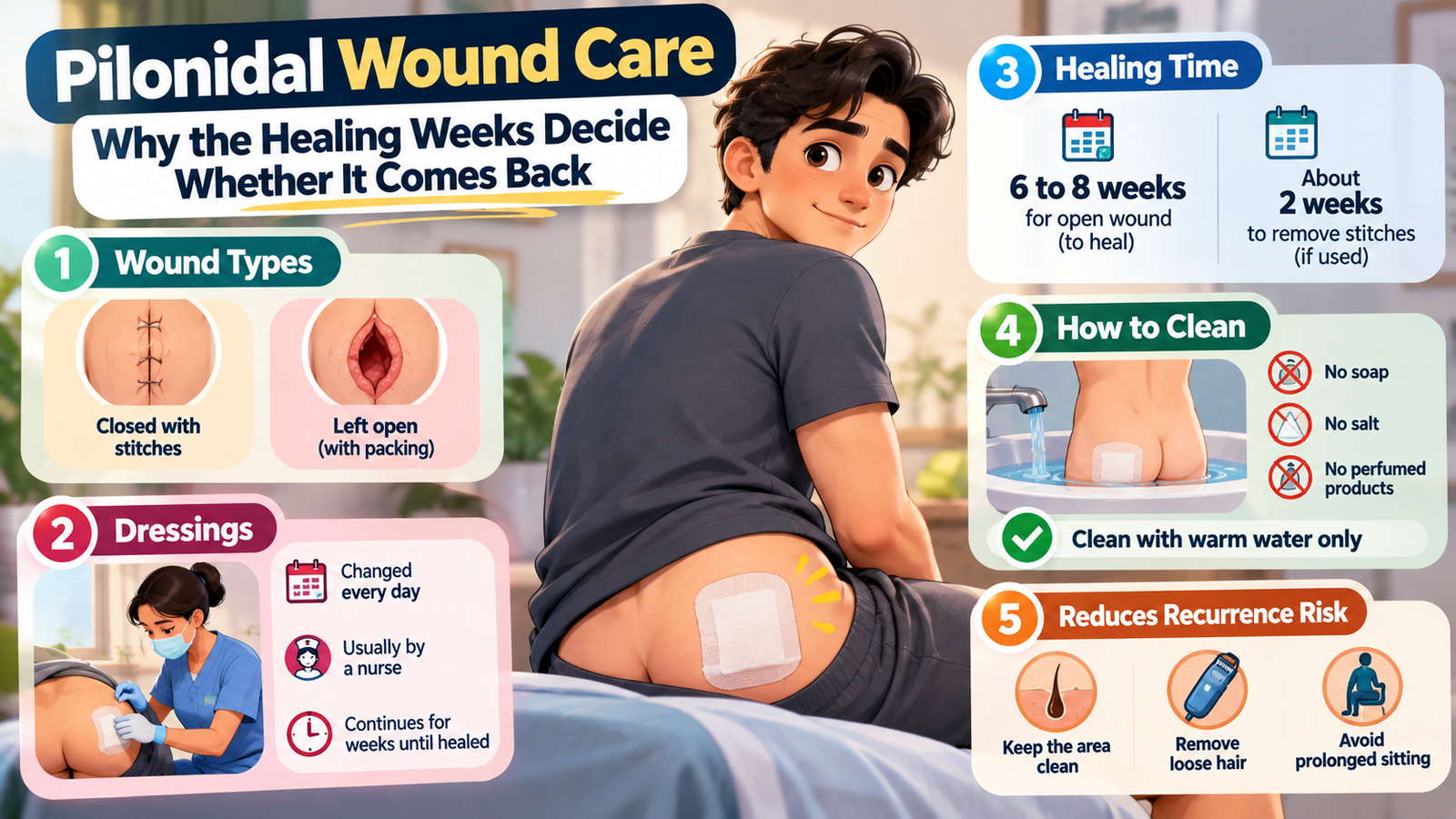
A pilonidal wound left open is packed and dressed every day, and NHS guidance gives about 6 to 8 weeks for it to heal. The instructions given for that period are specific, and following them is the part of treatment that happens after you leave rather than an optional extra.
Most writing about pilonidal sinus is about the operation. Almost none is about the six weeks afterwards, which is the part patients actually live through and the part nobody prepares them for.
If you are reading this with a dressing in place and a wound that seems to be taking far too long, this page is for you.
What happens to the wound after pilonidal surgery?
It is either closed with stitches or left open to heal gradually, and the two produce completely different experiences over the following weeks. Which one you have determines almost everything about your recovery.
Guy’s and St Thomas’ NHS Foundation Trust describes both. Where the wound is closed: “You have a dressing over your wound and sometimes a dressing inside the wound. This needs to be changed every day.” Where it is left open: “You might have packing (material to soak up any drainage) inside your wound and a dressing over the wound.”
What packing is, since it alarms people who were not warned: material placed inside the wound to absorb drainage, changed regularly as the wound gradually closes. It is not a complication and it is not a sign anything has gone wrong. It is how an open wound is managed.
Where stitches are used, the trust notes: “You need an appointment to remove your stitches about 2 weeks after surgery.”
Which approach was used for you, and why, is a reasonable thing to ask if nobody explained it. Our page on how pilonidal treatment is selected covers how that decision is made.
Why does an open wound take weeks rather than days?
Because it closes gradually from within rather than being brought together, and in a location that is moist, under tension and disturbed every time you sit down. The timeframe is longer than almost anyone expects.
Two figures circulate and they are both correct, for different wounds. The trust gives the open wound figure: “An open wound can take about 6 to 8 weeks to heal.” The NHS gives a shorter one: “The recovery time is about a month to completely heal, but it can be quicker.”
The difference is the wound type, not a disagreement. A closed wound is faster. A wound left open takes considerably longer, and if you have one and have read the shorter figure somewhere, you are likely to conclude at week five that something has gone wrong when nothing has.
So the first useful thing to establish is which you have, because it sets the whole timetable you should be measuring yourself against.
Who changes the dressings, and how often?
Daily, in most protocols, and usually by a nurse rather than by you. This is the single most practical thing to sort out before you leave hospital, and it is the one most often left vague.
| What you need to know | What NHS guidance describes | Why it matters |
|---|---|---|
| How often the dressing changes | Every day, for both closed and open wounds | Daily is a commitment that has to be arranged, not assumed |
| Who does it | The practice nurse at the GP surgery, in the NHS pathway | An equivalent arrangement must exist here before you go home |
| How long it continues | Until the wound heals, which for an open wound is about 6 to 8 weeks | This is weeks of appointments, not a few |
| Stitches, where used | Removed at about 2 weeks | A separate appointment from the dressings |
| After a flap reconstruction | The trust says your doctor or nurse explains if and how often | It varies, so it must be stated for you specifically |
The trust’s wording on who does it is direct: “The practice nurse at your GP surgery needs to change the dressing every day.”
That describes the NHS pathway in the United Kingdom, and it does not describe India. The principle transfers, the arrangement does not. Before you are discharged, establish who will change the dressing, where, how often, what it will cost, and what happens on a Sunday. A daily dressing with no plan for who does it is the commonest reason aftercare fails in the first fortnight.
How should the area be washed while it is healing?
Regularly and gently, with nothing added to the water. The instructions are more specific than most people are told, and the additions people make on their own are usually the problem.
The trust’s instruction is unusually precise: “Bathe the wound in a warm bath every day. Do not use soap, or put salt or any perfumed products in the water, until your wound has healed.”
Note what is ruled out, because every one of these is something people add believing it will help: soap, salt, and anything perfumed. The NHS separately emphasises the general principle: “It’s very important to keep the area between your buttocks clean by showering or bathing regularly.”
And one instruction that catches almost everybody out. The NHS says: “Do not shave the affected area unless a GP advises you to.”
That is worth reading twice, because the connection between hair and this condition is well known and the obvious conclusion is to remove the hair yourself immediately. Whether and when hair removal is appropriate, and by what method, is a decision for the clinician looking after your wound rather than something to start during the healing weeks.
What activity has to stop, and for how long?
Heavy lifting and exercise for at least the first week, swimming until the wound has healed, and cycling for considerably longer than most people assume. The restrictions are about protecting a wound in a place that moves constantly.
The trust’s list:
- Work. “Most people take 7 to 10 days off work after surgery.”
- Lifting and exercise. Avoid lifting anything heavy, exercising or running “for the first week or so after surgery”.
- Swimming. Not until the wound has healed, which for an open wound is the full six to eight weeks.
- Cycling. “do not ride a bicycle for 6 to 8 weeks after your surgery”.
The cycling restriction surprises people most, and it is the longest of them. It is also the one most often broken, because by week four a person feels considerably better and the wound is not visible to them.
Sitting deserves its own mention even though it is not in the list. Prolonged sitting on a hard surface puts direct pressure on the area for hours, and desk work and long journeys are worth planning around rather than enduring.
Which signs mean the wound needs looking at rather than waiting?
Contact your surgical team or a doctor the same day for any of these. Slow healing is normal here; deterioration is not.
- Feeling generally unwell, or a fever. The trust is explicit: “Call 111 or go to your nearest A&E if you feel generally unwell; you have a high temperature (fever).” In India, contact your surgical team or attend an emergency department.
- Pain you cannot control. The trust advises contacting a GP if pain is difficult to control.
- A new painful lump, bleeding, or pus. The NHS advises urgent review for “a small lump at the top of your bottom (between your buttocks) that’s painful, bleeding or leaking pus”.
- Increasing rather than decreasing discharge, which is the wrong direction after the first days.
- A wound that stops making progress over several weeks, rather than one that is simply slow.
- Redness spreading outwards from the wound edges.
The distinction that matters: a pilonidal wound healing slowly is doing what pilonidal wounds do, and six to eight weeks is normal rather than a failure. A wound that was improving and has started going backwards is a different thing and needs looking at.
Why is aftercare not the optional part of treatment?
Because the instructions are specific, they last for weeks, and the period they cover is the one you manage yourself. An operation is a day. The wound is two months.
Consider what the guidance actually asks of someone: a daily dressing change by a nurse, a daily bath with nothing added to the water, no lifting or exercise for a week, no swimming until healed, and no cycling for six to eight weeks. That is a substantial set of commitments and none of it happens in a hospital.
This is also where the practical failures cluster:
- No arrangement for daily dressings, so they become every few days by default.
- Products added to the bath in the belief that they speed healing, when the guidance specifically rules them out.
- Self-directed hair removal during the healing period, against explicit advice.
- Early return to cycling or exercise, because the person feels better long before the wound is closed.
- Stopping attention once the surface looks closed, which is not the same as healed.
None of this is a criticism of patients. It is a description of what happens when someone is discharged with a two-month regime explained once, on the day of an operation, while uncomfortable.
Is a recurrence a sign the first operation went wrong?
Usually not. This condition has a recognised tendency to come back, and a recurrence is far more often a property of the disease and its location than evidence that anything was done badly.
It is worth knowing how uncertain the underlying picture is. The NHS states plainly: “It’s not clear what causes a pilonidal sinus.” What it offers is a possible mechanism rather than a settled one: “A skin problem, pressure or friction may cause hair between the buttocks to be pushed inwards.”
Note the word may. A great deal of writing on this condition, including some aimed at patients, states the mechanism with much more confidence than the NHS does.
Why recurrence happens, what is understood about the tract and its branches, and what the less invasive treatments do about it, is covered in detail in our page on recurrent pilonidal sinus and laser treatment. That is the page to read for the mechanism. This one is about the wound.
What is fair to conclude if yours has come back: it is common, it is not automatically anybody’s fault, and it is information about which approach suited this sinus rather than a verdict on the surgeon.
What should you ask before agreeing to a second operation?
Ask what was found the first time, because the second decision should start from that rather than from scratch. The operative note from your first surgery is yours to request and it changes the conversation.
- What was found at the first operation, and what was left?
- Can I have a copy of the operative note?
- Why did this one come back, as far as you can tell?
- What are you proposing to do differently this time, and why?
- Will the wound be closed or left open, and how long will it take to heal?
- Who changes the dressing, how often, where, and at what cost?
- How long off work, and how long before cycling and exercise?
- What are the chances this one comes back too?
- Do you perform more than one approach for this, or only the one you are proposing?
- What would you do if this were your own family member?
The ninth question is the most revealing one. A surgeon who performs only a single technique will recommend that technique, and knowing that is not an accusation, it is context for the advice you are being given.
The sixth is the most practical. If nobody can answer who changes your dressing daily for the next two months, the plan is incomplete however good the operation is.
How is a non-healing or recurrent pilonidal wound assessed in Surat?
By establishing what has actually happened so far, which usually means the first operative note and an examination, before anything is proposed. In our practice in Surat, people arrive at this point frustrated and often having been told very little.
The two commonest situations are different from each other. One is a wound that is simply taking its normal course and has frightened someone who was told to expect a month. The other is a wound that has genuinely stopped progressing, which needs examining rather than waiting out.
Separating those two is most of the first consultation, and it does not need anything elaborate. What was done, when, what the wound has done since, and what it looks like now.
Where a further operation is genuinely the answer, the aftercare plan is settled before the operation is booked rather than explained on the day. Who changes the dressing, how often, where, for how long, and what it costs. A patient who leaves without that has been given half a treatment, which is the point this whole page is making.
Reconstruction of difficult wounds more generally is covered in our page on limb salvage after accidents.
Next step
If your wound is healing slowly, that is usually normal and the timetable above is the one to measure against. If it was improving and has started going backwards, or you feel unwell, that needs looking at rather than waiting out. Book a consultation with Dr. Ashutosh Shah in Surat, and bring your first operative note if you have one.
This page is for education and is not a substitute for the instructions given by the team that operated on you, which take precedence over anything here. Timeframes quoted come from the NHS sources named and linked, and describe UK care pathways that do not transfer directly to India. A painful, swollen area with fever may be an abscess and needs urgent attention. Please consult Dr. Ashutosh A Shah or your own surgeon about your situation.

