

✓ Medically reviewed by Dr. Ashutosh Shah, Plastic, Reconstructive & Cosmetic Surgeon (M.Ch., DNB)
Written by Dr. Ashutosh Shah, MS, MCh (Plastic Surgery), Consultant Plastic and Cosmetic Surgeon, Elegance Clinic, Surat. Reg. no. [REG NO].
Medically reviewed by Dr. Ashutosh Shah. Published 29 September 2026. Last reviewed 29 September 2026.
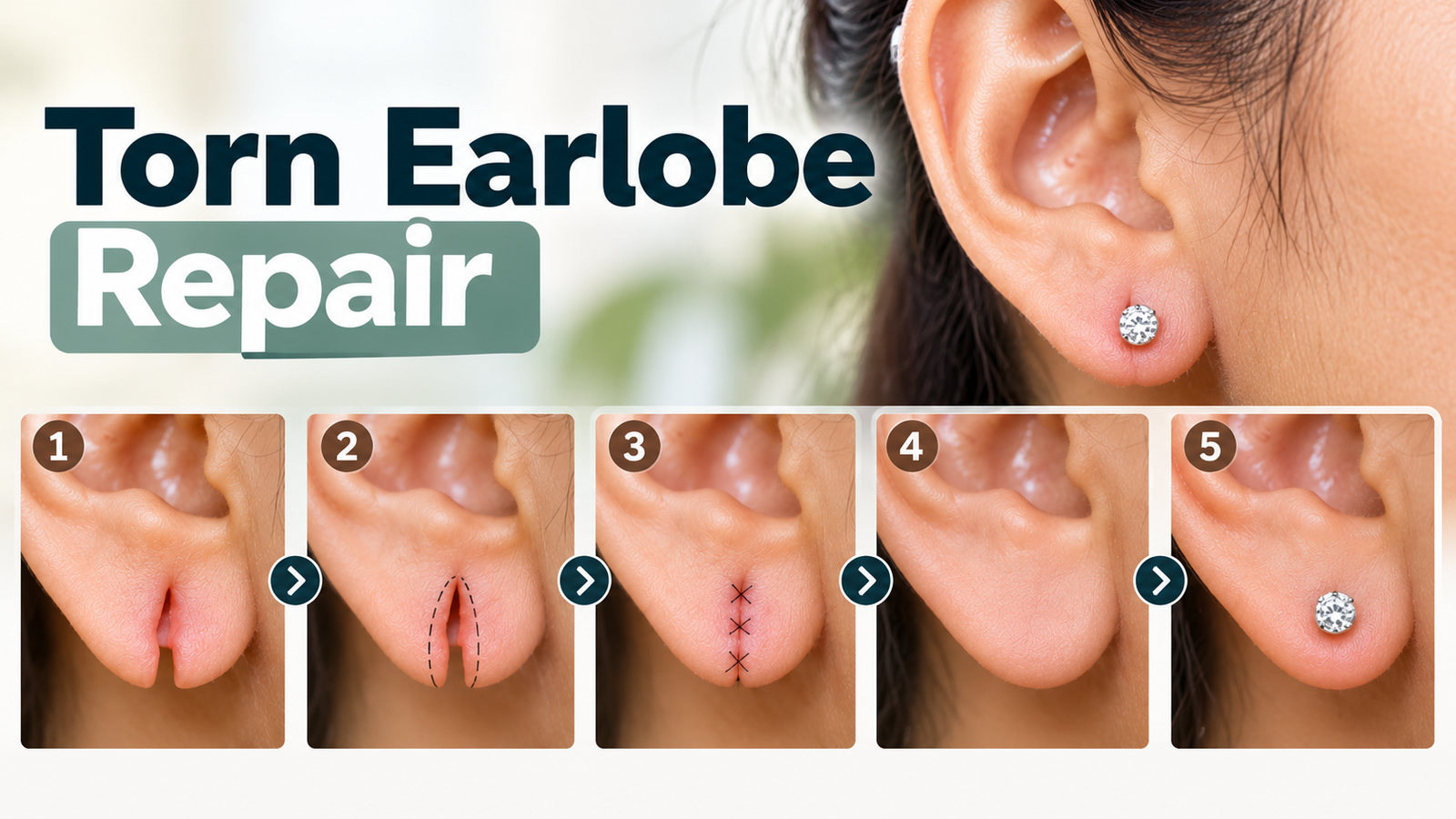
Torn earlobe repair is a small operation that closes a split or stretched piercing hole, because a torn lobe does not heal back together on its own. The edges are freshened and closed in layers, and re-piercing is possible later, through a different point rather than the old one.
Most people live with this for years before asking about it. They stop wearing earrings on that side, or wear one earring, or choose clip-ons, and quietly assume nothing can be done.
Something can, and it is one of the smaller operations in plastic surgery. This page covers why the split will not close by itself, what the repair involves, what the scar is honestly like, and the question almost everyone actually came here for, which is whether the ear can be pierced again afterwards.
Why does a torn earlobe not heal on its own?
Because both edges of the split have already healed separately, each with its own skin surface. Two finished surfaces pressed together do not join.
The Cleveland Clinic puts the practical consequence plainly: “Earlobes damaged after an injury may not return to how they looked before without surgery.”
It helps to think about what a healed split actually is. When the lobe tore, the wound healed the only way a wound can, by covering itself with skin. That happened on both sides of the gap. What you are left with is not an open wound waiting to close but two small, finished edges facing each other.
There is one partial exception, and it applies to stretching rather than tearing. The Cleveland Clinic notes that “Gently stretched earlobe gauges may shrink on their own over time”, though it adds that this can take a long time and applies to gentle stretching rather than to a lobe that has split through.
So waiting is a reasonable strategy for a mildly stretched hole and no strategy at all for a split one.
How do earlobes tear?
Either suddenly, from a pull, or slowly, from weight and time. Both end in the same place, but they do not look the same and they do not need the same repair.
DermNet covers the sudden version in one line: “Physical force may dislodge a piercing and result in tearing, bleeding, swelling and/or pain as common complications.”
The slow version is the more common one in practice, and the Cleveland Clinic names both routes to it: “Your earlobe size may increase if you wear heavy earrings.” and “Or you may stretch your earlobes to wear larger jewelry called gauges.”
| How it happened | What the lobe looks like | What the repair has to do |
|---|---|---|
| Pulled through in one go, by a catch, a child or clothing | A clean split running from the hole to the bottom edge | Close the full thickness and restore the edge in a straight line |
| Gradual widening under heavy earrings | An elongated slot, often still joined at the lower rim | Narrow the opening while keeping the rim intact |
| Deliberate stretching with gauges | A large round hole with healed skin all the way round it | Remove the healed lining, then rebuild the lobe to a normal outline |
| Repeated small tears that healed each time | A thin, notched or scalloped lower edge | Restore the contour rather than simply close a gap |
| Injury or accident | An irregular tear, sometimes with tissue missing | Repair, and reconstruct where there is a shortage of tissue |
| Years of sleeping in and catching earrings | A thinned lobe that has not split yet | Strengthen before it goes, rather than close after it has |
That last row is the one worth acting on. A lobe that has thinned but not yet split is easier to deal with than one that has, and most people wait for the split anyway.
Fully split, partly stretched or thinned: which do you have?
Look at the lower edge of the lobe in a mirror. Whether the tear reaches that edge is the single thing that changes the operation.
- Fully split. The tear runs all the way to the bottom edge, so the lobe is in two parts below the hole. The edge itself has to be rebuilt.
- Partly torn, or elongated. The hole has stretched downwards into a slot but a bridge of tissue still joins it at the bottom. The rim is intact and the repair is smaller.
- Stretched but round. A wide open hole with a complete healed rim, usually from gauges. There is more lining to remove and more lobe to rebuild.
- Thinned, not torn. The tissue between the hole and the edge has worn thin and translucent. Nothing has given way yet.
The Cleveland Clinic groups all of these under one procedure name, describing an earlobe repair, or “lobuloplasty”, as “a common cosmetic surgery that fixes torn, split, stretched or drooping earlobes.”
One thing not on this list is a lump. If what you have is a raised growth at the piercing site rather than a split, that is a different problem with a different treatment, and it is covered on our post about ear keloids after piercing.
What does torn earlobe repair actually involve?
A short procedure under local anaesthetic, done awake, with fine stitches. It is one of the smaller operations in plastic surgery and most people are surprised by how ordinary it is.
The Cleveland Clinic describes the anaesthetic step: “They’ll use a very thin needle to inject a small amount of local anesthetic into your earlobe.” It sets out the procedure itself in three steps, of which the middle one is the important one: “Make a cut (an incision) in your earlobe”, “Remove any excess skin or scar tissue”, and “Close the incision site.”
What that looks like from where you are sitting:
- The lobe is marked, with you upright, so the new lower edge lines up with the other ear.
- Local anaesthetic is injected. This is the part people mind, and it is brief.
- The healed lining is removed from both edges of the split. Section five explains why this is the step that decides the result.
- The lobe is closed in layers, not just at the surface, so the repair has strength through its full thickness.
- Fine stitches go in, and the Cleveland Clinic notes these are “either tiny dissolvable or removable stitches”.
- You go home the same day, with the ear uncovered or lightly dressed.
Both ears can usually be dealt with in the same sitting if both are torn, which most people would rather do than come twice. On how long it takes to settle afterwards, the Cleveland Clinic says: “It could take several weeks to completely heal after an earlobe repair.”
Why do the edges have to be freshened rather than simply closed?
Because skin will not heal to skin. The healed lining on each edge has to be removed to create raw surfaces that can knit to each other.
This is the whole operation in one idea, and it is why a split lobe cannot be taped, glued or pressed shut at home. The Cleveland Clinic’s middle step is the one that does it: “Remove any excess skin or scar tissue.”
Follow it through:
- A long standing split is fully healed. Each edge is covered in skin, exactly like the skin on the rest of your ear.
- Healing needs raw tissue to work with. Two intact skin surfaces held together simply sit against each other.
- So the lining is excised. A thin strip of skin is removed from each edge, turning a healed split back into a fresh wound.
- Then it is closed. Now the two sides can heal to each other, because there is something for them to heal with.
There is a consequence worth knowing. Because a strip is removed from each side, the lobe ends up very slightly smaller than it was. This is normal, it is planned for when the lobe is marked, and it is why the surgeon looks at both ears rather than only the torn one.
What does the scar look like, and where does it sit?
A fine line running from where the hole was down to the edge of the lobe. It is permanent, and it is the trade this operation makes.
The Cleveland Clinic is measured about it: “You’ll likely have a very small scar on your ear after your skin heals.” That is a fair description and it is not the same as saying nothing will show. A repaired lobe has a line on it. What changes is that a line is far less noticeable than a split, and it does not catch on things.
Three things influence how it settles:
- How the edge is rebuilt. A notch at the lower border is the giveaway of a repair done in a straight line without accounting for the edge. Avoiding it is the technical part of the operation.
- How your skin scars. Indian skin has a greater tendency to darken along a healing line, and some people scar thickly. Raise any personal or family history of raised or keloid scars before surgery.
- Time. A new scar looks its most obvious early and keeps settling well past the point most people stop watching it.
DermNet notes what raises the risk of a difficult scar: “There is an increased likelihood of keloid and hypertrophic scarring if there are post-procedure complications (such as haematoma, infection, and excess skin tension) and/or delayed wound healing.” How thickened scars are treated if they do develop is set out on our post about keloid and thickened scars.
When can the ear be pierced again, and why not through the same point?
Yes, it can be re-pierced, after the repair has fully settled, and the new hole goes somewhere else on the lobe. Both halves of that answer matter.
On timing, the Cleveland Clinic gives a working figure: “On average, you may need to wait three to six months.” Read that as an average rather than an entitlement. DermNet’s note applies here too: “Healing times vary and are affected by the location of the piercing, individual client factors and aftercare.” The person who repaired the lobe should be the person who says it is ready.
On placement, and this is the part almost nobody is told. The repair line is a scar running through the full thickness of the lobe. Scar is not as strong as the tissue it replaced. Putting a new piercing through that line means putting a hole through the weakest part of the lobe, which is precisely the part most likely to give way again.
So the new piercing is placed in intact tissue, away from the repair line, usually a little higher or to one side. It is a small difference in position and it is the difference between a lobe that holds and a lobe that splits a second time.
When you do go ahead, the aftercare is ordinary piercing aftercare. The American Academy of Dermatology advises: “Leave your jewelry in your new piercing for six weeks or more, even at night.” and “Always wash your hands before touching newly pierced areas.”
The AAD also names the sign that means something different is happening: “If the skin around your piercing becomes raised, you may be developing a type of scar called a keloid.” If that is what you are seeing, the ear keloid page is the one you want, not this one.
One last thing that decides whether the repair lasts. The Cleveland Clinic notes that “Wearing large or heavy jewelry in your ears may impact how your ears look over time.” The lobe that tore once tore for a reason, and the reason is usually still in your jewellery box.
What can be done if the lobe has lost height or shape?
It can be rebuilt rather than merely closed, and that is a different conversation from a straight repair.
Some lobes arrive with tissue genuinely missing, after an accident, after years of gauging, or after a previous repair that was closed under tension. Closing those in a straight line leaves a lobe that is smaller, notched or pulled upwards.
What can be done depends on how much lobe is left:
- Where there is enough tissue, the edge is reshaped as part of the closure so the outline matches the other ear.
- Where the lobe is short, local tissue can be rearranged to restore height rather than simply shortening the lobe further.
- Where a previous repair has notched, the notch is revised, which is a smaller procedure than the original.
The honest framing is that symmetry between the two ears is the goal and perfect symmetry is not promised, because the two lobes were never identical to begin with. Ask to be shown, on your own ears, what the planned lower edge will line up with.
Who should wait, and what should be sorted out first?
Anyone with an active problem at the site, and anyone whose jewellery habits have not changed. The first is a healing issue, the second is the reason for the repeat.
Wait or sort out first:
- Any current infection, soreness or discharge at the site. This is a planned procedure and it can wait a fortnight.
- A raised lump rather than a split. That is a keloid question and it is answered on the ear keloid page. Repairing around one without addressing it is a wasted operation.
- A known tendency to thick or raised scars. Not a reason to refuse, but a reason to plan differently, and to say so before rather than after.
- The heavy earrings themselves. If the same jewellery goes back in, the same thing happens again. This is the most useful thing on the list and the one most often skipped.
- Anything that affects healing generally, including smoking and uncontrolled diabetes, which are worth mentioning even for a procedure this small.
How is a torn earlobe assessed at Elegance Clinic, Surat?
By looking at both ears, upright, and by working out where the new lower edge should sit before anything is cut.
In our practice in Surat, the most common thing we see is someone who has had a split lobe for years and is faintly apologetic about raising it, usually at the end of an appointment about something else. It is worth saying that this is a legitimate thing to come in for on its own. The second most common is a lobe that has already been repaired once, without the edge being rebuilt, leaving a notch that bothers the person more than the original split did.
An assessment covers which type of tear you have, how much lobe there is to work with, what the lower edge should line up with on the other side, any history of thickened scarring, and when re-piercing would be reasonable and where it should go. Related procedures are listed under our services.
If the honest answer is that a stretched hole may settle on its own with time and lighter jewellery, that is what you will be told.
Next step
If you have a split, stretched or thinned lobe and want to know what can be done about it, the useful step is a look at both ears rather than a photograph. You can book a consultation to have the tear assessed and be told what the repair would involve and when re-piercing would be reasonable.
This page is for education and is not a substitute for professional assessment. A lump, discharge or persistent soreness at a piercing site should be examined rather than treated as a simple tear. Discuss your own situation with Dr. Ashutosh Shah or another qualified surgeon.

