

|
Getting your Trinity Audio player ready...
|
✓ Medically reviewed by Dr. Ashutosh Shah, Plastic, Reconstructive & Cosmetic Surgeon (M.Ch., DNB)
Written by Dr. Ashutosh A Shah, M.B.B.S., M.S., M.Ch., D.N.B., Board Certified Plastic Surgeon, Elegance Clinic, Surat. Reg. no. [REG NO]. 22+ years in plastic and reconstructive surgery.
Medically reviewed by Dr. Ashutosh A Shah · Published 30 September 2026 · Last reviewed 30 September 2026
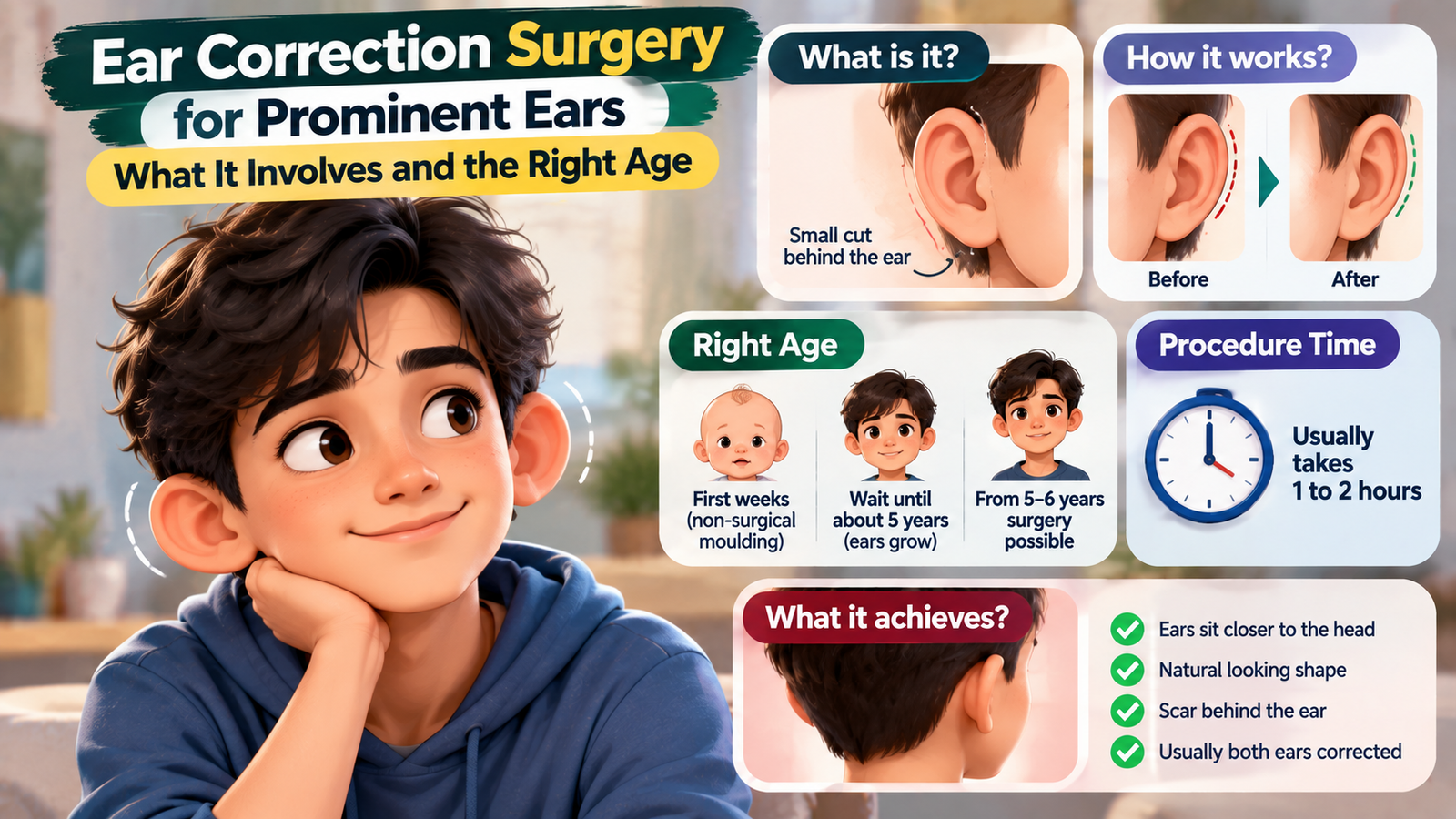
Ear correction surgery, also called otoplasty, reshapes the cartilage of prominent ears so they sit closer to the head. It is usually considered from about five or six years of age, once the ear has reached most of its adult size. The aim is ears that go unnoticed rather than ears that match exactly.
Most people reading this are a parent rather than a patient, and usually something specific prompted the search.
Two things are worth knowing early: there is a narrow window in the first weeks of life when something can be done without surgery, and after that the answer involves waiting until the ear has grown.
What is ear correction surgery?
An operation that reshapes the cartilage of the ear so it sits closer to the head. It is also called otoplasty or pinnaplasty, and the incision is placed behind the ear.
The NHS describes what is involved: “making a small cut behind the ear to expose the ear cartilage”, then “putting stitches at the back of the ear to reshape or position it closer to the head”.
On duration: “An otoplasty usually takes 1 to 2 hours.”
What that means practically:
- The scar sits behind the ear, in the crease, which is why otoplasty scars are rarely a concern afterwards.
- The cartilage is reshaped rather than removed, so the ear keeps its structure.
- Both ears are usually addressed, even when one is more prominent, because the aim is balance.
- It is a day procedure in most cases, though the anaesthetic depends on the person’s age and what is planned.
Why do ears stick out in the first place?
Usually because a natural fold in the cartilage did not form fully, or because the bowl of the ear is deeper than average, or both. It is a matter of cartilage shape rather than anything having gone wrong.
The two common contributors:
- An underdeveloped antihelical fold. The ear has a natural fold that holds the upper part back towards the head. Where it has not formed fully, the upper ear projects.
- A deep conchal bowl. The cup-shaped hollow near the ear canal, when deeper than average, pushes the whole ear outwards.
Prominent ears often run in families and are usually present from birth. They are not a medical problem, they do not affect hearing, and the reason people seek correction is appearance and how others respond to it.
That distinction matters for what follows, because it means nothing is being repaired. This is an operation about shape, and it should be discussed on those terms rather than as treatment for a condition.
What age is right, and why does it matter?
Generally from about five or six, because the ear needs to have reached most of its adult size first. The NHS sets the lower boundary clearly: “Ear pinning surgery is not suitable for children younger than 5 because their ears are still growing and developing.”
| Age | What is possible | Why |
|---|---|---|
| First week of life | Non-surgical moulding, where available and appropriate | The cartilage is at its most pliable and treatment is shortest |
| Up to about three weeks | Moulding still, with effectiveness falling | A review reports only half as effective when started after this point |
| Weeks to about five years | Generally watchful waiting | NHS: surgery is not suitable under 5 as the ears are still growing |
| From about five or six | Surgery becomes possible | The ear has reached most of its adult size |
| Older childhood and teens | The usual time, and the child can participate in the decision | NHS describes it as usually done on children and young teenagers |
| Adulthood | The same operation, with no upper limit | Nothing about being an adult makes it less effective |
Read the five-or-six figure as a general guide rather than a threshold you cross. Ears grow at different rates, and whether a particular child’s ear has reached a suitable stage is established by examining that child. Nobody can tell you from an age alone.
Can anything be done without surgery in newborns?
Yes, in the first weeks of life, and the window is genuinely narrow. If your baby is days old and you are reading this, that is the single most useful thing on this page.
Non-surgical moulding uses a splint to reshape the cartilage while it is still soft. A review of the literature on non-surgical correction explains why it works only early: “It is theorized that treatment during the neonatal period is the most effective due to maternal estrogen still present in the neonatal circulation, which would make the ear more pliable.”
Note the word theorized. That is the review’s own hedging and it is worth keeping.
How narrow the window is, in the review’s terms:
- Starting in the first week means the shortest treatment. The review reports that “If initiated in the first week of life, treatment duration can be reduced from 6-8 weeks to 2 weeks or less, according to Doft et al and Matic et al”.
- Starting after three weeks markedly reduces the chance of success. The review notes that “Byrd et al stated that only 50% of molding therapy was effective if initiated after the first three weeks of life”.
And the caveat that specifically concerns this page. The same review covers prominent and protruding ears among the deformities treated this way, and describes them as the most difficult to correct by moulding.
So the honest position for a parent of a newborn with prominent ears: this is worth asking about urgently, because the window closes in weeks and the option disappears entirely if missed. It is also the deformity least likely to respond fully, so it should be discussed as something worth trying early rather than as an assured alternative to surgery.
If your baby is newborn and their ears concern you, ask about this within days rather than waiting for a routine appointment. This is one of very few situations in this field where a week genuinely matters.
What does the operation actually involve?
An incision behind the ear, reshaping of the cartilage, and stitches that hold the new position. It takes one to two hours and is usually a day procedure.
The sequence, following the NHS description:
- Anaesthetic, which varies with age and what is planned. Younger children generally need a general anaesthetic; older children and adults may not.
- A small cut behind the ear, exposing the cartilage.
- Reshaping, which may involve creating or strengthening the fold that holds the ear back, reducing the depth of the bowl, or both.
- Stitches at the back of the ear that hold the reshaped cartilage in its new position.
- Dressings, often a bandage around the head initially.
What to establish at the consultation rather than on the day: which of these your child actually needs, whether one ear or both will be operated on, what anaesthetic is planned, and whether it is a day case.
The NHS gives one piece of advice about the process itself that is worth following: “Always book an appointment to meet the surgeon before the operation.”
What does recovery look like for a child and for an adult?
A headband at night for several weeks, stitches out within about a week and a half, school within a fortnight, and swimming after about a month. The restrictions are mostly about protecting the ears while the cartilage settles.
The NHS timeline:
- Stitches and bandage. “After 5 to 10 days: the bandage (if used) and stitches are removed.”
- School. “After 1 to 2 weeks: most children can return to school.”
- Swimming. “After 4 to 6 weeks: swimming should be OK.”
- Sleeping. “You might need to wear a headband at night for several weeks to protect your ears while you sleep.”
The headband is the part families underestimate, and it is the part that matters most for a child. It is worn at night for weeks, and a child who pulls it off in their sleep is putting tension on healing cartilage. It is worth discussing before the operation how that will be managed, particularly with a younger child.
Adults follow broadly the same timetable, with work in place of school. The main practical difference is that an adult can be relied on to follow the restrictions, which is not a small thing over several weeks.
What are the risks, and what should you be told about them?
The specific risks of this operation are inflammation of the cartilage, bleeding under the skin, asymmetry, stiffness, and the ears returning towards their original position. These should be discussed before you consent, not afterwards.
The NHS lists, alongside the general risks of any surgery, the ones specific to ear correction:
- Inflammation of the ear cartilage, which may need antibiotics.
- A blood clot in the skin of the ear, which may need to be drained.
- Stiff ears, which usually settles.
- The ears no longer being symmetrical.
- The surgery being unsuccessful, with the protrusion returning.
Alongside those, the general surgical risks it names are excessive bleeding, infection at the incision site, and an allergic reaction to the anaesthetic.
The one that deserves particular attention when the patient is a child is the last of the specific risks. Cartilage has memory, and an ear held in a new position can drift back towards its old one. That possibility should be part of the conversation before surgery rather than a surprise a year later.
The NHS also notes that “Ear correction surgery may be available on the NHS, particularly for children who need it”, which is worth knowing as context: this is a procedure health services do fund in some circumstances rather than a purely cosmetic one.
What does a good result look like, and what should it not look like?
Ears that nobody notices. That is the entire aim, and it is a lower bar than most people expect and a harder one than it sounds.
What a good result is:
- Ears that sit closer to the head without drawing attention to the fact that something was done.
- A natural fold, with a smooth curve rather than a sharp ridge.
- Reasonable balance between the two sides, which is not the same as a perfect match.
- A scar behind the ear that is not visible in normal life.
What it should not be:
- Ears flattened hard against the head, which reads as obviously operated on.
- A sharp, artificial-looking edge where the fold was created.
- Perfect symmetry, which does not occur naturally and looks wrong when it is manufactured.
On symmetry specifically, because it is the commonest unrealistic expectation. Almost nobody has matching ears. Two ears that are close but not identical is the normal human arrangement, and it is what a good operation aims at. Asking for them to match exactly is asking for something that will look less natural than what you started with.
How should a child be involved in the decision?
They should be able to say, in their own words, what bothers them. That single test separates the situations where this operation helps from the ones where it should wait.
Parents who bring a child for this are almost always responding to something real, usually something that happened at school, and often after months of watching their child become self-conscious. That instinct to act is not the problem and nobody should be made to feel it is.
But the child is the one having the operation, wearing the headband for weeks, and living with the result. So the useful question in the consultation is put to them, not to the parent: what would you like to be different, and whose idea was coming here?
A child who can answer that clearly is in a good position to proceed. A child who shrugs, or looks at their parent before answering, is telling you something worth hearing.
The harder situation is a child who is not bothered and a parent who is. Waiting is a legitimate outcome there, and it costs very little: the operation is available throughout childhood and adulthood, and a child who becomes bothered at eleven can have it done then. Nothing is lost by waiting except a year or two.
How is this assessed at Elegance Clinic, Surat?
By examining the ear to see what is actually producing the prominence, and by talking to the child as well as the parent. In our practice in Surat, the examination is often the shorter half of the consultation.
What the examination establishes is mechanical: whether the fold has formed, how deep the bowl is, how much projection there is, and whether the two sides differ. That determines what the operation would involve, and it cannot be judged from a photograph or a description.
The other half is the conversation, and with a child it is directed at them. What they would like to be different, whether anything has been said to them, and whether this is something they want. That is not a formality and it does change outcomes.
Where a child is under five, or the ear has not grown enough, the answer is to wait and to say so plainly rather than to schedule something. Where a newborn is concerned, the timing is urgent for the reasons set out above and should be raised immediately rather than at the next routine visit.
Related pages on this cluster: torn earlobe repair, which covers the lobe rather than the cartilage, and ear keloids after piercing. Emergency care for burns, including to the ear, is covered in burn first aid.
Next step
If your baby is a newborn and their ears concern you, ask about non-surgical moulding within days rather than waiting, because that window closes in weeks. For an older child, an examination establishes whether the ear has grown enough and what would be involved. Book a consultation with Dr. Ashutosh Shah at Elegance Clinic, Surat.
This page is for education and is not a substitute for examination. Ages given are general guidance rather than thresholds, and whether surgery is appropriate for a particular child is established by assessing that child. Prominent ears do not affect hearing and are not a medical problem, and waiting is always a reasonable option. Please consult Dr. Ashutosh A Shah or another qualified surgeon about your own situation.

