

|
Getting your Trinity Audio player ready...
|
✓ Medically reviewed by Dr. Ashutosh Shah, Plastic, Reconstructive & Cosmetic Surgeon (M.Ch., DNB)
Written By
Dr. Ashutosh Shah, M.Ch., DNB (Plastic Surgery)
Specialty: Plastic, Reconstructive, Cosmetic & Hair Transplant Surgery
Experience: 22+ Years
Position: Founder & Director, Elegance Clinic, Surat
With more than 22 years of surgical experience, Dr. Ashutosh Shah combines his qualifications in Plastic Surgery with experience in cosmetic and reconstructive care. At Elegance Clinic, treatment planning focuses on choosing procedures according to the patient’s skin, treatment area, and individual concerns.
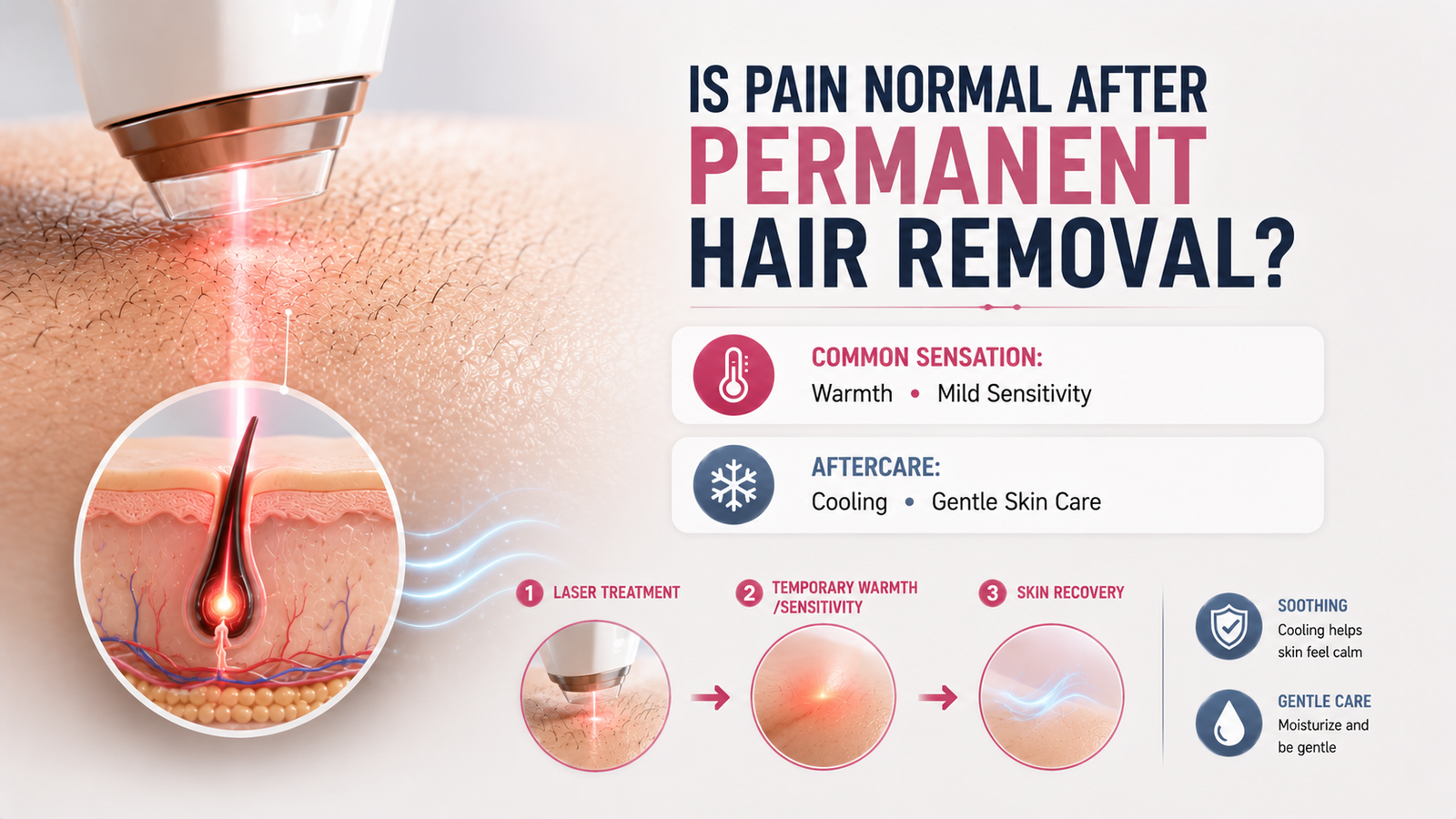
Some warmth, tenderness, or a mild stinging sensation can occur after laser-based permanent hair reduction. For many people, this discomfort is temporary and settles as the treated skin calms. However, pain after permanent hair removal should not automatically be ignored, particularly when it becomes intense, continues to worsen, or appears with blistering or significant skin changes.
Laser hair reduction works by delivering controlled light energy that is absorbed by pigment in the hair. The resulting heat damages targeted hair follicles to reduce future hair growth. Because heat is involved, temporary redness and swelling around follicles can occur after treatment. The American Academy of Dermatology notes that redness and swelling are common after laser hair removal and typically resemble a mild sunburn.
The degree of discomfort can differ according to the treatment area, skin characteristics, hair density, device settings, cooling methods, and individual sensitivity.
Key Takeaways
- Mild warmth, tenderness, or stinging can occur after laser hair reduction.
- Temporary redness and swelling around treated follicles can also occur.
- Discomfort should generally improve rather than progressively worsen.
- Strong heat exposure and irritating skincare may make recently treated skin more uncomfortable.
- Blistering, severe pain, marked swelling, or unusual colour changes deserve professional assessment.
- Permanent hair reduction usually requires multiple treatment sessions.
- Treatment parameters should be selected according to the patient’s skin and hair characteristics.
Is Pain Normal After Permanent Hair Removal?
Mild discomfort can be normal immediately after laser hair removal, but severe or increasing pain is not something to dismiss as routine.
The treated area may feel warm, sensitive, or similar to mildly sun-exposed skin. Redness may also appear around individual follicles.
These effects occur because the treatment intentionally delivers energy to hair follicles while trying to protect the surrounding skin.
The important point is the direction of recovery. Ordinary post-treatment sensitivity should begin settling. Pain that becomes stronger instead of weaker requires more attention.
Patients considering treatment can read about laser hair removal at Elegance Clinic to understand how the procedure is used for unwanted hair reduction.
Why Can the Skin Hurt After Laser Hair Removal?
Several factors can influence post-treatment discomfort.
Heat Delivered to the Follicle
Laser treatment relies on controlled heat. This can temporarily make the surrounding skin feel warm or sensitive.
Treatment Area
Certain areas of the body may naturally feel more sensitive than others because of skin characteristics, hair density, and nerve distribution.
Hair Characteristics
Coarser or denser hair can affect how energy interacts with the treatment area. Treatment settings therefore need to be selected individually.
Skin Characteristics
Skin pigmentation influences laser selection and treatment parameters. Appropriate settings are important for balancing effective follicle targeting with skin protection.
Recent Skin Exposure
A recently tanned, irritated, or otherwise sensitised treatment area can require additional consideration before laser treatment.
How Long Can Discomfort Last?
There is no exact recovery time that applies to every patient.
For uncomplicated treatment, mild sensitivity generally improves as the initial skin reaction settles. The American Academy of Dermatology reports that redness and swelling after laser hair removal often last approximately one to three days.
That does not mean every symptom lasting longer represents a complication. Skin response varies.
What matters is whether symptoms are improving normally or developing concerning features.
What Can Help the Skin Feel More Comfortable?
Gentle post-treatment care can help avoid adding unnecessary irritation while the skin settles.
Cooling measures may sometimes be recommended immediately after treatment. Patients should follow the instructions given by their treating professional because aftercare can vary according to the area and device used.
It is generally sensible to avoid unnecessarily rubbing, scratching, or aggressively exfoliating sensitive treated skin.
Sun protection is also important after laser treatment. The AAD recommends protecting treated skin from direct sunlight and following the dermatologist’s aftercare instructions.
Patients should avoid experimenting with harsh products simply because the skin feels uncomfortable.
When Is Pain After Hair Removal Not Normal?
Pain deserves assessment when it is severe, progressively worsening, or accompanied by significant changes in the treated skin.
Laser hair removal can rarely cause complications such as blistering, infection, scarring, or changes in skin colour.
Contact the treating clinic if you notice substantial blistering, increasing swelling, severe tenderness, an open or weeping area, signs of infection, or unexpected pigment changes.
A significant reaction should be examined rather than repeatedly treated at home without knowing its cause.
Can Skin Colour Change After Laser Hair Removal?
Yes. Temporary or longer-lasting changes in skin pigmentation can occur after laser treatment.
The treated skin can become darker or lighter than the surrounding area. Risk can be influenced by skin type, sun exposure, laser parameters, and other factors.
This is one reason an appropriate pre-treatment assessment matters.
Patients interested in understanding the clinic’s wider cosmetic and reconstructive approach can learn more about Dr. Ashutosh Shah’s clinical background before deciding on treatment.
Does Pain Mean the Laser Treatment Worked Better?
No. More pain does not mean better hair reduction.
Laser treatment should not be judged by how much discomfort a patient experiences.
The objective is to deliver suitable energy to the targeted follicles while limiting unnecessary damage to surrounding tissue. Excessively aggressive treatment does not automatically produce a better result and can increase the risk of unwanted skin reactions.
Similarly, a comfortable session does not automatically mean that treatment was ineffective.
Results should be assessed through hair reduction over the treatment course, not through pain intensity.
Why Are Several Hair-Reduction Sessions Usually Needed?
Hair follicles do not all pass through their growth cycle simultaneously.
Laser treatment is most effective when hairs are in a suitable growth phase, so multiple sessions are commonly required to target different follicles over time.
The exact number varies according to the treatment area, hair characteristics, hormonal influences, device, and individual response.
Patients should also understand that the more accurate term is often long-term or permanent hair reduction, rather than guaranteeing that every treated hair will disappear permanently.
What Should Be Checked Before the Next Session?
If the previous treatment produced more discomfort than expected, tell the treating professional before another session begins.
The skin response from the previous appointment can provide useful information when planning subsequent treatment.
A clinician may consider the treatment area, current skin condition, tanning or sun exposure, previous reaction, hair characteristics, medications, and other relevant factors before deciding whether treatment should proceed.
Do not hide a previous blister, burn-like reaction, or prolonged pigmentation change simply because the skin looks better by the next appointment.
How Elegance Clinic Approaches Laser Treatment
Aesthetic laser treatment is not only about removing visible hair. Skin type, hair characteristics, treatment location, previous response, and realistic expectations can influence the treatment plan.
Dr. Ashutosh Shah, Founder and Director of Elegance Clinic, holds M.Ch. and DNB qualifications in Plastic Surgery and has more than 22 years of surgical experience. His work spans Plastic, Reconstructive, Cosmetic and Hair Transplant Surgery.
Patients who want to understand the clinic and its medical approach before choosing a cosmetic procedure can explore more about Elegance Clinic and its surgical leadership.
Conclusion
Mild pain after permanent hair removal can occur because laser energy creates a temporary reaction around treated hair follicles. Warmth, tenderness, redness, and mild swelling may settle as the skin recovers.
The important distinction is between temporary sensitivity that improves and pain that becomes progressively worse.
Severe discomfort, blistering, marked swelling, skin breakdown, or unexpected colour changes should not simply be considered proof that the treatment was “strong.” These symptoms may require professional assessment.
Appropriate treatment settings, skin assessment, sun precautions, and aftercare can all contribute to a safer laser hair-reduction experience.
Need Help With an Unexpected Skin Reaction?
If your skin is more painful or irritated than you expected after a hair-removal session, avoid guessing whether another treatment is safe. You can speak with the Elegance Clinic team about the reaction and whether the skin should be assessed before your next session.
Frequently Asked Questions
1. Is pain normal after laser hair removal?
Mild warmth, stinging, or tenderness can occur temporarily. Severe or worsening pain should be assessed.
2. How long does redness last after laser hair removal?
Redness and swelling commonly settle within hours to a few days, although individual responses vary.
3. Does stronger pain mean better hair removal?
No. Pain intensity is not a reliable measure of treatment effectiveness.
4. Can laser hair removal burn the skin?
Burn-like reactions and blistering are possible complications, although they are not expected routine outcomes.
5. Can I apply ice after laser hair removal?
Cooling may help some temporary discomfort, but follow the specific aftercare instructions provided by your treating professional.
6. Why does my skin feel hot after treatment?
Laser energy generates controlled heat around targeted follicles, which can temporarily make the surrounding skin feel warm.
7. When should I contact the clinic after treatment?
Seek advice for severe or increasing pain, significant blistering, unusual swelling, skin breakdown, discharge, or concerning colour changes.
8. Should I have another session if my skin reacted badly?
Tell your treating professional about the previous reaction first. Your skin should be assessed when necessary before additional treatment.

