

|
Getting your Trinity Audio player ready...
|
✓ Medically reviewed by Dr. Ashutosh Shah, Plastic, Reconstructive & Cosmetic Surgeon (M.Ch., DNB)
Women’s Intimate Surgery Insights by Dr. Ashutosh Shah
Dr. Ashutosh Shah, M.Ch., DNB (Plastic Surgery)
Specialty: Plastic, Reconstructive & Cosmetic Surgery
Experience: 22+ Years
Position: Founder & Director, Elegance Clinic, Surat
Dr. Ashutosh Shah is a board-certified Plastic, Reconstructive and Cosmetic Surgeon with more than 22 years of surgical experience. His practice includes aesthetic genital procedures, reconstructive surgery and cosmetic treatments at Elegance Clinic.
Last Updated: August 2026
Introduction
Changes in vaginal tightness can occur after childbirth, ageing or stretching of the vaginal tissues. Some women notice a feeling of looseness, reduced support or changes in intimate comfort and begin looking for a more lasting solution.
This often leads to the question: Can surgery tighten a loose vagina?
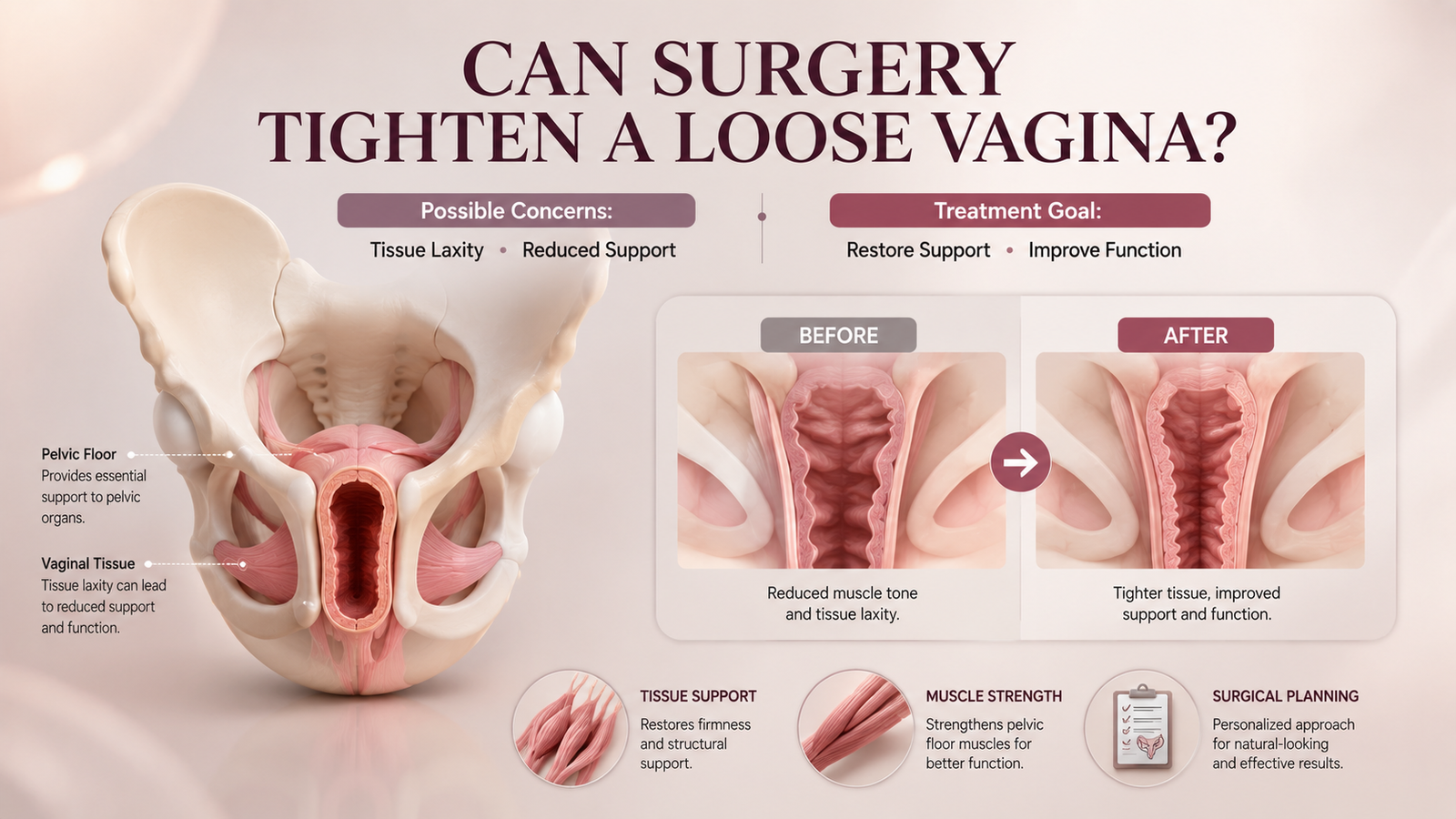
Yes. Surgical vaginal tightening, commonly called vaginoplasty, can be considered for selected women when laxity involves stretched vaginal tissues and muscles. However, surgery is not automatically necessary for every feeling of looseness.
At Elegance Clinic, aesthetic genital treatments include both surgical and nonsurgical options. The clinic’s dedicated surgical vaginal tightening treatment is intended to address vaginal laxity according to the patient’s anatomy and concerns.
Key Takeaways
- Vaginal laxity may become noticeable after childbirth, ageing or tissue stretching.
- Vaginoplasty is a surgical procedure used to tighten selected vaginal tissues.
- Not every patient who feels vaginal looseness requires surgery.
- Surgical and nonsurgical vaginal treatments have different indications.
- Treatment should be based on anatomy and symptoms rather than the idea of achieving a standard degree of “tightness.”
- Future pregnancy and childbirth may affect surgical results.
- Recovery and temporary activity restrictions are important after surgery.
- A personal examination is necessary before deciding whether vaginoplasty is appropriate.
What Does a “Loose Vagina” Actually Mean?
The phrase “loose vagina” is commonly used by patients, but medically the concern is better described as vaginal laxity.
It can refer to a feeling that the vaginal opening or canal has become wider or that the surrounding tissues provide less support than before.
The severity varies considerably.
Some women notice relatively minor changes, while others experience more substantial tissue stretching after childbirth.
The treatment therefore should not be selected simply because a patient uses the word “loose.” The underlying tissues and symptoms need to be assessed.
Why Can the Vagina Feel Looser?
Several factors can influence vaginal tissue tone.
| Possible Factor | What May Change | Treatment Consideration |
|---|---|---|
| Vaginal childbirth | Muscles and soft tissues may stretch | Degree of laxity should be assessed |
| Multiple deliveries | Repeated stretching may increase tissue changes | Surgical correction may be considered in selected cases |
| Ageing | Tissue elasticity can change | Treatment depends on severity |
| Menopause | Hormonal changes may affect vaginal tissues | Other vaginal symptoms should also be evaluated |
| Significant tissue laxity | Vaginal canal or opening may feel wider | Surgical tightening may be an option |
| Mild laxity | Limited tissue change | Nonsurgical options may sometimes be discussed |
| Pelvic-floor weakness | Reduced muscular support | Pelvic-floor assessment may be useful |
The cause and degree of laxity matter because different problems should not automatically receive the same treatment.
How Does Vaginal Tightening Surgery Work?
Vaginoplasty aims to reduce excessive vaginal laxity by surgically tightening selected tissues of the vaginal canal.
The exact technique depends on the patient’s anatomy and the degree of tissue stretching.
The procedure may involve removing selected excess tissue and bringing stretched supporting tissues or muscles closer together to create improved support and a narrower vaginal canal.
Elegance Clinic describes vaginoplasty as its surgical vaginal tightening option for women experiencing changes in vaginal firmness associated with factors such as childbirth or ageing.
The goal should not be to make the vagina “as tight as possible.” Excessive tightening could create discomfort and would not represent a desirable surgical outcome.
Who May Consider Vaginal Tightening Surgery?
Surgery may be discussed when vaginal laxity is significant enough to bother the patient and there is an anatomical problem that surgery can reasonably address.
For example, a woman may notice persistent looseness following childbirth despite adequate recovery.
Other patients may have concerns related to both the vaginal opening and deeper tissues.
The surgeon needs to understand what the patient actually wants to improve before recommending a procedure.
A consultation should also review previous deliveries, future pregnancy plans, previous pelvic surgery and relevant medical conditions.
Does Every Woman With Vaginal Laxity Need Surgery?
No.
This is an important distinction.
Mild symptoms do not automatically justify an operation. Pelvic-floor rehabilitation or another nonsurgical approach may be relevant depending on the cause and symptoms.
Elegance Clinic also provides nonsurgical laser vaginal rejuvenation, which it describes as an option using laser or radiofrequency technology for selected vaginal concerns.
However, nonsurgical treatment should not be presented as equivalent to surgical reconstruction when substantial muscle or tissue laxity exists.
The appropriate option depends on what needs to be corrected.
Is Vaginoplasty the Same as Labiaplasty?
No.
Vaginoplasty primarily addresses laxity involving the vaginal canal and supporting tissues.
Labiaplasty concerns the external labial tissues.
A patient may have concerns about one area without having a problem with the other. Some women may discuss more than one procedure, but they should not be combined simply because both fall under aesthetic genital surgery.
The broader aesthetic genital surgery programme at Elegance Clinic includes vaginoplasty, labiaplasty, labial fat grafting and other procedures, each designed for different anatomical concerns.
Can Surgery Improve Intimate Sensation?
Some patients seek vaginoplasty because they believe vaginal laxity has affected sensation during intimacy.
Reducing significant anatomical laxity may change how the vaginal tissues feel, but improved sexual satisfaction cannot be guaranteed.
Sexual experience is influenced by many factors beyond vaginal diameter, including arousal, lubrication, hormonal health, pelvic-floor function, relationship factors and individual sensitivity.
For that reason, surgery should not be marketed as a guaranteed way to improve sexual pleasure.
The surgical objective is to correct appropriate anatomical laxity.
Can the Vagina Become Too Tight After Surgery?
Potentially, which is why appropriate surgical planning matters.
The objective of vaginoplasty should be functional tightening rather than maximum tightening.
Excessive narrowing could potentially contribute to discomfort, particularly during intercourse.
Individual anatomy varies, so there is no single ideal vaginal diameter that should be created for every patient.
This is another reason an examination and realistic discussion of expectations are important before surgery.
Is Vaginal Tightening Surgery Permanent?
Surgical correction can provide long-lasting structural change, but it should not be described as permanently unaffected by future life events.
Pregnancy and vaginal childbirth can stretch the tissues again.
Ageing and natural tissue changes also continue after surgery.
Women planning another pregnancy may therefore wish to discuss the timing of vaginoplasty with their surgeon before proceeding.
What Is Recovery Like After Vaginoplasty?
Recovery varies according to the extent of surgery and the individual patient.
Temporary swelling, tenderness and discomfort can occur during early healing. Patients receive instructions regarding hygiene, wound care, medications and activity.
Strenuous exercise and sexual intercourse generally need to be avoided during the healing period until the surgeon confirms that recovery is adequate.
Patients should follow their own postoperative instructions rather than using another patient’s recovery timeline as a substitute for medical advice.
What Are the Possible Risks?
Like any operation, vaginal tightening surgery carries potential risks.
These can include bleeding, infection, wound-healing problems, scarring, changes in sensation, asymmetry, discomfort, over-tightening or under-correction.
Anaesthesia also carries its own considerations.
The presence of a potential complication does not mean it will occur, but patients should understand realistic risks before consenting to an elective procedure.
Elegance Clinic’s own treatment guidance recommends personal consultation because results and suitability vary between patients.
How Do You Know Whether Surgery Is Right for You?
The decision begins with identifying exactly what has changed.
Useful questions include:
- Did the concern begin after childbirth?
- Is the laxity mainly at the vaginal opening or deeper inside?
- Are there pelvic-floor symptoms?
- Is there pain or another medical symptom?
- Have nonsurgical measures already been attempted?
- Is another pregnancy planned?
- What improvement does the patient realistically expect?
The answers help distinguish a cosmetic concern from a functional problem and determine whether surgery is appropriate.
Conclusion
Yes, surgery can tighten a loose vagina in appropriately selected patients.
Vaginoplasty can address significant vaginal laxity by tightening stretched tissues and, where appropriate, supporting structures. However, not every woman who notices a change in vaginal tightness needs surgery.
Mild laxity, pelvic-floor weakness, hormonal changes and other concerns may require a different approach.
The goal should be comfortable, proportionate and functional correction, not simply making the vagina as tight as possible.
A personalised assessment helps determine whether surgical vaginoplasty, a nonsurgical option or another form of care better matches the patient’s anatomy and expectations.
Intimate Aesthetic Care at Elegance Clinic
Elegance Clinic provides aesthetic genital treatments alongside its wider plastic, cosmetic and reconstructive surgery services. Its genital-aesthetic programme includes surgical vaginal tightening as well as selected nonsurgical treatments.
Dr. Ashutosh Shah is the Director of Elegance Clinic and holds M.Ch. and DNB qualifications in Plastic Surgery. The clinic’s official information describes him as a board-certified Plastic, Reconstructive and Cosmetic Surgeon with more than 22 years of surgical experience.
Patients who want to understand the clinic’s philosophy, experience and range of aesthetic procedures can learn more about Elegance Clinic and Dr. Shah’s approach before deciding whether intimate surgery is appropriate.
Choose the Treatment Based on the Tissue Change
If vaginal laxity is affecting your comfort or confidence, the first decision should not be “laser or surgery?” A clinical assessment can determine how much tissue laxity is present and which approach is reasonable. Patients can contact Elegance Clinic for a confidential consultation to discuss their concerns and treatment options.
Frequently Asked Questions
1. Can surgery really tighten a loose vagina?
Yes. Vaginoplasty can surgically tighten selected vaginal tissues when significant anatomical laxity is present.
2. What is vaginal tightening surgery called?
It is commonly called vaginoplasty or surgical vaginal tightening.
3. Is vaginoplasty suitable after childbirth?
It may be considered when persistent tissue laxity remains after childbirth, but individual assessment is necessary.
4. Can vaginal tightening be done without surgery?
Nonsurgical treatments may be discussed for selected concerns, but they are not equivalent to surgical correction of significant tissue laxity.
5. Is vaginal tightening surgery painful?
Anaesthesia is used during surgery. Temporary discomfort, swelling and tenderness can occur during recovery and are managed according to the surgeon’s postoperative plan.
6. Can childbirth loosen the vagina again after surgery?
Yes. Future pregnancy and vaginal delivery can stretch previously tightened tissues.
7. Can vaginoplasty make the vagina too tight?
Over-tightening is a potential concern. The objective should be appropriate functional correction rather than maximum narrowing.
8. How do I know whether I need vaginoplasty or nonsurgical treatment?
A clinical examination is needed to assess the degree and location of laxity, symptoms, medical history and treatment goals.

