

|
Getting your Trinity Audio player ready...
|
✓ Medically reviewed by Dr. Ashutosh Shah, Plastic, Reconstructive & Cosmetic Surgeon (M.Ch., DNB)
Written By
Dr. Ashutosh Shah, M.Ch., DNB (Plastic Surgery)
Specialty: Plastic, Reconstructive, Cosmetic & Hair Transplant Surgery
Experience: 22+ Years
Position: Founder & Director, Elegance Clinic, Surat
Dr. Ashutosh Shah holds M.Ch. and DNB qualifications in Plastic Surgery and has more than 22 years of surgical experience. His work includes cosmetic and reconstructive procedures, making reconstructive planning an important part of his clinical practice.
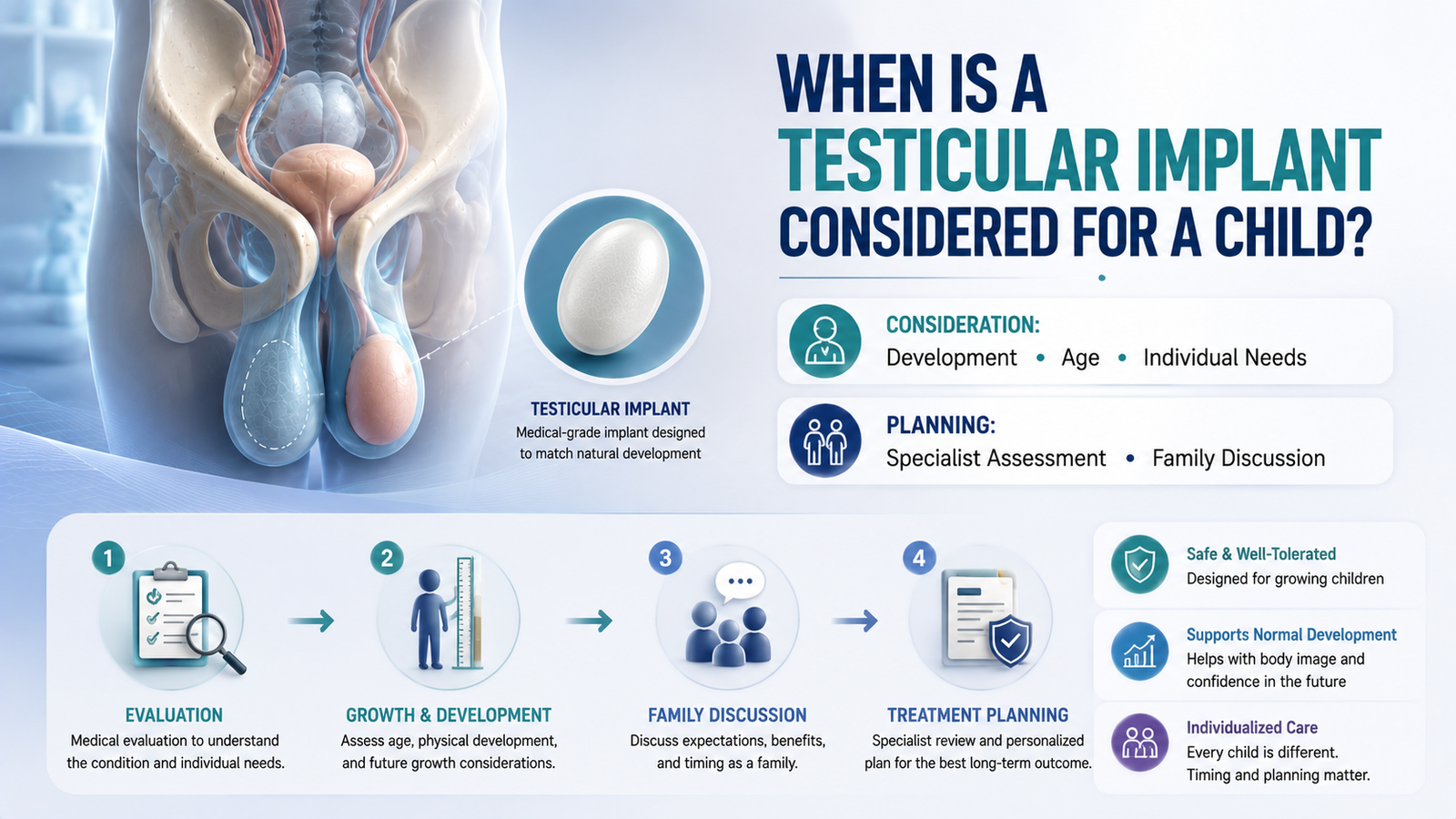
A child testicular implant, also called a pediatric testicular prosthesis, may be considered when one testicle is absent because of a congenital condition, previous removal, illness, trauma, or another medical reason. The purpose of the implant is primarily reconstructive: it creates the appearance and presence of a testicle within the scrotum. Elegance Clinic’s dedicated testicular implant service also describes the procedure as an option for congenital absence or loss of a testicle.
One of the most important things for parents to understand is what the implant cannot do. A prosthesis is not living testicular tissue. It does not produce testosterone or sperm and does not restore fertility. Its purpose is mainly to improve physical symmetry and appearance.
Not every child with an absent testicle automatically needs an implant. The reason for the missing testicle, the child’s current anatomy, age and development, previous operations, available tissue, implant size, and family preferences can all influence the decision.
Parents considering this option can first review the clinic’s dedicated Testicular Implant service to understand the procedure before discussing whether it is appropriate for their child.
Key Takeaways
- A testicular implant replaces appearance, not testicular function.
- Children may have an absent testicle for congenital or acquired reasons.
- Not every child requires a prosthesis.
- There is no single ideal age that applies to every child.
- Implant size and future growth need consideration.
- A prosthesis does not produce sperm or testosterone.
- Later reassessment or replacement may sometimes be necessary.
- Treatment planning should consider the child’s long-term needs, not only immediate symmetry.
What Exactly Is a Testicular Implant?
A testicular implant is a prosthetic device placed within the scrotum to reproduce the shape and presence of an absent testicle.
Elegance Clinic’s Aesthetic Genital Surgery services include testicular implant treatment among reconstructive genital procedures. The clinic notes that implants are available in different sizes to meet different patient requirements.
The prosthesis should not be confused with transplantation of a functioning testicle.
It provides a physical replacement for appearance but does not become biologically active.
Why Might a Child Need a Testicular Prosthesis?
There are different circumstances in which parents may be offered a discussion about an implant.
A child may have been born without normally developed testicular tissue. Another child may have lost a testicle after severe torsion, trauma, illness, or surgery.
The underlying condition matters because the first priority is always appropriate management of the medical problem itself.
The implant is a separate reconstructive decision.
For example, when a testicle has been removed because it could not safely be preserved, placing a prosthesis does not reverse that medical event. Instead, it may later help recreate a more balanced external appearance.
Does Every Child With One Testicle Missing Need an Implant?
No. A testicular prosthesis is not automatically required simply because one testicle is absent.
The need is different from treatments required to protect the child’s physical health.
For some families, reconstruction may be considered because of visible asymmetry or concern about how the child may feel about the difference as they mature. Other families may prefer to wait until the child is older and can participate more actively in the decision.
The important question is therefore not only “Can an implant be placed?”
It is also:
“What benefit would placing it at this stage provide for this child?”
That distinction helps keep the decision centred on the child’s individual circumstances.
At What Age Can a Child Have a Testicular Implant?
There is no universal age at which every child should receive a prosthesis.
Timing may depend on the reason for testicular absence, previous surgery, scrotal development, available tissue, implant sizing, expected growth, and whether another operation is already planned.
Earlier placement may have certain reconstructive considerations, while waiting until later development can provide different advantages.
Parents should also remember that a prosthesis itself does not grow with the child.
For this reason, the possibility of future reassessment should be discussed before an implant is placed at a younger age.
Can the Implant Restore Hormones or Fertility?
No. A testicular prosthesis cannot produce testosterone, sperm, or fertility.
This is one of the most important expectations to establish before surgery.
If parents are concerned about puberty, hormone production, fertility, or the function of the remaining biological testicle, those questions need separate medical assessment.
The prosthesis should therefore be viewed as a reconstructive implant, not a functional replacement organ.
How Is the Right Implant Size Chosen?
Implant selection should consider the child’s anatomy and available space rather than simply choosing the largest possible prosthesis.
The opposite side, scrotal development, age, tissue condition, and expected appearance can influence sizing.
For a younger child, future growth is particularly relevant.
An implant that appears proportionate during childhood may not necessarily remain proportionate through later development. This does not mean every childhood implant must be replaced, but families should understand that later reassessment may sometimes be appropriate.
What Happens During Testicular Implant Surgery?
During surgery, the prosthesis is positioned within the scrotum through an appropriately planned surgical approach.
The precise technique can vary according to the child’s anatomy, previous procedures, scarring, tissue condition, and implant selected.
The operation is performed using appropriate anaesthesia, and the surrounding tissues need to be handled carefully to provide suitable coverage and positioning for the implant.
Parents should receive procedure-specific information rather than assuming every pediatric testicular implant operation follows exactly the same surgical plan.
What Is Recovery Like After Surgery?
Recovery varies between children.
Temporary swelling, bruising, tenderness, and discomfort can occur during early healing. Activity may need to be restricted for a period according to the procedure and the surgeon’s instructions.
Parents should follow advice regarding wound care, bathing, clothing, activity, medication, and follow-up appointments.
Unexpected increasing redness, wound separation, significant swelling, discharge, fever, or worsening pain should be reported to the treating medical team.
Can a Testicular Implant Need Replacement Later?
Yes, replacement or revision can sometimes become appropriate, but it is not inevitable for every patient.
A child can grow considerably after an implant is placed. Later evaluation may therefore consider whether the implant remains appropriate in size, position, appearance, and comfort.
Revision may also become necessary if complications occur.
This possibility should be part of the original discussion so that parents understand the procedure as long-term reconstructive care, rather than assuming that childhood placement can never require another decision.
What Are the Possible Risks?
Like other surgical implants, testicular prostheses have potential risks.
These can include infection, bleeding, wound-healing difficulties, scarring, discomfort, implant movement or an unsatisfactory position, asymmetry, extrusion, and the possibility of revision or removal.
Perfect symmetry with the natural opposite testicle also cannot be guaranteed.
Individual risk can be influenced by previous surgery, tissue quality, anatomy, implant size, and general health.
Should the Child Be Involved in the Decision?
As children become developmentally capable of understanding their condition, their views can become increasingly relevant.
A young child’s medical decisions are primarily made by parents or guardians together with clinicians. An older child or adolescent, however, may have personal feelings about their body, asymmetry, surgery, or whether they want an implant.
This makes communication important.
The aim should not be to create anxiety about normal appearance. Instead, age-appropriate discussion can help the child understand why an implant is being considered and what it can realistically achieve.
Reconstructive Planning With Dr. Ashutosh Shah
Pediatric reconstruction often requires thinking beyond the immediate operation. Growth, previous surgery, tissue availability, expected appearance, and the possibility of future procedures can all influence planning.
Dr. Ashutosh Shah is the Founder and Director of Elegance Clinic and holds M.Ch. and DNB qualifications in Plastic Surgery. His professional background includes plastic, cosmetic, reconstructive, and microvascular surgery.
Parents can review Dr. Ashutosh Shah’s profile and qualifications as part of researching their child’s reconstructive options.
Questions Parents Can Ask Before Choosing an Implant
Before making a decision, parents may find it useful to discuss why the implant is being considered now, whether waiting is reasonable, how the size will be selected, what appearance can realistically be achieved, whether another procedure could be needed after growth, and what complications should be watched for.
These questions can help shift the discussion from simply having an implant to developing an appropriate long-term reconstructive plan.
Conclusion
A child testicular implant may be considered when a testicle is absent and reconstruction of the scrotal appearance is desired.
The implant can improve physical symmetry, but it cannot reproduce the biological functions of a natural testicle. It does not produce sperm, hormones, or fertility.
There is also no single age or treatment plan that is appropriate for every child. Timing should take into account the underlying condition, previous procedures, anatomy, development, future growth, implant sizing, and the child’s needs.
For families considering surgery, understanding both the benefits and limitations of a prosthesis is an important part of making an informed decision.
About Elegance Clinic
Elegance Clinic provides cosmetic, plastic, and reconstructive surgical care under the leadership of Dr. Ashutosh Shah. Its official website lists a dedicated testicular implant service within its aesthetic genital surgery offerings.
Families who want additional background about the clinic, its approach, and Dr. Shah’s surgical experience can visit the About Elegance Clinic and Dr. Ashutosh Shah page.
A Different Next Step for Parents
Choosing a prosthesis for a child does not need to begin with deciding yes or no to surgery. A more useful first step is understanding why the testicle is absent, whether reconstruction offers a meaningful benefit now, and what waiting could mean for future treatment.
When your family is ready to discuss those questions, the Elegance Clinic Contact Us page provides options for reaching the clinic and arranging an individual consultation.
Frequently Asked Questions
1. Is a testicular implant necessary for every child with an absent testicle?
No. It is generally a reconstructive option rather than an automatic requirement.
2. Does a testicular implant work like a natural testicle?
No. It provides shape and appearance but does not produce testosterone or sperm.
3. Can a testicular prosthesis improve fertility?
No. The prosthesis itself has no reproductive function.
4. What is the best age for a child to receive an implant?
There is no universal best age. Timing should be individualised according to anatomy, development, previous treatment, and other factors.
5. Does a testicular implant grow as the child grows?
No. The implant itself does not grow, so later reassessment may sometimes be appropriate.
6. Can the implant be replaced in the future?
Yes. Revision or replacement may sometimes be considered because of growth, position, size, symptoms, or complications.
7. Will both sides look exactly identical after surgery?
Perfect symmetry cannot be promised. The aim is generally to create a more balanced appearance.
8. Can parents choose to wait until their child is older?
Depending on the child’s medical circumstances, delayed reconstruction may be an option worth discussing with the treating specialists.

