

|
Getting your Trinity Audio player ready...
|
✓ Medically reviewed by Dr. Ashutosh Shah, Plastic, Reconstructive & Cosmetic Surgeon (M.Ch., DNB)
Clinical insight from:
Dr. Ashutosh Shah — M.Ch., DNB (Plastic Surgery)
Founder & Director, Elegance Clinic
Board-Certified Plastic, Reconstructive & Cosmetic Surgeon
Surgical Experience: 22+ Years
Updated: September 2026
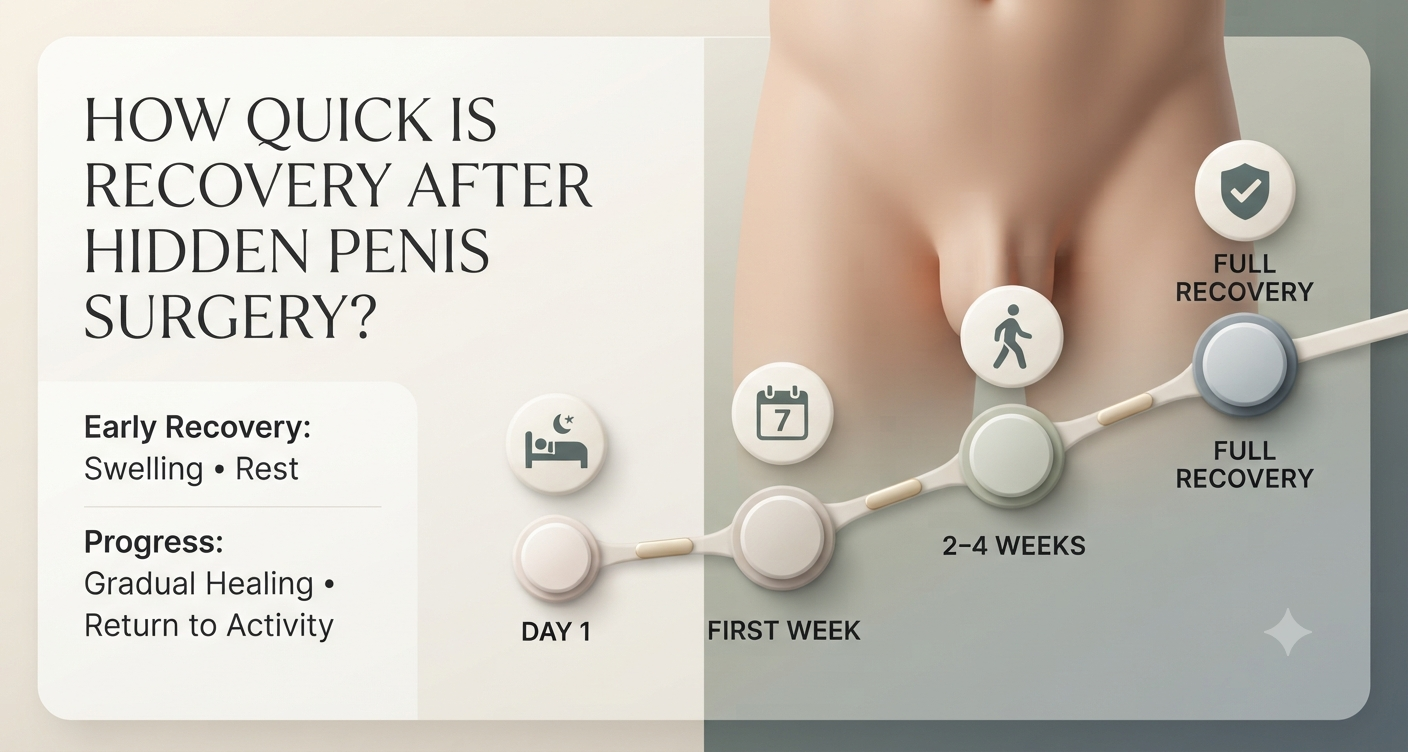
People considering hidden penis surgery often want to know how quickly they can return to normal life. The answer depends on an important distinction: early wound recovery is not the same as complete surgical healing.
A quick recovery after hidden penis surgery should therefore not mean rushing back to normal activity. Recovery depends on the cause of the hidden or buried penis, the type and extent of reconstruction, tissue quality, wound healing and whether additional procedures are required.
Some patients may undergo relatively limited correction, while others require more extensive reconstructive surgery. Their recovery timelines cannot reasonably be identical.
Recovery Starts Before the Operation
One factor patients often overlook is that recovery planning begins during surgical assessment.
Hidden or buried penis can occur in different clinical circumstances. The operation therefore needs to be designed around the underlying anatomy rather than simply trying to expose more of the penis.
The extent of surgery can influence:
Wound size → Swelling → Mobility → Dressing requirements → Follow-up → Return to routine
A smaller procedure and a more extensive reconstruction should not be expected to have the same recovery experience.
Stage 1: The Early Healing Period
Immediately after surgery, the priority is protecting the operated tissues.
Swelling, bruising, tenderness and discomfort can occur during the early period. Dressings and wound-care requirements depend on the procedure performed.
This is not the stage to judge the final appearance.
Postoperative swelling can temporarily alter the appearance of the surgical area.
Stage 2: Wound Care Becomes the Priority
As early swelling begins to settle, attention shifts toward wound healing.
Patients should follow their surgeon’s instructions about:
- keeping the area clean,
- dressing care,
- activity restrictions,
- prescribed medication,
- and follow-up appointments.
Because hidden penis surgery can involve different reconstructive techniques, generic online aftercare instructions should not replace the patient’s own postoperative plan.
Stage 3: Returning to Everyday Activities
Feeling better does not necessarily mean that deeper tissues have completed healing.
Return to routine depends on what the activity involves.
Desk-based work may have different demands from work requiring heavy lifting, prolonged physical activity or significant friction around the surgical region.
Patients should therefore discuss their occupation and normal activities before surgery so that recovery expectations can be planned realistically.
Stage 4: Swelling Continues to Change
Postoperative swelling does not always disappear immediately.
The appearance during early recovery may therefore differ from the later surgical outcome.
This is particularly important for patients who become concerned about symmetry, contour or appearance shortly after surgery.
Early photographs should not automatically be interpreted as the final result.
Why Do Some Patients Recover More Quickly Than Others?
There is no universal hidden penis surgery recovery calendar.
Healing may be influenced by:
Extent of reconstruction: More extensive surgery may require a longer recovery.
Tissue condition: Previous scars or altered tissue can affect surgical planning.
Individual healing: People naturally recover at different rates.
Associated medical factors: General health can influence wound healing.
Postoperative care: Following wound and activity instructions supports appropriate recovery.
Complications: Infection, wound separation or other problems can delay healing.
What Can Slow Down Recovery?
Trying to accelerate recovery by ignoring restrictions can sometimes have the opposite effect.
Excessive friction, premature strenuous activity, poor wound care or missing follow-up may create unnecessary problems.
A genuinely efficient recovery is one in which tissues are allowed to heal appropriately without preventable setbacks.
What Does “Quick Recovery” Really Mean?
For reconstructive surgery, quick recovery should mean:
Appropriate healing + manageable symptoms + progressive return to routine + absence of significant complications
It should not mean:
Rushing activity + ignoring swelling + skipping wound care + expecting immediate final results
This distinction helps establish realistic expectations before surgery.
When Is Recovery Not Progressing Normally?
Patients should contact their treating team if symptoms become progressively worse rather than better.
Important warning signs can include:
- increasing pain,
- rapidly worsening swelling,
- spreading redness,
- fever,
- unusual or foul-smelling discharge,
- significant bleeding,
- wound separation,
- or another unexpected postoperative change.
These symptoms require professional assessment rather than self-treatment.
Can Surgical Planning Influence Recovery?
Yes.
The operation should address the patient’s specific anatomical problem while preserving appropriate tissue and function.
This requires evaluation of the surrounding skin, soft tissue, previous surgery or scars and the underlying reason for the hidden appearance.
The reconstructive approach at Elegance Clinic is based on individual anatomy rather than using the same operation for every patient.
Can You Speed Up Hidden Penis Surgery Recovery?
There is no reliable shortcut that makes surgical tissues heal instantly.
Patients can instead focus on avoiding unnecessary delays by:
- following wound-care instructions,
- taking prescribed medicines as directed,
- avoiding restricted activities,
- attending scheduled follow-up,
- reporting unusual symptoms early,
- and allowing sufficient time for tissue healing.
The goal is smooth recovery, not artificially fast recovery.
When Can the Final Result Be Judged?
Not immediately after surgery.
Early swelling and tissue changes can temporarily affect appearance. As healing progresses, swelling settles and tissues gradually stabilize.
The appropriate time for evaluating the outcome depends on the procedure performed and individual recovery.
Patients should therefore avoid judging the final result during the earliest postoperative period.
Recovery Is Part of the Surgery, Not an Afterthought
A successful treatment plan includes both the operation and what happens afterward.
The patient should understand:
What will be corrected → What early recovery may feel like → How the wound should be cared for → Which activities are restricted → What warning signs matter → When follow-up is required
This makes recovery more predictable and reduces unrealistic expectations.
FAQs
Is hidden penis surgery recovery fast?
Recovery varies according to the extent of surgery and individual healing.
Will there be swelling after surgery?
Temporary postoperative swelling can occur.
When can I return to work?
It depends on the procedure and whether your work is sedentary or physically demanding.
Can I exercise immediately?
Activity restrictions are usually required during early healing. Follow your surgeon’s postoperative plan.
Can recovery be accelerated?
There is no safe way to force tissues to heal instantly. Appropriate care can help avoid unnecessary delays.
When can I see the final result?
The early postoperative appearance is not the final result because swelling and tissue healing continue.
What can delay recovery?
Complications, inappropriate activity, wound problems and individual healing factors may extend recovery.
Focus on Better Healing, Not the Fastest Timeline
Hidden penis surgery is reconstructive treatment, so recovery should be measured by safe wound healing and progressive return to normal activities, not simply by the smallest possible number of days.
Dr. Ashutosh Shah, Founder & Director of Elegance Clinic, has more than 22 years of experience in plastic, reconstructive and cosmetic surgery. His professional qualifications and surgical background are available on Dr. Ashutosh Shah’s profile.
If you are considering surgical correction, contact Elegance Clinic for an individual evaluation and procedure-specific recovery guidance.

