

|
Getting your Trinity Audio player ready...
|
✓ Medically reviewed by Dr. Ashutosh Shah, Plastic, Reconstructive & Cosmetic Surgeon (M.Ch., DNB)
Reviewed for medical accuracy
Dr. Ashutosh Shah, M.Ch., DNB (Plastic Surgery)
Board-Certified Plastic, Reconstructive & Cosmetic Surgeon
Founder & Director, Elegance Clinic
22+ Years of Surgical Experience
Updated: September 2026
Testicular implant surgery, also known as testicular prosthesis surgery, may be considered when one or both testicles are absent. The implant is primarily intended to restore the appearance and feel of the scrotum rather than replace the hormonal or reproductive function of a natural testicle.
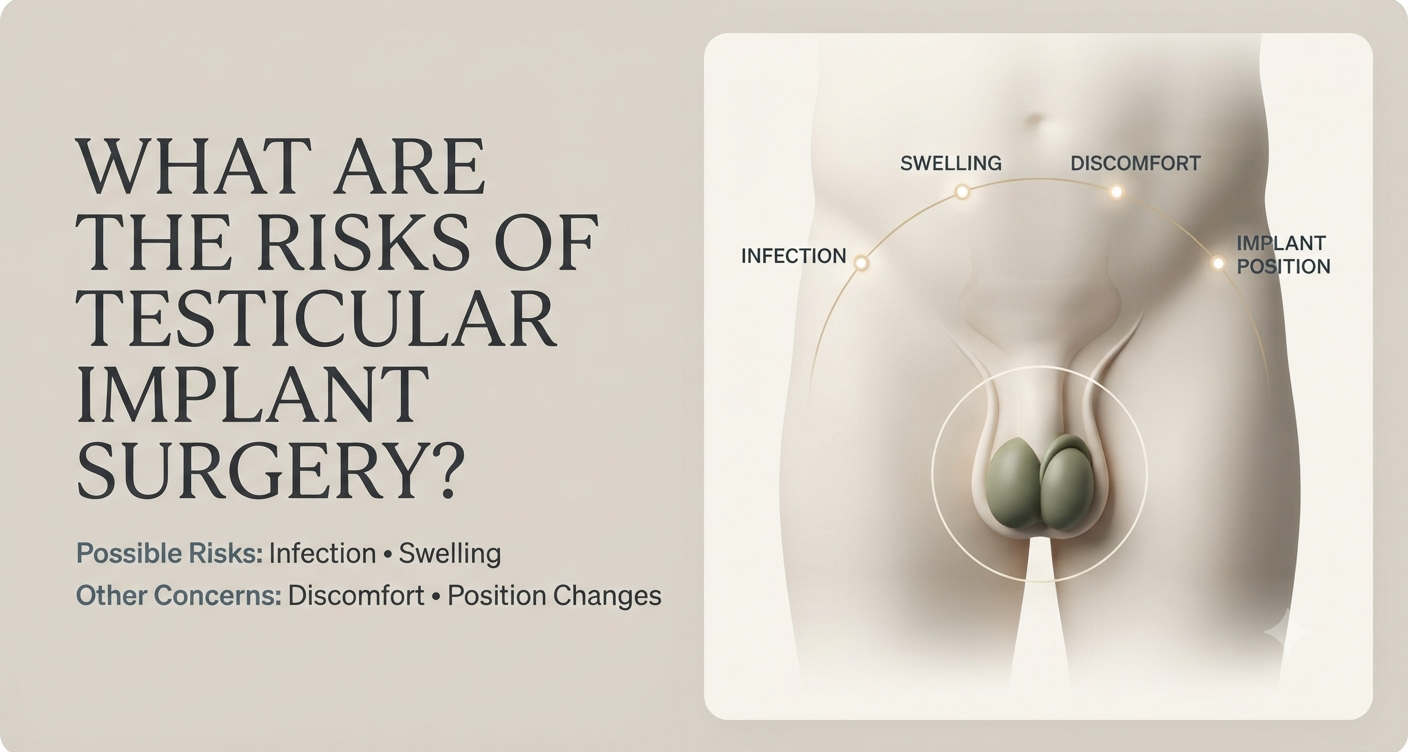
Like any surgical procedure involving an implant, it has potential complications. Understanding the risks of testicular implant surgery before treatment helps patients make a more informed decision and recognize problems that may require medical attention during recovery.
Rather than asking whether the procedure is completely safe or risky, it is more useful to understand what can go wrong, how often individual risks matter clinically, and what factors can influence them.
What Does a Testicular Implant Actually Do?
A testicular prosthesis is designed to occupy the space of a missing testicle and improve scrotal symmetry.
It is important to understand what it does not do.
A prosthetic testicle does not produce sperm and does not function as a hormone-producing natural testicle. Its purpose is primarily reconstructive and cosmetic.
This distinction should be clear before surgery.
The Risks Can Be Divided Into Three Groups
Instead of treating every complication as the same, the risks are easier to understand when separated into:
1. General Surgical Risks
These can occur with many operations and may include:
- bleeding,
- swelling,
- bruising,
- infection,
- discomfort,
- wound-healing problems,
- and scarring.
2. Implant-Specific Risks
Because a foreign implant is being placed in the body, additional concerns can include implant displacement, an undesirable position, firmness, asymmetry or implant-related infection.
3. Appearance and Satisfaction Concerns
Even when surgery heals without a major medical complication, the final appearance or feel may differ from what the patient expected.
Understanding all three categories is important.
Is Infection Possible After Testicular Implant Surgery?
Yes. Infection is one of the important potential complications of any implant-based procedure.
Signs such as increasing redness, worsening pain, unusual discharge, fever or progressive swelling should be assessed promptly.
In significant implant infections, additional treatment may be necessary. In some circumstances, removal of the implant can become necessary.
This is one reason careful surgical technique and postoperative monitoring matter.
Can the Implant Move?
Implant position can change.
A prosthesis that sits too high, too low or in an undesirable orientation may create visible or physical asymmetry.
The surgeon therefore considers the available scrotal tissue, implant size and positioning during treatment planning.
Perfect symmetry cannot be guaranteed because natural anatomy also varies between individuals.
Can the Body Reject a Testicular Implant?
Patients sometimes describe implant complications as “rejection,” but this term can be misleading.
A prosthesis is a foreign material, so the body naturally forms tissue around it. Problems can occur if there is infection, excessive scar response, poor positioning or another implant-related complication.
A qualified surgeon can explain the specific implant-related risks relevant to the planned procedure.
Will a Testicular Implant Feel Exactly Like a Natural Testicle?
Not necessarily.
A prosthetic testicle is designed to approximate the appearance and volume of a natural testicle, but it is still an implant.
Differences may remain in:
- firmness,
- movement,
- position,
- shape,
- and sensation.
Realistic expectations are therefore an important part of preoperative counselling.
Does Implant Size Matter?
Yes.
Choosing an implant is not simply about selecting the largest possible size.
The surgeon considers existing anatomy, the opposite testicle when present, available scrotal space and soft-tissue characteristics.
An inappropriate implant size may contribute to discomfort or an unnatural appearance.
What Can Increase the Risk of Complications?
Risk is influenced by both surgical and patient-related factors.
Relevant considerations can include tissue quality, previous surgery, scarring, active infection, wound-healing capacity and postoperative care.
This is why individual assessment matters before implant surgery is recommended.
At Elegance Clinic, reconstructive procedures are planned after considering anatomy, medical history, expectations and surgical suitability rather than treating every patient with an identical approach.
What Should Recovery Normally Look Like?
Some swelling, bruising and discomfort can occur during early healing.
These symptoms should generally move toward improvement rather than progressively becoming more severe.
Patients receive postoperative instructions according to their procedure and should follow the treating surgeon’s recommendations regarding wound care, activity and follow-up.
Which Warning Signs Need Medical Attention?
Contact the treating team if there is:
- worsening rather than improving pain,
- rapidly increasing swelling,
- spreading redness,
- fever,
- unusual wound discharge,
- significant bleeding,
- wound opening,
- or a noticeable unexpected change in implant position.
Early assessment can help identify whether a symptom represents normal healing or a complication.
How Can Surgical Risks Be Reduced?
No surgeon can remove every possible risk, but appropriate planning can help manage them.
Important factors include suitable patient selection, correct implant choice, sterile surgical technique, appropriate positioning, postoperative wound care and scheduled follow-up.
Patients should also disclose relevant medical conditions, previous operations and medications before surgery.
The Most Important Question Before Surgery
The decision should not be based only on:
“Can I get an implant?”
A more useful discussion is:
Why do I want the implant? → Is my anatomy suitable? → What can it realistically achieve? → What are my individual risks? → What happens if a complication develops?
This produces a more informed surgical decision.
FAQs
Is testicular implant surgery safe?
It can be performed in appropriately selected patients, but like all surgery it carries potential complications.
Can a testicular implant become infected?
Yes. Implant-related infection is a recognized potential complication.
Can the implant move after surgery?
Implant displacement or an undesirable position can occur.
Does a prosthetic testicle produce sperm?
No. Its purpose is primarily reconstructive and cosmetic.
Does the implant produce testosterone?
No. A prosthetic testicle does not replace the hormone-producing function of a natural testicle.
Will both sides look exactly identical?
Perfect symmetry cannot be guaranteed.
Can a testicular implant need another operation?
In some cases, complications or dissatisfaction with position may make revision or implant removal necessary.
Making an Informed Decision
Testicular implant surgery can help restore scrotal volume and appearance when a testicle is absent, but the decision should include a realistic discussion about infection, implant position, scarring, healing, sensation and aesthetic limitations.
Dr. Ashutosh Shah has 22+ years of surgical experience across plastic, reconstructive and cosmetic surgery. You can review Dr. Ashutosh Shah’s profile for more information about his professional background.
For an individual surgical assessment, contact Elegance Clinic.

