

|
Getting your Trinity Audio player ready...
|
✓ Medically reviewed by Dr. Ashutosh Shah, Plastic, Reconstructive & Cosmetic Surgeon (M.Ch., DNB)
Written by Dr. Ashutosh Shah, M.Ch., DNB (Plastic Surgery)
Director, Elegance Clinic, Surat
Dr. Ashutosh Shah is a Board-Certified Plastic, Cosmetic and Reconstructive Surgeon with more than 22 years of surgical experience in cosmetic and reconstructive procedures.
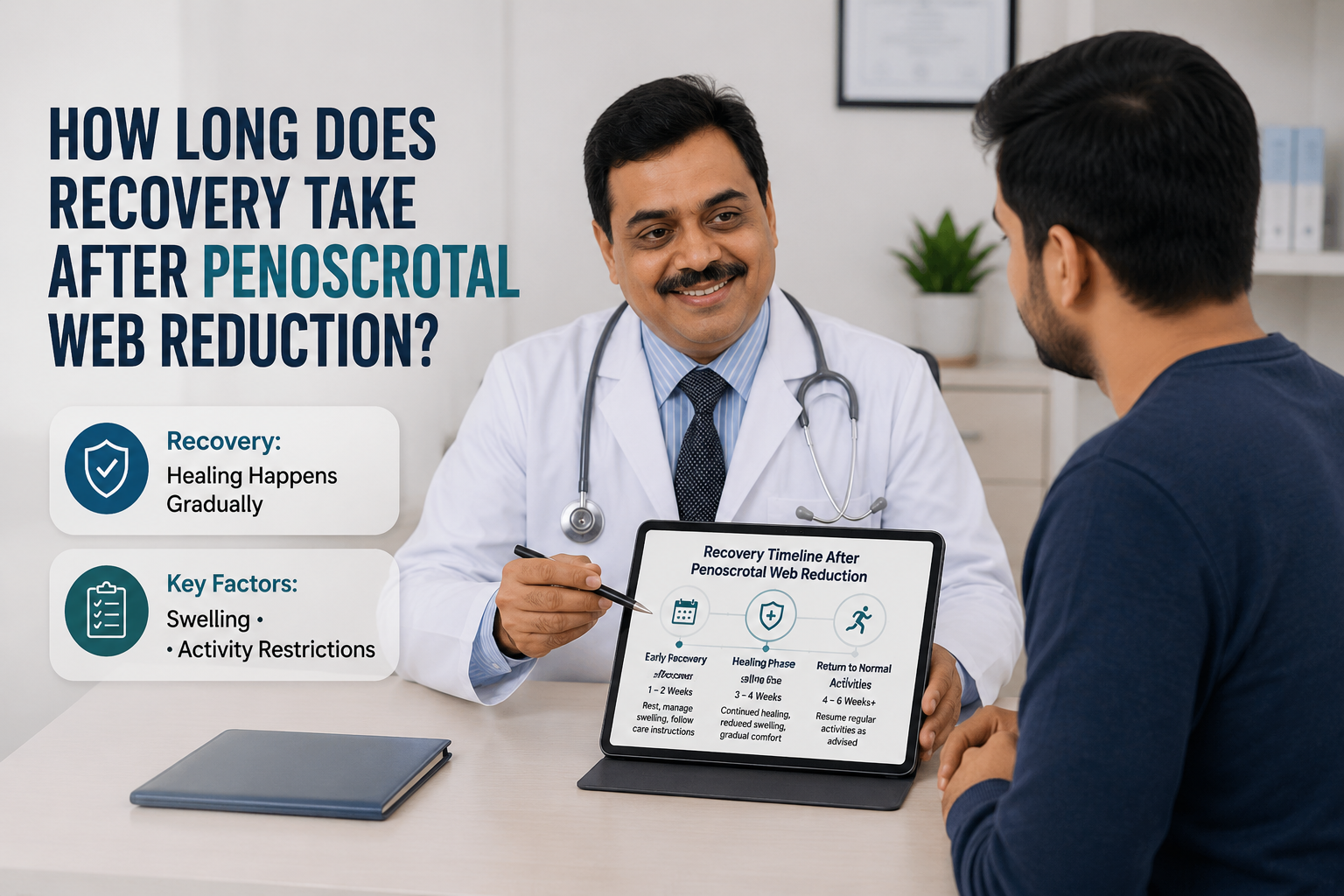
Recovery after penoscrotal web reduction is not the same for everyone. The healing period depends on how extensive the webbing is, how much skin needs to be reshaped, whether the procedure is combined with another operation, and how the individual’s tissues respond during healing.
For many patients, the early part of recovery is mainly about allowing the operated area to settle. Swelling, tenderness, tightness, and changes in how the skin feels can make the area seem different from the expected final result. These early changes gradually improve as the incision strengthens and the tissues adapt.
Penoscrotal web reduction is performed to correct the skin connection between the underside of the penis and scrotum. It may be considered when the webbing creates an unusual appearance, causes tension during erections, interferes with sexual activity, or produces functional discomfort. Published surgical reports show that healing and complication patterns can vary with the technique and severity of the condition.
Because this is a specialised procedure, recovery should be discussed with the surgeon performing it rather than relying on a fixed number of days.
Key Takeaways
- Penoscrotal web reduction generally requires several weeks rather than a few days of healing.
- Early swelling and tenderness do not represent the final appearance.
- Daily activity can usually increase gradually as the incision becomes stronger.
- Exercise and sexual activity require a longer recovery period than ordinary light activity.
- The appearance of the treated area can continue to refine after the wound has initially healed.
- Recovery can be longer when the correction is extensive or combined with another procedure.
- Follow-up is important to make sure the incision and reconstructed skin are healing properly.
What Should You Expect Immediately After Surgery?
The first stage is usually about protecting the newly reshaped skin. The area can feel tender, tight, or swollen, and sitting or walking may feel different for a short period.
The appearance may also be misleading at this stage. Swelling can make the skin look fuller or less even than it will later. A small amount of bruising or sensitivity may also occur.
The priority during this period is not to judge the cosmetic result. It is to allow the surgical area to settle without unnecessary tension, rubbing, or pressure.
The treating surgeon may provide specific instructions regarding dressing, hygiene, clothing, activity, and follow-up. Those instructions should take priority over general information.
What Happens During the First Two Weeks?
The first two weeks are mainly a transition from immediate postoperative care toward normal daily life.
As discomfort decreases, patients can usually become more mobile. However, the wound is still developing strength beneath the surface even when it looks reasonably good externally.
This is why patients may need to limit activities that repeatedly stretch or compress the treated area.
Work requirements also matter. Someone working at a desk may be comfortable sooner than someone whose job involves prolonged walking, lifting, climbing, or other physical activity.
The goal is gradual progress rather than rushing back to a normal routine.
When Can You Walk Normally?
Walking is usually possible during recovery, but comfort can vary during the first few days. The amount of movement that feels comfortable depends on swelling, tenderness, the extent of the correction, and individual healing.
Light movement can be useful during recovery, while prolonged or strenuous activity may need to wait.
If walking becomes increasingly painful rather than gradually easier, the treating surgeon should be informed.
When Can You Return to Exercise?
Exercise should be reintroduced in stages.
Activities that create repeated movement, pressure, friction, or stretching around the groin should not be resumed simply because the skin incision looks closed.
Running, cycling, gym exercises, heavy lifting, and sports may require a longer pause than everyday walking.
A sensible progression is:
Early healing: Focus on comfortable movement and protecting the surgical area.
Intermediate healing: Gradually increase normal activity if the wound is settling well.
Later recovery: Resume more demanding exercise when the surgeon confirms that the tissues are sufficiently healed.
There is no universal “safe day” for every patient.
When Can Sexual Activity Resume?
Sexual activity requires more caution because erections and sexual movement place stress on the reconstructed area.
Waiting until the wound has healed adequately helps reduce the risk of pain, bleeding, wound separation, or excessive tension on the developing scar.
Some clinical guidance places complete recovery for webbed-penis surgery at roughly several weeks, but the appropriate timing depends on the individual procedure and healing progress.
Patients should therefore obtain clearance from their treating surgeon rather than using another person’s recovery as a timetable.
How Long Does Swelling Last?
Swelling generally decreases gradually rather than disappearing suddenly.
The amount can depend on:
- The severity of the original webbing
- The amount of tissue repositioned
- The surgical technique
- Whether another procedure was performed
- Individual healing
A treated area may look different from day to day during the early phase. This does not necessarily mean that the surgical result is changing permanently.
As swelling settles, the angle between the penis and scrotum becomes easier to assess and the scar begins to soften.
When Does the Final Result Become Clear?
The final appearance should be assessed after the tissues have had time to mature.
A wound can appear healed on the surface while deeper tissues are still adapting. The scar may initially feel firm or look more noticeable and then gradually become less prominent.
In a published adult case of secondary penoscrotal webbing, the incision was healing normally at an early postoperative review, with further symptomatic and cosmetic improvement documented at two months.
That does not mean every patient reaches the same stage at two months. It simply demonstrates why recovery should be viewed as a process rather than a single deadline.
What Can Make Recovery Slower?
Healing may take longer when the procedure involves more extensive reconstruction or when the patient’s tissues have additional challenges.
Factors that can influence recovery include:
- Larger or more complicated webbing
- Additional procedures performed at the same time
- Smoking
- Medical conditions affecting wound healing
- Infection
- Excessive tension on the wound
- Poor postoperative care
- Individual differences in scar formation
Previous surgery or scarring in the region may also influence the surgical plan.
This is why a surgeon should discuss the expected recovery based on the actual anatomy rather than giving an overly precise promise.
What Problems Should Not Be Ignored?
Some swelling and discomfort are expected. What matters is the direction of recovery.
Contact your surgeon if you notice:
- Pain that is becoming stronger rather than improving
- Rapidly increasing swelling
- Persistent or significant bleeding
- Increasing redness or warmth
- Unusual discharge
- Fever
- Separation of the wound
- Difficulty passing urine
- A sudden change that concerns you
These symptoms do not automatically mean a serious complication, but they deserve professional assessment.
Can the Surgery Leave a Scar?
Yes. Any procedure involving an incision can produce a scar.
The appearance of the scar depends on the incision design, surgical technique, skin characteristics, and individual healing. The scar can initially be more noticeable and gradually change in colour, texture, and firmness.
The purpose of surgery is not to eliminate every visible sign of an incision. It is to correct the webbing while creating a balanced and functional result with a reasonable scar.
When Should You See a Specialist?
Consider a specialist consultation when penoscrotal webbing causes:
- Tension during erections
- Discomfort during sexual activity
- Difficulty with the appearance of the penis-scrotum junction
- Functional concerns
- Persistent dissatisfaction after previous treatment
- A problem following circumcision or another procedure
An examination is important because the extent and cause of penoscrotal webbing can vary.
Published surgical literature describes several repair techniques, and the appropriate reconstruction depends on the specific anatomy.
Frequently Asked Questions
Q: How long does recovery take after penoscrotal web reduction?
A: Most patients need several weeks for healing, with the early discomfort improving first and the final tissue appearance developing more gradually.
Q: Is swelling normal after surgery?
A: Yes. Swelling is common during early healing and should generally decrease over time.
Q: When can I return to work?
A: This depends on your job. Desk-based work may be easier to resume than physically demanding work, but the incision should be healing comfortably.
Q: When can I exercise again?
A: Exercise should be restarted gradually after the wound has strengthened. High-impact activities may need a longer recovery period.
Q: When can sexual activity resume?
A: Sexual activity should generally wait until the surgical area has adequately healed and the surgeon confirms that it is safe to resume.
Q: Will the final appearance be visible immediately?
A: No. Swelling can temporarily alter the appearance, and the scar and surrounding tissues continue changing during recovery.
Q: Can penoscrotal web reduction be performed again?
A: Revision surgery may sometimes be considered when residual or recurrent problems occur, but the need depends on the anatomy and the original surgical result.
About Dr. Ashutosh Shah and Elegance Clinic
Dr. Ashutosh Shah, M.Ch., DNB (Plastic Surgery) is a Board-Certified Plastic, Cosmetic and Reconstructive Surgeon and Director of Elegance Clinic, Surat. He has more than 22 years of surgical experience and works across cosmetic and reconstructive surgery.
Elegance Clinic was established in Surat in 2014 and provides cosmetic surgery, plastic surgery, dermatology, hair restoration, laser treatments, and reconstructive procedures. The clinic focuses on individual assessment, careful treatment planning, patient safety, and natural-looking results.
Conclusion
Recovery after penoscrotal web reduction should be viewed as a gradual healing process rather than a fixed number of days. The first stage is usually marked by swelling, tenderness, and restricted activity, followed by a period in which the tissues become more comfortable and the surgical contour becomes easier to appreciate.
Walking and light daily activity can usually progress before more demanding activities such as exercise or sexual activity. The exact timing should depend on how the incision is healing and the advice of the surgeon who performed the procedure.
It is also important to remember that the appearance during the first days or weeks is not necessarily the final result. Scar maturation and tissue settling continue beyond the initial wound-healing stage.
If you are considering penoscrotal web reduction, an individual consultation with Dr. Ashutosh Shah at Elegance Clinic, Surat, can help you understand the expected healing process, activity restrictions, risks, and realistic outcome for your particular anatomy.
Book a consultation at Elegance Clinic, Surat, to discuss penoscrotal web reduction and your recovery expectations.

