

|
Getting your Trinity Audio player ready...
|
✓ Medically reviewed by Dr. Ashutosh Shah, Plastic, Reconstructive & Cosmetic Surgeon (M.Ch., DNB)
Written by Dr. Ashutosh Shah, M.Ch., DNB (Plastic Surgery)
Director, Elegance Clinic, Surat
Dr. Ashutosh Shah is a Board-Certified Plastic, Cosmetic and Reconstructive Surgeon with more than 22 years of surgical experience, including cosmetic and reconstructive procedures.
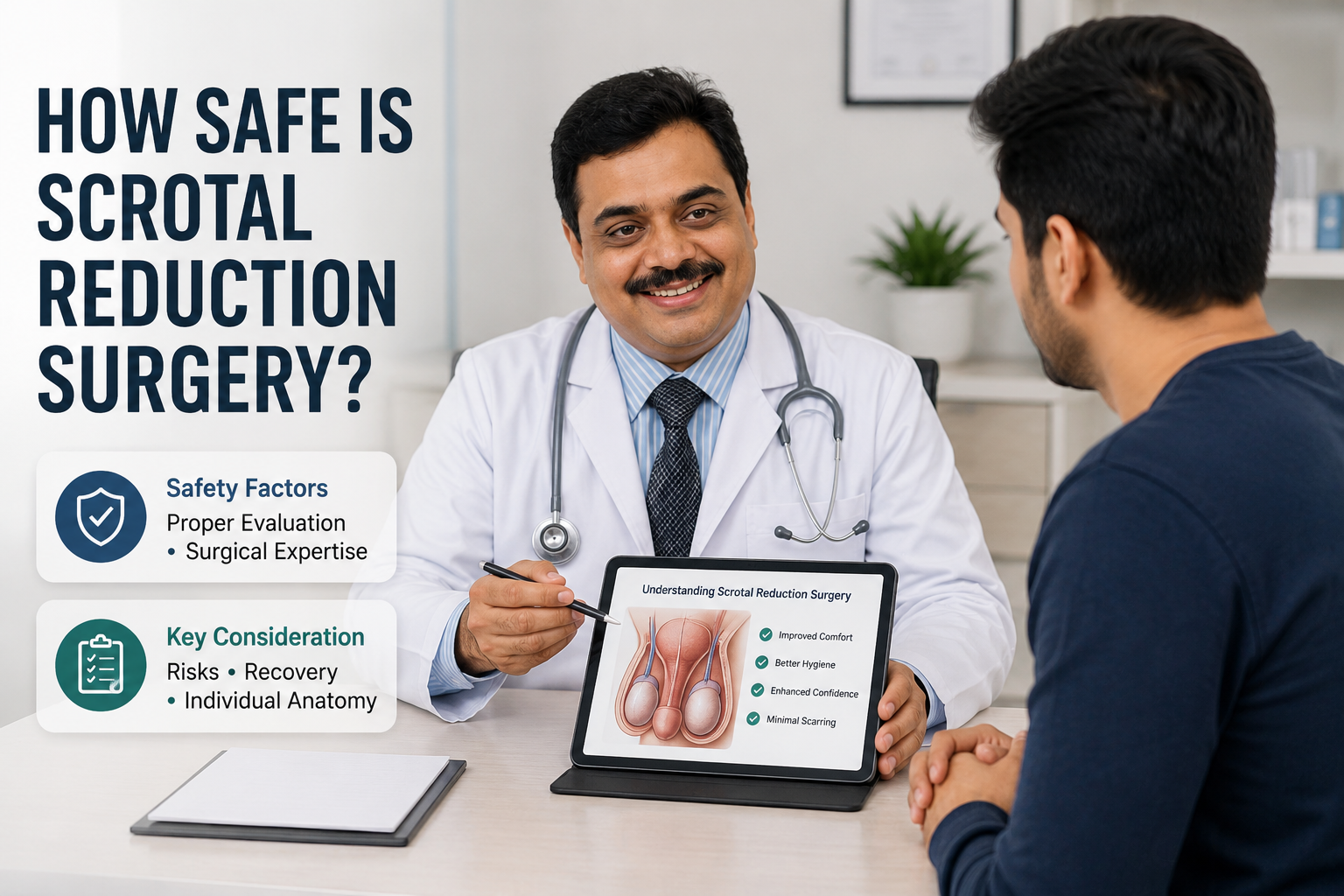
Scrotal reduction surgery is a procedure used to reduce excessive or loose scrotal skin when the appearance or size of the scrotum causes ongoing discomfort, movement-related irritation, clothing problems, or personal cosmetic concern. The procedure may also be considered when the scrotal skin has become more relaxed over time or after changes in weight and tissue elasticity.
The important question is not simply whether scrotal reduction surgery is safe, but whether it is appropriate for the individual patient and whether the planned correction matches the actual problem. The scrotum is a sensitive area containing skin, nerves, blood vessels, and structures that protect the testicles. Removing too little tissue may provide limited improvement, while removing too much can create discomfort or an unnatural result.
Like any operation, scrotal reduction has possible risks. These may include swelling, bruising, infection, bleeding, wound-healing problems, scarring, temporary changes in sensation, asymmetry, or the possibility of needing further treatment. Most concerns can be discussed during a detailed consultation before surgery.
This article explains what the procedure is intended to correct, how safety is assessed, what recovery can involve, and what patients should realistically expect from treatment.
Key Takeaways
- Scrotal reduction is intended to reduce excessive or loose scrotal skin and improve comfort or appearance.
- It is surgery, so temporary and procedure-specific complications are possible.
- Swelling, bruising, soreness, and temporary sensitivity changes can occur during healing.
- Careful tissue removal is important because excessive correction can affect comfort and appearance.
- Recovery is gradual, and the final result should not be judged immediately after surgery.
- A sudden change in scrotal size or a new lump should be medically evaluated before cosmetic surgery is considered.
- Individual examination is necessary to determine whether scrotal reduction is appropriate.
What Does Scrotal Reduction Surgery Actually Change?
Scrotal reduction focuses on the skin and soft-tissue envelope surrounding the testicles. The goal is to reduce excessive tissue and improve the way the scrotum hangs or fits against the body.
The procedure does not exist simply to make the area “smaller.” Surgical planning considers:
- How much skin is present
- Where the excess tissue is located
- Whether the problem is mainly cosmetic or functional
- How the scrotum sits during standing and movement
- Skin quality and elasticity
- Previous surgery or injury
- The patient’s expectations
When can excess scrotal skin become bothersome?
A person may notice:
- Pulling or heaviness
- Friction while walking or exercising
- Difficulty with certain clothing
- Discomfort during sexual activity
- Excessive movement of the tissue
- A cosmetic concern about the shape or position
Some degree of scrotal looseness is completely normal. Surgery is considered only when the concern is significant enough to justify an operation and the examination supports it.
How Safe Is Scrotal Reduction Surgery?
For a suitable patient, scrotal reduction can be performed with careful surgical planning. Safety depends on the patient’s health, the amount of tissue being removed, the surgical technique, wound care, and individual healing.
The operation is performed in a delicate anatomical region, so preserving healthy tissue is particularly important.
A preoperative consultation should establish whether the problem is actually excess skin. Enlargement can sometimes be related to swelling, fluid, a hernia, infection, or another condition. Cosmetic surgery should not be used to treat an undiagnosed medical problem.
That is why an examination comes before treatment planning.
What Are the Main Risks?
No surgical procedure is completely risk-free. With scrotal reduction, most patients are counseled about both expected healing effects and less common complications.
Swelling and bruising
The treated area may become swollen or bruised after surgery. This can make the result look larger or uneven during the early recovery period.
Bleeding
Small amounts of bleeding can occur after surgery. A larger collection of blood under the skin may require medical attention.
Infection
Any incision can become infected. Increasing redness, warmth, discharge, fever, or worsening pain should be reviewed by the treating surgeon.
Wound-healing problems
The scrotal area is exposed to movement, moisture, and friction, all of which can influence healing.
Scarring
An incision creates a scar. The final appearance depends on the incision design, individual skin characteristics, healing, and postoperative care.
Changes in sensation
Temporary numbness, tingling, or sensitivity can occur because small nerves may be affected by surgery. Sensation often changes as the tissues heal, although persistent changes are possible.
Asymmetry
The two sides of the scrotum are not naturally identical. Surgery aims for a balanced result but cannot guarantee perfect symmetry.
Could Scrotal Reduction Affect Sexual Function?
The purpose of the procedure is generally to address excess surrounding tissue rather than the testicles themselves. Even so, the area contains sensitive nerves, and temporary discomfort or altered sensation may occur during recovery.
Patients should discuss concerns about sexual function before surgery rather than assuming that healing will be identical for everyone.
Sexual activity is usually postponed during the initial healing period. The timing should be determined by the surgeon according to the extent of the operation and the patient’s recovery.
A return to activity should be based on healing rather than a fixed schedule copied from another patient.
What Happens During the Procedure?
The technique varies according to the patient’s anatomy and the amount of tissue that needs correction.
A typical surgical plan involves:
Examination and markings
The surgeon assesses the scrotal skin while considering how it sits naturally and where excess tissue is present.
Anaesthesia
The appropriate form of anaesthesia is selected based on the procedure and the patient’s medical circumstances.
Tissue adjustment
The surgeon removes or reshapes the necessary excess skin and soft tissue while aiming to preserve normal structures.
Closure
The remaining skin is carefully brought together and closed to create a balanced contour.
The objective is controlled correction, not maximum tissue removal. Good planning is particularly important because the scrotal skin has an important protective and temperature-regulating role.
What Is Recovery Like?
Recovery varies according to the amount of tissue treated and the individual’s healing response.
First few days
Swelling, bruising, tightness, soreness, and sensitivity can occur.
First couple of weeks
The tissues gradually settle, but discomfort may still be present with movement or prolonged sitting.
Later healing
The scar begins to mature and swelling continues to decline. The appearance can improve progressively rather than changing all at once.
During recovery, patients may need to temporarily reduce:
- Strenuous exercise
- Heavy lifting
- Cycling
- Activities causing repeated friction
- Sexual activity
The surgeon should provide individualized instructions because the safest return to activity depends on how the wound is healing.
Can Scrotal Reduction Leave a Scar?
Yes. Any procedure involving an incision can leave a scar.
The final scar may become flatter and less noticeable as it matures, but scar appearance is influenced by individual healing and cannot be predicted perfectly.
Patients who are prone to prominent scars should discuss this before surgery.
A well-planned incision can help keep the scar as discreet as reasonably possible, but no surgical technique can promise a completely invisible scar.
Is Scrotal Reduction Permanent?
The tissue removed during surgery does not simply return in the same form, so the structural change is intended to be long-lasting. However, the appearance of the scrotum can change with ageing, changes in body weight, skin elasticity, and normal tissue relaxation.
The purpose of surgery is therefore to create a lasting improvement, not to permanently stop natural changes in the body.
Who May Be Suitable for Scrotal Reduction?
A person may be considered when excess or loose scrotal tissue is producing persistent physical or cosmetic concerns.
A consultation may be appropriate when there is:
- Significant skin laxity
- Movement-related discomfort
- Friction during exercise
- Clothing interference
- Ongoing cosmetic concern
- A stable and realistic expectation of improvement
Patients with an unexplained increase in scrotal size, a lump, significant pain, or sudden swelling need medical evaluation before considering cosmetic surgery.
When Is Scrotal Reduction Not the Right Solution?
Not every enlarged or hanging scrotum is caused by excess skin.
The appearance may sometimes be influenced by:
- Fluid around the testicle
- Hernia
- Swelling
- Infection
- Previous trauma
- Other medical conditions
A cosmetic procedure should not be used until the cause is understood.
This is especially important if the change is recent or associated with pain.
What Can Help Make the Procedure Safer?
Safety begins before surgery.
During consultation, patients should discuss:
Previous operations: Earlier procedures may affect tissue and scar placement.
Medical conditions: Conditions affecting bleeding, healing, or infection risk need to be considered.
Medications: Some medicines and supplements may affect bleeding or recovery.
Smoking: Smoking can interfere with wound healing and should be discussed honestly.
Expectations: The surgeon should explain what can realistically be improved and what cannot.
A good consultation is therefore part of the treatment, not simply an administrative step before surgery.
When Should You See a Specialist?
Consider a specialist assessment if excessive or sagging scrotal skin is causing persistent discomfort, affecting movement, interfering with clothing, or creating a significant personal concern.
You should also seek medical evaluation before considering cosmetic surgery if you notice:
- Sudden swelling
- A new lump
- Significant pain
- Rapid enlargement
- Skin colour changes
- Changes after an injury
- Persistent tenderness
These symptoms may indicate a condition that needs medical investigation rather than cosmetic correction.
Frequently Asked Questions
Q: Is scrotal reduction surgery safe?
A: It can be performed safely in suitable patients, but bleeding, infection, swelling, scarring, sensation changes, and asymmetry are possible.
Q: Why do people have scrotal reduction?
A: It may be considered when excess or loose scrotal skin causes discomfort, friction, movement problems, clothing issues, or cosmetic concerns.
Q: Does scrotal reduction affect the testicles?
A: The procedure is intended to address surrounding skin and soft tissue. The specific surgical plan is designed around preserving normal anatomy.
Q: How long does recovery take?
A: Early swelling and soreness usually improve gradually, while complete tissue healing and scar maturation take longer.
Q: Can scrotal reduction affect sensation?
A: Temporary changes in sensitivity can occur. Persistent changes are less common but should be discussed as a possible surgical risk.
Q: Can the scrotum become loose again?
A: The procedure is intended to provide long-term improvement, but natural ageing and changes in skin elasticity can affect the appearance over time.
Q: When should scrotal enlargement be medically checked?
A: Sudden enlargement, a lump, significant pain, or unexplained swelling should be medically assessed before considering cosmetic surgery.
About Dr. Ashutosh Shah and Elegance Clinic
Dr. Ashutosh Shah, M.Ch., DNB (Plastic Surgery) is a Board-Certified Plastic, Cosmetic and Reconstructive Surgeon and Director of Elegance Clinic, Surat. He has more than 22 years of surgical experience and specialises in cosmetic and reconstructive procedures.
Elegance Clinic was established in Surat in 2014 and provides cosmetic surgery, plastic surgery, dermatology, hair restoration, laser treatments, and reconstructive care. The clinic focuses on individualized planning, patient safety, and natural-looking outcomes.
Conclusion
Scrotal reduction surgery can be an option for people who have excessive or loose scrotal skin that causes discomfort, movement-related problems, or significant cosmetic concern. It can provide a long-term change in the amount and position of excess tissue, but it is still surgery and carries possible complications.
Swelling, bruising, soreness, scarring, wound-healing problems, infection, sensation changes, and asymmetry are among the issues that should be discussed before treatment. Recovery is gradual, and the early postoperative appearance should not be mistaken for the final result.
The most important safety step is confirming that excess skin is actually responsible for the concern. Sudden swelling, pain, or a new lump requires medical assessment first.
A personal consultation with Dr. Ashutosh Shah at Elegance Clinic, Surat can help determine whether scrotal reduction is appropriate and explain the expected benefits, risks, and recovery.
Book a consultation at Elegance Clinic, Surat, to discuss your concerns and treatment options.

