

|
Getting your Trinity Audio player ready...
|
✓ Medically reviewed by Dr. Ashutosh Shah, Plastic, Reconstructive & Cosmetic Surgeon (M.Ch., DNB)
Written by Dr. Ashutosh Shah, M.Ch., DNB (Plastic Surgery)
Director, Elegance Clinic, Surat
Dr. Ashutosh Shah is a Board-Certified Plastic, Cosmetic & Reconstructive Surgeon with more than 22 years of surgical experience, with expertise in cosmetic procedures, reconstructive surgery, skin-related procedures, and aesthetic treatments.
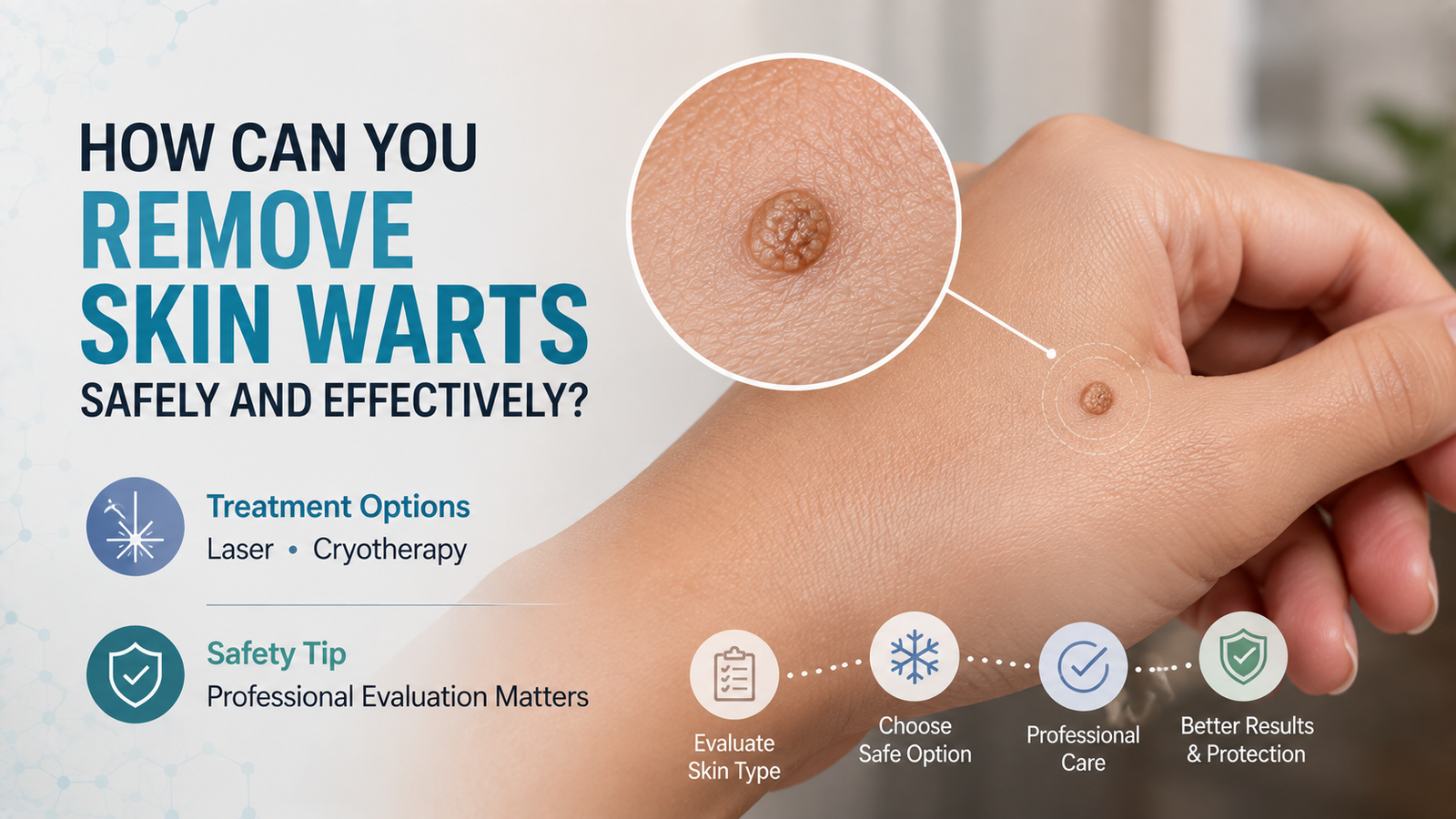
kin warts are small, usually harmless growths that can appear on the hands, fingers, feet, face, or other parts of the body. They are commonly caused by certain types of human papillomavirus (HPV) and can spread through direct contact or by sharing items that have touched an affected area. Some warts disappear without treatment, but this can take months or even years. Treatment may be considered when a wart is persistent, painful, spreading, repeatedly irritated, or cosmetically bothersome.
Skin wart removal does not involve one universal procedure. The most suitable method depends on the location, size, number, appearance, and type of wart, as well as the patient’s skin and medical history. Options can include topical treatments, freezing, chemical treatment, electrosurgery, curettage, laser treatment, or surgical removal in selected cases.
It is also important to confirm that a growth is actually a wart before trying to remove it. Some other skin conditions can resemble warts, and a changing, bleeding, painful, rapidly growing, or unusual lesion may need professional examination rather than home treatment.
This guide explains how skin warts are assessed, which removal options may be considered, what recovery can involve, how scarring can be reduced, and when a specialist should examine the growth.
Key Takeaways
- Skin warts are commonly associated with certain types of HPV and may spread through contact.
- Many warts are harmless and can eventually disappear, but untreated warts may remain for months or years.
- Treatment choice depends on the wart’s location, size, type, number, and appearance.
- Freezing, topical medicines, chemical treatment, electrosurgery, curettage, laser treatment, and excision may be considered in different situations.
- Warts on the face or genital area, or growths that bleed, hurt, change, or are difficult to identify, should be professionally assessed.
- Attempting to cut or tear a wart at home can cause bleeding, infection, scarring, and spread.
- A specialist can help confirm the diagnosis and select a removal method that fits the location and patient’s skin.
What Is a Skin Wart?
A skin wart is a non-cancerous growth caused by infection with certain types of HPV. Warts can develop on different parts of the body and may have a rough, raised, flat, or thread-like appearance depending on the type. They can spread from one area of the body to another or between people through contact.
Warts are not all identical. Their appearance and location can affect the most appropriate treatment.
Common types include:
Common warts
These are often rough and raised and frequently appear on the hands or fingers.
Flat warts
These may be smaller and smoother than common warts and can occur in larger numbers.
Filiform warts
These are thin projections that often appear around the face or neck.
Plantar warts
These develop on the soles of the feet and can become uncomfortable because of pressure while walking.
The treatment used for a wart on the hand may not be suitable for a facial lesion. Location matters because preserving surrounding skin and minimising scarring becomes particularly important in visible areas.
HPV: A group of viruses that can infect the skin and mucous membranes. Certain types can cause common skin warts.
Why Do Skin Warts Develop?
Warts develop when certain HPV types enter the skin, often through a small cut, scratch, or weakened area of the skin barrier. The virus can spread through direct contact or indirectly through contaminated objects and surfaces.
You may be more likely to notice warts when the skin is frequently exposed to moisture, friction, or minor injury.
Warts can also spread when a person:
- Scratches or picks an existing wart
- Bites nails around a wart
- Shares personal items
- Shaves over an affected area
- Touches a wart and then another area of broken skin
This is one reason repeated picking is discouraged. Manipulating a wart can irritate it and potentially help spread the virus to nearby skin.
How Can You Tell If a Skin Growth Is a Wart?
A typical wart may have a rough or uneven surface, but appearance alone cannot always establish the diagnosis. Some other skin growths can resemble warts, which is why unusual or changing lesions should be evaluated before treatment.
A specialist may examine:
- Surface texture
- Colour
- Shape
- Size
- Location
- Growth pattern
- Number of lesions
- Whether the area is painful or bleeding
In many cases, a wart can be diagnosed simply by examining the skin. If the growth looks unusual, changes rapidly, fails to respond to treatment, or the diagnosis is uncertain, a biopsy may sometimes be required to distinguish a wart from another skin condition.
When appearance should not be ignored
Professional assessment is particularly important when a growth:
- Changes in appearance
- Grows rapidly
- Bleeds
- Becomes painful
- Develops an open sore
- Does not improve with treatment
- Appears on the face or genital area
These features do not automatically mean the growth is dangerous, but they make an accurate diagnosis more important.
Which Skin Wart Removal Treatments Are Available?
There are several approaches to skin wart removal, and the choice depends on the type and location of the wart. Some small warts can respond to topical treatment, while persistent or difficult lesions may require an in-clinic procedure.
Topical treatment
Salicylic acid is one of the commonly used treatments for certain non-genital warts. It gradually breaks down the layers of the wart and usually requires repeated application rather than a single treatment.
It may be considered for selected common, plantar, and flat warts, but it should not be casually applied to sensitive or unsuitable areas.
Cryotherapy
Cryotherapy uses controlled freezing to destroy wart tissue. A blister or crust may develop after treatment, and more than one session may be needed depending on the wart.
Cryotherapy can be useful for selected warts, but it may cause temporary discomfort or changes in skin colour.
Chemical treatment
Certain chemical agents can be applied by a medical professional to create a controlled reaction that destroys the wart.
Depending on the treatment, blistering, irritation, discomfort, or temporary pigmentation changes can occur.
Electrosurgery and curettage
Electrosurgery uses controlled heat to destroy the wart, while curettage involves scraping away the treated tissue. These procedures may be performed under local anaesthesia.
They may be considered for selected persistent or raised warts. Possible effects include soreness, swelling, bleeding, temporary discoloration, and scarring.
Laser treatment
Laser treatment may be considered for stubborn warts that have not responded adequately to other options. It uses focused energy to destroy the affected tissue.
It may be useful in selected cases but can require more than one treatment and may cause temporary discomfort, swelling, discoloration, or a burning sensation.
Surgical removal
Excision involves removing the wart using a surgical technique. Because it creates a wound that has to heal, there is a possibility of bleeding, infection, and scarring. It may be appropriate in selected cases rather than being the first choice for every wart.
Which Removal Method Is Best for a Skin Wart?
There is no single wart removal treatment that is best for everyone. A small wart in one location may respond to a topical approach, while a persistent or unusual lesion may need an in-clinic procedure. The specialist considers the wart’s characteristics and the risk of scarring before choosing a method.
| Treatment | May Be Considered For | Main Advantage | Important Limitation |
|---|---|---|---|
| Topical treatment | Selected small warts | Can be used over time | Requires repeated treatment |
| Cryotherapy | Several common wart types | In-clinic and relatively quick | May require multiple sessions |
| Chemical treatment | Selected persistent warts | Can target the wart directly | May cause irritation or pigmentation changes |
| Electrosurgery/curettage | Selected raised or stubborn warts | Can remove visible wart tissue | Greater wound and scarring considerations |
| Laser | Difficult or persistent warts | Useful for selected resistant cases | May need repeat treatment |
| Excision | Selected individual lesions | Immediate removal of visible lesion | Creates a wound and possible scar |
The choice is therefore based on diagnosis, location, size, persistence, skin type, and desired cosmetic outcome.
Is Home Wart Removal Always Safe?
No. Home treatment may be suitable for certain small, typical warts, but it should not be used indiscriminately. Products containing salicylic acid can irritate surrounding skin, while aggressive attempts to cut, burn, or tear a wart can cause injury and infection.
Home treatment is particularly inappropriate when:
- The growth is on the face.
- It is in the genital area.
- The diagnosis is uncertain.
- The lesion is bleeding or changing.
- There are many warts.
- You have diabetes or poor circulation.
- You have reduced sensation in the area.
- Your immune system is weakened.
- Previous treatment has failed.
A simple rule is useful: do not cut off an unidentified skin growth yourself.
A lesion that looks like a wart may not be a wart, and unnecessary damage to the skin can create a larger problem than the original growth.
[INTERNAL LINK: Skin Lesion Removal Treatment → https://www.eleganceclinic.in/our-services/skin-treatments/]
What Happens During Professional Wart Removal?
Professional removal begins with diagnosis. The specialist first examines the lesion and decides whether it is suitable for removal and which technique is most appropriate.
Assessment
The growth is examined for its shape, colour, texture, location, and history.
Treatment planning
The removal method is selected according to the lesion and the surrounding skin. Facial or highly visible areas may require particular attention to scar prevention.
Local anaesthesia when needed
Some procedures require the skin to be numbed beforehand to improve comfort.
Wart treatment or removal
Depending on the technique, the wart may be frozen, chemically treated, destroyed with controlled energy, scraped, or removed surgically.
Aftercare
The treated area is cared for according to the procedure. Some treatments produce a blister or crust, while others leave a small wound that needs time to heal.
The objective is not simply to remove the visible growth. It is also to protect the surrounding skin and achieve an acceptable healing result.
How Long Does Skin Wart Removal Take to Heal?
Healing depends on the removal method and the size and location of the treated wart. A simple topical treatment may not create a traditional wound, while freezing, electrosurgery, laser treatment, or excision can produce temporary crusting, soreness, swelling, or a blister.
After cryotherapy, for example, a blister or crust can occur and the area commonly heals within several days, although repeat treatments may be needed.
With other procedures, healing can take longer depending on how deeply the tissue was treated.
During recovery, the area may temporarily look:
- Red
- Darker or lighter
- Swollen
- Crusted
- Sensitive
These changes do not necessarily represent the final appearance.
Patients should avoid picking at a treated area because disturbing the healing tissue can increase irritation and may affect the final scar.
Can Wart Removal Leave a Scar?
Yes, some wart removal techniques can leave a scar, although the risk varies according to the method, location, depth of treatment, skin type, and individual healing.
Treatments that destroy or remove tissue more deeply generally have more potential to create a visible mark than superficial approaches.
Laser treatment, electrosurgery, curettage, and excision can all result in temporary or persistent changes in skin appearance in selected cases.
When treating a wart on a visible area such as the face, the choice of treatment should take both wart clearance and cosmetic outcome into account.
Scar: A permanent change in the skin that develops as part of the body’s healing response after tissue injury.
Scar formation cannot always be predicted, so it is important to discuss the potential cosmetic outcome before treatment.
Can Warts Come Back After Removal?
Yes. Removing the visible wart does not always guarantee that another wart will never appear. HPV can remain in the surrounding skin, and some warts recur or new ones develop after treatment.
Recurrence can depend on the type of wart, immune response, treatment method, and whether other nearby areas are affected.
A successful treatment plan may therefore require more than simply removing the visible growth once.
Some warts clear without treatment, while others can persist for a long time. Treatment is often chosen when the wart is troublesome, spreading, painful, persistent, or cosmetically concerning.
How Can You Reduce the Chance of Spreading Warts?
Because warts can spread, everyday habits matter.
Avoid:
- Picking or scratching the wart
- Biting nails around a wart
- Sharing razors
- Sharing towels or personal grooming items
- Shaving directly over the wart
- Touching the wart and then another area of broken skin
Keeping the area covered when appropriate and washing hands after touching the lesion can help reduce transmission.
A wart should also be treated carefully when it is located in an area exposed to repeated friction.
When Should You See a Specialist?
A specialist evaluation is recommended when the diagnosis is uncertain or the wart is not responding to treatment. Professional review is especially important for facial or genital lesions and for growths that bleed, hurt, change, grow rapidly, or repeatedly return.
You should also consider an assessment if:
- A new growth appeared suddenly.
- The lesion looks different from your other warts.
- There are multiple spreading lesions.
- Home treatment has not worked.
- The area becomes painful or inflamed.
- You have diabetes or reduced circulation.
- You have a weakened immune system.
Not every skin growth that looks like a wart should be treated as one. Getting the diagnosis right is the first step toward safe removal.
For patients seeking professional treatment in Surat, Elegance Clinic Surat provides consultation and treatment planning for selected skin concerns.
Dr. Ashutosh Shah, M.Ch., DNB (Plastic Surgery) is a Board-Certified Plastic, Cosmetic and Reconstructive Surgeon and Director of Elegance Clinic, Surat. With more than 22 years of surgical experience, he has expertise in cosmetic and reconstructive procedures and the management of selected skin and aesthetic concerns.
Elegance Clinic was established in Surat in 2014 and provides cosmetic surgery, plastic surgery, dermatology, hair restoration, laser treatments, and reconstructive procedures. The clinic has centres in Adajan and Vesu and focuses on personalised treatment planning, safety, and natural-looking outcomes.
Skin warts are usually harmless, but they can be persistent, spread to other areas, become irritated, or create cosmetic concerns. There is no single removal method that is suitable for every wart. Depending on the lesion, treatment may involve topical medication, freezing, chemical treatment, electrosurgery, curettage, laser treatment, or surgical removal.
The most important first step is confirming that the growth is actually a wart. A lesion that changes, bleeds, becomes painful, grows quickly, or does not respond to treatment deserves professional assessment rather than repeated home treatment. Facial and genital growths also require greater caution.
Safe skin wart removal should aim not only to clear the visible growth but also to protect surrounding skin and minimise unnecessary scarring. Treatment should therefore be selected according to the wart’s location, type, size, persistence, and the patient’s individual circumstances.
Book a consultation at Elegance Clinic, Surat, to have an unusual or persistent skin growth assessed and discuss an appropriate removal option.
Frequently Asked Questions
Q: Can skin warts be removed permanently?
A: Warts can often be cleared with treatment, but recurrence or new warts can occur because the underlying viral infection may remain in the skin.
Q: What is the fastest way to remove a wart?
A: Professional treatment can clear some warts more quickly than waiting for them to disappear naturally, but the number of sessions depends on the wart and treatment method.
Q: Is wart removal painful?
A: Some treatments can cause temporary discomfort, stinging, soreness, or blistering. Local anaesthesia may be used for procedures that require it.
Q: Can a wart be removed at home?
A: Some small, typical warts may respond to appropriate over-the-counter treatment, but facial, genital, changing, bleeding, painful, or uncertain lesions should be professionally assessed.
Q: Can wart removal leave a mark?
A: Temporary redness or pigmentation changes can occur, and some procedures may leave a scar. The risk depends on the treatment, lesion, location, and individual healing.
Q: Can warts come back after treatment?
A: Yes. A treated wart can recur, and new warts may develop elsewhere because treatment does not always eliminate the underlying viral infection.

