

|
Getting your Trinity Audio player ready...
|
✓ Medically reviewed by Dr. Ashutosh Shah, Plastic, Reconstructive & Cosmetic Surgeon (M.Ch., DNB)
Double chin liposuction vs injections is not simply a choice between surgery and a nonsurgical treatment. A double chin may result from excess fat, loose skin, prominent neck muscle bands, a recessed chin, or natural neck anatomy. Liposuction suits selected patients with good skin elasticity, injections target suitable fat deposits, and a neck lift addresses sagging skin and muscle bands.
The right treatment depends on what creates the fullness beneath your jawline.
Some people develop a double chin despite maintaining a healthy weight. Others notice it after weight loss, ageing or changes in skin elasticity.
A treatment that removes fat may work well for one person but provide disappointing results for someone whose main concern is loose skin or a small chin.
At Elegance Clinic, Dr. Ashutosh Shah, MS, MCh (Plastic Surgery), D.N.B., with 22+ years of experience, assesses facial proportions, submental fat, skin quality, and neck anatomy when discussing suitable cosmetic treatment options.
Understanding the cause helps patients avoid unnecessary procedures and set realistic expectations.
What Is Actually Causing Your Double Chin?
A double chin is not always caused by excess body fat.
The area beneath the chin contains fat, skin, muscles, and underlying anatomical structures. Changes in any of these can affect the neck profile.
1. Excess submental fat
Submental fat is the fatty tissue beneath the chin.
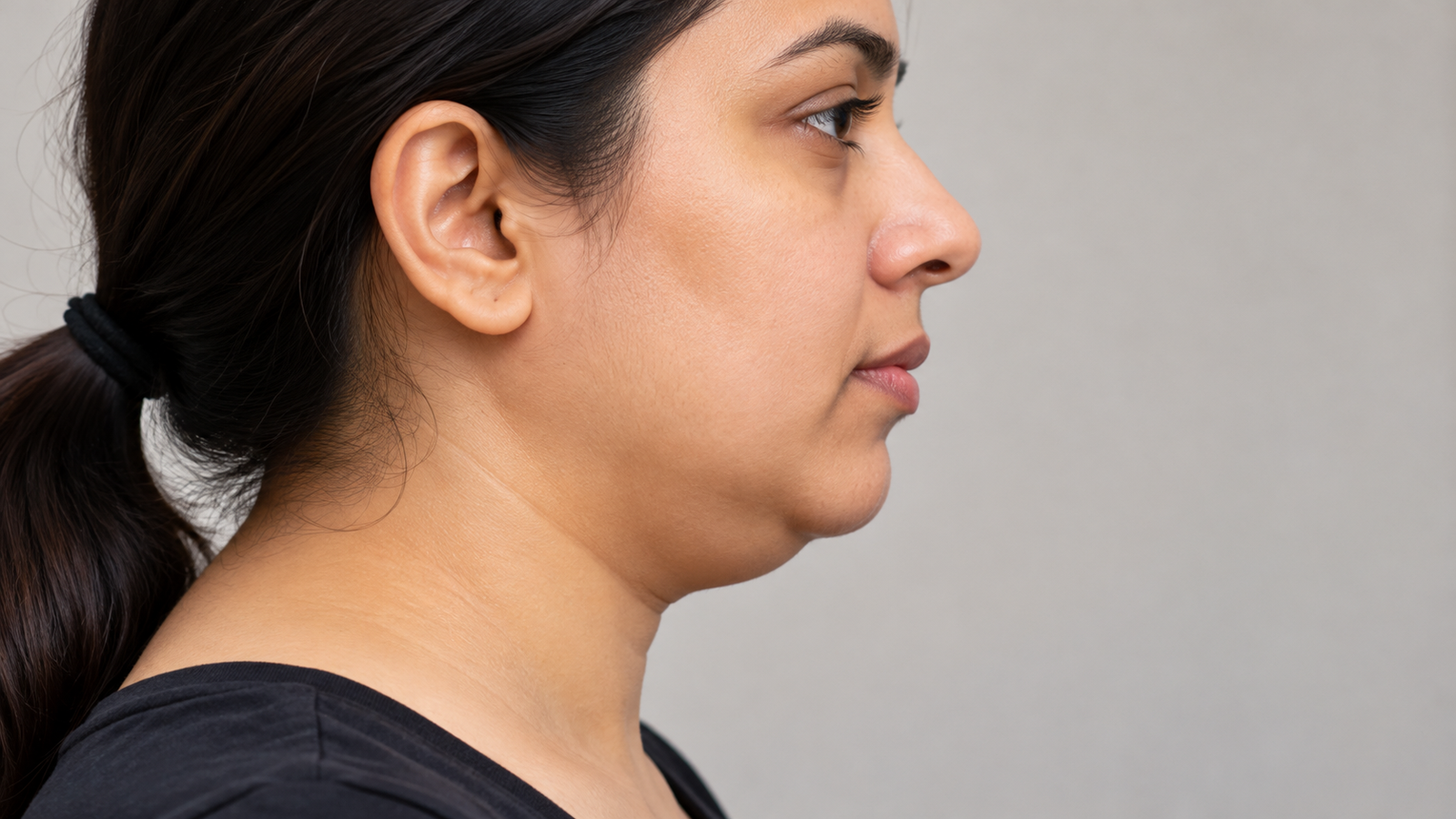
It may create a soft, rounded appearance, especially when viewed from the side.
Genetics, weight changes, and fat distribution can contribute to this concern.
Patients with a localised fat deposit and relatively elastic skin may be candidates for fat-reduction procedures.
2. Loose or sagging skin
Skin gradually loses elasticity with ageing.
Significant weight loss may also leave excess skin beneath the chin.
Removing fat alone may not correct the problem and can sometimes make existing laxity more noticeable.
3. Prominent platysmal bands
The platysma is a thin muscle that extends through the neck.
With ageing, its edges may become visible as vertical cords.
These bands can change the neck contour even when very little fat is present.
4. Small or recessed chin
A naturally small chin can make the neck appear fuller because the lower face has less forward projection.
The person may not have much excess fat.
Chin augmentation may improve facial balance in selected cases.
5. Low hyoid position or natural neck anatomy
The hyoid bone and deeper neck structures influence the angle between the chin and neck.
Some people naturally have a less defined neck angle because of their anatomy.
Liposuction cannot change the position of the hyoid bone.
The Five-Cause Mirror Test: Which Treatment Matches Your Double Chin?
A mirror can help you describe your concern before a consultation, but it cannot reliably diagnose the cause.
| Possible cause | What you may notice in the mirror | Best-matched treatment to discuss | Typical downtime | What it will not fix |
|---|---|---|---|---|
| Excess fat | Soft fullness beneath the chin | Submental liposuction or suitable fat-dissolving injections | Days to weeks of visible swelling; longer contour settling | Significant loose skin |
| Loose skin | Sagging or crepey skin, especially after weight loss | Neck lift or selected skin-tightening treatments | Often 2–3+ weeks of visible recovery after surgery | A recessed chin |
| Platysmal bands | Vertical cords, sometimes more visible when tensing the neck | Neck lift with appropriate muscle correction | Several weeks of recovery | Underlying skeletal anatomy |
| Small chin | Weak chin projection on side view | Chin implant or other suitable augmentation | Swelling and recovery vary by procedure | Excess neck skin or substantial fat |
| Low hyoid position | Naturally broad or less-defined chin-neck angle | Individualised assessment; sometimes limited improvement with contouring | Depends on the procedure | The natural position of the hyoid bone |
Important: This table is a starting point, not a treatment recommendation. A plastic surgeon must examine skin elasticity, fat distribution, muscle position, and facial proportions before selecting a procedure.
When Is Submental Liposuction the Right Answer?
Submental liposuction removes selected fat deposits from beneath the chin using a small cannula.
It can improve the jawline and neck contour when excess fat is the main cause.
Who may benefit from double chin liposuction?
Suitable candidates often have:
- A localised deposit of submental fat
- Reasonably good skin elasticity
- Stable body weight
- Realistic expectations
- No major untreated medical condition affecting surgical safety
Skin quality is particularly important.
After removing fat, the overlying skin needs enough elasticity to adapt to the new contour.
If the skin is already significantly loose, liposuction alone may leave sagging tissue.
How does the procedure work?
The surgeon creates small access incisions, introduces a fine cannula, and removes an appropriate amount of fat.
The exact technique, anaesthesia, and treatment extent depend on the patient’s anatomy and medical assessment.
Patients may need a compression garment during recovery.
For additional information, explore Liposuction procedures.
How long does recovery take?
Bruising and swelling commonly occur after chin liposuction.
Some patients return to desk work within several days, while others need longer.
Visible swelling often improves over the first few weeks, but the final contour may take several months to settle.
Recovery varies with the amount of fat removed, the technique used, and individual healing.
What are the limitations?
Liposuction does not reliably correct:
- Significant skin laxity
- Prominent platysmal bands
- A recessed chin
- A naturally low hyoid position
Removing more fat is not always the solution. Excessive fat removal can create irregularities or make underlying structures more noticeable.
Double Chin Liposuction vs Injections: What Is the Difference?
Both approaches aim to reduce fat beneath the chin, but they work differently.
Liposuction physically removes fat through a surgical procedure.
Fat-dissolving injections use an injectable substance to destroy selected fat cells.
Comparison of liposuction and fat-dissolving injections
| Feature | Chin liposuction | Fat-dissolving injections |
|---|---|---|
| Treatment type | Surgical | Injectable |
| Main target | Localised submental fat | Selected submental fat deposits |
| Number of sessions | Often one procedure | May require multiple sessions |
| Anaesthesia | Local anaesthesia with or without sedation, or another appropriate plan | Usually outpatient injections |
| Swelling | Common after surgery | Common and sometimes pronounced after injections |
| Skin tightening | Depends mainly on skin elasticity | Does not reliably correct significant skin laxity |
| Results | Develop as postoperative swelling settles | Develop gradually after treatment sessions |
| Scarring | Small access-incision scars | No surgical incision, but injection-site reactions occur |
| Main limitation | Cannot reliably fix loose skin or weak chin projection | Less suitable for substantial fat or major skin laxity |
Neither treatment is automatically better for everyone.
The appropriate option depends on fat volume, skin quality, treatment availability, and patient preferences.
What Can Fat-Dissolving Injections Do, and How Many Sessions Are Needed?
Deoxycholic acid is an injectable substance used in certain countries to treat submental fat.
It disrupts fat-cell membranes, allowing the body to gradually clear the treated tissue.
Are fat-dissolving injections FDA-approved?
The US Food and Drug Administration approved Kybella (deoxycholic acid) in 2015 for improving the appearance of moderate to severe submental fat in adults.
However, US FDA approval does not mean that the same product is approved or commercially available in India.
Patients should confirm the exact product, manufacturer, regulatory status, and clinician qualifications before treatment.
Avoid unverified products advertised as generic fat-melting injections.
How many sessions are required?
For the US-approved Kybella product, the prescribing information permits up to six treatment sessions, spaced at least one month apart.
Not everyone needs six sessions, and this schedule should not be applied to other products.
The number of treatments depends on the amount of fat, response, and safety considerations.
What are the side effects?
Common reactions can include:
- Swelling
- Bruising
- Pain or tenderness
- Numbness
- Firmness around injection sites
More serious complications can include temporary injury to the marginal mandibular nerve, causing an uneven smile, and swallowing difficulty. Skin ulceration or tissue injury can also occur.
These risks make appropriate patient selection and qualified administration essential.
Double Chin Injections Near Piplod Surat: Which Treatment Fits Your Jawline?
Choosing a treatment should begin with an examination rather than a preference for a particular device or injection.
At Elegance Clinic, Dr. Ashutosh Shah can evaluate whether the appearance comes mainly from fat, skin laxity, or facial proportions.
Before deciding between injections and liposuction, patients should ask:
- Is the fullness actually caused by submental fat?
- Does the skin have enough elasticity to adapt after fat reduction?
- Would a small chin limit the improvement?
- How much swelling and recovery should I expect?
- Is the proposed injectable product appropriately authorised and available?
- Would surgery, nonsurgical treatment or no procedure provide the most reasonable outcome?
The treatment plan should reflect the examination findings rather than assume that every double chin requires fat removal.
When Does Loose Skin Mean a Neck Lift Instead?
A neck lift addresses selected signs of ageing in the neck, particularly excess skin and changes in the underlying platysma muscle.
Patients with pronounced skin laxity may not achieve sufficient improvement through fat removal alone.
What can a neck lift correct?
Depending on the technique, a neck lift may:
- Remove or reposition excess skin
- Tighten or reshape the platysma
- Improve the chin-neck contour
- Address selected fat deposits when combined with other procedures
When is liposuction not enough?
Imagine a patient who has lost substantial weight.
The fat beneath the chin may already be reduced, but loose skin remains.
Further fat removal would not solve the main problem.
A neck lift or another appropriate surgical approach may offer a more meaningful improvement.
How long does recovery take?
Patients commonly experience swelling, bruising, and tightness after neck lift surgery.
Visible recovery may take several weeks, while swelling and scars continue maturing for months.
The exact timeline depends on the surgical technique and individual healing.
Does a neck lift leave scars?
Yes. Incisions may be placed around the ears, beneath the chin, or in other locations depending on the operation.
Surgeons aim to position scars discreetly, but they cannot guarantee invisible scars.
How Does a Small Chin Change the Treatment Plan?
A recessed chin can create the impression of a double chin even when submental fat is limited.
The lower face may lack projection, making the jawline appear less defined.
In these cases, removing fat alone may provide only a small improvement.
Chin augmentation
Chin augmentation can improve projection and facial balance in appropriately selected patients.
Options may include a chin implant or another procedure chosen according to facial anatomy.
A surgeon should also assess the patient’s bite and jaw relationship, because some skeletal concerns require a different specialist evaluation.
Explore Chin and cheek augmentation.
Can chin augmentation and liposuction be combined?
Sometimes.
A patient may have both a recessed chin and excess submental fat.
The surgeon may consider combining procedures if the anatomy, treatment goals, and medical condition support that approach.
However, combination surgery introduces additional planning and recovery considerations.
Patients can also view the Face makeover gallery to understand the range of facial procedures, without assuming that another patient’s outcome predicts their own.
Can Skin Tightening Replace Liposuction or a Neck Lift?
Nonsurgical skin-tightening treatments may improve mild skin laxity in selected patients.
However, the degree of improvement varies.
They generally cannot reproduce the results of surgical skin removal when substantial excess skin is present.
Some treatments use energy-based devices to stimulate collagen remodelling.
Results may develop gradually, and repeated sessions may be required.
Patients considering Laser skin tightening should discuss the expected benefit, limitations, potential side effects, and suitability for their skin type.
For a double chin caused mainly by a large fat deposit, skin tightening alone may not provide the desired reduction.
Similarly, a patient with major skin laxity should not assume that liposuction combined with a device will always eliminate the need for a neck lift.
What Happens if You Choose the Wrong Double Chin Treatment?
Treating the wrong anatomical cause can lead to disappointing results.
For example:
Fat removal when skin is loose: The remaining skin may appear more noticeable.
Injections when fat volume is substantial: The patient may need repeated sessions and still achieve insufficient reduction.
Liposuction for a recessed chin: The underlying facial proportion remains unchanged.
Skin tightening for prominent muscle bands: The visible neck cords may persist.
Aggressive fat removal in a naturally low neck contour: The procedure cannot reposition deeper anatomical structures.
A careful consultation can help identify these limitations before treatment.
Frequently Asked Questions
1. Will a double chin come back after liposuction?
Liposuction permanently removes the fat cells that the surgeon extracts, but remaining fat cells can enlarge with weight gain. Ageing and changes in skin elasticity can also alter the neck contour over time. Maintaining a stable weight may help preserve the result.
2. How long does swelling last after chin liposuction?
Swelling often improves noticeably within the first few weeks, although residual swelling can continue for several months. The exact recovery period depends on the extent of treatment, surgical technique, and individual healing.
3. Are fat-dissolving injections safe?
An appropriately approved deoxycholic acid product can be an option for suitable adults when administered by a qualified clinician. However, injections can cause swelling, nerve injury, swallowing difficulty, and other complications. Patients seeking double chin injections near piplod surat should confirm the product’s regulatory status and the practitioner’s qualifications before treatment.
4. Can weight loss alone remove a double chin?
Weight loss may reduce a double chin when excess fat is a major contributor. However, genetics, loose skin, chin projection, and natural neck anatomy can affect the appearance even at a healthy body weight.
5. Is there a scar after double chin liposuction?
Chin liposuction requires small access incisions, which leave scars. These scars are often discreet, but their final appearance depends on incision placement, skin healing, and individual scarring tendencies.
6. Can young people with a double chin have liposuction?
Adults with localised submental fat and good skin elasticity may be suitable candidates after medical assessment. Age alone does not determine eligibility. The surgeon should examine fat distribution, facial proportions, health and expectations.
7. Should I get liposuction or injections for my double chin?
The choice depends on the amount of fat, skin elasticity, desired outcome, tolerance for downtime and availability of an appropriately authorised injectable product. Double chin liposuction vs injections should be decided through clinical assessment rather than advertisements or price alone.
8. Does double chin liposuction leave loose skin?
It can, particularly when the patient already has poor skin elasticity or significant laxity. Liposuction removes fat but does not remove excess skin. Some patients may require a different procedure to address sagging.
9. Is my double chin fat or a weak chin?
A soft fat deposit may contribute to fullness, while a recessed chin can make the neck appear less defined even without much fat. Some patients have both. A plastic surgeon can assess the jawline, chin projection, skin, and fat distribution to identify the main cause.
Key Takeaways
- A double chin can result from fat, loose skin, platysmal bands, a recessed chin, or natural neck anatomy.
- Double chin liposuction vs injections is most relevant when excess submental fat is the main concern.
- Liposuction may suit patients with localised fat and good skin elasticity.
- Fat-dissolving injections may require several sessions and have specific safety considerations.
- A neck lift addresses significant loose skin and selected muscle changes.
- Chin augmentation may improve a recessed chin but does not remove excess skin.
- A low hyoid position can limit how sharply the neck can be contoured.
- A clinical examination is essential before choosing treatment.
Conclusion
Choosing between double chin liposuction vs injections requires understanding what causes the fullness beneath the chin.
Fat-reduction procedures may help patients with excess submental fat, but they cannot reliably correct significant skin laxity, prominent neck bands, or a recessed chin.
A neck lift may suit patients with loose skin and muscle changes, while chin augmentation may improve facial proportions in selected cases.
At Elegance Clinic, Dr. Ashutosh Shah, MS, MCh (Plastic Surgery), D.N.B., with 22+ years of experience, can assess skin elasticity, submental fat, and chin-neck anatomy to discuss an individualised treatment plan.
