

|
Getting your Trinity Audio player ready...
|
✓ Medically reviewed by Dr. Ashutosh Shah, Plastic, Reconstructive & Cosmetic Surgeon (M.Ch., DNB)
A fibroadenoma removal surgery may be recommended when a breast lump grows, causes discomfort, affects breast shape, or needs further examination because the diagnosis is uncertain. However, not every fibroadenoma needs to be removed. Many non-cancerous breast lumps can be safely monitored after appropriate medical assessment.
At Elegance Clinic, Dr. Ashutosh Shah helps patients understand their breast lump diagnosis and available treatment options. The decision to remove a lump depends on its size, growth, symptoms, examination findings, and imaging or biopsy results. Therefore, the first step is to establish the diagnosis before deciding whether observation or surgery is appropriate.
What Are the Common Non-Cancerous Breast Lumps?
Breast lumps (fibroadenoma removal surgery) can develop for several reasons, and many are benign. However, a new lump should never be ignored because its appearance or feel alone cannot reliably confirm the diagnosis.
Common non-cancerous breast lumps include:
- Fibroadenoma: A solid lump made of glandular and connective tissue. It is common in younger women and often feels smooth, firm,m and movable.
- Giant fibroadenoma: A larger fibroadenoma that may grow noticeably and change the shape or appearance of the breast.
- Breast lipoma: A soft lump formed from fatty tissue. It is usually painless.
- Breast cyst: A fluid-filled sac that may cause tenderness or discomfort, particularly around menstruation.
- Galactocele: A milk-filled cyst that can develop during breastfeeding or after pregnancy.
- Breast abscess: A collection of pus associated with infection. It may cause pain, redness, swelling, and fever.
Although these conditions may all present as breast lumps, their treatments differ. A typical fibroadenoma may need only monitoring, whereas a painful abscess may require prompt treatment and drainage.
What Is Triple Assessment and Why Must It Come First?
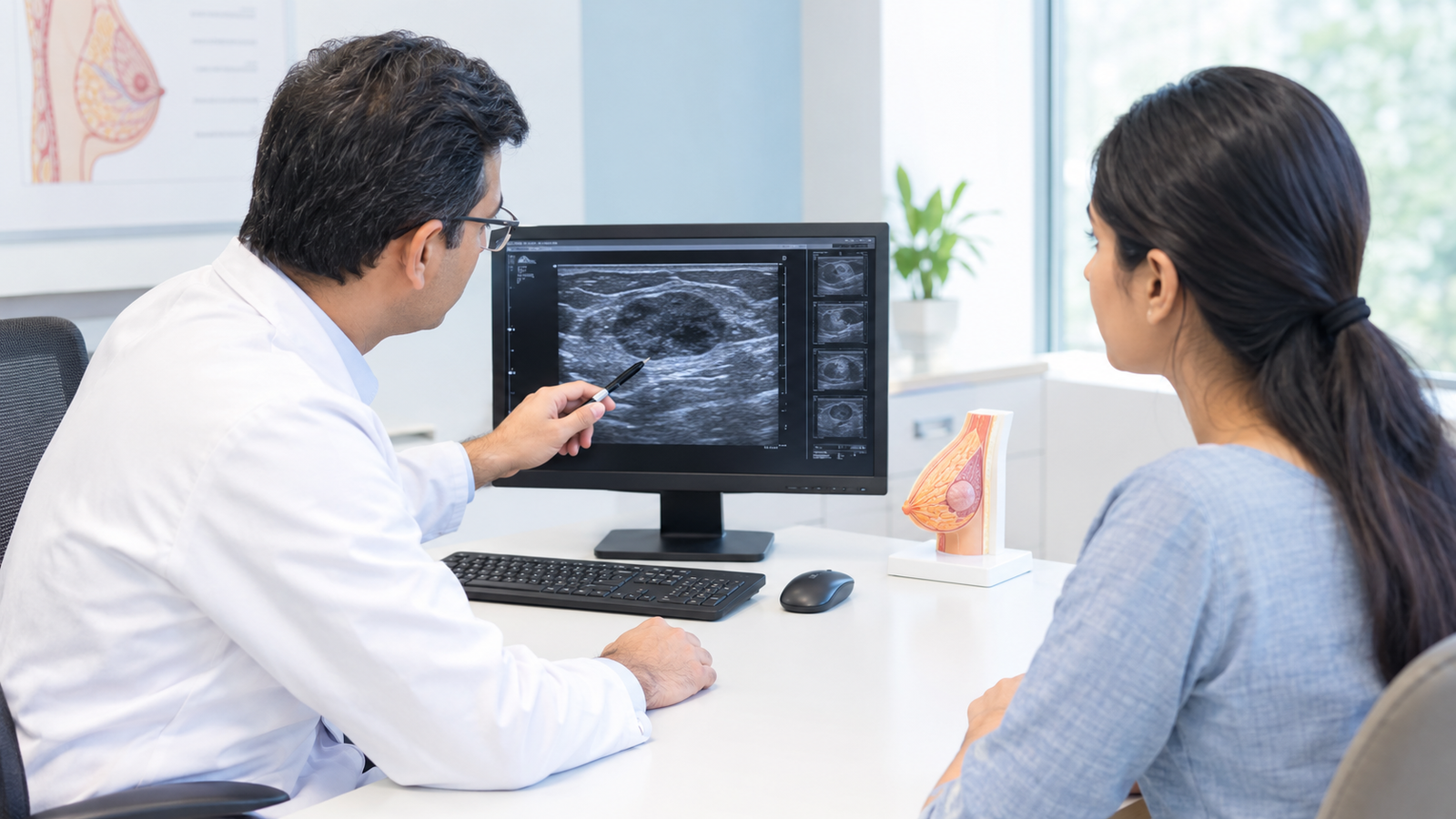
Triple assessment is an important approach to evaluating a fibroadenoma removal surgery. It combines clinical examination, breast imaging, ing and tissue sampling when indicated. Together, these steps help doctors determine whether a lump is benign or requires further investigation.
1. Clinical examination
The doctor examines the lump’s size, location, mobility, tenderness, and consistency. Changes in the nipple or surrounding skin, along with relevant medical and family history, are also considered.
2. Breast imaging
Ultrasound is commonly used to assess breast lumps in younger women. Depending on the patient’s age and clinical findings, diagnostic mammography or other imaging may also be appropriate.
The American College of Radiology uses the BI-RADS classification system to describe breast imaging findings and recommend appropriate next steps. A probably benign finding may require follow-up imaging, while a suspicious finding generally needs a biopsy.
3. Core needle biopsy, when indicated
A core needle biopsy collects small tissue samples for examination under a microscope. It can help confirm whether a solid breast lump is a fibroadenoma or whether another diagnosis needs consideration.
The clinical examination, imaging,g and biopsy findings must be consistent. This agreement is known as radiological-pathological concordance.
Why is this important? A benign core biopsy that agrees with the clinical and imaging findings supports a reliable diagnosis before a planned removal decision. If the results do not agree, or a phyllodes tumour is suspected, additional investigation or surgical excision may be necessary.
The American Society of Breast Surgeons and Society of Breast Imaging published consensus guidance in 2025 supporting observation for appropriately diagnosed fibroadenomas without atypia. Removal may be considered for symptoms, patient preference, substantial growth,th or size-related concerns.
When Can a Fibroadenoma Be Left Alone?
A fibroadenoma does not automatically require surgery. In many cases, observation is appropriate when the diagnosis is reliable, and the lump is not causing significant problems.
Monitoring may be suitable when:
- The examination and appropriate investigations support a benign diagnosis.
- The lump is stable and does not cause significant discomfort.
- Imaging and any indicated biopsy findings are consistent.
- There are no concerning changes in the breast.
- The patient is comfortable with the recommended follow-up plan.
For a small, confirmed fibroadenoma, surgery may offer limited additional benefit. Observation avoids an incision, anaesthesia-related risks and the possibility of changes in breast contour.
Follow-up depends on the imaging classification and the overall clinical assessment. Some probably benign lumps require repeat ultrasound after an appropriate interval. Under the 2025 consensus guidance, a concordant fibroadenoma confirmed by core biopsy without atypia does not require special imaging follow-up beyond age-appropriate screening.
Nevertheless, a lump should be reassessed if it grows, becomes painful,l or develops other concerning features. Do not assume that every lump described as benign on ultrasound can be left untreated without considering the complete clinical picture.
When Is Fibroadenoma Removal Surgery Recommended?
The decision to remove a fibroadenoma depends on several factors rather than one measurement alone.
The lump is growing. Substantial growth requires reassessment. Rapid enlargement may raise concern about a phyllodes tumour or another diagnosis, even when earlier findings were reassuring.
The lump is large. A large fibroadenoma can stretch surrounding tissue, create discomfort, rt or affect breast shape. A lump measuring around 3 cm may deserve closer assessment, while masses around 4 to 6 cm may prompt stronger consideration of removal. However, these measurements are not universal surgical cutoffs.
The lump causes persistent symptoms. Pain, pressure, tenderness, or discomfort can influence the decision. Before surgery, the doctor should also consider whether the symptoms are actually caused by the lump, since removing a fibroadenoma does not guarantee that all breast pain will disappear.
The diagnosis is uncertain. If imaging and biopsy results disagree, or a phyllodes tumour cannot be excluded, the surgeon may recommend removing the mass for complete histopathological examination.
The patient prefers removal. Some patients remain worried about a lump or find it uncomfortable. After discussing the benefits, risks and alternatives, elective removal may be a reasonable option.
The final recommendation should consider the diagnosis, the patient’s preferences and the potential effects of surgery on breast appearance.
Watch or Remove? A Comparison of Common Breast Lumps
| Lump type | Typical finding | When monitoring may be suitable | When treatment or removal may be needed |
|---|---|---|---|
| Fibroadenoma | Solid, usually smooth and movable | Confirmed, stable and asymptomatic | Growth, symptoms, uncertainty or patient preference |
| Giant fibroadenoma | Large solid mass | When specialist assessment supports observation | Size, growth or breast distortion |
| Breast lipoma | Soft, fatty lump | Typical appearance without symptoms | Pain, growth or diagnostic uncertainty |
| Galactocele | Milk-filled cyst | Small and uncomplicated | Pain, infection, persistence or uncertainty |
| Breast cyst | Fluid-filled lump | Simple cyst without troublesome symptoms | Persistent pain or concerning imaging features |
| Breast abscess | Painful, inflamed collection | Observation alone is generally inappropriate | Prompt treatment, often including drainage |
This comparison provides general guidance only. The appropriate treatment depends on the examination and diagnostic findings. Not every benign lump needs removal, and not every lump can safely be monitored.
How Is the Incision Placed to Hide the Scar?
Scar placement is an important consideration for patients undergoing breast lump surgery. The surgeon chooses the incision according to the lump’s size, depth,h and location while prioritising safe removal and preservation of healthy tissue.
An incision may be placed along the edge of the areola, where the natural transition in skin colour can make a healed scar less noticeable. Alternatively, an incision may be placed in a natural breast crease or near the lump itself.
A small incision is not always the best option if it makes complete removal difficult. The surgeon must balance access to the lump with wound healing, breast shape, pe and cosmetic considerations.
After removal, the tissue is sent for histopathological examination to confirm the diagnosis. Although careful incision planning can help minimise visible scarring, no operation can guarantee a scar-free result. Healing depends on individual skin characteristics, genetics, and wound care.
You can also explore the breast surgery gallery to learn more about breast surgery procedures and their cosmetic considerations.
What Happens to Breast Shape After a Large Lump Is Removed?
Removing a small fibroadenoma often causes little visible change in breast shape. However, removing a large or deep mass can leave an indentation, a hollow area, or a difference between the breasts.
The likelihood of a visible change depends on the amount of tissue removed, the location of the lump,p and the amount of surrounding breast tissue. A large lump close to the skin or behind the nipple may require different surgical planning from a smaller lump located deeper in the breast.
Before surgery, discuss the likely cosmetic outcome with your surgeon. In selected cases, additional techniques may help preserve breast contour. The primary goal is to remove the lump safely while preserving as much healthy tissue as possible.
What Is Recovery Like After Fibroadenoma Removal?
Fibroadenoma removal is often performed as a day-care procedure, although the treatment plan depends on the lump and the patient’s health.
Small, accessible lumps may sometimes be removed under local anaesthesia, which numbs the treatment area. Other procedures may require sedation or general anaesthesia. Your surgeon will recommend an appropriate option based on the complexity of the procedure and your comfort.
After surgery, mild pain, swelling, bruising and temporary tenderness are common. These symptoms generally improve over the following days.
To support recovery:
- Follow your surgeon’s instructions for wound care and dressings.
- Take prescribed medicines as directed.
- Avoid strenuous activity and heavy lifting until cleared.
- Attend follow-up appointments to review healing and the pathology report.
- Seek medical advice if you develop increasing redness, worsening pain, fever, wound discharge, or rapidly increasing swelling.
The incision may heal over the next couple of weeks, although swelling can take longer to settle and the scar continues to mature over time. Recovery varies according to the extent of surgery and individual healing.
If you experience breast discomfort after physical activity, read our guide to breast pain after exercise for further information about common causes and when medical assessment may be appropriate.
Frequently Asked Questions
Can a fibroadenoma turn into cancer?
A typical fibroadenoma is benign and does not usually become cancerous. However, a new or changing lump should be reassessed because the original diagnosis may need confirmation or the lump may represent a different condition.
Can fibroadenoma be removed without surgery?
Some confirmed fibroadenomas may be treated using specialist minimally invasive techniques, such as vacuum-assisted removal or, in selected cases, cryoablation. Availability and suitability vary. Observation is also appropriate for many patients. These alternatives should be discussed only after the diagnosis has been established.
Will the lump come back after removal?
A completely removed fibroadenoma generally does not regrow in the same location, but new fibroadenomas can develop elsewhere in either breast. A new lump should receive medical assessment rather than being assumed to be the original one returning.
Can I breastfeed after fibroadenoma surgery?
Many women can breastfeed after fibroadenoma removal. The effect depends on the lump’s location, the incision, and whether milk ducts or surrounding tissue are affected. If you plan a future pregnancy, discuss this with your surgeon before surgery.
How long is recovery after lump removal?
Many patients resume light daily activities within a few days, depending on their procedure and comfort. More strenuous activities may need to wait longer. Follow your surgeon’s individual instructions rather than relying on a fixed recovery timeline.
Should an unmarried girl get a fibroadenoma removed before marriage?
Marital status is not a medical reason to remove a fibroadenoma. A stable, confirmed benign lump can often be monitored. Surgery should be considered according to the diagnosis, growth, symptoms, personal preference, and informed discussion of risks and benefits.
Should a 2 cm fibroadenoma be removed or watched?
A 2 cm fibroadenoma does not automatically require surgery. If examination and appropriate tests confirm a benign, stable fibroadenoma, monitoring may be suitable. Growth, symptoms, uncertainty, or personal preference may change the recommendation.
Can fibroadenoma be removed without a visible scar?
A surgeon may place the incision along the areola edge or a natural breast crease to make the scar less noticeable. However, every incision can leave a scar, and the final appearance varies between individuals.
What is the difference between a fibroadenoma and a breast cancer lump?
A fibroadenoma is typically smooth, firm, and movable, while a cancerous lump may feel hard, irregular, or fixed. However, these features overlap, and touch alone cannot reliably distinguish them. Clinical examination, imaging, and biopsy when indicated provide a more dependable assessment.
When Should You Consult a Breast Lump Surgeon in Udhna Surat?
Arrange a medical assessment if you notice a new breast lump, a lump that is growing, persistent localised pain, nipple changes, skin dimpling, or an unexplained change in breast shape. A red, hot and painful breast, particularly with fever, may indicate an infection and needs prompt medical attention.
At Elegance Clinic, Dr. Ashutosh Shah can help patients understand their diagnosis, available treatment options, and the potential cosmetic implications of removal. The right approach is to establish the diagnosis first and then decide whether observation or surgery offers the greatest benefit.
Visit the Breast Treatment page at Elegance Clinic to learn about available assessment and treatment services. You can also book an appointment to discuss an individual breast lump.
