

|
Getting your Trinity Audio player ready...
|
✓ Medically reviewed by Dr. Ashutosh Shah, Plastic, Reconstructive & Cosmetic Surgeon (M.Ch., DNB)
Written by Dr. Ashutosh Shah, MS, MCh (Plastic Surgery), Consultant Plastic and Cosmetic Surgeon, Elegance Clinic, Surat. Reg. no. [REG NO].
Medically reviewed by Dr. Ashutosh Shah. Published 28 September 2026. Last reviewed 28 September 2026.
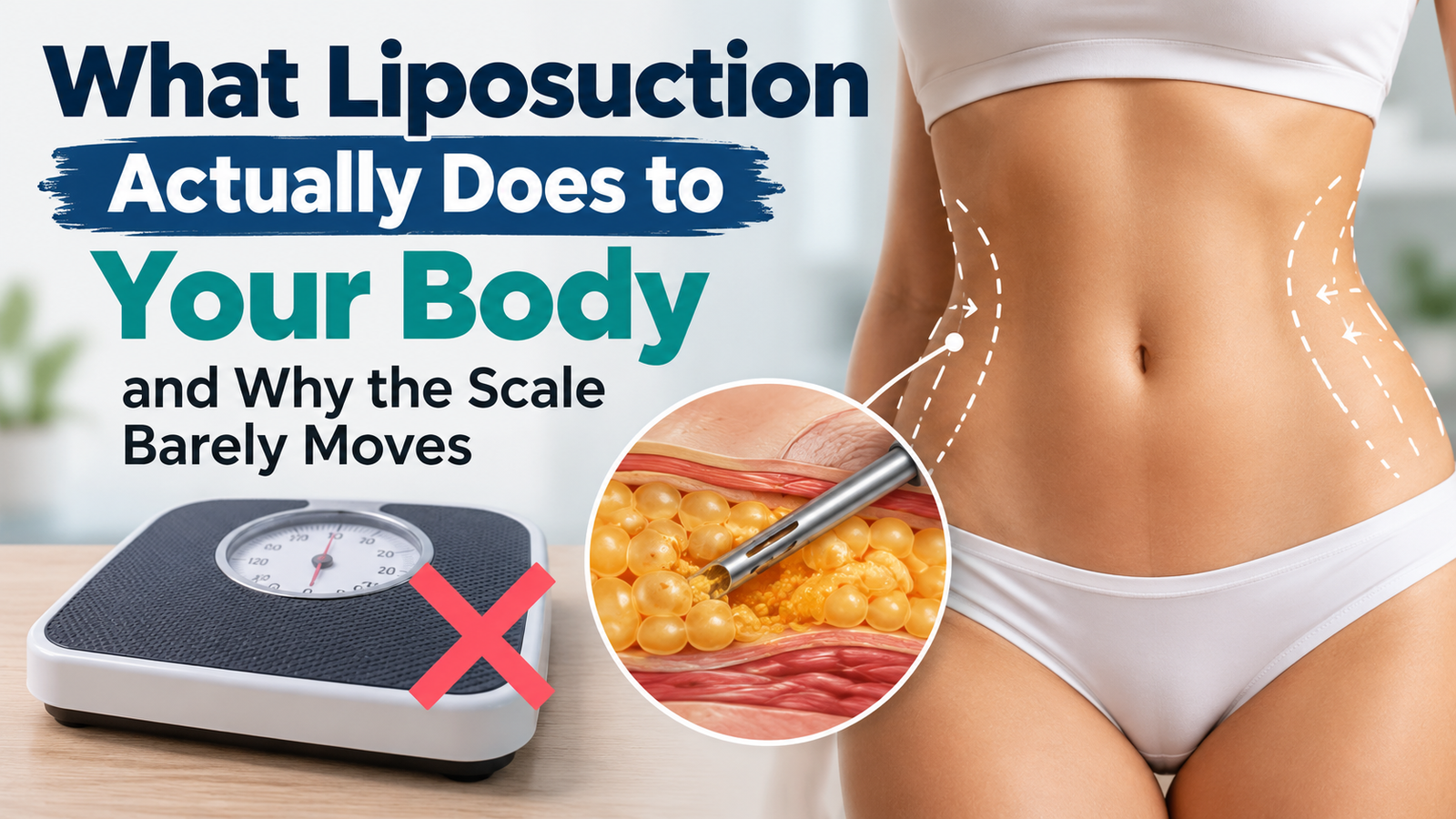
The liposuction weight loss myth is that the operation makes you lighter, when it actually removes fat from specific areas to change body contour. The amount removed is limited for safety reasons, so the scale often barely moves. It does not treat obesity, does not improve metabolic health, and does not stop remaining fat expanding again.
Almost everyone who books a liposuction consultation has a number in their head. Sometimes it is a target weight, sometimes it is how many kilos they expect to lose. That number is the problem, because it is measuring the wrong thing.
This page explains what the operation physically removes, why the limit on how much can be taken exists, what happens to the fat left behind, and which problems it genuinely solves. It also sets out, plainly, the things it cannot do.
What does liposuction physically remove?
Liposuction removes fat from the layer directly beneath the skin, through small cannulas inserted at inconspicuous entry points. It removes nothing else. No skin is cut out, no muscle is repaired, and nothing inside the abdominal cavity is touched.
Your body stores fat in two places that matter here. Subcutaneous fat sits between the skin and the muscle, and it is the layer you can gather between your fingers. Visceral fat sits deeper, packed around the organs inside the abdominal wall, and you cannot pinch it.
A cannula reaches the first layer and cannot reach the second. That single anatomical fact explains most of what follows on this page, including why the operation changes how you look far more than it changes how you are.
Why does the number on the scale barely change?
Because fat is bulky but light, and because the amount taken is deliberately limited. Fat occupies a lot of space for its weight, so removing enough to visibly change a contour does not add up to much on a weighing scale.
There is a second reason the scale misleads in the early weeks. Fluid is infiltrated into the tissue during the procedure and swelling follows it, so immediately afterwards the reading can be higher than it was before surgery. That settles, slowly.
The honest way to measure a liposuction result is not a scale at all. It is how clothes fit, and how the shape reads in a mirror. If the number is what you are chasing, this is not the operation that delivers it.
Why is the amount removed limited, and what sets the limit?
Safety sets it, and the limit is decided for each patient rather than read off a chart. Four things drive that decision: fluid shifts, blood loss, how long the person is under anaesthetic, and how much raw tissue surface the surgery creates.
Fat is not removed dry. Fluid is infiltrated first, and the body then has to handle both what was put in and what was taken out. The more that is treated in one sitting, the harder that balancing act becomes, and it is the balancing act, not the fat, that carries the risk.
- Fluid balance. Large volumes shift fluid in and out of the circulation, and that shift is what has to be managed during and after surgery.
- Blood loss. It rises with the volume and the number of areas treated.
- Anaesthetic time. A longer operation is a different risk profile, not the same one stretched out.
- Surface area. More treated tissue means more space for fluid to collect afterwards.
This is why a surgeon who agrees to everything you ask for in one sitting, without discussing operating time, has not answered the question you should be asking. Staging into two smaller procedures is often the safer plan, and a good assessment says so.
What happens to the fat that is left behind?
It stays, and it can still enlarge. Liposuction removes fat cells from the treated area, and those specific cells do not grow back. The fat cells everywhere else in your body are untouched and behave exactly as they always did.
So if you gain weight after surgery, the gain still happens. It goes to the places where the fat cells remain, which can mean the shape you paid for changes anyway, and sometimes in a distribution that looks less balanced than before.
That is the real answer to whether liposuction is permanent. The removal is permanent. The result is conditional on your weight staying roughly where it was on the day of surgery.
Which problems does liposuction genuinely solve?
One problem, done well: a defined pocket of fat sitting under skin that still has good elasticity, in someone whose weight is already stable. That is what the operation was designed for and it does it reliably.
The NHS puts the same boundary in a single sentence, noting that liposuction “works best in people who are not overweight and in areas where the skin is firm and elastic”. Read that as a description of the right patient, not a disclaimer.
The areas it suits are the ones that hold fat stubbornly regardless of training: flanks, outer thighs, the area under the chin, the upper arms, and localised abdominal pockets. Elegance Clinic sets out the techniques used, including laser liposuction, on its liposuction service page.
Which problems does liposuction not touch?
Most of the ones people hope it will. The table below is the whole list in one place, and it is worth reading before a consultation rather than after one.
| What you want changed | Does liposuction address it? |
|---|---|
| A defined pocket of fat under firm, elastic skin | Yes. This is what it is for |
| Where fat sits on your body, as a shape | Yes, within the safe limits above |
| Your body weight | No. The scale barely moves |
| Obesity | No. The NHS states it is not a treatment for it |
| Fat around the organs inside the abdomen | No. A cannula cannot reach it |
| Insulin resistance, cholesterol, blood pressure | No. See the section below |
| Loose skin that no longer retracts | No, and it can make looseness more visible |
| Stretch marks | No. The NHS states this explicitly |
| Cellulite | No. The NHS states this explicitly |
| Separated abdominal muscle | No. Muscle is not touched |
Two of those rows come straight from the NHS, which says liposuction “will not remove cellulite or stretch marks”. Patients are told this often and remember it rarely, because the hope is stronger than the sentence.
The last three rows are a different question entirely, about skin and muscle rather than fat, and they have their own answer. If that is your situation, read the companion guide on choosing between a tummy tuck and liposuction instead of this page.
Why does the liposuction weight loss myth matter for obesity and metabolic risk?
Because believing it can delay treatment that would actually help. The NHS states directly that liposuction “is not a treatment for obesity”, and the reason is anatomical rather than a matter of degree.
The fat most strongly linked to insulin resistance, cholesterol and cardiovascular risk is the visceral fat packed around the organs. Liposuction cannot reach that compartment at all. Removing the outer layer leaves the inner one exactly as it was.
This has been examined directly. A study in the New England Journal of Medicine reported an absence of an effect of liposuction on insulin action and on risk factors for coronary heart disease. A flatter profile after surgery is not a healthier one, and it should never be sold as one.
If metabolic health is the actual concern, the surgery is the wrong door. Elegance Clinic handles that separately through its weight management and body programmes, and the order matters: address the weight first, consider contouring afterwards.
Who does liposuction actually suit?
Someone at a weight they can hold, with firm skin, and a specific area that has not responded to consistent diet and training. All three conditions, not one or two of them.
Stable weight matters most, because operating while someone is still actively losing or gaining means the result changes underneath them afterwards. Skin elasticity matters next, because the skin has to shrink down over the space that is left.
- Good fit. Weight steady for several months, a defined pocket of fat, skin that springs back, realistic expectations about the scale, a non-smoker or willing to stop.
- Poor fit. Still actively losing weight, hoping the operation will kickstart a weight loss plan, skin that has been stretched hard and no longer retracts, or expecting a change in a blood test result.
- Not yet. Someone whose main goal is health rather than shape. The sequence is weight management first, and the door stays open afterwards.
Being told “not yet” is a better outcome than an operation that gives you a result you did not want. A clinic that never says it is not assessing anyone.
What should a consultation establish before a date is offered?
Five things, and all five before any date is discussed. If a surgery date is offered before these are settled, that is information about the clinic rather than about you.
- Whether your weight is stable. Your weight history over the past several months, not just today’s number.
- Whether your skin will retract. This is an examination finding. It cannot be judged from a photograph or a phone call.
- Which areas, and in what order. Whether everything is safe to do in one sitting, or whether it should be staged.
- What the operation will not change. Said out loud, by the surgeon, before you consent. The table above is a fair checklist to bring.
- Your general health and medication. Smoking in particular, because it affects healing more than most people expect.
Bring one more question with you: what happens to my result if I gain weight afterwards. The answer should be a straight description of the fat redistributing, not reassurance.
How is suitability for liposuction assessed at Elegance Clinic, Surat?
By examination, in a fixed order: weight stability first, then skin quality, then the fat itself. The assessment decides whether the operation is offered at all, not simply how it is planned.
In our practice in Surat, the commonest reason someone leaves a consultation without a surgery date is that they are still mid way through losing weight and have come in hoping liposuction will finish the job. That conversation is usually a disappointment on the day and the right decision six months later, when the same person comes back at a settled weight and gets a result that holds. The second commonest reason is skin that will not retract, which is a five minute finding on examination and no amount of reading substitutes for it.
What a consultation here covers: your weight history and whether it is currently stable, previous surgery, smoking, a skin elasticity examination, which areas are realistic and whether they should be staged, and a plain statement of what the operation will not do. Dr. Ashutosh Shah is a plastic and cosmetic surgeon in Surat, and his background and qualifications are on his profile page.
Next step
If you are considering liposuction, the useful next step is an examination rather than more reading, because skin elasticity and weight stability are findings rather than opinions. Book a consultation through the Elegance Clinic contact page in Surat, and bring your weight history from the past year with you.
This article is for education and is not a substitute for professional diagnosis or treatment. Whether liposuction suits you can only be decided after an examination. Please consult Dr. Ashutosh Shah or another qualified plastic surgeon about your own circumstances.

