

|
Getting your Trinity Audio player ready...
|
✓ Medically reviewed by Dr. Ashutosh Shah, Plastic, Reconstructive & Cosmetic Surgeon (M.Ch., DNB)
Written by Dr. Ashutosh A Shah, M.B.B.S., M.S., M.Ch., D.N.B., Board Certified Plastic and Reconstructive Surgeon, Elegance Clinic, Surat. Reg. no. [REG NO]. M.Ch. in Plastic Surgery, 22+ years of microsurgical and hand trauma practice. Qualifications and certificates.
Medically reviewed by Dr. Ashutosh A Shah · Published 29 September 2026 · Last reviewed 29 September 2026
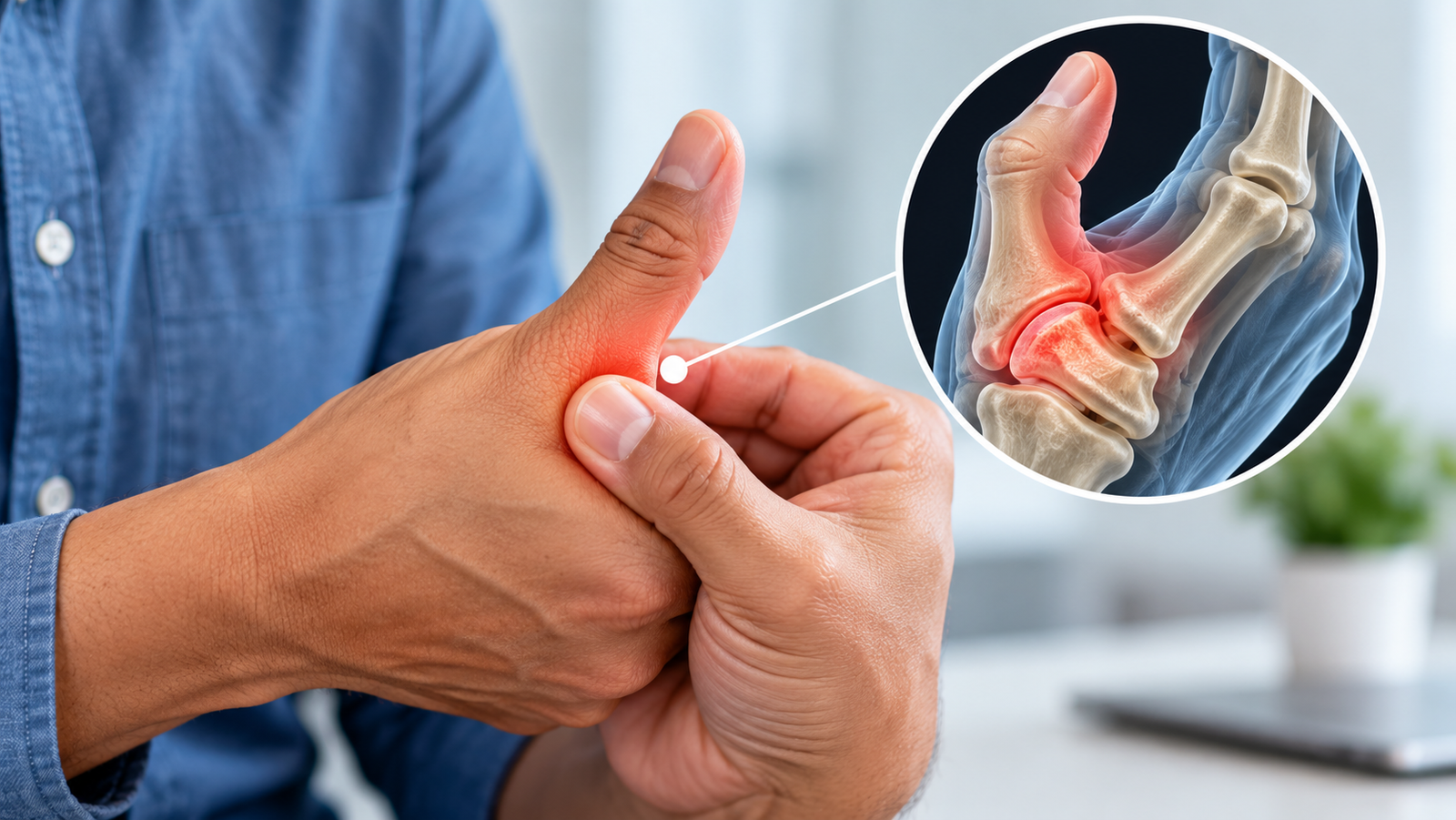
Thumb injury treatment is assessed differently from a finger, because the thumb carries a large share of grip and pinch. Its base joint is a saddle joint that moves in two planes with some rotation, producing opposition, which no other digit can do. Persistent pain or lost movement should be assessed rather than waited out.
People wait a long time with a bad thumb. A finger that will not bend gets noticed within days, because you can see it lagging behind the others. A thumb adapts quietly, the hand starts working around it, and six months pass before anyone calls it a problem.
This page is about what makes the thumb different, what causes it to stay painful or stiff after the original injury has healed, and what is still possible at each stage. It also says, plainly, when it is too late.
Why is the thumb not simply another finger?
Because it is the digit every grip is built around. The other four fingers work as a set and can substitute for each other. The thumb has no substitute, so losing part of its movement removes a function nothing else performs.
Think about what your hand did in the last hour. Turning a key, holding a cup, doing up a button, gripping a steering wheel, picking up a phone. Every one of those is the thumb working against the fingers rather than alongside them.
That is why a thumb injury costs more function than the same injury in a ring finger, and it is why the assessment is different. The question is never only whether the thumb has healed. It is whether the thumb can still be placed where the hand needs it.
What does the thumb joint do that finger joints do not?
It rotates. The joint at the base of the thumb, where the thumb meets the wrist, is built as a saddle, and that shape allows a twist that no finger joint permits.
StatPearls describes that joint as a “saddle-shaped articular surface defined by the first metacarpal and the trapezium”, and notes that it “assists with thumb flexion/extension and adduction/abduction ranges of motion, and has relatively minimal axial rotation”. Two planes of movement, plus that small amount of rotation.
The rotation is the part that matters. It is what lets the thumb pad turn to face the fingers instead of lying flat beside them. That movement is called opposition, and it is defined as “the motion of reaching across the palm towards the little finger, by flexing and medially rotating the metacarpal on the axis of the trapezium”.
The muscles that drive it sit in the fleshy pad at the base of the thumb, which StatPearls calls the thenar eminence, described as the bulge formed by three muscles acting on the thumb. None of the other four digits has anything equivalent.
Why does stiffness in the thumb cost more function than elsewhere?
Because the thumb has to travel further to do its job. A finger mainly needs to curl in one direction. The thumb has to move out, around and across, and losing any part of that arc takes a whole class of grip with it.
A stiff finger still contributes to a fist. A stiff thumb that cannot cross the palm cannot pinch, and pinch is what most precise tasks actually use.
There is a second problem specific to this part of the hand. The web space, the soft triangle of skin and muscle between the thumb and the index finger, tightens when the thumb sits in one position for long enough. Once it tightens, the thumb cannot be brought out to the side even when the joints themselves would still allow it. The limitation moves from the joint to the tissue around it.
- Pinch is lost first. Holding a coin, a key, a needle, a shirt button.
- Span grip goes next. Holding a wide jar, a large glass, the rim of a bucket.
- Power grip survives longest, which is why people underestimate the problem. The hand still feels strong on a handle while being useless for a key.
- The other hand takes over quietly, and the injured hand gets used less, which makes the stiffness worse.
What causes pain and stiffness after a thumb injury has healed?
Usually one of five things, and they need separating because the treatment for each is different. Healed skin and healed bone do not mean a healed hand.
- The joint surface did not heal smooth. If a fracture ran into the joint and the surfaces did not line up exactly, the joint grinds rather than glides. StatPearls notes that “residual articular incongruity can increase the risk of posttraumatic CMC arthritis”.
- The bone healed in the wrong position. The same source warns that poor reduction “may result in a permanent thumb deformity with more significantly diminished pinch strength and/or instability at the CMC joint”.
- A ligament was torn and never repaired. The joint then moves, but not in a stable way, and the pain comes on under load rather than at rest.
- The web space contracted. The joints may be fine. The soft tissue between thumb and index finger has simply shortened and will not let the thumb out.
- A tendon is tethered by scar. The muscle pulls, the tendon does not slide, and movement stops short of where it should.
Nerve injury can also leave a thumb weak rather than stiff, particularly the loss of opposition strength. That is a different problem with a different assessment, and it is covered separately in our guide to hand nerve injury and nerve repair.
Why is waiting the commonest mistake after a thumb injury?
Because the options narrow as the tissue settles, and they narrow without any warning sign. Nothing hurts more at six months than at six weeks. It simply becomes harder to change.
The table below is a decision guide, not a healing schedule. It describes what treatment usually remains available as time passes, which is a different question from how an injury heals week by week. That healing pattern is covered in the companion guide to finger and hand injury recovery.
| How long since the injury | What is usually still possible |
|---|---|
| Days, before swelling settles | The widest choice. The original structure can often be repaired or realigned directly |
| Early weeks, tissue still remodelling | Position and movement can frequently still be influenced with splinting and therapy, without an operation |
| Months, thumb stiff but the joint surface intact | Release of tightened tissue and reconstruction of what is missing are usually still options |
| Months, joint surface already damaged | The aim shifts. Restoring a stable, pain free pinch becomes more realistic than restoring the original range |
| Years, with established arthritis at the base joint | Treatment is directed at pain and stability rather than at recovering lost movement |
Read the bottom two rows carefully. They do not say nothing can be done. They say the goal changes, and a goal that changes without anyone explaining why is how people end up disappointed by a technically successful operation.
What does a proper thumb assessment involve?
Working out which of those five causes is responsible, because the treatment follows the cause rather than the symptom. Two thumbs that look identically stiff can need completely different operations.
A hand assessment for a stiff or painful thumb should cover the following, in roughly this order.
- What the injury actually was. Crush, cut, twist or fall. Whether anything was fixed at the time, and what.
- Which movements are lost. Not just how far the thumb bends, but whether it can reach across the palm, and whether it can be held out to the side.
- Whether the block is joint or tissue. A joint that will not move when relaxed is a joint problem. A joint that moves when relaxed but not when the person tries is a tendon or muscle problem.
- Whether the joint is stable under load. Pain only on pinching usually points at a ligament rather than a surface.
- The web space. Measured on purpose, because it is the most commonly missed cause of a thumb that will not come out.
- Sensation. A numb thumb pad makes a mechanically perfect thumb functionally poor.
- Imaging where it changes the plan. Usually to check the joint surface and alignment rather than to confirm what examination already showed.
What thumb injury treatment is possible when movement has already been lost?
More than most people expect, and the options depend entirely on which structure is limiting things. This is the section to read if you have been told nothing can be done, without anyone having examined which of the five causes applies.
Broadly, the approaches fall into four groups.
- Releasing what has tightened. Where a contracted web space or scarred tissue is the block, opening that up and holding the thumb in a better position can restore the arc the joints still have.
- Freeing a tethered tendon. Where the tendon cannot slide, releasing the scar around it lets the existing muscle work again.
- Rebuilding stability. Where a ligament is missing, reconstruction aims at a thumb that holds under pinch rather than one that simply moves.
- Addressing the joint itself. Where the surface is damaged, treatment is directed at a stable, comfortable thumb in a useful position. Movement is not always the goal, and a pain free thumb in a good position is worth more than a mobile one that hurts.
These are surgical decisions taken after examination, not from a page. What the page can tell you is that “it is too late” and “the joint surface is damaged so the plan changes” are two very different statements, and they are often confused with each other.
Why is hand therapy part of the treatment and not an alternative to it?
Because an operation changes what is anatomically possible and therapy is what converts that into use. A released web space that is not then held and worked simply tightens again.
Thumb therapy is specific rather than general. It is not the same programme as a finger, and the general case is covered in the finger and hand recovery guide. For a thumb, the work concentrates on three things.
- Keeping the web space open. Usually with positioning and splinting, because this is the gain most easily lost.
- Retraining opposition. Reaching the thumb across to each fingertip in turn, which is the movement StatPearls defines as reaching across the palm towards the little finger.
- Rebuilding pinch, not just grip. Squeezing a ball trains the wrong thing. Pinch strength has to be trained as pinch.
StatPearls lists thumb stiffness among the recognised complications after injury at this joint and points to early range of motion work as part of managing it. That is the same principle applied late: the thumb has to be moved, deliberately, or it settles.
When is it genuinely too late?
When the joint surface is destroyed and the thumb has been out of use long enough that the muscles have wasted, the goal of restoring the original movement is usually gone. That should be said plainly rather than implied.
What is almost never gone is the possibility of improving pain and position. A thumb that hurts constantly and sits in the wrong place can usually be made more comfortable and more useful even when its old range is not recoverable.
Two honest points to hold together. Late treatment is frequently worthwhile. Late treatment is also frequently a smaller result than early treatment would have been, and anyone who tells you otherwise is selling rather than assessing.
On when to seek help in the first place, the NHS advice on hand and finger pain is a reasonable threshold. It suggests seeing a doctor if pain “is stopping you doing normal activities”, if it “is getting worse or keeps coming back”, or if it “has not improved after treating it at home for 2 weeks”. It advises contacting urgent care if the pain is severe, if you “heard a snap, grinding or popping noise at the time of the injury”, or if “you’re not able to move your finger or hold things”.
How is a stiff or painful thumb assessed in Surat?
By examination first, with imaging used to answer a specific question rather than to start the conversation. The examination decides which of the five causes is limiting the thumb, and the plan follows from that.
In our practice in Surat the most common story on a thumb clinic list is not a dramatic injury. It is someone who had a crush or a fall eight or ten months ago, was told the bone had healed, and has been quietly working around a thumb that will not come out to the side ever since. In a sizeable share of those, the joints still have movement available and the limitation is the web space, which is a soft tissue problem rather than a bone problem and was never examined for. That finding takes two minutes and changes the entire plan.
What an assessment here covers: the original injury and what was done at the time, which specific movements are lost, whether the block is joint or tissue, stability under pinch, the web space measured deliberately, sensation in the thumb pad, and imaging only where it will change the decision. Hand trauma and reconstruction are set out on the reconstructive surgery page, and Dr. Shah’s training and credentials are on his profile page.
Next step
If your thumb is still painful or will not move properly months after an injury, an examination is the useful next step, because which structure is blocking it cannot be worked out from a description. Book an assessment through the contact page in Surat, and bring any X-rays or operation notes from the original injury with you.
This article is for education and is not a substitute for professional diagnosis or treatment. What is possible after a thumb injury varies considerably with which structures were damaged and how long ago. Please consult Dr. Ashutosh A Shah or another qualified hand or plastic surgeon about your own thumb.

