

|
Getting your Trinity Audio player ready...
|
✓ Medically reviewed by Dr. Ashutosh Shah, Plastic, Reconstructive & Cosmetic Surgeon (M.Ch., DNB)
Written by Dr. Ashutosh Shah, MS, MCh (Plastic Surgery), Consultant Plastic and Cosmetic Surgeon, Elegance Clinic, Surat. Reg. no. [REG NO].
Medically reviewed by Dr. Ashutosh Shah. Published 23 September 2026. Last reviewed 23 September 2026.
Tummy tuck vs liposuction is not a choice between two versions of the same operation. A tummy tuck removes loose skin and repairs separated abdominal muscle. Liposuction removes fat and does neither. Which one suits you depends on whether your main problem is skin, muscle or fat, and many people have more than one.
Most people arrive at this question having already decided the answer is a matter of budget or recovery time. It is not. The two operations treat different tissue, and choosing the wrong one is the single most common way people end up disappointed with abdominal surgery.
This page is a decision guide. It covers what each operation does, how to work out which problem you have, when the two are combined, how the recovery compares, and why the cheaper operation is sometimes the more expensive decision.
Tummy tuck vs liposuction: what does each operation actually do?
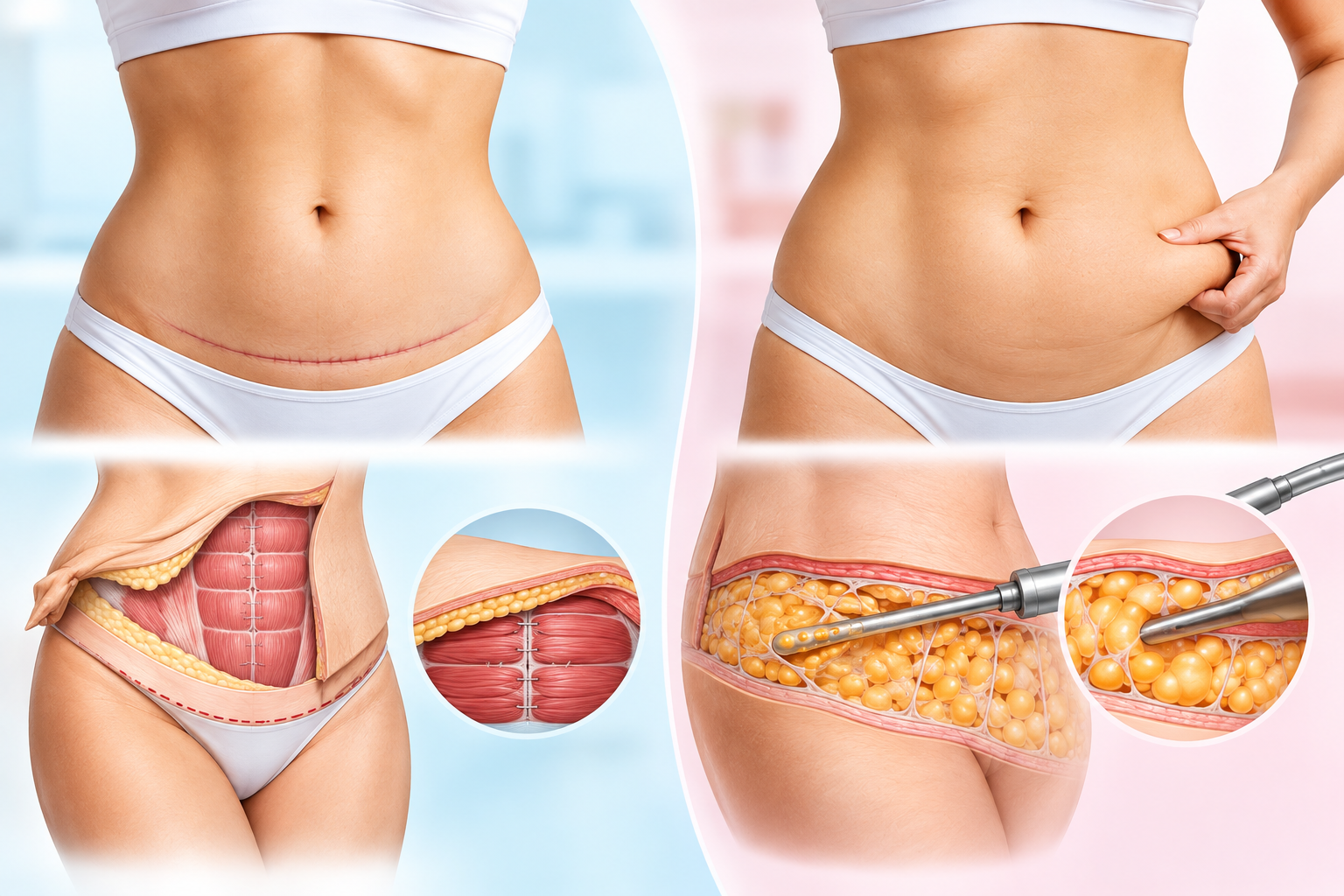
A tummy tuck removes skin and tightens muscle. Liposuction removes fat. That is the whole distinction, and everything else follows from it.
The NHS describes a tummy tuck, or abdominoplasty, as a procedure that “can involve removing excess loose skin, fat and stretch marks and tightening the abdominal muscles”. StatPearls describes the same operation as addressing abdominal skin laxity, excess subcutaneous fat, and laxity of the abdominal musculature, with the separated muscle repaired by stitching the two edges back towards the midline after the skin flap is lifted.
Liposuction does none of that. It removes fat from beneath the skin through small cannulas. It does not cut skin out, it does not stitch muscle, and the NHS is explicit that it “will not remove cellulite or stretch marks”.
| What it does | Tummy tuck (abdominoplasty) | Liposuction |
|---|---|---|
| Removes fat | Yes, from the section of tissue that is excised | Yes, this is its entire purpose |
| Removes loose skin | Yes, this is its main purpose | No. Skin is left exactly as it was |
| Repairs separated muscle | Yes, by stitching the edges back to the midline | No. Muscle is not touched |
| Removes stretch marks | Only those sitting on the skin that is removed | No |
| Leaves a long scar | Yes, low across the abdomen, permanent | No. Small cannula entry points only |
| Typical anaesthesia | General, usually with a hospital stay | Depends on the volume and area treated |
| Helps when skin has lost its stretch | Yes | No, and it can make it look worse |
Read that table as two different tools rather than two grades of the same tool. Nobody asks whether a hammer is better than a spanner.
Which of the three abdominal problems do you have?
There are three, and they need different answers. Excess fat with firm skin. Loose skin that no longer retracts. Separated abdominal muscle, which changes the shape of the abdomen even when skin and fat are unremarkable.
Most people have some combination. The question is not which one you have exclusively, it is which one is doing most of the damage to the shape you see.
- Mostly fat. The bulge is soft, you can gather it easily between finger and thumb, and the skin itself still snaps back when you let go.
- Mostly skin. The tissue hangs in a fold, particularly when you lean forward, and releasing a pinched fold leaves it creased rather than flat.
- Mostly muscle. The abdomen looks rounded or domed rather than loose, often worse at the end of the day, and there is a ridge or gap felt down the midline.
Separated abdominal muscle is called rectus diastasis, and it is covered properly in our companion post on why a tummy stays loose after weight loss, which also explains the at-home check for it. This page will not repeat that.
What does the pinch test tell you at home?
The pinch test separates fat from skin, which is the distinction that decides between the two operations. Sit upright, gather the tissue below your navel between finger and thumb, then let go and watch what the skin does.
- If you gather a thick, soft roll and the skin springs flat the moment you release it, your dominant problem is fat and the skin still has elasticity.
- If what you gather is thin and skin-like rather than bulky, and it stays creased for a second or two after release, your dominant problem is skin.
- If you gather very little but the abdomen still projects forward, look at the muscle rather than the surface.
This is a prompt for a better conversation, not a diagnosis. It tells you which question to ask at your consultation. It does not replace an examination, and it is unreliable if you are still actively losing weight.
When is liposuction alone the right answer?
When the problem is localised fat sitting under skin that still has good recoil, and the abdominal muscle is intact. In that situation liposuction does exactly what it is designed to do and a tummy tuck would be an over-treatment with a permanent scar attached.
The NHS puts the same point positively, noting that liposuction “works best in people who are not overweight and in areas where the skin is firm and elastic”. Read that sentence carefully before you book anything, because it is also the clearest statement of who it does not work for.
Typical fit: a stable weight, a defined pocket of fat that has not responded to training, skin that has never been stretched hard by pregnancy or by a large weight change, and no gap felt down the midline.
When would liposuction alone make the abdomen look worse?
When the skin has already lost its ability to retract. Removing the fat underneath loose skin leaves the same amount of skin with less underneath it to fill out, and the looseness becomes more visible rather than less.
This is the most common way an abdominal operation disappoints someone. The surgery is done competently, the fat is genuinely removed, and the result looks worse than the starting point because the wrong problem was treated.
It is also the reason a low quote is worth reading carefully. Liposuction is the cheaper operation. If your assessment concluded liposuction and you know your skin does not spring back, ask directly why.
The same logic applies where there is significant muscle separation. Fat removal does nothing to a doming abdominal wall, and thinning the layer in front of it can make the doming easier to see.
When is a tummy tuck the right answer instead?
When skin, muscle, or both are the dominant problem. If the skin no longer retracts, only removing it changes the shape. If the muscle edges have separated, only stitching them back changes the profile.
StatPearls describes that muscle repair as plication, performed after the skin flap is lifted, using permanent or long lasting sutures to bring the edges back towards the midline. No non-surgical treatment and no amount of fat removal reproduces it.
A tummy tuck is a bigger operation with a permanent scar and a longer recovery, and it should be chosen because it is the operation your abdomen needs, not because it sounds more thorough. Where the looseness sits only below the navel, a narrower variant may apply, and Elegance Clinic has a page on the reverse tummy tuck, which addresses laxity in the upper abdomen rather than the lower. Which variant fits is decided at examination, not from a page.
Can the two be done together in one operation?
Often, yes. Liposuction of the flanks and the upper abdomen is regularly planned alongside a tummy tuck so that the sides match the front once the skin has been removed. Done as one planned procedure it is usually called lipoabdominoplasty.
StatPearls treats this as routine enough to give it a practical instruction: when liposuction is planned at the same time as abdominoplasty, the intended areas should be clearly marked before surgery. Combining is a recognised, planned technique, not an upsell in itself.
The reason it is common is simple. A tummy tuck tightens the front of the abdomen. If the flanks are untouched, the contour can step awkwardly at the sides. Treating both gives a result that follows the shape of the body rather than stopping at the edge of the excised skin.
When is combining them not the safer choice?
When it would make one long operation out of two manageable ones. Every additional area treated adds operating time, blood loss and anaesthetic exposure, and those are the things that turn a routine recovery into a complicated one.
Honest position on this page: I am not going to tell you that combining is as safe as doing either operation alone. There is published work comparing the two, and I have not been able to read it in full, so it is not cited here and the claim is not made. What is reasonable to say is this.
- Combining is appropriate when the total volume and operating time stay within what the surgeon and anaesthetist judge safe for you specifically.
- Staging into two operations is the right call when the combined procedure would be long, when the area to be treated is large, or when there are medical reasons to keep any single anaesthetic short.
- Seroma, a collection of fluid under the skin flap, is the most common complication after abdominoplasty according to StatPearls, and anything that increases the raw surface area involved is worth weighing against the convenience of one sitting.
- Smoking matters more here than almost anywhere else. StatPearls recommends stopping at least four weeks before and four weeks after surgery. This is not a lifestyle suggestion, it is about whether the skin flap heals.
A surgeon who agrees to combine everything you ask for without discussing operating time has not answered the question you should be asking.
How do downtime and scars compare?
A tummy tuck takes longer to recover from and leaves a permanent scar. Liposuction has small entry points and a shorter return to normal activity, but it settles slowly and the final shape takes months to appear.
| Recovery | Tummy tuck | Liposuction |
|---|---|---|
| Off work and exercise | About 4 to 6 weeks, per NHS guidance | Shorter, varies with the area treated |
| Gentle exercise | Within the 4 to 6 week window above | From about 3 to 4 weeks, per NHS guidance |
| Strenuous activity | Guided by your surgeon, later than gentle exercise | Avoided for about 10 to 12 weeks, per NHS guidance |
| Time to full recovery | About 6 weeks to see the full effect, per NHS | Swelling can take up to 6 months to settle, per NHS |
| Scar | Long, low, permanent. Fades but does not disappear | Small cannula points, usually inconspicuous |
| Compression garment | Yes | Yes |
Two things that table does not show. First, liposuction’s quicker return to work is not the same as a quicker final result, because the shape keeps changing for months. Second, a tummy tuck scar is a certainty, not a risk, and anyone choosing that operation should see where it will sit before consenting. Where it sits and how it matures is covered in the companion post on tummy tuck surgery.
What are the risks specific to each operation?
Both carry the general risks of surgery: bleeding, infection, blood clots, anaesthetic reactions and a result that does not match what was hoped for. Each also has risks that belong to it specifically.
More associated with a tummy tuck: fluid collecting under the skin flap, which StatPearls identifies as the most common complication of the operation; problems with healing along the scar, particularly in smokers; numbness of the skin between the scar and the navel, which can be long lasting; thickened scarring.
More associated with liposuction: lumpy or uneven contour, which the NHS lists first among its risks; bruising and bleeding under the skin; numbness that can persist for months; changes in skin colour over the treated area; fluid accumulation.
Neither list is complete and neither is a reason on its own to avoid surgery. They are the things a consent conversation should actually cover. If yours does not, that is information too.
Why is the cheaper operation not always the cheaper decision?
Because the wrong operation costs the full price of the right one afterwards. Liposuction quoted against a tummy tuck will nearly always be the lower figure, and if your problem is skin or muscle, that lower figure buys a result you will want revised.
There is a second cost that does not appear on any quote. A tummy tuck cannot easily be undone, and a revision after a poorly planned first operation is harder than the original, because the tissue planes have already been disturbed.
Practical way to compare quotes without getting lost in numbers:
- Ask which of the three problems the quote is treating. If the answer is vague, the plan is vague.
- Ask whether the quote assumes muscle repair. That single item changes both the operation and the price.
- Ask what is included: anaesthesia, hospital stay, garment, follow up visits, and what a revision would cost if one is needed.
- Ask what happens if the examination on the day of surgery suggests a different plan.
For what it is worth, financing the right operation is a better decision than paying cash for the wrong one. Elegance Clinic sets out its EMI options separately.
Is either operation a weight loss treatment?
No. Neither is, and neither should be offered as one. This matters enough to state on its own rather than leave implied.
The NHS says of liposuction that it “is not a treatment for obesity”. Of a tummy tuck it says it is “not a quick fix for losing weight” and that it is “not a procedure for someone who is overweight”.
Both are contouring operations for people who are already at a weight they can hold. That is not a technicality, it is a safety point and a results point at the same time:
- Operating before your weight is stable means the result changes underneath you afterwards.
- Higher body weight raises the risk of wound healing problems and fluid collections after a tummy tuck.
- Neither operation changes the fat inside the abdominal cavity, which is the fat most relevant to metabolic health. A flatter profile after surgery is not the same as a healthier one.
If losing weight is the goal, the surgery is a conversation for afterwards, not instead.
How is an abdomen assessed at Elegance Clinic, Surat?
By examination, in that order: skin quality first, then muscle, then fat. The assessment decides the operation, not the other way round.
In our practice in Surat the commonest reason someone leaves a consultation with a different plan than the one they arrived with is skin elasticity. People who have read about liposuction and are certain it is what they need frequently have skin that will not retract over the space left behind, and that is a five minute finding on examination that no amount of online reading substitutes for. It is also the finding that most often turns a single operation into a staged plan.
What a consultation covers: your weight history and whether it is currently stable, previous abdominal surgery and where those scars sit, pregnancies, smoking, a skin and muscle examination, and a straight answer about which of the three problems is dominant. If the honest answer is that surgery is not the right step yet, you will be told that.
Dr. Ashutosh Shah is a plastic and cosmetic surgeon in Surat. His background and qualifications are on his profile page, and the clinic’s liposuction service page sets out the techniques used, including laser liposuction.
Next step
If you are trying to choose between the two, the useful next step is an examination rather than more reading, because skin elasticity and muscle separation are findings, not opinions. Book a consultation through the Elegance Clinic contact page in Surat and bring your weight history with you.
This article is for education and is not a substitute for professional diagnosis or treatment. Which operation suits you can only be decided after an examination. Please consult Dr. Ashutosh Shah or another qualified plastic surgeon about your own circumstances.

