

|
Getting your Trinity Audio player ready...
|
✓ Medically reviewed by Dr. Ashutosh Shah, Plastic, Reconstructive & Cosmetic Surgeon (M.Ch., DNB)
Written by Dr. Ashutosh Shah, MS, MCh (Plastic Surgery), Consultant Plastic and Reconstructive Surgeon, Elegance Clinic, Surat. Reg. no. [REG NO].
Medically reviewed by Dr. Ashutosh Shah. Published 26 September 2026. Last reviewed 26 September 2026.
A blister on a baby’s skin is most often harmless, such as a sucking blister present from birth. A few causes are serious and have specific signs: blisters that spread, cluster, weep, or appear with fever or poor feeding need same-day assessment.
If your baby has a blister or rash and is also unwell, do not finish reading this page first. Take the baby to the nearest emergency department. Signs that need emergency care now, per NHS guidance on rashes in babies and children, include a stiff neck, being bothered by light, seeming confused or not responding normally, difficulty breathing including grunting or the tummy sucking in under the ribs, skin, lips or tongue looking pale, blue, grey or blotchy, or a rash that does not fade when a glass is pressed against it. On darker skin, check the soles of the feet, palms, lips, tongue and inside the eyelids. The NHS also says plainly that as a parent you may know when your child seems seriously unwell, and that you should trust your judgement.
With that said, the reassuring part is true as well. Most blisters that appear on a baby’s skin in the first weeks are one of a small number of harmless things, and they settle without any treatment at all.
This page is written to help you tell which situation you are in. It does not diagnose, because a blister cannot be diagnosed from a description, and it does not tell you to wait a set number of days, because the signs below are what matter rather than the clock.
What are the common causes of a blister on a baby’s skin?
Most are one of four harmless things: a sucking blister, one of the common newborn rashes, a friction blister, or heat-related blistering. None of these needs treatment.
DermNet’s list of blisters and pustules in neonates separates the benign causes from the ones that matter, and the benign group is the larger one.
| Cause | What it looks like | Where | When it appears |
|---|---|---|---|
| Congenital sucking blister | A blister or shallow erosion, usually single | Forearm, hands, fingers | Present at birth |
| Erythema toxicum neonatorum | Red patches, small bumps and pustules | Face, trunk and limbs | First days |
| Transient neonatal pustular melanosis | Pustules, then small marks as they fade | Widespread | First days |
| Neonatal acne | Small spots and blackheads rather than blisters | Cheeks, chin, forehead, scalp, chest | First weeks |
| Friction or heat | Clear small blisters where skin rubs or stays hot | Anywhere clothing, a seam or a nappy edge presses | Any time |
Two of those are worth knowing by name, because parents are often told them at the hospital and then forget which was which. Erythema toxicum and transient neonatal pustular melanosis both look alarming, both appear in the first days, and both go away.
Which features are reassuring?
A settled, feeding, comfortable baby is the single most reassuring feature. After that: a small number of blisters, no change over hours, no fever, and skin around them that looks normal.
- The baby is feeding normally and is their usual self.
- There is no fever.
- The blister is not spreading and the number is not increasing hour by hour.
- It is not grouped or clustered together on a red base.
- There is no discharge, crusting or smell.
- It sits somewhere that rubs, such as a hand the baby sucks or a seam that presses.
Reassuring is not the same as certain. It means what you are looking at fits the common pattern, and that watching it is reasonable while you arrange a routine review rather than an urgent one.
Which features mean the baby should be seen today?
Any unwell baby, and any blister that is grouped, spreading, weeping or crusting. Those two categories cover almost everything that matters.
See a doctor the same day if any of these apply:
- The baby is unwell in any way. Fever, feeding poorly, unusually sleepy or floppy, or simply not themselves.
- The blisters are grouped or clustered together on a red base. DermNet describes grouped vesicles on an erythematous base as the pattern seen in herpes simplex and in chickenpox in a newborn, and both are treated urgently.
- They are spreading, or there are visibly more than there were a few hours ago.
- They are rupturing, weeping or crusting, or the skin looks raw where one has broken. Bacterial infection can progress in a newborn.
- The skin around them is red, hot or swollen.
- The skin seems fragile, blistering or peeling where it is handled or where clothing rubs.
- Blisters were present at birth, other than a clear sucking blister on the hand or forearm.
- There is a family history of a blistering or fragile skin condition.
- Your instinct says something is wrong. The NHS treats that as a legitimate reason on its own, and so should you.
Notice that most of this list is about the baby and the pattern rather than about the individual blister. That is deliberate. A single blister on a well baby is rarely the problem. A blistering baby who is unwell is always worth seeing.
What is a sucking blister?
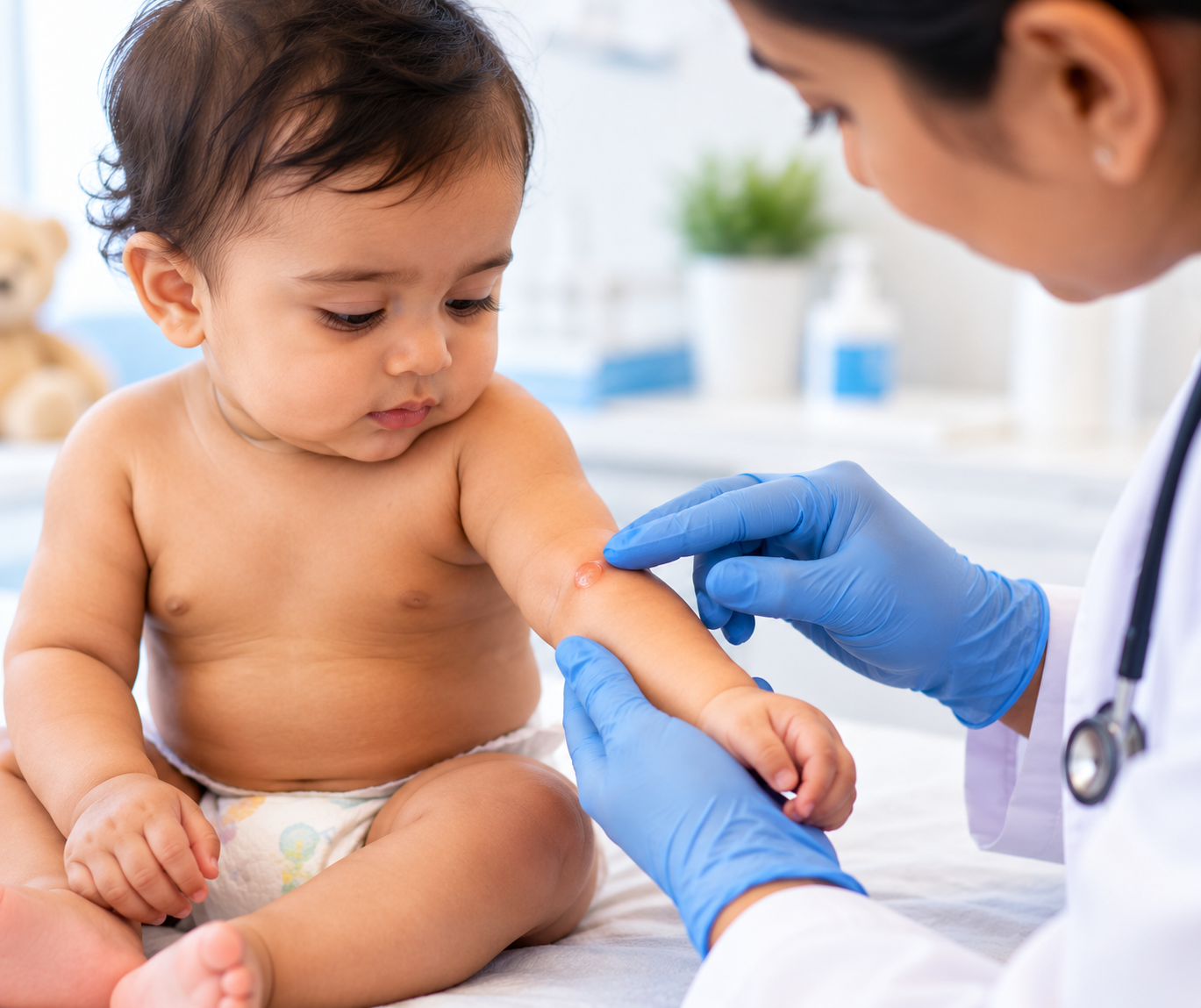
A blister the baby made themselves by sucking, usually before birth. DermNet places them on the forearm, hands and fingers, and they are present at birth.
They need nothing. They heal on their own, they do not scar meaningfully, and they are one of the few blisters where being present at birth is not a reason for concern.
The reason they are worth naming is that they are the commonest cause of a parent being alarmed on day one. Knowing this exists, and where it appears, saves a good deal of worry.
What do the common newborn rashes look like?
Blotchy red patches with small bumps and pustules, appearing in the first days and moving around the body. That description covers most of what alarms parents in the first week.
Erythema toxicum neonatorum, in DermNet’s description, is erythematous macules, papules and pustules on the face, trunk and limbs. In plain terms: red patches with small raised spots on top, some of which look like tiny pustules, which come and go in different places over a few days.
Transient neonatal pustular melanosis is a pustular eruption that can be more widespread and leaves small marks behind as the pustules fade. Those marks worry parents more than the pustules did, and they also settle.
What both have in common is a baby who is entirely well. That is the deciding feature, not the appearance.
When is a blister a sign of infection?
When it is grouped, when it is spreading, when it weeps or crusts, or when the baby is unwell. Those are the patterns that separate an infection from a rash.
Two patterns are worth understanding, without trying to diagnose which you are looking at:
- Grouped blisters on a red base. DermNet describes this pattern for herpes simplex in a newborn, typically on the face and scalp and sometimes the trunk and buttocks, appearing within days to weeks after birth, and for chickenpox, which is generalised. Both are serious in a newborn and both need urgent assessment.
- Flaccid, superficial blisters that burst and leave a red base. DermNet describes this for staphylococcal infection, which can be localised but can also progress to a much more widespread condition with fever.
Neither description is something you should be matching against your own baby to decide whether to go. They are here so that you understand why “grouped”, “spreading” and “bursting” are the words on the urgent list rather than arbitrary alarm.
Why do blisters present from birth need review?
Because the harmless and the serious overlap at exactly that moment. A sucking blister is present at birth. So are several inherited conditions that cause fragile skin.
DermNet notes that epidermolysis bullosa, a group of inherited conditions causing generalised skin fragility with blistering after minor trauma, is present at birth and should be suspected in newborns with a family history. It also describes congenital absence of a patch of skin, most typically in the midline at the back of the scalp, which is usually managed without surgery but is assessed.
So a blister present at birth that is not a straightforward sucking blister on a hand or forearm is examined rather than watched. Not because it is likely to be serious, but because that is the one timing where you cannot tell from the outside.
What should you never do at home?
Do not burst it, and do not put anything on it. The blister roof is a sterile cover over healing skin, and infant skin is more fragile than adult skin to begin with.
- Do not pop, pierce or peel it. Opening it creates a route in for infection and removes the protection underneath.
- Do not apply any cream, ointment, antiseptic, oil or home remedy. That includes anything that worked for an older child, and anything recommended informally. A treated blister is also harder for a doctor to interpret.
- Do not give any medicine intended for an adult or older child, in any dose.
- Do not scrub or soak the area. Clean water and gentle drying, nothing more.
- Do not wait to see if it settles if anything on the same-day list above applies.
Keeping the area clean and dry, and keeping the baby out of clothing that rubs it, is the whole of appropriate home care. Anything beyond that is a decision for a doctor who has seen it.
What will a doctor actually look at?
The baby first, then the blister. That order tells you most of what an assessment is for.
An assessment usually covers how the baby is in themselves, including feeding, temperature and alertness; the pregnancy and delivery; whether anything similar runs in the family; when the blisters appeared and whether they are increasing; where they are and whether they are grouped; and whether the surrounding skin and the rest of the body are normal.
Most of the time the answer is a name for something harmless and no treatment. Where it is not, the point of seeing someone early is that the serious causes are treatable when they are found early and much harder when they are not.
When does a skin lesion become a plastic surgery question?
Rarely, and it is worth being straight about that. For most blisters on a baby, the right doctor is a paediatrician, and if a skin condition is suspected, a dermatologist.
Reconstructive plastic surgery becomes relevant in a smaller set of situations: where a baby is born with an area of skin missing or a congenital lesion that will need reconstruction, where a wound in fragile skin is not healing and needs surgical care, where scarring follows and needs managing, or where a lesion needs removing and closing properly.
If scarring is the concern after a skin problem has healed, that is covered separately in our post on keloid scar treatment.
If your question is simply what this blister is, take the baby to a paediatrician. This page would rather send you to the right person than keep you here.
How are paediatric skin lesions assessed at Elegance Clinic, Surat?
Alongside paediatric colleagues, not instead of them. Anything that looks infective or systemic is a paediatric problem first, and surgical input follows only if it is needed.
In our practice in Surat, the paediatric skin referrals that reach a reconstructive surgeon are usually not the acute blisters at all. They are the congenital lesions that were noticed at birth and reviewed later, the wounds in fragile skin that have not closed, and the scars left behind after something has healed. The acute, frightening, first-week blister is nearly always a paediatric question, and the most useful thing this page can do is say so.
Dr. Ashutosh Shah is a plastic and reconstructive surgeon in Surat. His background is on his profile page and in his team listing.
Next step
If your baby is unwell, seek medical care today rather than booking anything. If the blister is the only issue and the baby is well, a routine paediatric review is the right first step, and a reconstructive opinion follows only if one is needed. For a surgical opinion on a congenital skin lesion or a scar, contact us through the Elegance Clinic contact page in Surat.
This article is for education and is not a substitute for examining a baby. No blister can be diagnosed from a description or a photograph. If you are worried about your baby, seek medical advice rather than relying on this page.

