

|
Getting your Trinity Audio player ready...
|
✓ Medically reviewed by Dr. Ashutosh Shah, Plastic, Reconstructive & Cosmetic Surgeon (M.Ch., DNB)
Written by Dr. Ashutosh Shah, MS, MCh (Plastic Surgery), Consultant Plastic and Cosmetic Surgeon, Elegance Clinic, Surat. Reg. no. [REG NO].
Medically reviewed by Dr. Ashutosh Shah. Published 29 September 2026. Last reviewed 29 September 2026.
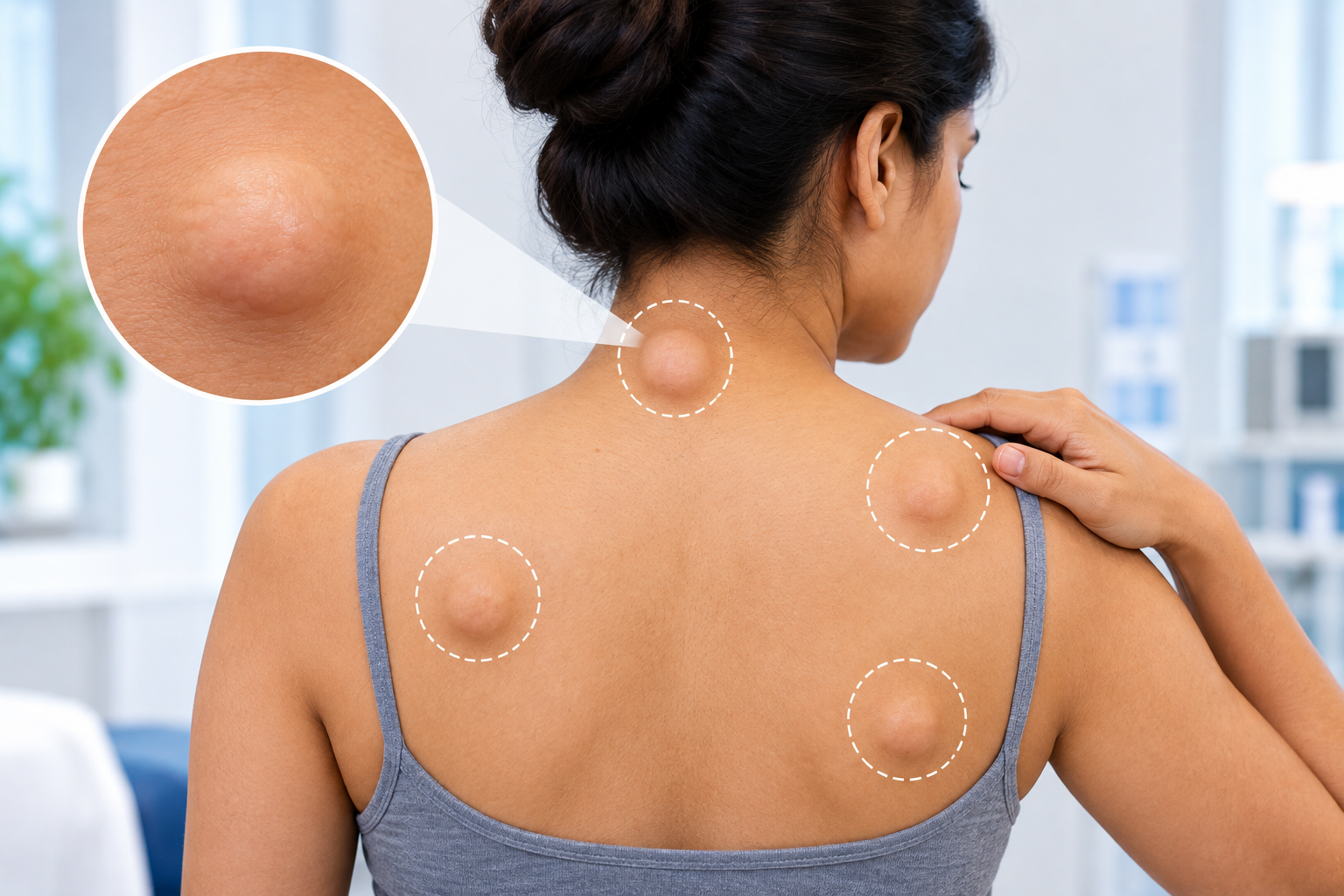
Multiple lipoma means more than one soft, fatty lump growing under the skin. They are benign, usually painless and slow growing, but the number and size can increase over time. Removal is considered when a lump grows, becomes painful, presses on something, or the diagnosis is uncertain.
Finding one soft lump is unsettling. Finding three or four is the point at which most people stop waiting and start searching, usually at night, usually fearing the worst.
So the answer comes first on this page rather than at the end of it. Then the parts that actually change what you do: why they appear in more than one place, how to tell them from something that needs urgent attention, and when removing them is worth it.
What is a lipoma, and what does multiple lipoma mean?
A lipoma is a benign lump of fat that grows slowly under the skin. Multiple lipoma simply means more than one of them, in more than one place on the body.
The NHS describes them in one line: “Lipomas are soft, fatty lumps that grow under your skin.” Mayo Clinic places them more precisely, as “a slow-growing, fatty lump that most often is located between the skin and muscle layer but below the skin.”
DermNet gives the clinical definition, and one word in it matters for everything further down this page: “A lipoma is a very common benign, slow-growing tumour of mature adipocytes (fat cells), which grows slowly under the skin in the subcutaneous tissue; rarely, it may expand deep to the fascia or intramuscularly.”
The word is tumour, and it frightens people who meet it for the first time in a search result. In medicine it means a growth, not a cancer. Section four deals with that directly rather than leaving you to infer it.
Where they turn up is predictable. The NHS notes that “Lipomas often appear on your shoulders, chest, arms, back, bottom or thighs.”
Why do lipomas appear in more than one place?
Usually because of an inherited tendency rather than anything you did. Mayo Clinic states it plainly: “Lipomas tend to run in families, so genetic factors likely play a role in their development.”
Having several is less common than having one, and it is worth knowing where you sit. DermNet quantifies it: “While most lipomas are solitary, some 5-10% of patients will have multiple lesions, usually associated with an underlying syndrome or genetic disorder (e.g., familial multiple lipomatosis, Proteus syndrome, PTEN hamartoma syndrome, Gardner syndrome, or multiple endocrine neoplasia type 2B).”
Read that sentence carefully, because it is easy to read badly. It does not say that having several lumps means you have a syndrome. It says that when multiple lipomas occur, an underlying tendency is usually the reason, and most of those tendencies are simply familial. Mayo Clinic records the plain version of the same fact: “Some people have more than one lipoma.”
What it does mean is that multiple lipomas are worth mentioning to a doctor as multiple, rather than presenting one lump at a time on separate visits. The pattern is information.
Age and general health sit in the background rather than causing them. DermNet notes that “While lipomas typically affect patients between 40 and 60 years of age, they can occur at any age and are more common in patients with hyperlipidaemia, type 2 diabetes mellitus, and obesity.”
That is an association, not a verdict on how you have lived. Nobody gets lipomas as a punishment, and no diet removes one that is already there.
How do you tell a lipoma from something else?
Mostly by how it feels and how it behaves. DermNet notes that “Lipomas are usually diagnosed clinically”, which means an experienced examination usually settles it without a scan.
The two features doctors rely on are texture and movement. Mayo Clinic describes a lipoma as “Soft and doughy to the touch.” The NHS adds that they “feel soft and squishy” and “may move slightly under your skin if you press them.”
The table below is what those features look like from your side, and what they do not fit. It is a guide to what to report, not a way to diagnose yourself.
| What you can feel | What it fits | What it does not fit |
|---|---|---|
| Soft, doughy, gives under a finger | The classic lipoma texture | Something firm or stony that does not yield |
| Slides a little under the skin when pressed | A lump sitting loosely in the fat layer | A lump anchored to deeper tissue |
| No pain when you press it | Most lipomas | A lump that is tender, hot or red |
| Has been there for a long time, barely changing | Slow growth, which is typical | Anything that has changed noticeably and recently |
| Rounded, sometimes lumpy at the edge | A lipoma, which is often lobulated | A lump with an irregular hard edge |
| You have several, in different places | Multiple lipomas, worth reporting together | One lump behaving differently from the rest |
That last row is the one people miss. If you have several lumps that all feel the same and one that does not, the odd one out is the one to lead with at your appointment.
Are multiple lipomas dangerous?
No. Mayo Clinic answers it in seven words: “A lipoma isn’t cancer, and it typically is harmless.” The NHS agrees that “They’re harmless and do not usually need any treatment”.
That is the answer, and it is not being softened or qualified. Having several does not change it, because several benign lumps are still benign lumps.
What does deserve attention is a lump that behaves unlike a lipoma. The NHS lists the circumstances in which to see a GP, and these are worth reading as written rather than summarised:
- “you get a lump anywhere on your body”, which is to say a new one should be looked at once rather than watched indefinitely.
- “a lump is painful, red or hot to touch”
- “a lump is hard and does not move”
- “a lump increases in size”
None of those means something serious is happening. They mean the lump is not behaving the way a lipoma behaves, so the assumption that it is one should be checked rather than continued.
There is also a routine safeguard built into removal itself. The NHS notes that “If you have it removed it may be sent to a laboratory to check it is a lipoma.” That is standard practice, not a sign anyone is worried.
When does a lipoma need removing, and when does it not?
Most do not need removing at all. Mayo Clinic puts the threshold where it belongs: “Treatment generally isn’t needed, but if the lipoma bothers you, or if it’s painful or growing, you may want to have it removed.”
The honest version of that, in a clinic rather than on a page, is that removal is a decision about symptoms and certainty rather than about the lump existing. The reasons that genuinely justify it:
- It is causing symptoms. DermNet notes that “Rarely, large lipomas may compress nerves or other adjacent structures, leading to pain, numbness, or other symptoms.” A lump doing that has stopped being cosmetic.
- It is growing. Change is the reason, not size on its own.
- It catches, rubs or gets in the way, under a waistband, a bra strap, a collar or a shoulder bag.
- The diagnosis is not certain. Removing it settles the question, and the laboratory check above is part of that.
- It genuinely bothers you. Mayo Clinic lists this first for a reason, and a surgeon who dismisses it is answering a question you did not ask.
What is not on that list is the number of lumps you have. Having several is not by itself a reason to remove any of them, and nobody should be advised to clear them all because they can be counted.
What does removal involve, and why is it not liposuction?
A lipoma is taken out through a small cut, together with the thin capsule around it. That last part is the whole difference, and it is why suction is not the same operation.
DermNet states the standard in one sentence: “Surgical excision is curative, provided the thin capsule is completely removed.”
Follow that logic through, because it answers a question people ask constantly:
- A lipoma is fat inside a thin bag. The bag is the capsule.
- Excision removes the lump and the bag together. That is why DermNet calls it curative.
- Liposuction removes fat through a cannula. It has no way of taking the capsule with it.
- So a lipoma is excised, not suctioned. They are different operations answering different problems.
This matters here because liposuction is a well known word and lipoma is not, so the two get blurred together, including by search engines. If you are actually looking for body contouring rather than lump removal, that is a separate subject and it is covered on our post about what liposuction is and is not for.
The operation itself is small and done under local anaesthetic in most cases, with the lump sent for the laboratory check the NHS describes. Several lumps in different places are usually dealt with in planned groups rather than all in one sitting, because each one is its own small wound.
What scar does removal leave, and where does it sit?
A line roughly the length of the lump, placed along a skin crease wherever the anatomy allows. Removing a lump trades it for a mark, and that trade should be understood before rather than after.
Three things decide how the scar turns out, and only the first is within anyone’s control on the day:
- Where the cut is placed. Along a natural crease or line, so it settles into something the skin already does.
- How your skin scars. Indian skin has a greater tendency to darken along a healing line, and some people scar thickly. Raise any personal or family history of raised or keloid scars before surgery, not afterwards.
- Time. A new scar is at its most obvious in the early months and continues settling well beyond the point most people stop looking.
If you already know you scar badly, say so at the consultation and ask what that changes about the plan. How thickened scars behave and what can be done about them is set out on our post about keloid and thickened scars.
For a lump that is not causing symptoms and is not changing, the scar is a fair argument for leaving it alone.
Do lipomas come back, and do new ones appear?
Two separate questions, and they have different answers. A properly excised lipoma should not regrow. New ones elsewhere are a different matter.
On recurrence at the same site, the DermNet sentence from section six carries the answer inside it: excision is curative “provided the thin capsule is completely removed”. Recurrence at the same place therefore points to capsule left behind rather than to bad luck. It is a fair and non-confrontational thing to ask a surgeon before the operation.
On new lumps elsewhere, nothing done to one lipoma changes the tendency that produced it. If the reason you have several is the familial one DermNet and Mayo Clinic both describe, that reason is unaffected by surgery. Removing three lumps does not make a fourth less likely.
Nobody can promise you otherwise, and anyone who does is selling the wrong thing. What removal settles is the lump in front of you.
What should you tell your doctor at the first visit?
Bring the pattern, not just the lump that worries you most. The pattern is what turns a two minute look into a useful assessment.
- How many you have, and roughly where. Say at the start that there is more than one.
- How long each has been there, and which appeared most recently.
- Whether any has changed, in size, firmness or comfort, and over what period.
- Whether any is painful, numb, tingling or catching on clothing.
- Whether anyone in your family has them. Mayo Clinic notes they tend to run in families, so this is a real question and not small talk.
- Any history of thick or raised scars, yours or in your family.
- What you actually want. Reassurance, removal of one specific lump, or a plan for several. They lead to different appointments.
You do not need to name anything or arrive with a theory. Describing what you have noticed, accurately, is the useful contribution.
How are multiple lipomas assessed at Elegance Clinic, Surat?
By examining all of them rather than the one you point at, because the odd lump out is the one that matters.
In our practice in Surat, the most common thing we see is someone who has had several soft lumps for years, told nobody, and come in now because one of them changed. They are usually braced for bad news and have often not slept well. The assessment nearly always ends with reassurance, and the part that actually helped was checking every lump rather than the one that prompted the visit.
An assessment covers the number, sites and character of each lump, which ones fit the typical picture and which do not, whether any is causing symptoms, and whether removal is worth the scar for the ones that are not. Where a lump is removed, it goes for the laboratory check as a matter of routine. Related procedures are listed under our services.
If the answer is that nothing needs doing, that is what you will be told, and it is a complete answer rather than a fobbing off.
Next step
If you have found more than one lump and want it looked at properly rather than guessed at online, the useful step is an examination of all of them. You can book a consultation to have each lump assessed and be told plainly which, if any, need anything doing.
This page is for education and is not a substitute for professional assessment. Any new lump, or a lump that changes, should be examined by a doctor. Discuss your own situation with Dr. Ashutosh Shah or another qualified surgeon.

