

|
Getting your Trinity Audio player ready...
|
✓ Medically reviewed by Dr. Ashutosh Shah, Plastic, Reconstructive & Cosmetic Surgeon (M.Ch., DNB)
Written by Dr. Ashutosh Shah, MS, MCh (Plastic Surgery), Consultant Plastic and Cosmetic Surgeon, Elegance Clinic, Surat. Reg. no. [REG NO].
Medically reviewed by Dr. Ashutosh Shah. Published 29 September 2026. Last reviewed 29 September 2026.
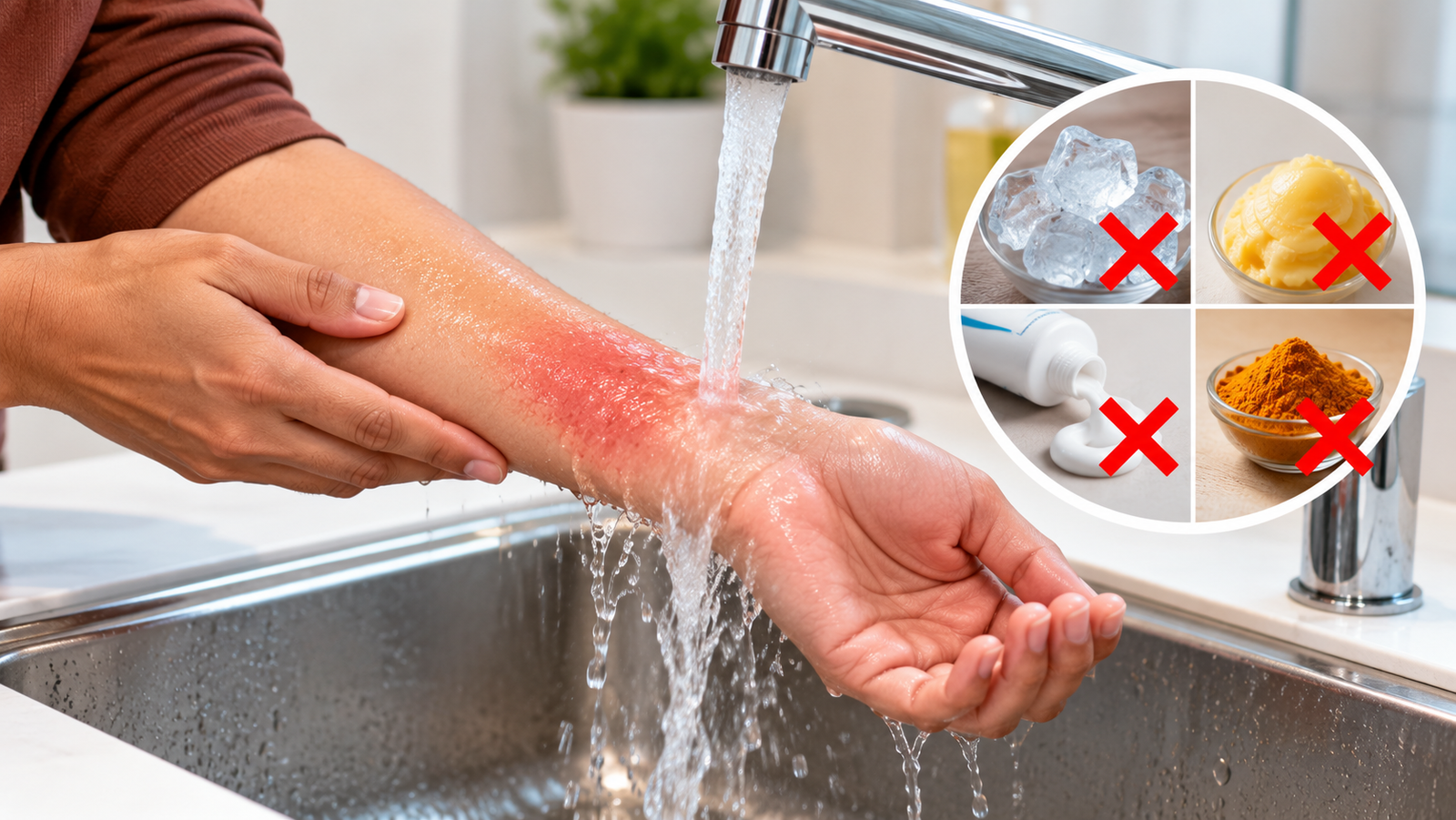
Burn first aid begins with cool running water for 20 minutes, started as soon as possible, because cooling limits how deep the injury goes. Nothing else should be applied. Ice, butter, toothpaste and haldi all make the injury worse, and any large, deep, chemical or electrical burn needs emergency care immediately.
Go straight to the nearest emergency department, or call 112, if the burn is large or deep, if it is on the face, hands, genitals or bottom, if it was caused by acid, a chemical or electricity, or if the person is a young child. Start the cool water on the way. Do not wait to see how it looks tomorrow.
Most people reach for something to put on a burn. That instinct is the problem. The single most useful thing in the house is the cold tap, and almost everything people apply instead makes the injury deeper, the infection risk higher, or the assessment harder for whoever sees it next.
This page sets out what to do, in order, and what must never go on a burn. Every instruction here is quoted from the NHS, the World Health Organization, an NHS burn care network or the British Red Cross, and each is attributed where it appears.
Why do the first minutes change how a burn heals?
Because heat keeps working after the contact stops. Skin holds the temperature for some time, and the injury goes on deepening while it does. Cooling stops that process, which is why the first minutes matter more than anything that happens later.
How deep a burn ends up is what decides almost everything that follows: whether it heals on its own, whether it needs surgery, and how it scars. That depth is not fully set at the moment of contact. It is still being decided while you are deciding what to do.
This is not a small problem locally. The World Health Organization records that “In India, over 1 million people are moderately or severely burnt every year.” Most burns happen at home, which means most burn first aid is given by someone with no training, in a kitchen, in the first sixty seconds.
How long should cool running water be applied?
Twenty minutes, started as soon as possible. The NHS instruction is to “Hold the burn or scald under cool running water for 20 minutes. Do this as soon as possible, within 3 hours of it happening.”
The British Red Cross gives the same first step: “Cool the burn under cold running water for at least 20 minutes.” An NHS burn care network puts it as placing the area “in cool water or under a gently running cold tap for at least 20 minutes”.
Two points people get wrong. Twenty minutes feels far longer than it sounds, and most people stop after two or three. And the NHS three hour window means that if you did not cool it at the time, cooling it now is still worth doing.
Twenty minutes is the dose, and it is also the ceiling. The World Health Organization warns to “Avoid prolonged cooling with water because it will lead to hypothermia”, which matters most in a small child or an older person. The NHS burn network answers that directly: “Keep the person warm by using a blanket or layers of clothing.” while adding that you should “Avoid putting blankets or layers of clothing directly on the burn.” Cool the burn, warm the person, stop at twenty minutes.
One thing to do while the water runs. The NHS says to “Remove any clothing or jewellery that’s near the affected area”, but also that you should “do not remove anything that is stuck to the affected area”. Rings and bangles especially, because the area swells.
What must never go on a burn?
Nothing except cool running water and, afterwards, a clean covering. The table below lists what people actually reach for, and what each one does, with the source for each.
| What people apply | What it actually does, and who says so |
|---|---|
| Ice or iced water | WHO: “Do not apply ice because it deepens the injury”. The NHS burn network simply says “Do not use ice” |
| Butter or ghee | NHS: “do not put any creams, oils or butter on burns or scalds”. The Red Cross notes that “Butter, cream or toothpaste will not cool the area” |
| Toothpaste | Red Cross: it “will not cool the area”. Any cooling feeling is superficial and the paste then has to be cleaned off damaged skin |
| Haldi or turmeric paste | WHO: “Do not apply paste, oil, haldi (turmeric) or raw cotton to the burn” |
| Raw cotton or cotton wool | WHO, same instruction. Fibres stick to the surface and have to be picked out later |
| Oils of any kind | NHS lists oils alongside creams and butter. Oil holds heat against the skin, which is the opposite of the aim |
| Ointments, creams or sprays | NHS burn network: “Do not use any ointment or cream on the burn. And never use butter, oil, spray or any other household medicine” |
| Plasters or sticky dressings | NHS: “do not use plasters or sticky dressings to cover a burn or scald”. Red Cross: adhesive bandages “will stick to the skin and can cause further damage” |
| Bursting the blisters | NHS: “do not burst any blisters” |
Read that table as one instruction rather than nine. If it is not cool running water or a clean covering, it does not go on a burn.
Why are household remedies worse than doing nothing?
Because they do three separate kinds of harm at once, and the person applying them believes they are helping. That combination is what makes them dangerous rather than merely useless.
- They trap heat. Anything greasy holds the temperature against the skin, which lets the burn go on deepening. This is why the WHO singles out ice for deepening the injury and why the NHS groups oils with butter and creams.
- They raise the infection risk. A burn has lost the skin barrier. Kitchen substances are not sterile, and turmeric paste, cotton wool and household ointments all introduce material into an open wound.
- They stop the burn being assessed. Whoever sees it next has to clean the surface before they can judge the depth, and cleaning a burn is painful. In a child it can mean sedation for something that was entirely avoidable.
- They cost the twenty minutes. The time spent finding and applying a remedy is the time that should have been spent at the tap, and that window does not come back.
There is no version of this where the remedy helps and the water was optional. The water is the treatment.
Should a burn blister be popped?
No. The NHS instruction is flat: “do not burst any blisters”. A blister is a sterile cover over damaged skin, and opening it removes the only barrier the wound has.
Blisters look alarming and they tempt people, particularly when they are large or in an awkward place. Leave them. If one bursts by itself, do not peel the loose skin away and do not apply anything to it. Cover it as described below and have it seen.
A blister that appears some hours after the burn is not a sign that something went wrong with the first aid. It is a normal part of how a burn of a certain depth behaves.
How should a burn be covered until it is seen?
Loosely, with cling film or a clean plastic bag, and only after the cooling is done. The NHS puts it precisely: “When the burn or scald has cooled, lay cling film over it if you can. Do not wrap the cling film around it.”
The Red Cross gives the same step: “After the burn has been cooled, loosely cover it with cling film or a clean plastic bag.” The WHO version, for someone being moved to hospital, is to “Wrap the patient in a clean cloth or sheet and transport to the nearest appropriate facility”.
- Lay it on, never wrap it round. Wrapping constricts as the area swells. This matters most on a limb or a finger.
- Nothing sticky. Plasters and adhesive dressings stick to burnt skin and tear it when removed.
- Nothing underneath it. No cream, no ointment, no powder. The covering goes straight onto the cooled burn.
- Not on the face. Cling film is for limbs and trunk. A facial burn goes to an emergency department, covered with nothing.
Which burns need emergency care rather than a clinic appointment?
Go straight to the nearest emergency department, and call 112 if you need an ambulance. The NHS lists a burn that “is very large or deep”, one that “is on your face, genitals or bottom”, and one that “has been caused by an acid or chemical, or by electricity”.
In practice, treat the following as emergency department, not clinic, and start the cool water while you are arranging to go.
- Any burn that is large, or that looks deep, or where the skin is white, leathery or charred rather than red.
- Any burn on the face, the hands, the feet, a joint, the genitals or the bottom.
- Any burn caused by acid, a chemical or electricity, whatever it looks like.
- Any burn in a young child, an elderly person, or someone with diabetes or a condition affecting healing.
- Any burn where the person has breathed in smoke, or has a hoarse voice, a cough or soot around the mouth or nose.
- Any burn where the person seems unwell, confused, cold or shocked, regardless of the size of the burn itself.
A burn that is none of these, is small, and is not on a hand, face or joint can reasonably be seen at a clinic rather than an emergency department. If you are unsure which category you are in, treat it as the more serious one.
Why is the threshold lower for burns in children?
Because a child’s skin is thinner, so the same heat for the same time produces a deeper injury, and because a child loses body heat far faster during cooling. Both facts push in the direction of getting seen sooner rather than later.
The NHS sets its threshold for seeking advice about a child under 5 years old lower than for an adult, and that principle holds regardless of which health system you are in. In India that means the nearest emergency department rather than waiting for a clinic appointment.
One instruction deserves its own line, because it is a mistake made with the best intentions. The NHS burn network warns: “Never place a child in a bath full of cold water. This can cause them to go into shock and other complications”. Cool the burnt area under a running tap. Do not cool the whole child.
How are electrical and chemical burns different?
Both go to an emergency department regardless of how the skin looks, and the NHS names them specifically among burns caused “by an acid or chemical, or by electricity”. The visible mark is a poor guide to the damage in either case.
Electrical burns. The current travels through the body, so the injury can be far greater than the small mark on the skin suggests, and it can affect the heart. Before touching the person, make sure the power is off. Do not pull someone away from a live source with your hands.
Chemical burns. The chemical keeps damaging tissue until it is removed, so irrigation matters even more than in a heat burn. The WHO instruction is to “Stop the burning process by removing clothing and irrigating the burns”. Take off contaminated clothing, avoiding contact with it yourself, and keep the water running. Take the container or a photograph of the label with you.
Do not try to neutralise a chemical with another chemical. Water, for a long time, then the emergency department.
Why is scarring largely decided in the first minutes?
Because scarring follows depth, and depth is what those first minutes control. A burn that is cooled properly and kept clean may heal at a level where scarring is minimal. The same burn left to deepen may not.
That is the honest reason a plastic surgeon writes a first aid page. By the time a burn scar reaches a reconstructive clinic, the most powerful intervention has already happened or been missed, and it happened at a kitchen tap. Nothing done later recovers as much as those twenty minutes would have.
Where a burn does scar, how that scar behaves is a separate subject with its own answers, including why some scars keep thickening and what controls them. That is covered in our guide to keloid and thickened scars, and the clinic’s laser treatment for keloid scars page sets out what is used.
How is a burn or burn scar assessed at Elegance Clinic, Surat?
By examination, with the first question always being what was done in the first hour. What the burn was caused by, how long it was cooled, and what was applied to it changes both what we are looking at and how it is cleaned.
In our practice in Surat the most common avoidable finding is a burn that arrives with something on it. Haldi paste and toothpaste are the two we see most, applied by someone who was trying to help, and both have to be cleaned off before the depth can be judged at all. In a child that turns a two minute assessment into a distressing one. The second most common finding is a burn that was cooled for about two minutes because twenty felt impossibly long while a child was screaming.
An assessment covers what caused the burn and when, what first aid was given, what has been applied, the depth and the area involved, whether the site is one that needs specialist care such as a hand, face or joint, tetanus status, and what the dressing plan is. Serious and extensive burns belong in a burns unit, and we will say so rather than treat them here. Dr. Ashutosh Shah is a plastic and reconstructive surgeon in Surat, and his background is on his profile page.
Next step
If the burn is serious by any of the measures above, stop reading and go to the nearest emergency department, calling 112 if you need an ambulance. For a small burn that has been properly cooled, or for a burn scar that has already formed, book a review through the Elegance Clinic contact page in Surat, and tell us what was applied to it.
This article is for education and is not a substitute for emergency care or professional diagnosis. Every first aid instruction above is quoted from the NHS, the World Health Organization, an NHS burn care network or the British Red Cross, and those sources are linked in the text. If you are dealing with a burn now and are unsure how serious it is, treat it as serious and seek emergency care.

