

|
Getting your Trinity Audio player ready...
|
✓ Medically reviewed by Dr. Ashutosh Shah, Plastic, Reconstructive & Cosmetic Surgeon (M.Ch., DNB)
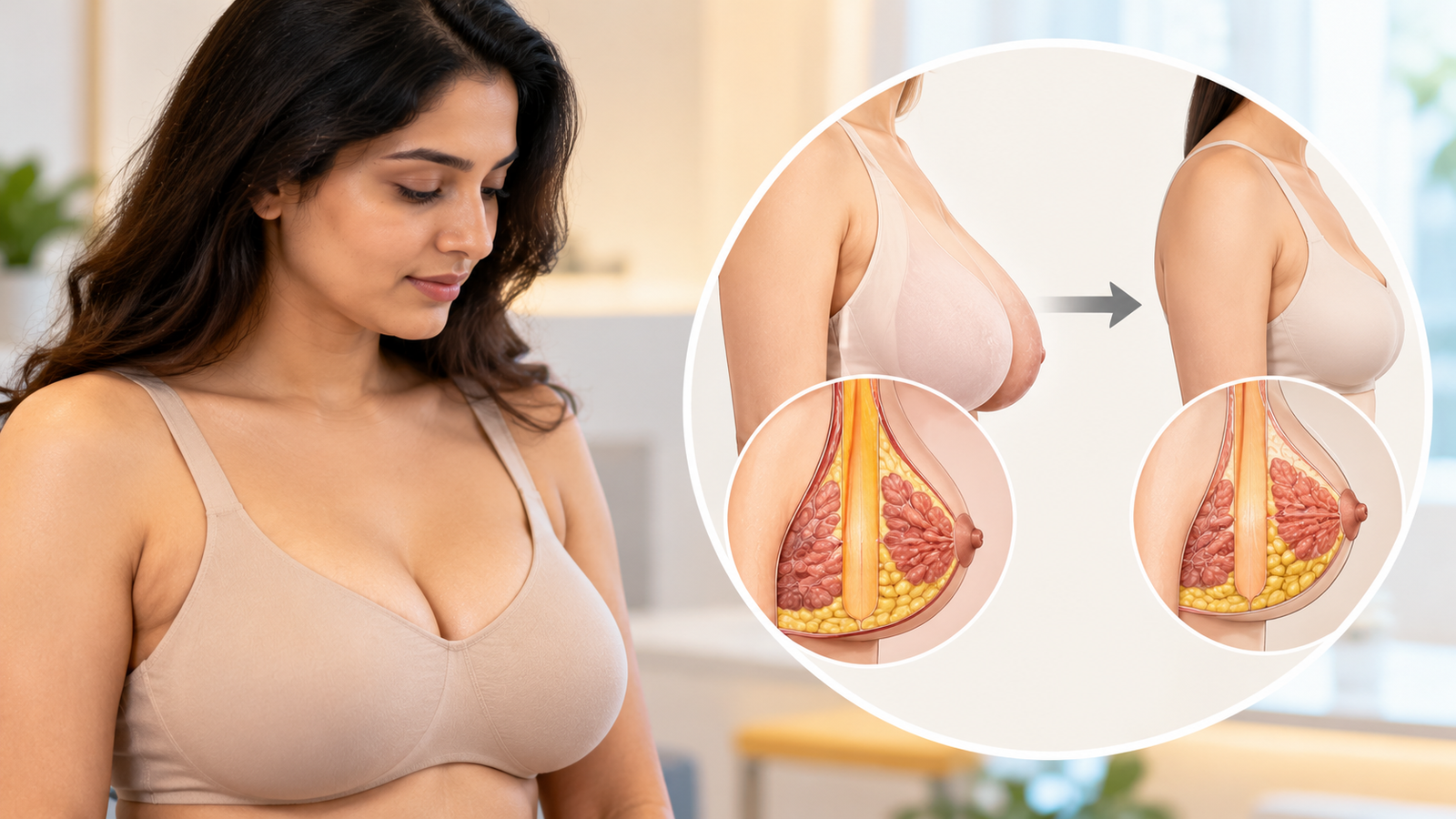
The pedicle technique breast reduction surgeons use helps preserve the nipple’s blood supply while removing excess breast tissue and reshaping the breast. A pedicle is a section of tissue that remains connected to the nipple-areola complex. This connection supports blood circulation and may help preserve sensation and breastfeeding function, although outcomes vary between patients.
Breast reduction surgery involves more than removing excess breast tissue. The surgeon must also create a balanced breast shape while protecting important structures, including blood vessels, nerves and the nipple-areola complex.
One of the most important decisions involves choosing the right pedicle technique.
Patients may hear terms such as inferior pedicle, superior pedicle or superomedial pedicle during a consultation. These terms describe different ways surgeons preserve tissue connections while reshaping the breast.
Understanding the technique can help patients ask informed questions about their surgery.
What Is the Pedicle Technique in Breast Reduction?
A pedicle is a section of breast tissue that remains attached to the nipple and areola during surgery.
This tissue contains blood vessels and may include important nerve pathways and glandular connections.
During breast reduction, the surgeon removes selected areas of excess fat, glandular tissue, and skin while keeping the nipple connected to its supporting tissue.
The surgeon then reshapes the remaining breast tissue and moves the nipple-areola complex to a suitable position when necessary.
This approach differs from removing the nipple completely and reattaching it as a free nipple graft.
Why Do Surgeons Use a Pedicle?
The pedicle helps maintain the biological connection between the nipple and the remaining breast.
Its main purposes include:
- Preserving blood circulation to the nipple-areola complex
- Supporting tissue survival during healing
- Allowing the surgeon to reposition the nipple
- Maintaining selected nerve and glandular connections
- Helping create a balanced breast shape
However, no pedicle technique can guarantee complete preservation of nipple sensation or breastfeeding ability.
The outcome depends on anatomy, surgical planning, the amount of tissue removed, and individual healing.
Why Is Nipple Blood Supply Important During Breast Reduction?
The nipple-areola complex requires a continuous blood supply to remain healthy.
Small arteries deliver oxygen and nutrients, while veins carry blood away from the tissue.
During breast reduction, the surgeon must protect enough of these connections to support healing.
The nipple blood supply in breast reduction is particularly important when the surgeon needs to reposition the nipple over a substantial distance.
If circulation becomes inadequate, complications may occur.
These can include delayed healing, changes in nipple color, tissue damage, or, rarely, partial or complete nipple-areola necrosis.
How Does the Pedicle Protect Circulation?
The surgeon designs a tissue attachment that includes a reliable vascular supply.
Instead of separating the nipple from the breast completely, the surgeon moves it while maintaining its connection to the pedicle.
The design must provide enough tissue to support circulation without creating excessive tension or compromising the final breast shape.
Surgeons consider both arterial inflow and venous drainage during this process.
How Does the Pedicle Technique Work During Surgery?
Although the exact steps vary, pedicle-based breast reduction generally follows a planned sequence.
Step 1: Breast Assessment and Marking
Before surgery, the surgeon evaluates:
- Breast size and shape
- Skin elasticity
- Nipple position
- Breast asymmetry
- Estimated tissue removal
- Existing scars or previous surgery
The surgeon marks the planned incision pattern and intended nipple position.
Step 2: Pedicle Selection
The surgeon chooses a pedicle design based on the patient’s anatomy and surgical goals.
This decision helps determine which tissue connections will support the nipple.
Step 3: Removal of Excess Tissue
The surgeon removes selected breast tissue, fat and skin.
Throughout this process, the surgeon protects the planned pedicle.
Step 4: Breast Reshaping
The surgeon rearranges the remaining tissue to create a smaller, more balanced breast.
The nipple-areola complex moves to its planned position while remaining attached to the pedicle.
Step 5: Closure and Dressing
The surgeon closes the incisions and applies appropriate dressings.
A supportive surgical bra may help during the initial recovery period.
What Are the Different Types of Pedicle Techniques?
Surgeons use several breast reductiontechniques, and each pedicle design offers different advantages and limitations.
The names generally describe the direction from which the tissue supporting the nipple originates.
1. Inferior Pedicle Technique
The inferior pedicle keeps the nipple connected to tissue extending from the lower part of the breast.
Surgeons have used this established technique for many years.
It can provide reliable blood supply in appropriately selected patients and allows substantial breast reshaping.
However, the long-term shape depends on tissue quality, breast weight and the surgical design.
Some patients may experience lower-pole stretching or bottoming out over time.
2. Superior Pedicle Technique
The superior pedicle maintains a tissue connection from the upper part of the breast.
Surgeons may select this technique for particular breast shapes and degrees of nipple repositioning.
Its suitability depends on how far the nipple needs to move and whether the tissue connection can maintain adequate circulation.
3. Superomedial Pedicle Technique
The superomedial pedicle keeps the nipple connected through tissue from the upper-inner portion of the breast.
Surgeons commonly use this approach because it can support breast reshaping and projection in selected patients.
It may also help maintain upper and central breast fullness.
However, the surgeon must carefully assess pedicle length, tissue thickness and circulation, especially in very large reductions.
4. Medial Pedicle Technique
The medial pedicle preserves a connection from the inner part of the breast.
It may help maintain blood supply and support reshaping in suitable patients.
The choice depends on individual anatomy and the surgeon’s experience.
Pedicle Technique Comparison
| Pedicle Type | Tissue Connection | Potential Advantage | Important Consideration |
|---|---|---|---|
| Inferior | Lower breast | Established option for a range of reductions | Long-term lower-pole stretching may occur |
| Superior | Upper breast | Suitable for selected reshaping patterns | Large nipple movements require careful planning |
| Superomedial | Upper-inner breast | Can support projection and shaping | Requires careful vascular assessment |
| Medial | Inner breast | Offers another option for preserving circulation | Suitability depends on anatomy and reduction goals |
Important: No single pedicle technique is best for every patient. A surgeon’s assessment and experience matter more than choosing a technique based only on its name.
How Do Surgeons Choose the Right Pedicle?
Surgeons consider several factors before selecting a pedicle technique.
Breast Size and Volume
Larger breasts may require more extensive tissue removal and nipple repositioning.
The surgeon must design a pedicle that maintains circulation throughout the procedure.
Nipple Position
The distance between the existing and planned nipple positions affects surgical planning.
A greater distance can make pedicle design more complex.
Skin Quality
Skin elasticity influences how well the breast maintains its shape after surgery.
Patients with stretched or less elastic skin may need additional reshaping.
Breast Tissue Distribution
Some patients have more tissue in the lower breast, while others have greater fullness in the upper or outer areas.
The surgeon considers where to remove tissue and where to preserve volume.
Previous Breast Surgery
Earlier breast reduction, augmentation or other procedures may alter tissue circulation.
A surgeon must review previous operative details when available before planning another procedure.
Patient Goals
The desired breast size, shape and level of reduction also influence technique selection.
At Elegance Clinic, Dr. Ashutosh Shah, a plastic and reconstructive surgeon practising since 2004, evaluates breast anatomy, nipple position, tissue quality and patient expectations before recommending a suitable surgical approach.
Does the Pedicle Technique Preserve Nipple Sensation?
The pedicle technique aims to preserve important tissue connections, but nipple sensation can still change after surgery.
Some patients experience temporary numbness, tingling or increased sensitivity.
Others notice a longer-lasting reduction in sensation.
Why Can Sensation Change?
Breast reduction may stretch, disturb or divide sensory nerve branches.
Swelling can also temporarily affect nerve function.
The extent of sensory changes depends on:
- Individual nerve anatomy
- Surgical technique
- Amount of tissue removed
- Degree of nipple repositioning
- Healing response
Some patients experience gradual improvement over several months.
However, permanent changes remain possible.
Patients should discuss this risk before surgery rather than assuming a particular pedicle guarantees normal sensation.
Can You Breastfeed After Pedicle Breast Reduction?
Some patients can breastfeed after pedicle-based breast reduction, but others experience reduced milk production.
The outcome depends partly on how much glandular tissue, ductal tissue and nerve connection remains intact.
A pedicle may preserve some of these structures, but it does not guarantee successful breastfeeding.
Factors That Affect Breastfeeding
These include:
- Amount of glandular tissue removed
- Preservation of milk ducts
- Nerve integrity
- Previous breast surgery
- Individual milk production
- Postoperative healing
Patients who plan future pregnancies should tell their surgeon before surgery.
The surgeon can discuss how different approaches may affect breastfeeding potential.
Is a Pedicle Technique the Same as a Free Nipple Graft?
No.
These are different approaches to managing the nipple-areola complex during breast reduction.
Pedicle-Based Breast Reduction
The surgeon keeps the nipple attached to a section of breast tissue.
This connection supports circulation and may preserve some sensation and glandular function.
Free Nipple Graft
The surgeon completely separates the nipple-areola complex and reattaches it at a new position as a skin graft.
This approach may be considered in selected cases, such as certain extremely large reductions or complex anatomical situations.
However, free nipple grafting sacrifices the original ductal connections and generally causes substantial or complete loss of normal nipple sensation.
It also carries risks involving graft survival and pigmentation changes.
Surgeons therefore reserve it for circumstances where its potential benefits outweigh these limitations.
Does the Pedicle Technique Affect Breast Shape?
Yes.
The pedicle influences how the surgeon redistributes the remaining breast tissue.
However, it is only one part of the overall surgical plan.
The final shape also depends on:
- Amount of tissue removed
- Skin removal pattern
- Internal tissue reshaping
- Breast width and projection
- Skin elasticity
- Healing and scar formation
A well-planned reduction aims to create a breast size and shape that suits the patient’s body proportions.
The surgeon must also consider long-term changes caused by ageing, weight fluctuations and gravity.
What Are the Risks of Pedicle-Based Breast Reduction?
All breast reduction procedures carry risks.
Potential complications include:
- Bleeding or haematoma
- Infection
- Delayed wound healing
- Changes in nipple sensation
- Breast asymmetry
- Scarring
- Fat necrosis
- Reduced breastfeeding ability
- Partial or complete nipple-areola tissue loss
- Changes in breast shape over time
Serious circulation problems involving the nipple are uncommon but important.
Smoking and nicotine exposure can increase wound-healing complications because nicotine-related effects may impair tissue circulation.
Patients should discuss smoking cessation, medications, and relevant medical conditions with their surgeon before surgery.
How Long Does Recovery Take After Pedicle Breast Reduction?
Recovery varies according to the extent of surgery, general health, and individual healing.
| Recovery Period | What Patients May Experience |
|---|---|
| First week | Swelling, bruising, discomfort, and limited activity |
| Weeks 2–3 | Gradual improvement in discomfort and daily mobility |
| Weeks 4–6 | Further healing and possible return to more activities with clearance |
| Months 2–3 | Continued settling of breast shape and swelling |
| Months 6–12 | Scar maturation and gradual refinement of breast appearance |
| Beyond 12 months | Further scar changes and long-term tissue settling |
These are approximate timelines.
Patients should follow their surgeon’s specific instructions for wound care, support garments, sleeping positions, exercise and return to work.
When Should You Contact Your Surgeon?
Seek prompt medical attention if you develop:
- Increasing pain or swelling
- Fever
- Spreading redness
- Unusual wound discharge
- Persistent bleeding
- Sudden changes in nipple colour
- Darkening of nipple tissue
- Significant wound separation
Sudden nipple colour changes require urgent assessment because they may indicate a circulation problem.
Frequently Asked Questions
1. What Is the Pedicle Technique in Breast Reduction?
The pedicle technique keeps the nipple-areola complex attached to a section of breast tissue during reduction surgery. This connection helps maintain blood circulation while the surgeon removes excess tissue and reshapes the breast.
2. Which Pedicle Technique Is Best for Breast Reduction?
No single technique suits every patient. Surgeons choose between inferior, superior, superomedial and other pedicle designs according to breast anatomy, nipple position, tissue removal requirements and their experience.
3. Does the Pedicle Technique Keep the Nipple Alive?
The pedicle helps preserve blood circulation to the nipple-areola complex. However, circulation problems can still occur, and no technique guarantees tissue survival in every case.
4. Can Nipple Sensation Return After Breast Reduction?
Some patients experience gradual improvement in nipple sensation over several months. Others have persistent changes. Recovery depends on nerve preservation, surgical technique and individual healing.
5. Can I Breastfeed After Pedicle Breast Reduction?
Breastfeeding may remain possible, but surgery can reduce milk production. The outcome depends on preserved glandular tissue, milk ducts, nerves and other individual factors.
6. Does Every Breast Reduction Use a Pedicle?
Most conventional breast reduction techniques preserve a tissue connection to the nipple. However, selected complex or extremely large reductions may require a different approach, including free nipple grafting.
7. Does the Pedicle Technique Determine the Scar Pattern?
Not entirely. The pedicle describes the tissue connection supporting the nipple, while the incision pattern describes where the surgeon removes skin and creates scars. Surgeons can combine different pedicles with suitable incision designs.
8. Is Superomedial Pedicle Better Than Inferior Pedicle?
Both techniques have established uses. Their relative advantages depend on breast size, anatomy, desired shape and surgical planning. Neither is universally superior for all patients.
Conclusion
The pedicle technique plays an important role in breast reduction surgery because it helps preserve nipple blood supply while allowing the surgeon to remove excess tissue and reshape the breast.
Inferior, superior, superomedial and medial pedicle techniques provide different approaches to maintaining tissue connections.
The most appropriate technique depends on breast anatomy, nipple position, the amount of tissue removed and individual surgical goals.
Although pedicle-based surgery aims to preserve circulation and important tissue connections, changes in nipple sensation, breastfeeding ability and breast shape can still occur.
At Elegance Clinic, Dr. Ashutosh Shah evaluates these factors and discusses the benefits, limitations and risks of the available surgical techniques before planning breast reduction.
