

|
Getting your Trinity Audio player ready...
|
✓ Medically reviewed by Dr. Ashutosh Shah, Plastic, Reconstructive & Cosmetic Surgeon (M.Ch., DNB)
Clear aligners can correct many mild to moderate teeth alignment problems, including crowding, spacing, and certain bite issues. However, they are not suitable for every case. Complex tooth movements, severe bite problems, and certain jaw alignment issues may require traditional braces or other orthodontic treatments. A dentist or orthodontist must assess your teeth, gums, and bite before recommending clear aligners.
Many people prefer straight teeth without wearing visible metal braces. Clear aligners offer a discreet alternative because they use transparent, removable trays to move teeth gradually.
However, not every patient can achieve the desired result with aligners alone.
The success of treatment depends on the type of dental problem, the amount of tooth movement required, oral health, and how consistently the patient wears the trays.
This guide explains who may benefit from clear aligners, when conventional braces may work better, and how dentists decide which treatment to recommend.
What Are Clear Aligners and How Do They Work?
Clear aligners are custom-made, transparent plastic trays that gradually move teeth into planned positions.
A dentist or orthodontist examines the teeth and creates a treatment plan using digital scans or dental impressions.
The patient receives a series of aligner trays.
Each tray applies controlled pressure to selected teeth, encouraging gradual movement.
Patients typically change aligners according to the prescribed schedule, often every one or two weeks.
How Many Hours Should You Wear Clear Aligners?
Most clear aligner systems require patients to wear the trays for approximately 20–22 hours daily, although the exact instructions depend on the treatment plan.
Patients generally remove aligners while eating, drinking beverages other than plain water, brushing, and flossing.
Consistent wear is important.
If patients frequently remove their aligners or forget to wear them, teeth may not move according to the planned schedule.
This can increase treatment time or require additional aligner trays.
Are Clear Aligners Suitable for Every Dental Problem?
No. Clear aligners can treat many orthodontic problems, but some cases are more predictable with fixed braces or other treatment approaches.
The suitability of aligners depends on several factors:
- Severity of crowding or spacing
- Type of bite problem
- Amount of tooth rotation required
- Need for vertical tooth movement
- Jaw alignment
- Condition of the gums and supporting bone
- Patient age and dental development
- Ability to wear aligners consistently
Modern aligner systems can manage increasingly complex tooth movements when clinicians use appropriate attachments, elastics, and other techniques.
However, treatment complexity varies.
Patients should not assume that every case requires braces or that aligners can correct every problem equally well.
Which Dental Problems Can Clear Aligners Correct?
1. Mild to Moderate Crowding
Crowding occurs when the teeth do not have enough space to align properly.
Teeth may overlap, rotate, or appear uneven.
Clear aligners can often correct mild to moderate crowding by moving teeth into better positions.
Some patients may need interproximal reduction, a procedure that removes very small amounts of enamel between selected teeth to create space.
More severe crowding may require additional treatment planning, including possible extractions.
2. Gaps Between Teeth
Clear aligners can close many small and moderate spaces between teeth.
However, the dentist must identify why the gaps developed.
Possible causes include tooth size differences, missing teeth, gum disease, or abnormal oral habits.
Closing spaces without addressing the underlying cause may increase the risk of relapse.
3. Mild Overbite
An overbite describes how much the upper front teeth overlap the lower front teeth vertically.
Clear aligners may improve certain deep-bite problems.
However, severe cases may require more complex orthodontic mechanics.
4. Mild Underbite
An underbite occurs when the lower teeth sit ahead of the upper teeth.
Some mild dental underbites may respond to aligner treatment.
However, significant skeletal jaw differences may require braces, growth modification in suitable younger patients, or orthognathic surgery.
5. Crossbite
A crossbite occurs when certain upper teeth bite inside the corresponding lower teeth.
Clear aligners may correct selected dental crossbites.
More complex crossbites, particularly those involving jaw width or skeletal differences, may require other orthodontic appliances.
6. Relapse After Previous Braces
Some patients notice that their teeth gradually shift after completing orthodontic treatment.
This can happen when retainers are not worn as prescribed.
Clear aligners may help correct mild or moderate relapse.
However, the dentist must assess the current bite before planning retreatment.
When Are Traditional Braces a Better Choice?
Although clear aligners offer several advantages, traditional braces may provide more predictable control for certain complex movements.
Severe Tooth Rotations
Some teeth, particularly rounded teeth such as canines and premolars, can be difficult to rotate using aligners.
Attachments and careful planning can improve control, but certain severe rotations may respond better to fixed appliances.
Significant Vertical Tooth Movement
Moving teeth upward or downward within the jawbone can be challenging with aligners in some situations.
Braces may offer more direct control when substantial vertical movement is required.
Complex Bite Correction
Patients with severe deep bites, open bites, or other complicated bite relationships may need fixed appliances or additional orthodontic techniques.
Some complex cases can still be managed with aligners, but treatment selection depends on the specific movements required.
Major Jaw Alignment Problems
Clear aligners move teeth; they do not independently correct major skeletal discrepancies between the upper and lower jaws.
Patients with significant jaw alignment problems may require growth modification, combined orthodontic treatment, or jaw surgery.
Patients Who Cannot Wear Aligners Consistently
Clear aligners only work as intended when patients follow the prescribed wearing schedule.
Traditional braces remain attached to the teeth, so they do not depend on patients remembering to wear removable trays.
This may make braces a more practical choice for some individuals.
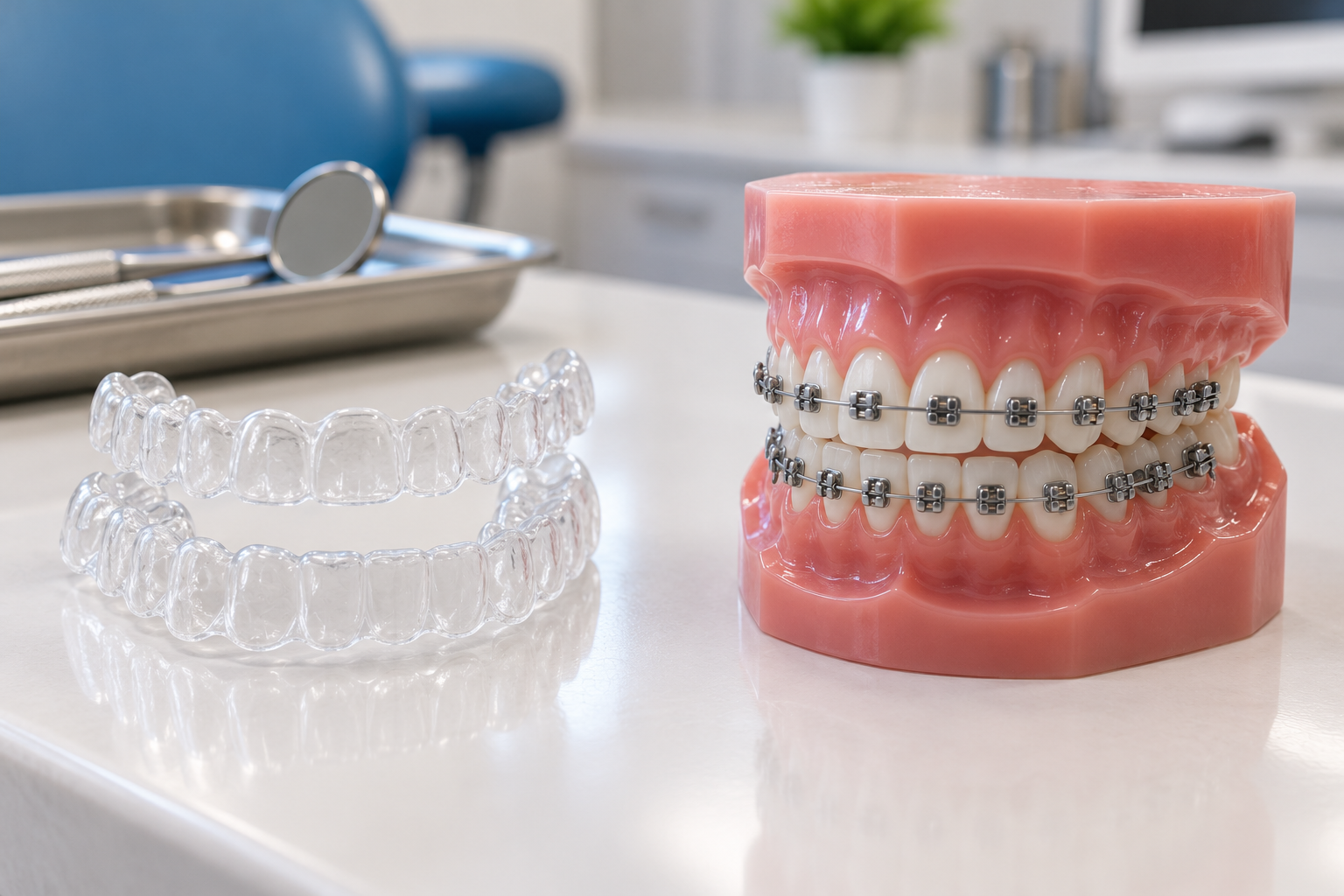
Clear Aligners vs Braces: What Is the Difference?
Patients often compare aligners vs braces before choosing orthodontic treatment.
Both approaches can straighten teeth, but they differ in appearance, maintenance, and suitability.
| Feature | Clear Aligners | Traditional Braces |
|---|---|---|
| Appearance | Transparent and less noticeable | Metal or ceramic brackets are visible |
| Removability | Removable | Fixed to teeth |
| Eating | Removed before meals | Remain attached during meals |
| Oral hygiene | Teeth can be brushed and flossed normally after removing trays | Cleaning requires additional care around brackets |
| Treatment suitability | Many mild, moderate and selected complex cases | Broad range, including many complex cases |
| Patient cooperation | Requires consistent daily wear | Does not require remembering to wear the appliance |
| Adjustments | New trays and periodic reviews | Regular orthodontic adjustments |
| Discomfort | Pressure or soreness after tray changes | Pressure, soreness, or bracket irritation |
| Treatment duration | Depends on complexity and compliance | Depends on complexity and treatment response |
Neither option is automatically faster or more effective for every patient.
A clinical assessment helps determine the most suitable treatment.
Who May Not Be a Good Candidate for Clear Aligners?
Some patients need additional dental care before starting orthodontic treatment.
Patients With Untreated Gum Disease
Active periodontal disease can damage the tissues and bone supporting the teeth.
Moving teeth without controlling gum disease may increase the risk of further damage.
The dentist should evaluate and stabilise periodontal health before starting treatment.
Patients With Untreated Tooth Decay
Cavities and other active dental problems should receive appropriate treatment before orthodontic tooth movement begins.
Aligners should fit healthy, stable teeth.
Patients With Poor Oral Hygiene
Clear aligners require regular cleaning.
Patients must brush and floss properly and clean their trays as instructed.
Poor hygiene can increase the risk of plaque accumulation, tooth decay, and gum inflammation.
Patients With Certain Complex Dental Conditions
Patients with missing teeth, implants, extensive dental restorations, or reduced periodontal support may still qualify for aligners.
However, they often need more detailed planning.
Dental implants cannot move like natural teeth because they are fixed directly to the surrounding bone.
The orthodontic plan must account for their position.
Are Clear Aligners Suitable for Teenagers?
Many teenagers can use clear aligners successfully.
However, suitability depends on dental development, orthodontic needs, and cooperation.
Teenagers must wear the trays consistently and avoid losing them.
Some aligner systems include features designed for growing patients.
However, younger patients with significant jaw development issues may benefit from other orthodontic appliances.
A dentist or orthodontist should evaluate growth and tooth eruption before recommending treatment.
What Are the Benefits of Invisible Braces?
Patients often use the term invisible braces when referring to clear aligners.
Their main benefits include appearance, removability, and convenience.
Discreet Appearance
Clear aligners are less noticeable than conventional metal braces.
However, tooth-coloured attachments may still be visible.
Easier Oral Hygiene
Patients can remove the trays before brushing and flossing.
This can make routine oral hygiene easier than cleaning around fixed brackets.
Fewer Food Restrictions
Patients remove aligners before eating, so they generally do not need the same food restrictions associated with fixed braces.
However, they must clean their teeth before reinserting the trays.
Comfortable Design
Clear aligners have smooth plastic surfaces without metal brackets or wires.
They may cause less soft-tissue irritation for some patients.
However, temporary pressure, soreness, or rubbing can still occur.
Digital Treatment Planning
Digital scans allow clinicians to plan tooth movement and explain the intended treatment sequence.
However, the digital simulation represents a treatment goal, not a guarantee of the final result.
What Are the Limitations of Clear Aligners?
Patients should understand the limitations before starting treatment.
Clear aligners may require:
- Consistent daily wear
- Tooth-coloured attachments
- Interproximal enamel reduction in selected cases
- Elastics for certain bite corrections
- Additional refinement trays
- Regular dental reviews
- Retainers after treatment
Some patients also experience temporary speech changes when they first begin wearing aligners.
These changes often improve as they adapt.
Patients who frequently forget their trays or remove them for extended periods may experience slower progress.
How Long Does Clear Aligner Treatment Take?
Treatment duration depends on the severity of the alignment problem and the movements required.
| Case Complexity | Approximate Treatment Duration |
|---|---|
| Minor alignment correction | 3–6 months |
| Mild to moderate crowding or spacing | 6–12 months |
| More complex orthodontic correction | 12–24 months or longer |
These are broad estimates rather than guaranteed timelines.
Some cases require refinements, additional attachments, or changes to the original treatment plan.
Regular reviews allow the dentist to check whether teeth are moving as expected.
Do Clear Aligners Work Faster Than Braces?
Not necessarily.
Clear aligners may offer efficient treatment for selected mild alignment problems.
However, braces may be more predictable for certain complex tooth movements.
Treatment duration depends more on the individual case than on the appliance alone.
How Does a Dentist Decide Whether Clear Aligners Will Work?
A proper orthodontic assessment involves more than checking whether teeth look crooked.
The dentist or orthodontist evaluates the full bite and supporting dental structures.
Step 1: Dental Examination
The clinician examines tooth alignment, gum health, bite relationships, and existing dental restorations.
Step 2: Digital Scans or Impressions
Digital scans or dental impressions record the position and shape of the teeth.
These records help create a treatment plan.
Step 3: X-Rays and Additional Records
The clinician may recommend appropriate dental X-rays and photographs to evaluate tooth roots, supporting bone, and jaw relationships.
Not every patient requires the same investigations.
Step 4: Treatment Planning
The clinician assesses which teeth need to move and whether aligners can produce those movements predictably.
They may also consider attachments, elastics, space creation, or other treatment methods.
Step 5: Discussion of Alternatives
Patients should understand the expected benefits, limitations, risks, treatment duration, and cost before choosing an appliance.
At Elegance Clinic, patients can discuss dental alignment concerns and receive guidance about suitable dental treatment options following an appropriate clinical assessment.
What Happens If Clear Aligners Do Not Work as Planned?
Sometimes teeth do not follow the predicted movement accurately.
Orthodontists call this a tracking problem.
Possible reasons include:
- Inconsistent aligner wear
- Poor tray fit
- Complex tooth movements
- Lost or damaged aligners
- Individual differences in tooth movement
The dentist may recommend additional scans, refinement trays, new attachments, or changes to the treatment plan.
In selected cases, switching to fixed braces may provide better control.
Patients should not continue wearing poorly fitting aligners without informing their clinician.
What Happens After Clear Aligner Treatment?
Teeth can shift after orthodontic treatment, regardless of whether the patient used aligners or braces.
Retainers help maintain the corrected positions.
Types of Retainers
Common options include:
- Removable clear retainers
- Removable wire-and-acrylic retainers
- Fixed retainers attached behind selected teeth
The dentist recommends a retention plan based on the treatment and individual risk of relapse.
Many patients need long-term retainer use to maintain their results.
Skipping retention increases the likelihood of teeth shifting over time.
Frequently Asked Questions
1. Can Clear Aligners Fix Severe Crowding?
Clear aligners can treat some complex crowding cases, but severe crowding may require additional techniques, extractions or fixed braces. The best option depends on tooth positions, available space and the overall bite.
2. Are Clear Aligners Suitable for Everyone?
No. Clear aligners suit many patients, but complex orthodontic problems, untreated gum disease and difficulty following the wearing schedule may make them unsuitable. A dentist or orthodontist must assess each case individually.
3. Can Clear Aligners Correct an Overbite?
Clear aligners can improve certain overbite problems. However, severe or skeletal bite discrepancies may require additional orthodontic treatment. The clinician must determine whether the problem involves tooth position, jaw alignment or both.
4. Are Clear Aligners Better Than Metal Braces?
Neither treatment is universally better. Clear aligners offer a discreet, removable option, while braces may provide more predictable control for certain complex movements. The best choice depends on the patient’s orthodontic needs.
5. Do Clear Aligners Hurt?
Patients may experience mild pressure or soreness when they start a new tray. This discomfort usually improves as the teeth adapt. Persistent or severe pain requires dental evaluation.
6. Can Teenagers Wear Clear Aligners?
Yes, many teenagers can use clear aligners. However, they must follow the prescribed wearing schedule. The clinician also considers dental development, growth and treatment complexity.
7. Can I Eat While Wearing Clear Aligners?
Patients should generally remove clear aligners before eating. They should also remove them before drinking beverages other than plain water unless their clinician provides different instructions.
8. What Happens If I Forget to Wear My Aligners?
Inconsistent wear may delay tooth movement and cause the trays to fit poorly. Patients should contact their dentist if they repeatedly miss the prescribed wearing time or notice that an aligner no longer fits correctly.
9. Do Clear Aligners Permanently Straighten Teeth?
Clear aligners can correct tooth alignment, but teeth may shift again without proper retention. Patients generally need retainers after treatment to help maintain the result.
Conclusion
Clear aligners can effectively correct many teeth alignment problems, but they are not suitable for every orthodontic case.
Patients with mild to moderate crowding, spacing, and selected bite problems may benefit from transparent aligner treatment.
However, severe tooth rotations, complex bite problems, and significant jaw alignment differences may require braces or other orthodontic approaches.
Treatment success also depends on healthy teeth and gums, careful planning, and consistent aligner wear.
A dental examination helps determine whether clear aligners can achieve the required movements safely and predictably.
At Elegance Clinic, patients can seek an individual dental assessment to discuss their alignment concerns and compare available treatment options before making a decision.
