

|
Getting your Trinity Audio player ready...
|
✓ Medically reviewed by Dr. Ashutosh Shah, Plastic, Reconstructive & Cosmetic Surgeon (M.Ch., DNB)
Introduction
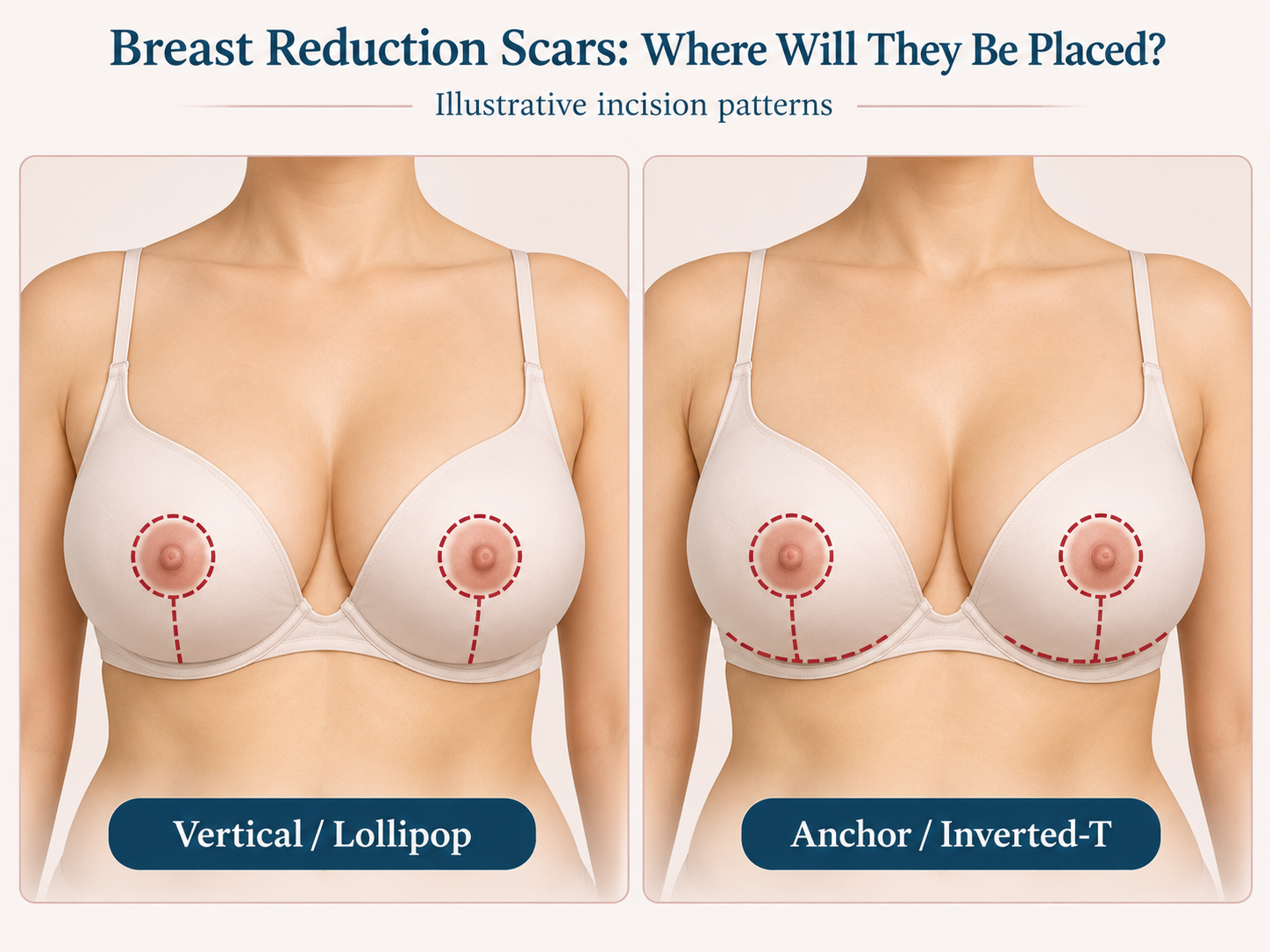
Breast reduction scars are usually placed around the areola, vertically down the lower part of the breast, and sometimes along the breast crease. The exact pattern depends on how much breast tissue and skin must be removed, breast shape, and the surgical technique. Although scars are permanent, they often become less noticeable as they heal.
Where Are Breast Reduction Scars Usually Placed?
The position of breast reduction scars depends on the incision pattern selected by the surgeon. The main goal is to remove excess tissue and skin, reshape the breasts, and place the incisions where they can heal appropriately.
Common scar locations include:
- Around the areola: A circular scar follows the border of the darker skin around the nipple.
- Vertically below the areola: A line extends from the lower edge of the areola toward the breast crease.
- Along the breast crease: A horizontal incision may be placed in the natural fold beneath the breast.
Not every patient needs all three incisions. Your surgeon will recommend a pattern based on your anatomy, the amount of reduction required, and your treatment goals.
What Is a Vertical Scar Breast Reduction?
A vertical scar breast reduction, often called a lollipop technique, usually creates two incisions: one around the areola and another extending vertically from the areola to the breast crease.
This approach may be suitable for patients who need a moderate reduction and reshaping. It avoids the longer horizontal scar beneath the breast that is part of the anchor pattern, although the vertical scar can still be visible during healing.
The suitability of this technique depends on breast size, skin quality, and the amount of tissue that needs to be removed.
What Is an Anchor Scar Breast Reduction?
An anchor scar breast reduction, also known as an inverted-T pattern, generally involves three incision lines:
- Around the areola.
- Vertically from the areola to the breast crease.
- Horizontally along the natural crease beneath the breast.
This technique may be recommended when a larger reduction or more extensive skin removal is needed. The horizontal scar is usually positioned in the breast fold, where it may be less noticeable in some positions.
Although the anchor pattern creates a longer scar, it can allow the surgeon to remove more excess skin and reshape the breast when clinically appropriate.
Vertical vs. Anchor Breast Reduction Scars
| Feature | Vertical (lollipop) pattern | Anchor (inverted-T) pattern |
|---|---|---|
| Incision locations | Around the areola and vertically below it | Around the areola, vertically below it, and along the breast crease |
| Horizontal scar | Usually absent | Present beneath the breast |
| Common consideration | Moderate reduction and reshaping | More extensive reduction or skin removal |
| Best choice | Depends on individual anatomy | Depends on individual anatomy |
Neither pattern is best for everyone. The surgeon should select the approach that safely achieves the required reduction and breast shape rather than choosing a technique solely to minimise scar length.
How Do Breast Reduction Scars Heal?
Scars change gradually after surgery. At first, they may look pink, red, raised, or firm. Over the following months, they often soften and fade, although the final appearance varies from person to person.
Scar maturation can take 12 months or longer. Some scars remain darker or wider, while others may become raised or thickened. Healing may be influenced by genetics, skin tone, wound tension, smoking, infection, and individual healing patterns.
Follow your surgeon’s wound-care instructions and attend recommended follow-up visits. Contact your surgical team if you notice increasing redness, worsening pain, wound separation, unusual discharge, or fever.
How Can You Make Breast Reduction Scars Less Noticeable?
You cannot guarantee an invisible scar, but appropriate aftercare can support healing and may improve the final appearance.
- Follow wound-care instructions: Keep incisions clean and care for them as directed by your surgeon.
- Avoid tension on healing incisions: Follow advice about lifting, exercise, and supportive garments.
- Protect scars from sunlight: Once the incisions have healed, use suitable sun protection and cover the area when possible.
- Ask about silicone products: Silicone gel or sheets may help some scars, but use them only when your surgeon confirms the skin has healed sufficiently.
- Avoid smoking: Smoking can interfere with wound healing.
- Discuss persistent scar changes: Raised, itchy, painful, or widening scars may need professional assessment.
Do not apply creams, oils, silicone products, or other treatments directly to open or unhealed incisions unless your surgical team specifically advises you to do so.
Can Breast Reduction Scars Be Revised?
Scar revision may be considered if a scar remains unusually wide, raised, uncomfortable, or cosmetically concerning after sufficient healing. The right approach depends on the type of scar and how long it has been present.
Options may include silicone-based treatment, selected injections for raised scars, laser treatments in appropriate cases, or surgical revision. No treatment can guarantee complete scar removal, and revision creates a new wound that will also form a scar.
Read more about scar revision treatment to understand possible approaches to improving the appearance of certain scars.
How Does Breast Reduction Surgery Affect Breast Shape and Scars?
Breast reduction changes both breast volume and shape. The incision pattern helps the surgeon remove excess tissue and skin while reshaping the remaining breast. Scar length alone does not determine the quality of the result.
Patients considering breast reshaping may also read about breast lift surgery to understand how breast lifting and reduction procedures can differ. For procedure-specific information, see the guide to breast reduction surgery.
Your surgeon can explain the expected scar pattern, likely healing process, potential risks, and realistic outcomes during consultation.
The location and length of breast reduction scars depend on the amount of tissue removed, skin elasticity, and the surgical technique selected. Understanding the procedure through our guide to breast reduction surgery can help you learn why some patients need a vertical scar while others require an anchor-shaped incision. Patients comparing different breast procedures can also read about breast lift surgery to understand how incision patterns vary. If you are concerned about thick, raised, or unusually visible scars, our article on scar revision treatment explains possible approaches to improving their appearance. For more information about healing and postoperative care, explore our guide to breast reduction recovery and risks.
Frequently Asked Questions
1. Where will my breast reduction scars be placed?
Scars are commonly located around the areola, vertically between the areola and breast crease, and sometimes horizontally along the crease beneath the breast. The exact locations depend on your breast anatomy, the amount of tissue and skin removed, and the surgical technique selected.
2. Are anchor scars longer than vertical breast reduction scars?
Generally, yes. An anchor pattern includes an additional horizontal incision along the breast crease, while a vertical pattern usually has scars around the areola and extending downward. However, the most appropriate technique depends on your surgical needs, not simply on which pattern creates fewer scars.
3. Will breast reduction scars disappear completely?
No. Surgical scars are permanent, but they often become softer and less noticeable over time. Their final appearance varies with skin type, genetics, healing, and aftercare. A surgeon can discuss realistic expectations and options for managing scars that remain raised, dark, or uncomfortable.
4. How long do breast reduction scars take to fade?
Scars usually change noticeably over several months, but maturation can take 12 months or longer. Early redness and firmness may gradually improve. Healing timelines differ between individuals, so follow-up appointments help your surgeon assess progress and recommend appropriate scar care.
5. Can I choose the vertical scar breast reduction technique?
You can discuss your preferences with your surgeon, but you may not be a suitable candidate for every incision pattern. The surgeon considers breast size, skin elasticity, the amount of reduction required, and safety before recommending a vertical or anchor technique.
6. Is an anchor scar breast reduction better for large reductions?
An anchor pattern is often considered when a larger reduction or more extensive skin removal is required. It can provide flexibility for reshaping, but the best technique depends on individual anatomy and clinical assessment. Your surgeon can explain the benefits and limitations of each option.
Conclusion
Breast reduction scars are typically placed around the areola, vertically down the breast, and sometimes along the breast crease. A vertical pattern may suit some patients, while an anchor pattern may be more appropriate when greater tissue or skin removal is needed. Discuss your options with a qualified surgeon to understand the likely scar locations, healing process, and realistic results.
