

|
Getting your Trinity Audio player ready...
|
✓ Medically reviewed by Dr. Ashutosh Shah, Plastic, Reconstructive & Cosmetic Surgeon (M.Ch., DNB)
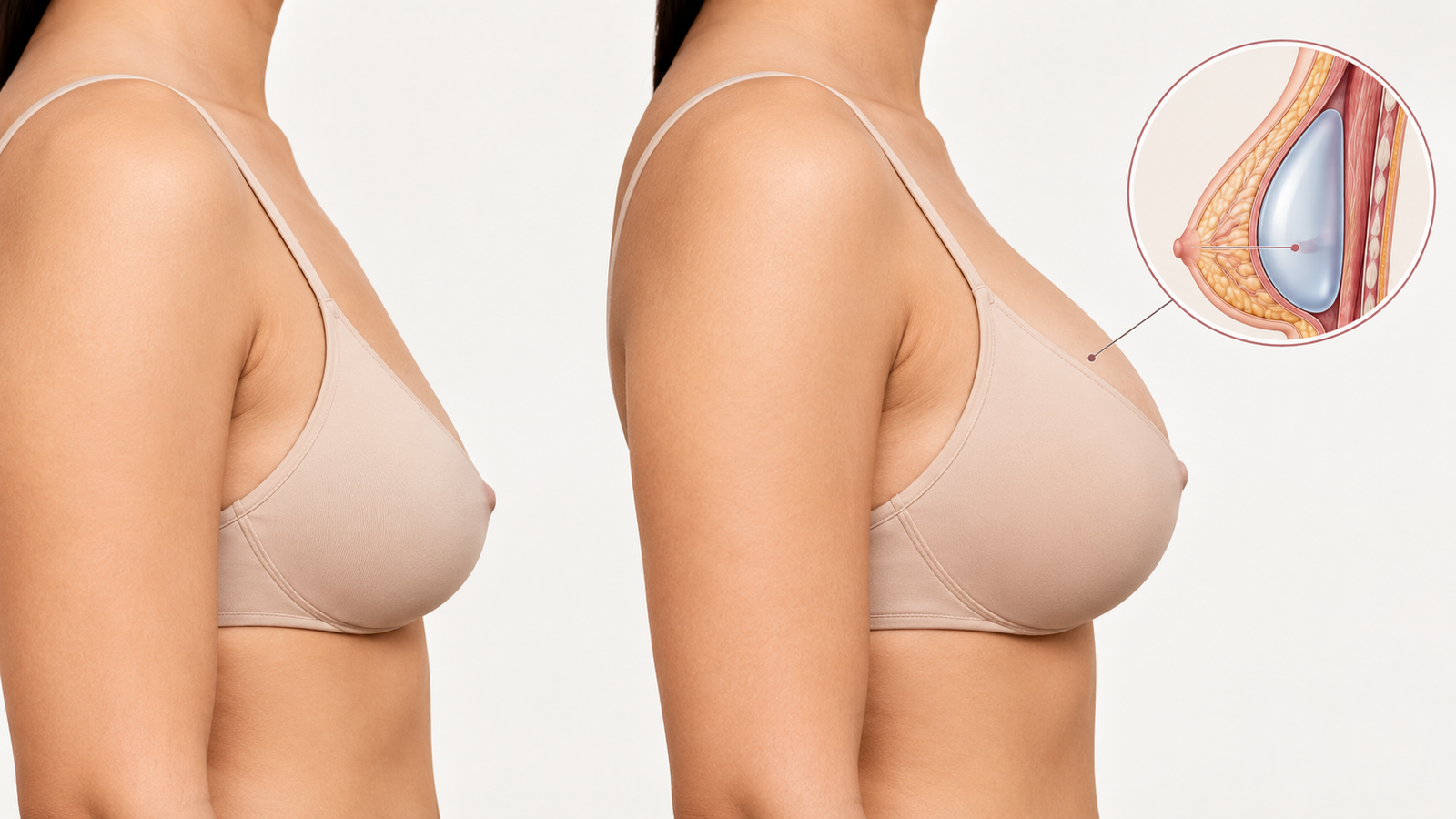
Breast implant surgery is a cosmetic procedure that increases breast volume or changes breast shape by placing implants inside the breasts. Surgeons usually position implants behind the breast tissue or chest muscle. The operation can improve fullness and proportions, but patients must understand implant choices, surgical risks, recovery requirements, and the possibility of future procedures.
Also called breast augmentation surgery, this procedure may help women who want fuller breasts, have naturally small breasts, or have experienced changes in breast volume after pregnancy or weight loss.
However, breast implants are not suitable for everyone. The best approach depends on breast anatomy, skin elasticity, existing breast tissue, medical history, and personal expectations.
At Elegance Clinic, Dr. Ashutosh A Shah, MS, MCh (Plastic Surgery), D.N.B., with 22+ years of experience, discusses breast shape, implant options, incision placement, and recovery considerations during individual consultations.
Understanding how the operation works helps patients make informed decisions before choosing surgery.
What Is Breast Implant Surgery?
Breast implant surgery is an operation in which a plastic surgeon places a medical implant inside a surgically created pocket to increase breast volume or modify breast contour.
The implant generally sits either:
- Behind the breast tissue but in front of the chest muscle
- Partly or completely beneath the pectoralis major muscle
The surgeon selects the position according to breast tissue thickness, body proportions, implant characteristics, and surgical goals.
Breast implants can create additional fullness in the upper or lower breast and may improve symmetry when the breasts differ in size.
However, implants do not automatically correct significant breast sagging.
Some patients with substantial drooping may need a breast lift, either separately or combined with augmentation.
Why Do Women Consider Breast Enlargement Surgery?
Women consider breast enlargement surgery for several reasons.
Naturally small breast size
Some women have smaller breasts because of genetics or natural body development.
They may prefer greater fullness or a different breast-to-body proportion.
Loss of breast volume after pregnancy
Pregnancy and breastfeeding can change breast volume and skin elasticity.
Some women notice that their breasts appear less full afterward.
An implant may restore volume, although loose skin may require additional treatment.
Breast volume changes after weight loss
Significant weight loss can reduce fatty tissue in the breasts.
This may change breast shape or create a deflated appearance.
Breast asymmetry
Most women have some natural difference between their breasts.
When the difference is substantial, breast augmentation may help improve symmetry.
Perfect symmetry cannot be guaranteed.
Personal cosmetic preferences
Some women simply want a different breast size or contour.
The decision should come from the patient’s own preferences rather than pressure from other people.
What Types of Breast Implants Are Available?
Breast implants differ in filling material, shape, surface, and size.
The surgeon should explain which products are appropriately approved and available for the intended use.
Silicone gel implants
Silicone implants contain a silicone gel within an outer silicone shell.
Many patients choose them because they may feel relatively similar to natural breast tissue.
However, implant feel depends on several factors, including existing tissue coverage and implant placement.
A silicone implant rupture may not produce obvious symptoms, making recommended imaging surveillance important.
Saline implants
Saline implants contain sterile salt water within a silicone shell.
If a saline implant ruptures, the breast may visibly lose volume as the saline is absorbed.
Availability varies by manufacturer and market.
Round implants
Round implants provide volume throughout the breast.
Their appearance depends on implant dimensions, placement, and the patient’s existing anatomy.
Anatomically shaped implants
Anatomical implants are designed with a tapered contour.
They may suit selected patients, but rotation can alter the intended shape.
Smooth and textured implants
Implant surfaces can be smooth or textured.
Certain textured implants have been associated with a higher risk of breast implant-associated anaplastic large cell lymphoma (BIA-ALCL).
Patients should ask about the exact implant brand, model, surface, and safety information.
How Is Breast Implant Size Selected?
Choosing an implant involves more than selecting a cup size.
Bra cup measurements vary between manufacturers and cannot reliably predict the final result.
A surgeon considers:
- Breast width
- Chest-wall dimensions
- Existing breast tissue
- Skin elasticity
- Nipple position
- Body proportions
- Desired degree of fullness
- Implant profile and projection
A larger implant is not always better.
An implant that is too large for the available tissue may increase discomfort, stretching, visible edges, or long-term complications.
During consultation, patients should discuss whether they prefer a subtle change or more noticeable fullness.
The surgeon can explain what is anatomically achievable.
How Does Breast Implant Surgery Work Step by Step?
The exact technique varies according to the implant, patient anatomy, and surgical plan.
Step 1: Consultation and assessment
The surgeon reviews the patient’s medical history, current medicines, previous breast surgery, and desired result.
The examination includes breast dimensions, skin quality, nipple position and symmetry.
Patients may need appropriate breast imaging depending on their age, symptoms, risk factors, and clinical findings.
Step 2: Implant selection
The surgeon discusses implant type, size, shape, surface and placement.
Patients should receive information about the implant manufacturer’s safety guidance and the possibility of future replacement or removal.
Step 3: Anaesthesia
Breast augmentation commonly takes place under general anaesthesia.
The anaesthesia team assesses the patient’s health and explains preparation instructions.
Step 4: Surgical incision
The surgeon creates an incision to access the implant pocket.
Common incision locations include:
Inframammary incision: Along the fold beneath the breast.
Periareolar incision: Around part of the border of the areola.
Transaxillary incision: Within the armpit.
Not every incision is appropriate for every implant or patient.
Step 5: Creating the implant pocket
The surgeon prepares a pocket either in front of or beneath the chest muscle.
The selected position depends on tissue coverage, anatomy, and the desired result.
Step 6: Implant placement
The surgeon places the implant into the pocket and checks its position.
The operation may include adjustments to improve balance between the breasts.
Step 7: Closure and dressing
The surgeon closes the incision and applies appropriate dressings.
Patients may receive a supportive surgical bra and individual postoperative instructions.
Where Are Breast Implants Placed?
Implant placement can affect appearance, recovery, and certain long-term considerations.
| Placement | Position | Possible advantages | Considerations |
|---|---|---|---|
| Subglandular | Behind breast tissue, in front of muscle | Avoids dissecting beneath the muscle | Implant edges may be more visible in patients with thin tissue |
| Submuscular | Beneath the pectoral muscle to varying degrees | Additional tissue coverage over part of the implant | More muscle-related discomfort or movement-related distortion may occur |
| Dual-plane | Partly beneath muscle, with additional breast tissue adjustments | May help selected patients achieve an appropriate contour | Requires careful anatomical planning |
No single position is ideal for every patient.
How Long Does Breast Implant Surgery Take?
An uncomplicated breast augmentation procedure commonly takes approximately one to two hours, although the duration varies.
Additional procedures, complex asymmetry, or previous surgery may increase operating time.
Some patients return home on the day of surgery, while others require observation or admission.
The surgeon and anaesthesia team determine the appropriate plan.
What Is Recovery Like After Breast Augmentation Surgery?
Recovery varies according to implant placement, surgical technique, health, and individual healing.
First 48 hours
Patients may experience:
- Tightness across the chest
- Swelling
- Bruising
- Discomfort
- Temporary difficulty with certain arm movements
Prescribed medication and postoperative support can help manage symptoms.
Patients should arrange assistance with daily activities when needed.
First week
Many patients gradually resume gentle daily activities.
However, they should avoid heavy lifting and strenuous upper-body exercise until their surgeon allows it.
Some people can return to desk-based work within approximately one week, while others require more time.
Weeks two to four
Swelling and discomfort often continue improving.
Patients may gradually increase activities according to their surgeon’s instructions.
They should not assume that reduced pain means the tissues have completely healed.
Weeks four to six
Some patients can resume additional exercise and physical activity after medical clearance.
Recovery restrictions depend on the surgical approach and individual progress.
Following months
Breasts may initially appear high, swollen, or firm.
The implants and surrounding tissues can continue settling over several months.
Incision scars also mature gradually.
What Are the Risks of Breast Implant Surgery?
Like any operation, breast implant surgery involves potential complications.
Patients should understand both short-term surgical risks and longer-term implant-related concerns.
Surgical risks
These include:
- Bleeding or haematoma
- Infection
- Anaesthesia-related complications
- Delayed wound healing
- Unfavourable scarring
- Changes in breast or nipple sensation
Capsular contracture
The body naturally forms a capsule of scar tissue around an implant.
Sometimes this capsule becomes unusually tight.
Capsular contracture can cause firmness, discomfort or changes in breast shape.
Severe cases may require another operation.
Implant rupture
Breast implants can rupture over time.
A saline implant rupture may cause visible deflation.
Silicone implant rupture may be less obvious and may require imaging for detection.
Implant displacement
An implant can shift from its intended position.
This may affect symmetry or breast contour.
Rippling
Some patients notice visible or palpable folds along the implant surface.
Rippling may be more apparent when breast tissue coverage is limited.
Breast implant-associated lymphoma
BIA-ALCL is a rare lymphoma associated particularly with certain textured breast implants.
It is not the same as ordinary breast cancer.
Persistent swelling, a new mass, or unexplained changes around an implant require clinical assessment.
Other rare implant-associated cancers, including squamous cell carcinoma arising in the implant capsule, have also been reported.
Systemic symptoms
Some patients report fatigue, joint pain, cognitive complaints, or other symptoms they associate with implants.
These are sometimes described as breast implant illness.
The causes and relationship to implants remain incompletely understood.
Patients experiencing unexplained symptoms should seek medical assessment rather than assuming a single cause.
Do Breast Implants Last Forever?
No.
Breast implants are not lifetime devices.
They do not necessarily require replacement at a fixed ten-year interval, but the chance of complications and additional surgery increases over time.
A patient may eventually need implant replacement, removal, or another procedure because of rupture, capsular contracture, changes in appearance, or personal preference.
For silicone gel implants, the US FDA recommends ultrasound or MRI screening beginning five to six years after placement and every two to three years thereafter, even without symptoms. Symptoms or concerning findings may require earlier evaluation.
Patients should also follow the specific implant manufacturer’s guidance and their surgeon’s recommendations.
Can Breast Implants Affect Breastfeeding?
Many women can breastfeed after breast augmentation.
However, surgery may affect milk production or nipple sensation in some patients.
The risk depends on the incision, implant placement, individual anatomy, and whether milk ducts or nerves are affected.
Patients planning future pregnancies should discuss breastfeeding concerns before surgery.
Breast augmentation does not guarantee that breastfeeding ability will remain unchanged.
Can Breast Implants Affect Mammograms?
Yes.
Implants can make some breast tissue more difficult to visualise during standard mammography.
Patients should inform the imaging centre that they have breast implants.
Additional implant-displacement views may be required.
Breast implants do not eliminate the need for age-appropriate breast screening.
Any new breast lump, unexplained pain, or persistent swelling should receive medical evaluation.
Breast Implants vs Fat Transfer: What Is the Difference?
Some patients prefer to explore breast enlargement without implants.
Fat transfer uses liposuction to collect fat from another body area, processes the fat, and injects suitable portions into the breasts.
| Feature | Breast implants | Fat transfer |
|---|---|---|
| Main material | Manufactured medical implant | Patient’s own fat |
| Volume increase | Can provide a larger, more predictable increase | Usually more limited per session |
| Incisions | Surgical access incision | Small liposuction and injection sites |
| Long-term considerations | Implant surveillance and possible revision | Some transferred fat may not survive |
| Additional procedures | May require replacement or removal | Additional sessions may be needed |
| Main limitation | Implant-related risks | Requires sufficient donor fat and appropriate tissue conditions |
Neither method is universally better.
A surgeon should assess the patient’s goals, body proportions, and medical suitability.
How Do You Choose the Right Breast Implant Surgeon?
Choosing a qualified surgeon is an important part of treatment planning.
Patients should ask about:
- The surgeon’s qualifications and experience with breast augmentation.
- The proposed implant brand, model, and regulatory status.
- The surgical facility and anaesthesia arrangements.
- The recommended implant position and incision.
- Expected recovery and activity restrictions.
- Complication management and emergency support.
- Long-term follow-up and implant surveillance.
- The possibility and cost of future revision surgery.
At Elegance Clinic, Dr. Ashutosh A Shah can discuss breast augmentation options according to the patient’s anatomy and treatment goals.
Patients should feel comfortable asking questions and taking time before making a decision.
Frequently Asked Questions
1. What is breast implant surgery?
Breast implant surgery is an operation that increases breast volume or changes breast shape by placing an implant behind the breast tissue or chest muscle. The procedure requires anaesthesia, an incision, and postoperative recovery.
2. Is breast implant surgery painful?
Patients receive anaesthesia during the operation. After surgery, they may experience tightness, swelling, and discomfort. Pain generally improves during recovery, although the degree and duration vary.
3. How long do breast implants last?
There is no guaranteed lifespan. Implants are not lifetime devices, but they do not automatically require replacement after exactly ten years. Some patients need revision surgery earlier, while others retain their implants longer with appropriate monitoring.
4. Can breast implants look natural?
A natural-looking result may be possible when implant size, shape, and placement suit the patient’s anatomy. However, appearance varies, and no surgeon can guarantee a particular result.
5. Will breast implants leave scars?
Yes. Every surgical incision creates a scar. Surgeons choose incision locations to make scars less noticeable where possible, but scar visibility depends on healing and individual skin characteristics.
6. Can I breastfeed after breast enlargement surgery?
Many women can breastfeed after augmentation, but surgery may affect milk production or nipple sensation in some cases. Discuss future pregnancy and breastfeeding plans before the procedure.
7. Can breast implants cause cancer?
Breast implants are associated with rare implant-capsule malignancies, particularly BIA-ALCL in patients with certain textured implants. These conditions are different from common breast cancer. Persistent swelling, a mass, or other unusual changes require evaluation.
8. What is the difference between breast augmentation and breast lift surgery?
Breast augmentation increases volume using implants or, in selected cases, fat transfer. A breast lift repositions sagging breast tissue and removes excess skin. Some patients may benefit from a combined procedure.
9. When can I return to work after breast implant surgery?
Some patients resume desk work after approximately one week. Physically demanding jobs may require more time. The surgeon should provide individual guidance based on healing and work requirements.
10. Can breast implants be removed later?
Yes. Breast implants can be removed, but removal is another surgical procedure. Depending on skin changes and patient goals, additional procedures such as a breast lift may be considered.
Key Takeaways
- Breast implant surgery increases breast volume or changes breast contour using medical implants.
- Implant options differ in filling material, shape, surface and size.
- Surgeons place implants behind breast tissue or beneath the chest muscle.
- Recovery commonly involves swelling, discomfort, and temporary activity restrictions.
- Breast implants carry risks including capsular contracture, rupture, infection and rare implant-associated malignancies.
- Implants are not lifetime devices and may require future surgery.
- Patients should understand long-term surveillance before choosing augmentation.
- A qualified plastic surgeon should assess anatomy, health, and expectations before recommending a procedure.
Conclusion
Breast implant surgery can increase breast volume and improve breast proportions in appropriately selected patients.
However, successful planning involves more than choosing an implant size. Patients should understand implant materials, placement, recovery, possible complications, and the likelihood of future procedures.
At Elegance Clinic, Dr. Ashutosh A Shah, MS, MCh (Plastic Surgery), D.N.B., with 22+ years of experience, discusses breast augmentation options and helps patients consider the benefits and limitations of surgery.
A well-informed decision should reflect personal goals, realistic expectations, and long-term health considerations.
