

|
Getting your Trinity Audio player ready...
|
✓ Medically reviewed by Dr. Ashutosh Shah, Plastic, Reconstructive & Cosmetic Surgeon (M.Ch., DNB)
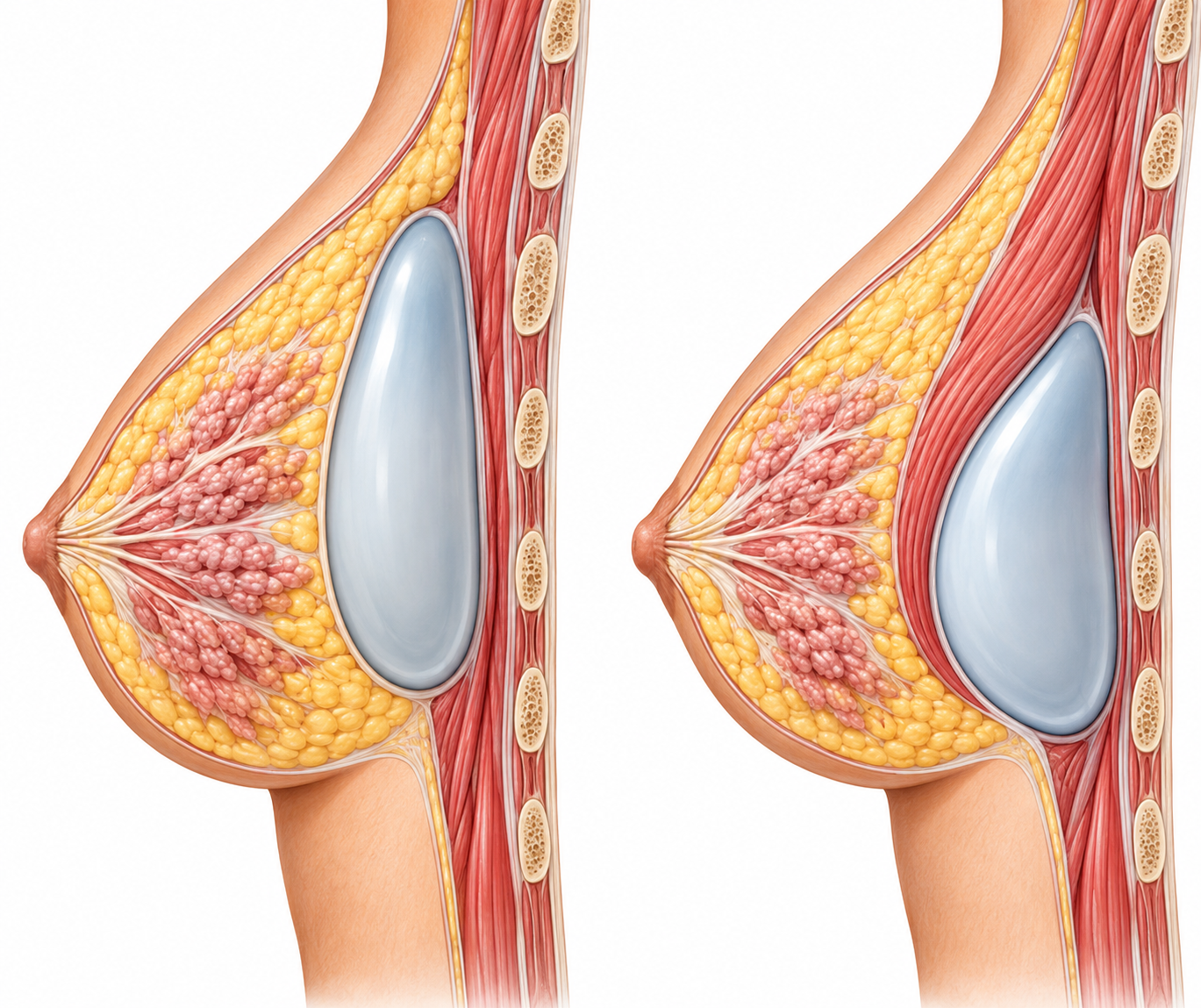
Breast implants can be placed either behind the breast tissue and above the chest muscle or partially or completely beneath the chest muscle. The right breast implant placement depends on natural breast tissue, skin thickness, body proportions, implant type and desired results. A plastic surgeon can explain which position is suitable for your anatomy.
What Does Breast Implant Placement Mean?
During breast augmentation, a surgeon creates a pocket to hold the implant. The pocket’s position affects how much natural tissue covers the implant, how the breasts look and feel, and how the implant may move during muscle activity.
The two main approaches are subglandular placement, which is above the chest muscle, and submuscular placement, which is beneath the muscle. A dual-plane technique combines features of both.
You can read the clinic’s guide to breast implant surgery for more information about the procedure and implant options.
Over-the-Muscle Implants: Subglandular Placement
With subglandular placement, the implant sits behind the breast tissue but in front of the pectoral muscle.
Potential advantages:
- The surgeon does not need to create a pocket beneath the chest muscle.
- Recovery may involve less muscle-related discomfort.
- The implant is less affected by chest muscle contraction.
Considerations:
- The implant may be more visible or palpable when natural breast tissue is thin.
- Rippling or visible implant edges may be more noticeable in some patients.
- Suitability depends on the amount and quality of breast tissue and skin coverage.
This approach may be considered for patients with sufficient natural tissue to cover the implant, but an individual examination is necessary.
Under-the-Muscle Implants: Submuscular Placement
With submuscular placement, the implant sits beneath the pectoral muscle, either fully or partly depending on the surgical technique.
Potential advantages:
- Additional soft-tissue coverage may help conceal the upper implant edge.
- It may reduce the visibility of rippling in selected patients.
- It may be preferred when natural breast tissue is relatively thin.
Considerations:
- Muscle-related discomfort may be greater during early recovery.
- The implant can move or change shape during chest muscle contraction, a phenomenon known as animation deformity.
- Recovery and activity restrictions may differ from those for over-the-muscle placement.
Submuscular placement is not automatically better for every patient. The surgeon must weigh tissue coverage, breast anatomy, implant characteristics and the patient’s preferences.
Subglandular vs Submuscular: Comparison
| Feature | Over the Muscle | Under the Muscle |
|---|---|---|
| Implant position | Behind breast tissue, in front of muscle | Beneath the chest muscle, fully or partly |
| Tissue coverage | Depends mainly on natural breast tissue | Additional muscle coverage over part of the implant |
| Early recovery | May involve less muscle-related discomfort | May involve more muscle-related discomfort |
| Muscle movement | Less affected by chest contraction | Possible implant movement during muscle contraction |
| Visibility and rippling | May be more noticeable with thin tissue | Additional coverage may help in selected patients |
| Best choice | Depends on anatomy and goals | Depends on anatomy and goals |
What Is Dual-Plane Breast Implant Placement?
Dual-plane placement positions the implant partly beneath the chest muscle, with the lower portion related to the breast tissue. The exact technique varies according to anatomy and the planned result.
A surgeon may consider this approach when the upper breast needs additional coverage while the lower breast requires appropriate shaping. It is not suitable for every patient, and the expected benefits and limitations should be discussed during consultation.
Which Breast Implant Placement Is Right for You?
There is no single placement that suits everyone. Your surgeon may consider:
- Breast tissue thickness: How much natural tissue covers the implant.
- Skin quality and elasticity: Whether the skin can support the planned implant.
- Chest and breast shape: Your existing proportions, symmetry and breast fold.
- Implant size and type: The dimensions and characteristics of the implant.
- Lifestyle and exercise: Whether frequent chest muscle activity is relevant to your preferences.
- Personal goals: Your desired fullness, contour and expectations about recovery.
Explore breast augmentation and breast implant services at Elegance Clinic to learn more about breast surgery options. A consultation should include discussion of potential complications, long-term monitoring and the possibility of future surgery.
Frequently Asked Questions
1. Are breast implants better over or under the muscle?
Neither position is universally better. Over-the-muscle placement may suit people with adequate natural tissue coverage, while under-the-muscle placement may provide additional coverage for selected patients. Your surgeon will recommend a position based on your anatomy, goals and risk factors.
2. Does under-the-muscle placement look more natural?
It can provide a smoother upper-breast transition for some patients, particularly those with thinner natural tissue. However, natural-looking results also depend on implant size, shape, breast anatomy and skin quality. No placement can guarantee a particular appearance.
3. Is recovery different for over-the-muscle and under-the-muscle implants?
Recovery varies by patient and surgical technique. Under-the-muscle placement can involve additional muscle soreness or tightness, while over-the-muscle placement may involve less muscle-related discomfort. Follow your surgeon’s instructions about activity, lifting and follow-up.
4. Can breast implants move when I exercise?
Implants placed beneath the chest muscle may move visibly when the muscle contracts. This is called animation deformity. The degree varies between patients and techniques. Discuss your exercise habits and concerns about muscle movement during your consultation.
Conclusion
Breast implant placement affects tissue coverage, recovery and how implants interact with the chest muscles. Subglandular, submuscular and dual-plane approaches each have potential advantages and limitations. A qualified plastic surgeon can assess your anatomy and explain the option most appropriate for your goals.
