

|
Getting your Trinity Audio player ready...
|
✓ Medically reviewed by Dr. Ashutosh Shah, Plastic, Reconstructive & Cosmetic Surgeon (M.Ch., DNB)
Clinical Perspective From Dr. Ashutosh Shah
M.Ch., DNB (Plastic Surgery)
Plastic, Reconstructive & Cosmetic Surgeon with 22+ years of clinical and surgical experience
Founder & Director, Elegance Clinic
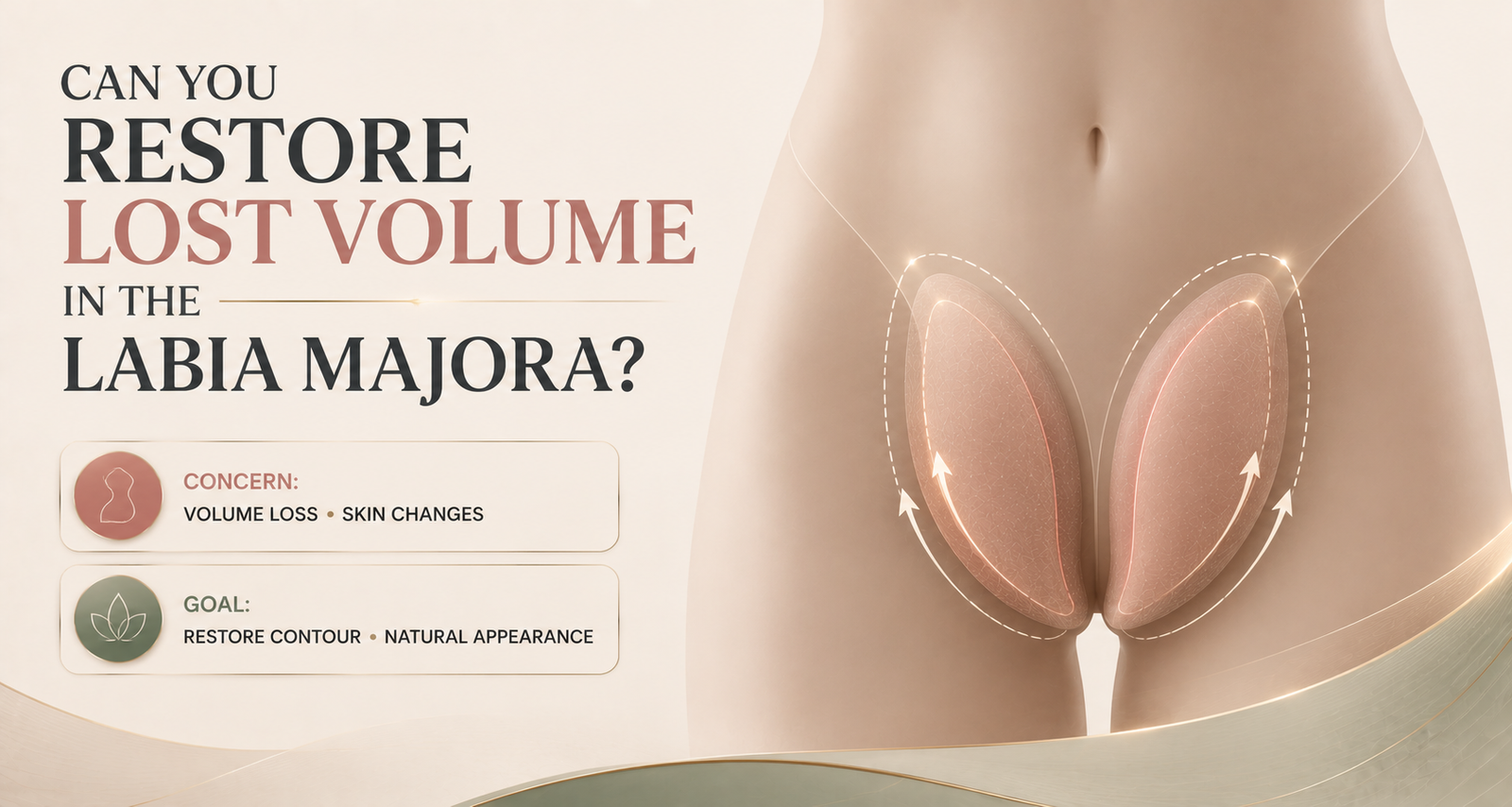
The labia majora are the outer folds of the vulva. Like other areas of the body, their volume and skin quality can change with ageing, weight changes, hormonal changes and individual anatomy.
Some women notice that the outer labia look less full or more deflated than before and ask whether the lost volume can be restored.
Yes, selected patients can restore volume in the labia majora through augmentation procedures such as fat grafting. The right approach depends on the amount of volume loss, tissue quality, available donor fat and the individual’s goals.
At Elegance Clinic, intimate aesthetic procedures are planned after assessing natural anatomy rather than treating normal variation as a medical problem.
Key Takeaways
- The labia majora naturally vary in size, shape and fullness.
- Ageing and changes in body fat can affect their volume.
- Labia majora augmentation aims to add volume rather than reduce tissue.
- Fat grafting uses the patient’s own fat for augmentation.
- Not everyone experiencing volume changes needs treatment.
- Some transferred fat may naturally be reabsorbed.
- Final fullness cannot be guaranteed precisely.
- Swelling and bruising can occur during recovery.
- Treatment should preserve normal anatomy and function.
- A medical assessment helps determine whether augmentation is appropriate.
What Are the Labia Majora?
The labia majora are the outer skin folds of the vulva that surround and help protect the inner external genital structures.
They contain skin, connective tissue and fatty tissue.
Their appearance varies considerably between individuals. They may naturally be fuller, flatter, symmetrical or asymmetric.
These differences are generally normal.
Why Can the Labia Majora Lose Volume?
Volume can change for several reasons.
Ageing can alter skin elasticity and subcutaneous tissue. Changes in body weight can also affect the amount of fatty tissue in the area.
Other contributing factors may include hormonal changes, pregnancy-related body changes and individual genetics.
Importantly, a less-full appearance does not automatically indicate disease.
For many women, it is simply a natural anatomical change.
Can Lost Labia Majora Volume Be Restored?
Yes. Labia majora augmentation can restore selected volume by adding tissue or injectable material to the outer labia.
One established cosmetic approach is fat grafting, also called fat transfer.
Elegance Clinic provides labial fat transfer for selected patients who want additional fullness or restoration of lost volume.
The objective should be proportionate augmentation rather than creating an artificial or predetermined shape.
What Is Labia Majora Augmentation?
Labia majora augmentation refers to procedures that increase volume in the outer labial tissue.
Depending on the patient’s anatomy and treatment plan, augmentation may involve:
- autologous fat grafting,
- selected injectable fillers,
- or another individually planned approach.
Fat grafting has the advantage of using tissue taken from the patient’s own body.
However, every option has limitations and risks.
Labia Majora Augmentation Options
| Concern | Possible Approach |
|---|---|
| Loss of outer labial volume | Fat grafting may be considered |
| Mild volume deficiency | Selected injectable treatment may sometimes be discussed |
| Asymmetric volume | Individualised correction may be considered |
| Significant loose skin | Volume addition alone may not solve the concern |
| Excess labial tissue | A reduction procedure may be more appropriate |
| Combination of volume loss and laxity | More than one approach may need assessment |
This is only a general guide. The appropriate treatment depends on examination.
How Does Fat Grafting to the Labia Majora Work?
Fat grafting uses the patient’s own fatty tissue.
Fat is first obtained from a suitable donor area through liposuction.
The harvested fat is then processed and carefully placed into selected areas of the labia majora to increase volume and improve contour.
Because the procedure uses living fat cells, some transferred fat can survive long term while another portion may be naturally reabsorbed.
Where Does the Fat Come From?
The donor area depends on the patient’s body and available fat.
Potential areas may include the abdomen, thighs or another suitable region.
The surgeon assesses whether enough donor fat is available and whether liposuction from that area is appropriate.
Very lean patients may have limited donor tissue.
Is Labia Majora Fat Grafting Permanent?
The answer is more nuanced than simply yes or no.
Fat cells that successfully establish a blood supply can remain for a long time.
However, not every transferred fat cell survives.
Some volume is normally lost as swelling settles and part of the transferred fat is reabsorbed.
Future weight changes and ageing can also influence the appearance.
Therefore, an exact permanent volume cannot be guaranteed.
Can Dermal Fillers Be Used?
Selected fillers may sometimes be considered for volume enhancement.
Fillers differ from fat transfer because they use an injectable material rather than the patient’s own fatty tissue.
Their suitability, duration and risk profile depend on the specific product and treatment plan.
Patients should ask exactly what product is proposed and whether it is appropriate for use in that anatomical area.
What Is the Difference Between Augmentation and Labiaplasty?
These procedures address different concerns.
Labia majora augmentation adds volume.
Labiaplasty reshapes or reduces selected labial tissue.
Elegance Clinic’s labiaplasty service addresses selected concerns involving the shape or size of the labia.
A patient with volume loss should not automatically undergo tissue reduction, just as someone with excess tissue may not benefit from adding volume.
Who May Consider Labia Majora Augmentation?
An adult may consider consultation if she is concerned about:
- loss of fullness,
- a deflated appearance,
- age-related volume changes,
- selected asymmetry,
- or changes after significant weight fluctuation.
The decision should come from the patient’s own preferences rather than pressure to make normal genital anatomy conform to a particular appearance.
Who May Not Be Suitable?
Treatment may need to be postponed or avoided when there is:
- active infection,
- untreated genital skin disease,
- significant uncontrolled medical illness,
- inadequate donor fat for planned fat grafting,
- unrealistic expectations,
- or another condition that should be treated first.
Smoking can also negatively affect healing and should be discussed with the surgeon.
What Happens Before the Procedure?
The consultation should include a private discussion about what specifically concerns the patient.
The doctor assesses:
- tissue volume,
- skin quality,
- symmetry,
- previous procedures,
- medical history,
- available donor fat,
- and desired degree of augmentation.
It is also important to determine whether the concern actually involves the labia majora rather than the labia minora, mons pubis or another nearby structure.
Is Labia Majora Augmentation Painful?
Discomfort varies according to the procedure performed.
With fat grafting, both the donor area and treated labial tissue can feel tender after surgery.
Swelling and bruising may occur.
Pain-control instructions are provided according to the individual procedure.
Severe or worsening pain should be reported to the treating doctor.
How Long Does Recovery Take?
Early swelling and tenderness generally improve gradually.
The exact recovery period varies according to:
- amount of fat transferred,
- extent of liposuction,
- individual healing,
- activity,
- and whether another procedure was performed simultaneously.
Patients should follow specific instructions about hygiene, clothing, exercise and intimate activity.
What Are the Risks?
Possible risks of fat grafting can include:
- swelling,
- bruising,
- bleeding,
- infection,
- asymmetry,
- contour irregularity,
- fat reabsorption,
- undercorrection,
- overcorrection,
- lumps or firmness,
- altered sensation,
- and need for additional treatment.
Individual risks should be discussed before treatment.
Will Augmentation Improve Sexual Sensation?
Labia majora augmentation is primarily a volume and contour procedure.
It should not be promised as a treatment for improving sexual pleasure, orgasm or sexual function.
Sexual concerns can have multiple anatomical, hormonal, pelvic-floor, psychological and relationship-related causes.
A cosmetic change should therefore not be presented as a guaranteed solution for sexual function.
Will the Results Look Natural?
Natural appearance depends on anatomy, treatment volume and technique.
Adding too much volume can create disproportion.
A conservative approach aims to restore or add fullness while respecting the patient’s existing anatomy.
There is no universal “ideal” labia majora shape.
How Is Labia Majora Augmentation Different From Other Intimate Procedures?
Elegance Clinic provides a broader aesthetic genital treatment service that includes different procedures for different anatomical concerns.
The important point is that these procedures are not interchangeable.
Volume loss, excess tissue, vaginal laxity, pigmentation and functional symptoms require different assessments.
Labia Majora Augmentation at Elegance Clinic
Dr. Ashutosh Shah is a Plastic, Reconstructive and Cosmetic Surgeon with M.Ch. and DNB qualifications and more than 22 years of surgical experience.
Patients considering an intimate aesthetic procedure can also learn about Dr. Ashutosh Shah and Elegance Clinic before deciding whether treatment is appropriate.
Restore Volume Only If It Is the Change You Want
Loss of labia majora fullness can occur naturally, and treatment is optional.
For women who personally want to restore volume, fat grafting or another appropriate augmentation approach may be considered after examination.
The goal should not be to create a standardised vulva. It should be to understand the patient’s anatomy, expectations and whether treatment can safely achieve the change she wants.
To discuss whether augmentation is appropriate, contact Elegance Clinic for a confidential consultation.
Frequently Asked Questions
Can labia majora volume be restored?
Yes. Fat grafting can add volume in appropriately selected patients.
Why does the labia majora lose volume?
Ageing, weight changes, hormones and individual anatomy may contribute.
Is fat grafting permanent?
Some transferred fat may survive long term, while some is naturally reabsorbed.
Is labia majora augmentation the same as labiaplasty?
No. Augmentation adds volume, while labiaplasty generally reshapes or reduces tissue.
Will the result look natural?
It can look subtle when treatment is appropriately planned for the individual’s anatomy.
