

|
Getting your Trinity Audio player ready...
|
✓ Medically reviewed by Dr. Ashutosh Shah, Plastic, Reconstructive & Cosmetic Surgeon (M.Ch., DNB)
From the Clinical Experience of Dr. Ashutosh Shah
Board-Certified Plastic, Cosmetic & Reconstructive Surgeon
M.Ch., DNB | 22+ Years of Experience
Vaginal dryness can cause burning, irritation, discomfort during intimacy or a persistent feeling of dryness. It commonly becomes more noticeable around menopause, but hormonal changes are not the only possible cause.
Some women searching for treatment come across vaginal laser therapy and ask whether it can restore moisture without surgery.
Energy-based vaginal treatments have been studied for symptoms including vaginal dryness and menopausal tissue changes. However, evidence regarding effectiveness and long-term safety remains limited, and laser should not be presented as a guaranteed or universally established cure for vaginal dryness.
The first step is therefore not choosing the laser. It is understanding why the dryness is occurring.
Key Takeaways
- Vaginal dryness has several possible causes.
- Menopause and reduced estrogen are common contributors.
- Dryness can also occur outside menopause.
- Laser is an energy-based treatment, not vaginal surgery.
- Some studies report symptom improvement, but evidence remains limited.
- Laser is not necessarily the first treatment for vaginal dryness.
- Lubricants and vaginal moisturisers can help some women.
- Clinician-directed hormonal treatment may be appropriate for selected patients.
- Persistent dryness, bleeding, discharge or pain requires medical assessment.
- Treatment should address the underlying cause rather than the symptom alone.
What Causes Vaginal Dryness?
Vaginal dryness occurs when the vaginal tissues do not maintain their usual moisture and lubrication, which can happen because of hormonal changes, medications, irritation, certain medical treatments or other health factors.
Reduced estrogen is an important cause, particularly around and after menopause.
Estrogen helps support the thickness, elasticity and moisture of vaginal tissue.
When estrogen levels fall, vaginal tissue can become thinner, less elastic and less lubricated.
Is Vaginal Dryness Always Caused by Menopause?
No.
Although menopause is a common cause, vaginal dryness can occur at other stages of life.
Possible contributors include:
- breastfeeding,
- certain medications,
- cancer treatments,
- hormonal changes,
- irritation from products,
- some medical conditions,
- and insufficient arousal during sexual activity.
This is why treatment should not begin with the assumption that every case has the same cause.
What Is Genitourinary Syndrome of Menopause?
Genitourinary syndrome of menopause, commonly abbreviated GSM, describes a group of symptoms associated with declining estrogen and changes affecting vaginal and urinary tissues.
Symptoms can include:
- vaginal dryness,
- burning,
- irritation,
- discomfort during intercourse,
- urinary symptoms,
- and tissue changes.
When dryness is part of GSM, several treatment approaches may be considered depending on symptom severity and medical history.
Can Laser Treatment Help With Vaginal Dryness?
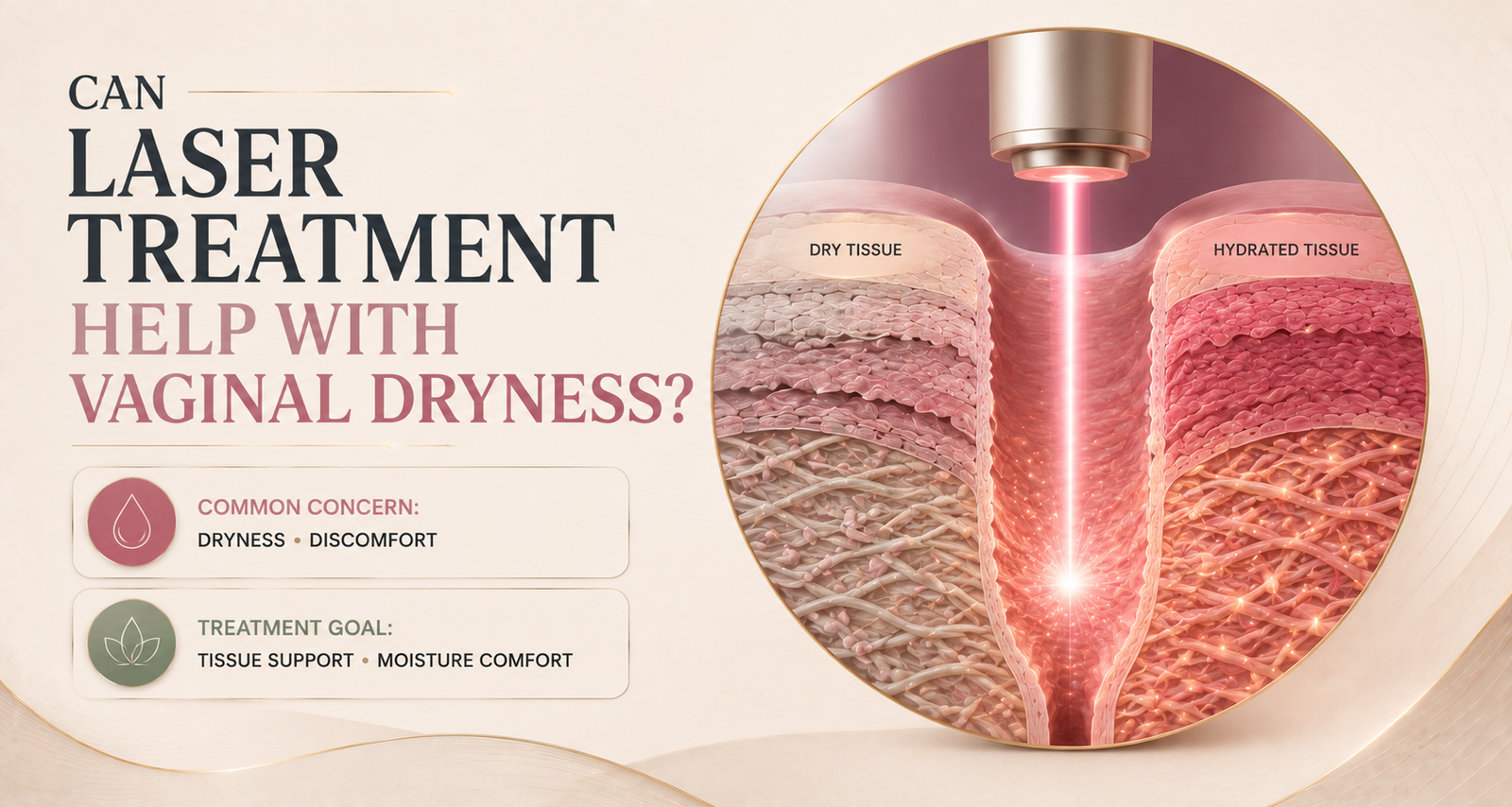
Vaginal laser treatment has been studied as an energy-based approach for symptoms such as dryness and menopausal vaginal changes, and some patients report improvement. However, current evidence does not support presenting laser as a guaranteed or universally established treatment for vaginal dryness.
Elegance Clinic provides laser vaginal rejuvenation among its nonsurgical intimate treatment options.
A proper consultation is important before considering the procedure.
How Does Vaginal Laser Treatment Work?
Depending on the device, controlled energy is delivered to vaginal tissue.
The proposed mechanism involves a controlled tissue response that may influence collagen remodelling and local tissue characteristics.
Some treatments use CO₂ laser technology, while other energy-based procedures may use radiofrequency.
These technologies are not identical and should not all be grouped together as if they have the same evidence, settings or risk profile.
Does Vaginal Laser Increase Lubrication?
Some women report improvement in dryness or lubrication after energy-based vaginal treatment.
However, individual responses vary.
It is important to distinguish between a reported improvement in symptoms and proof that the treatment permanently restores normal vaginal physiology.
The effect may be incomplete or temporary, and some patients may not experience meaningful improvement.
Is Vaginal Laser Proven to Treat Menopause-Related Dryness?
Evidence is still evolving.
Studies have investigated vaginal laser therapy for menopausal vaginal symptoms, but limitations include differences in devices, treatment protocols, follow-up periods and study quality.
Long-term evidence is less established than for some conventional approaches.
Patients should therefore be told about both potential benefits and uncertainty before choosing treatment.
What Should Be Tried Before Vaginal Laser?
Treatment depends on the cause.
For some women, conservative measures may be appropriate first.
Vaginal Moisturisers
Vaginal moisturisers are designed for regular use to help manage ongoing dryness.
They are different from lubricants.
Lubricants
Lubricants reduce friction during sexual activity and can help when dryness causes discomfort.
Hormonal Treatment
Selected women with menopausal vaginal symptoms may benefit from clinician-directed local vaginal estrogen or another hormonal approach.
Hormonal treatment is not suitable for everyone, so medical history matters.
Treating Another Cause
If dryness is caused by irritation, infection, medication or another condition, treating that problem may be more appropriate than performing laser therapy.
Is Vaginal Laser the Same as Vaginoplasty?
No.
Vaginoplasty is a surgical procedure that alters vaginal tissues.
Laser vaginal treatment is an energy-based nonsurgical procedure.
Elegance Clinic lists aesthetic genital treatments that include both surgical and nonsurgical approaches.
The terms should not be used interchangeably.
Who May Consider Vaginal Laser Treatment?
A clinician may discuss energy-based treatment with selected adults after:
- identifying the symptoms,
- reviewing medical history,
- considering hormonal status,
- ruling out important alternative causes,
- discussing established treatment options,
- and explaining the limitations of available evidence.
A treatment should not be selected simply because someone has vaginal dryness.
Who Should Be Assessed Carefully Before Treatment?
Particular attention may be required when there is:
- unexplained vaginal bleeding,
- active infection,
- abnormal discharge,
- significant pelvic pain,
- genital lesions,
- recent surgery,
- pregnancy,
- previous pelvic radiation,
- or a relevant cancer history.
The underlying condition may need investigation before any cosmetic or energy-based procedure is considered.
What Are the Possible Side Effects?
Energy-based vaginal treatment can cause temporary symptoms such as:
- warmth,
- irritation,
- burning,
- tenderness,
- spotting,
- or discomfort.
More significant complications have also been reported with energy-based vaginal procedures, including burns, scarring and persistent pain.
Severe, increasing or persistent symptoms after treatment should therefore be medically evaluated.
Is Vaginal Laser Painful?
The experience varies according to the device, treatment settings and individual sensitivity.
Some people may experience warmth or mild discomfort.
It should not be described as completely painless for everyone.
If pain becomes severe during or after treatment, it requires assessment.
How Many Sessions Are Needed?
There is no single number that can be promised for every patient.
Treatment protocols vary according to:
- device,
- symptoms,
- treatment settings,
- tissue condition,
- and individual response.
Patients should be cautious about packages that promise a predetermined outcome before a proper medical assessment.
Are the Results Permanent?
Vaginal laser should not be presented as a permanent cure for dryness.
Symptoms related to menopause and hormonal changes can persist or evolve.
Some patients may experience temporary improvement, while others may experience limited benefit.
Long-term management may still be necessary.
Can Vaginal Dryness Make Sex Painful?
Yes.
Reduced lubrication can increase friction and contribute to discomfort during intercourse.
However, painful intercourse, or dyspareunia, has many possible causes.
These include:
- dryness,
- pelvic-floor problems,
- infection,
- vulvar conditions,
- endometriosis,
- scarring,
- hormonal changes,
- and other gynaecological problems.
Persistent pain should therefore be evaluated rather than assumed to be caused only by dryness.
Can Vaginal Laser Improve Sexual Function?
It should not be promised to do so.
If dryness improves, some patients may experience less friction or discomfort during sexual activity.
That is different from proving that laser directly improves libido, arousal or orgasm.
Sexual function is influenced by many physical and psychological factors.
When Should Vaginal Dryness Be Checked by a Doctor?
Seek medical assessment if dryness is persistent or accompanied by:
- unexplained bleeding,
- unusual discharge,
- sores,
- significant itching,
- severe burning,
- pelvic pain,
- recurrent urinary symptoms,
- or persistent pain during intercourse.
These symptoms may require diagnosis before dryness treatment is chosen.
What Should You Ask Before Choosing Vaginal Laser?
Ask the clinician:
What is causing my dryness?
What device is being used?
What evidence supports it for my condition?
What are the risks?
Are there simpler alternatives?
What happens if it does not work?
Those questions are more useful than simply asking whether laser is “advanced.”
Vaginal Laser Treatment at Elegance Clinic
Elegance Clinic provides laser treatment for vaginal concerns and advises patients to undergo consultation before deciding whether treatment is appropriate.
Dr. Ashutosh Shah is a Plastic, Reconstructive and Cosmetic Surgeon with M.Ch. and DNB qualifications and more than 22 years of surgical experience.
Patients can learn about Dr. Ashutosh Shah and Elegance Clinic before arranging an intimate-treatment consultation.
Treat the Cause of Dryness, Not Just the Symptom
Laser is one possible option discussed for vaginal dryness, but it should not automatically be the first or only treatment.
A better approach begins by identifying whether the dryness is related to menopause, medication, irritation, another medical condition or a different cause.
Only then can the benefits, limitations and risks of laser be compared with moisturisers, lubricants, clinician-directed hormonal treatment or other appropriate options.
For a confidential assessment, contact Elegance Clinic to discuss which approach may be appropriate.
Frequently Asked Questions
Can laser help vaginal dryness?
It may improve symptoms in some women, but results vary and evidence remains limited.
Is vaginal laser permanent?
No permanent improvement should be guaranteed.
Is vaginal laser surgery?
No. It is an energy-based nonsurgical treatment.
What else can help dryness?
Moisturisers, lubricants and selected clinician-directed hormonal treatments may help depending on the cause.
When should dryness be checked?
Persistent dryness, bleeding, discharge or significant pain should be medically evaluated.
