

|
Getting your Trinity Audio player ready...
|
✓ Medically reviewed by Dr. Ashutosh Shah, Plastic, Reconstructive & Cosmetic Surgeon (M.Ch., DNB)
Understanding Safety, Surgical Planning and Recovery
Medical Guidance
Dr. Ashutosh Shah, M.Ch., DNB (Plastic Surgery)
Board-Certified Plastic, Reconstructive & Cosmetic Surgeon
Founder & Director, Elegance Clinic
22+ Years of Surgical Experience
Updated: September 2026
Labiaplasty is an intimate surgical procedure that changes the size, shape or symmetry of the labia, most commonly the labia minora. Women may consider the procedure because of persistent rubbing, discomfort during physical activities, asymmetry or personal aesthetic concerns.
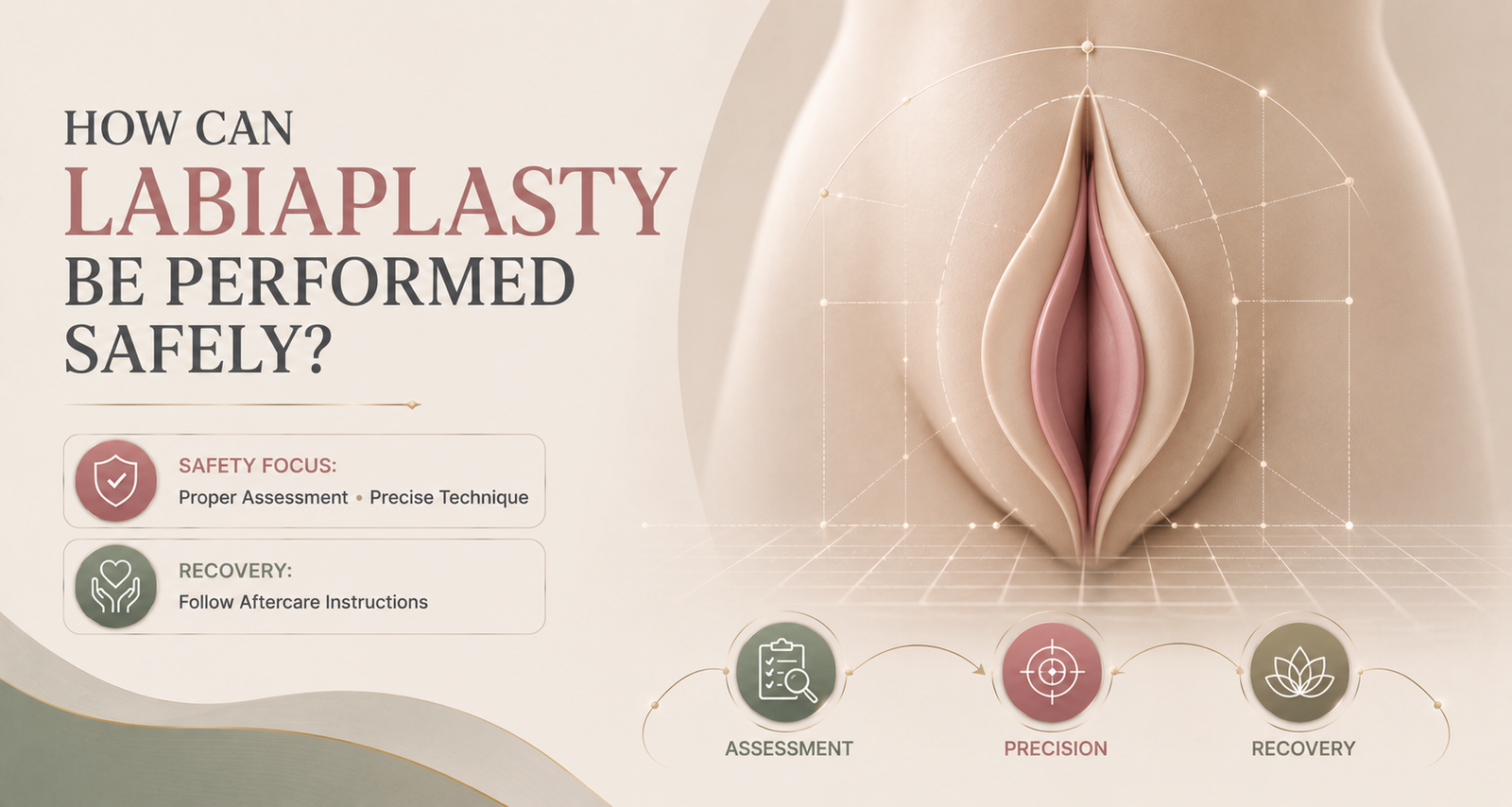
A safe labiaplasty procedure begins with appropriate patient selection, careful examination, conservative surgical planning, preservation of healthy tissue and nerves, infection prevention and proper postoperative care. However, no surgical procedure can be considered completely risk-free.
At Elegance Clinic, labiaplasty is planned according to individual anatomy rather than following one standard pattern of tissue reduction for every patient.
Key Takeaways
- Natural labial size, shape and symmetry vary considerably.
- Not every enlarged or asymmetric labia requires surgery.
- Safe surgery should prioritize both appearance and function.
- Excessive tissue removal can create complications.
- Swelling and temporary asymmetry are expected during early healing.
- Infection, bleeding, scarring and altered sensation are possible risks.
- Final results should not be judged during early recovery.
- Realistic expectations are essential before treatment.
What Is Labiaplasty?
Labiaplasty is a surgical procedure used to reshape or reduce labial tissue.
It most commonly involves the labia minora, although concerns involving the external genital area can include several different anatomical structures.
Women may consider surgery for physical symptoms, aesthetic concerns or both.
You can read more about labiaplasty surgery at Elegance Clinic to understand the procedure and treatment approach.
Why Do Women Consider Labiaplasty?
Reasons differ from one person to another.
Common concerns can include:
- rubbing during exercise,
- irritation in tight clothing,
- pulling or pinching,
- discomfort during certain activities,
- noticeable asymmetry,
- changes after childbirth,
- or dissatisfaction with appearance.
It is important to understand that longer, darker or asymmetric labia can all fall within normal anatomical variation.
Appearance alone does not mean there is a medical problem.
What Makes a Labiaplasty Procedure Safer?
Several factors contribute to surgical safety.
Appropriate Patient Selection
The first question is whether surgery is actually appropriate.
A consultation should identify the patient’s concern, symptoms, anatomy, expectations and relevant medical history.
Individual Surgical Planning
There is no single ideal labial shape or size.
The procedure should therefore be planned according to individual anatomy rather than trying to reproduce a standardized appearance.
Conservative Tissue Reduction
More reduction does not necessarily mean a better result.
Enough healthy tissue should remain to preserve natural function and avoid unnecessary tension.
Protection of Important Anatomy
Labial tissues contain nerves and blood vessels.
Knowledge of this anatomy is essential when planning tissue removal and closure.
Infection Prevention
Appropriate surgical sterility, hygiene and postoperative wound care help reduce infection risk.
Careful Recovery
Healing tissues should be protected from unnecessary friction, pressure and tension.
Are There Different Labiaplasty Techniques?
Yes.
Different techniques can be used depending on anatomy and the correction required.
Commonly discussed approaches include trim-type and wedge-type techniques.
Neither method is automatically superior.
The appropriate technique may depend on:
- tissue distribution,
- degree of enlargement,
- asymmetry,
- pigmentation,
- natural edge characteristics,
- previous surgery,
- and the desired correction.
Why Is Removing Too Much Tissue a Problem?
Over-reduction is an important consideration in labiaplasty.
Excessive tissue removal may contribute to:
- tightness,
- distortion,
- visible scarring,
- discomfort,
- asymmetry,
- altered sensation,
- or an unnatural appearance.
A safe surgical plan generally aims for proportionate correction rather than maximum reduction.
Can Labiaplasty Affect Sensation?
Temporary numbness or altered sensation can occur while tissues heal.
Persistent sensory changes are less common but remain a potential surgical risk.
Because intimate tissues contain sensory nerves, careful surgical technique and conservative planning are important.
No responsible surgeon should guarantee that sensation can never change.
What Happens During Labiaplasty?
Although the exact process varies, treatment generally involves:
- clinical examination,
- discussion of expectations,
- surgical marking,
- appropriate anaesthesia,
- controlled tissue reshaping or reduction,
- bleeding control,
- careful wound closure,
- and postoperative instructions.
The amount of correction should be determined by anatomy rather than a fixed measurement.
What Are the Risks of Labiaplasty?
Possible complications include:
- bleeding,
- hematoma,
- infection,
- significant swelling,
- wound separation,
- delayed healing,
- scarring,
- persistent asymmetry,
- undercorrection,
- overcorrection,
- altered sensation,
- discomfort,
- and possible revision surgery.
Understanding these risks is an important part of informed decision-making.
Is Swelling Normal After Labiaplasty?
Yes.
Intimate tissues can become noticeably swollen after surgery.
Bruising and temporary differences between the two sides can also occur.
This does not automatically indicate a poor result.
The tissues need time to heal and settle before the final appearance can be evaluated.
How Long Does Recovery Take?
Recovery varies according to the extent of surgery and individual healing.
During early recovery, patients may be advised to temporarily avoid:
- strenuous exercise,
- cycling,
- direct pressure,
- sexual intercourse,
- and activities that create friction around the surgical area.
Return to these activities should follow the treating surgeon’s advice.
What Warning Signs Need Medical Attention?
Contact the surgical team if there is:
- rapidly increasing swelling,
- heavy bleeding,
- worsening pain,
- fever,
- foul-smelling discharge,
- increasing redness,
- wound separation,
- or another unexpected change.
Prompt assessment is important when a complication is suspected.
Can Labiaplasty Create Perfect Symmetry?
No.
Natural asymmetry exists throughout the human body.
Surgery may improve a noticeable difference, but perfect symmetry cannot be guaranteed.
Healing, swelling and scar formation can also differ slightly between the two sides.
Why Does the Surgeon’s Experience Matter?
Labiaplasty requires both aesthetic judgement and understanding of delicate functional anatomy.
Dr. Ashutosh Shah is an M.Ch., DNB-qualified Plastic, Reconstructive and Cosmetic Surgeon with more than 22 years of surgical experience.
His surgical background includes aesthetic and reconstructive procedures where tissue preservation, scar placement, symmetry and functional considerations are important.
Patients considering intimate procedures can also explore Elegance Clinic’s genital treatment services to understand related treatment options.
Safety Begins With the Right Decision
A safe labiaplasty procedure is not simply about which surgical technique is used.
It starts with determining whether surgery is appropriate, understanding normal anatomical variation, identifying the exact concern and setting realistic expectations.
The philosophy described about Elegance Clinic emphasizes individualized surgical planning rather than a one-size-fits-all aesthetic result.
If physical discomfort, persistent asymmetry or another intimate concern is affecting you, request a confidential consultation with Elegance Clinic to understand whether treatment is appropriate.
FAQs
Is labial asymmetry normal?
Yes. Some natural asymmetry is extremely common.
Is labiaplasty completely safe?
No operation is completely risk-free.
Can labiaplasty change sensation?
Temporary changes can occur, while persistent changes are a possible surgical risk.
Is swelling expected?
Yes. Swelling is common during early recovery.
Does everyone with large labia need surgery?
No. Labial size varies naturally.
