

|
Getting your Trinity Audio player ready...
|
✓ Medically reviewed by Dr. Ashutosh Shah, Plastic, Reconstructive & Cosmetic Surgeon (M.Ch., DNB)
Understanding Functional, Structural and Aesthetic Intimate Concerns
Female intimate anatomy varies naturally from person to person. One woman may have longer labial tissue, another may notice asymmetry, while someone else may experience structural changes after childbirth.
These concerns should not automatically be grouped into one operation.
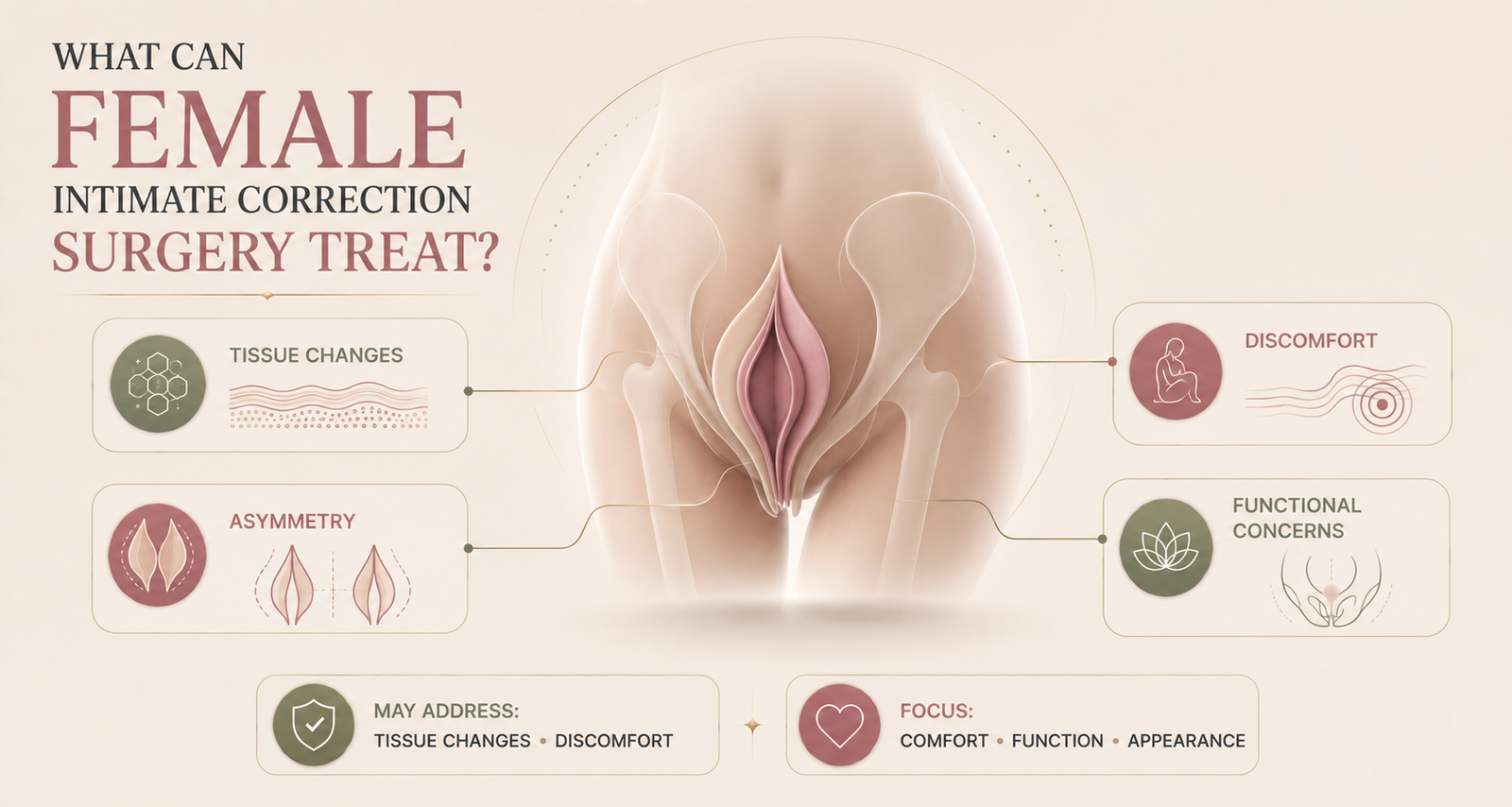
Female intimate correction surgery is a broad term covering selected procedures that address functional, structural or aesthetic concerns involving external female genital anatomy. The appropriate procedure depends on the specific tissue and problem being treated.
At Elegance Clinic, intimate concerns are assessed individually, with attention to normal anatomical variation, symptoms, tissue function and realistic expectations.
Key Takeaways
- Female intimate correction is not one single operation.
- Different anatomical concerns require different procedures.
- Natural variation in labial size, colour and symmetry is common.
- Treatment should preserve healthy tissue and function.
- Surgery should address a clearly defined concern.
- Overcorrection can create functional and aesthetic problems.
- Intimate surgery cannot guarantee sexual satisfaction.
- Appropriate procedure selection begins with examination.
What Is Female Intimate Correction Surgery?
Female intimate correction surgery can describe several procedures involving the external genital area.
Depending on the concern, surgery may involve reducing, reshaping, restoring or reconstructing selected tissues.
Areas that may be assessed include:
- labia minora,
- labia majora,
- clitoral hood,
- perineal tissues,
- and surrounding external structures.
Patients can explore female genital treatment options at Elegance Clinic for information about different procedures.
What Concerns Can Female Intimate Surgery Address?
Enlarged or Protruding Labia Minora
The labia minora naturally vary considerably in length and shape.
Longer labia are not automatically abnormal.
However, when excess or protruding tissue causes persistent physical discomfort or significant aesthetic concern, labiaplasty surgery may be considered.
Labial Asymmetry
One side can naturally be longer or shaped differently from the other.
Surgery may improve significant asymmetry in selected patients, although perfect symmetry cannot be promised.
Changes in the Labia Majora
Ageing, weight changes and other factors may alter the volume or appearance of the outer labia.
Some patients may require volume restoration rather than tissue reduction.
The treatment therefore differs from conventional labiaplasty.
Excess Clitoral Hood Tissue
Some women have excess or asymmetric tissue around the clitoral hood.
Selected cases may be considered for reduction, but treatment requires conservative planning because this region contains important sensory anatomy.
Changes After Childbirth
Pregnancy and vaginal delivery can alter tissues around the vaginal opening and perineal region.
When a persistent structural concern exists, reconstructive assessment can help determine whether surgical correction is appropriate.
What Is Considered Normal Intimate Anatomy?
There is a very broad range of normal female genital anatomy.
Labia naturally differ in:
- length,
- width,
- colour,
- texture,
- thickness,
- shape,
- and symmetry.
Labia that extend beyond the outer folds are not automatically abnormal.
Similarly, darker pigmentation and differences between the two sides can be completely natural.
Surgery should not be recommended simply because anatomy does not resemble edited photographs or a particular aesthetic trend.
Is Intimate Correction Surgery Only Cosmetic?
No.
Some patients consider surgery primarily because of appearance, while others experience physical symptoms.
Possible concerns include:
- repeated rubbing,
- irritation,
- pulling,
- discomfort in particular clothing,
- difficulty during certain physical activities,
- or discomfort associated with a structural change.
Understanding the patient’s main concern helps determine whether surgery is appropriate.
How Is the Correct Procedure Selected?
There is no universal intimate correction operation.
Assessment may consider:
- anatomy,
- symptoms,
- tissue distribution,
- symmetry,
- previous childbirth,
- previous surgery,
- scars,
- skin and tissue quality,
- and expectations.
Only after identifying the actual concern should a specific procedure be discussed.
Can Several Intimate Procedures Be Combined?
Sometimes.
A patient may have more than one anatomical concern, and selected procedures can occasionally be combined.
However, performing more procedures does not automatically create a better result.
Additional surgery can also mean:
- more swelling,
- larger healing areas,
- greater postoperative care,
- and potentially additional risk.
Combination treatment should therefore have a clear reason.
Can Surgery Improve Sexual Pleasure?
Sexual pleasure should not be guaranteed as an outcome of intimate cosmetic surgery.
Sexual response involves neurological, hormonal, physical, relational and psychological factors.
Surgical planning should instead prioritize appropriate anatomical correction and preservation of important sensory structures.
What Are the Risks?
| Possible Issue | What It Can Mean |
|---|---|
| Swelling | Common during early healing |
| Bruising | Usually temporary |
| Bleeding | Occasionally requires further treatment |
| Infection | Requires appropriate medical management |
| Wound separation | The incision may partially open |
| Scarring | Scar appearance varies |
| Asymmetry | Some difference may remain |
| Sensation changes | May be temporary or persistent |
| Overcorrection | Excessive reduction can create problems |
| Revision | Additional correction may occasionally be needed |
Risk differs according to the specific procedure and individual patient.
Why Is Overcorrection a Concern?
Intimate surgery should preserve adequate healthy tissue.
Excessive removal may contribute to:
- tightness,
- dryness,
- distortion,
- discomfort,
- visible scarring,
- altered sensation,
- or an unnatural appearance.
The objective is appropriate correction rather than creating the smallest possible anatomy.
What Is Recovery Like?
Recovery depends on which procedure is performed.
Swelling and tenderness are common initially.
Patients may need to temporarily avoid:
- strenuous exercise,
- cycling,
- direct pressure,
- swimming,
- and sexual activity.
The treating surgeon should determine when each activity can safely resume.
When Might Surgery Not Be Appropriate?
Surgery may not be recommended when there is no clearly defined anatomical concern or when the expected result cannot realistically be achieved.
Treatment may also need to be delayed when there is:
- active infection,
- untreated skin disease,
- significant inflammation,
- or another medical factor affecting healing.
Not every intimate concern requires surgery.
A Reconstructive Approach to Intimate Surgery
Female intimate procedures involve delicate anatomy where appearance and function must be considered together.
Rather than using a standard doctor-information block, this article reflects the surgical perspective of Dr. Ashutosh Shah, an M.Ch., DNB-qualified Plastic, Reconstructive and Cosmetic Surgeon with 22+ years of surgical experience and Founder & Director of Elegance Clinic.
His plastic and reconstructive surgery background is relevant when planning procedures where tissue preservation, scar position, symmetry and functional anatomy need to be considered together.
Readers can learn more about Dr. Ashutosh Shah and Elegance Clinic before considering an intimate procedure.
Appropriate Correction, Not a Standard Appearance
There is no universal appearance that female intimate anatomy should match.
Good treatment planning begins by distinguishing normal variation from a concern that may genuinely benefit from correction.
The objective should be proportionate treatment while preserving healthy tissue and function.
If you are considering intimate correction because of persistent discomfort, structural changes or an aesthetic concern, speak confidentially with the Elegance Clinic team to understand which treatment, if any, may be appropriate.
FAQs
Is female intimate correction one surgery?
No. It includes several different procedures.
Is labial asymmetry normal?
Yes. Natural asymmetry is common.
Does every intimate concern require surgery?
No.
Can procedures be combined?
Sometimes, when there is a clear reason to do so.
Are results guaranteed?
No. Anatomy and individual healing influence the outcome.
