

|
Getting your Trinity Audio player ready...
|
✓ Medically reviewed by Dr. Ashutosh Shah, Plastic, Reconstructive & Cosmetic Surgeon (M.Ch., DNB)
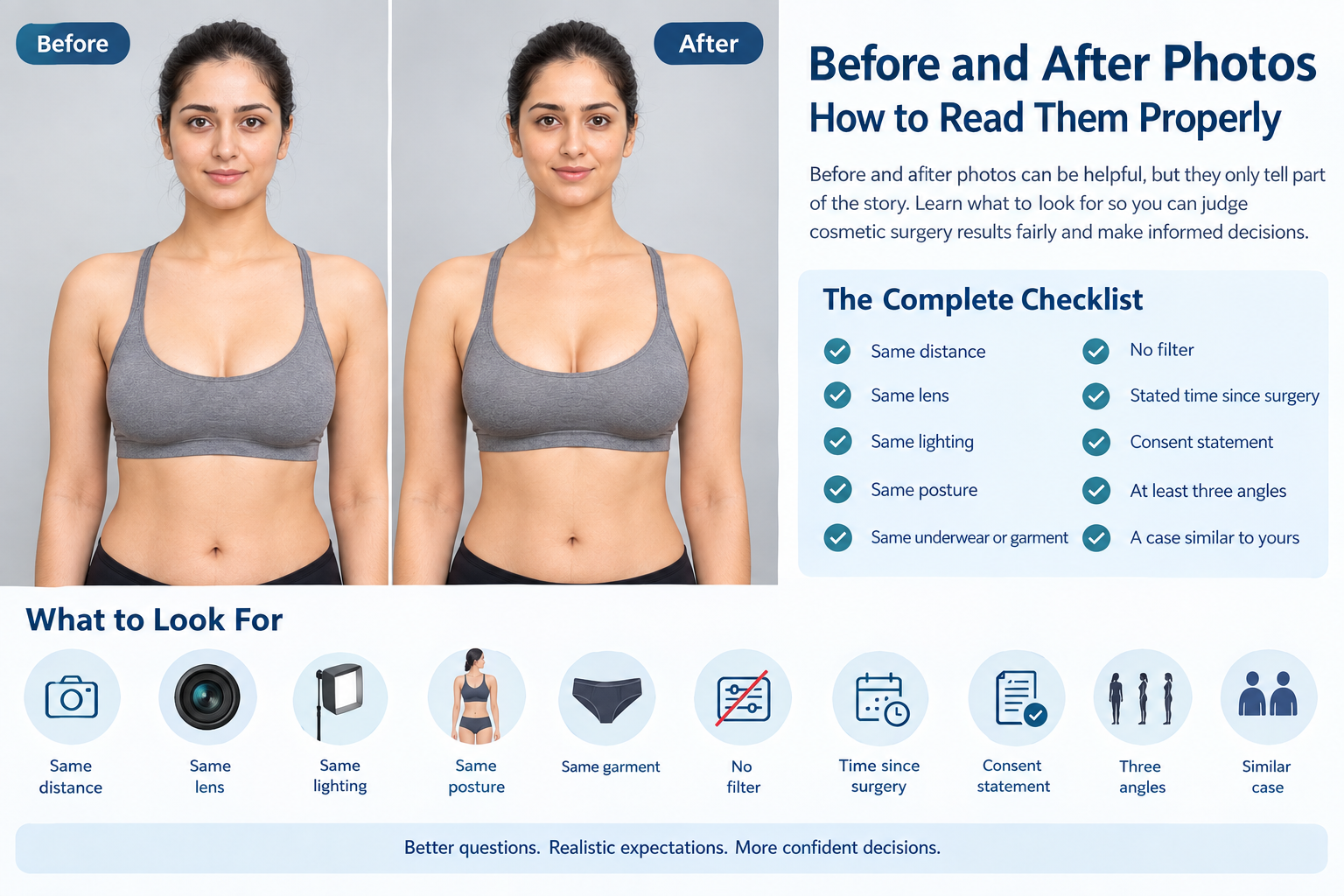
When learning how to read before and after photos, do not look only at the final result. Look at how both photographs were taken, how much time passed between them, whether the patient gave consent, whether the photographs show multiple angles and whether the case is similar to yours.
Lighting, camera distance, lens choice, posture, clothing and timing can all change how a result appears. A fair comparison therefore requires more than simply placing two photographs beside each other.
A clinic’s gallery should help you understand possible results without making one patient’s photograph appear to be a guarantee of what another patient will achieve.
What Makes a Before and After Pair a Fair Comparison?
A useful before and after pair should make it possible to compare the patient under reasonably similar photographic conditions.
Look for:
- Similar camera distance
- Same or comparable lens
- Similar lighting
- Similar posture
- Same or comparable underwear or garment
- No filters or artificial reshaping
- Clearly stated time since surgery
- Appropriate patient consent
- At least three useful angles
- A patient with a case similar to yours
If several of these factors change between the two photographs, it becomes harder to know how much of the visible difference comes from the procedure and how much comes from photography.
The FDA also advises patients considering breast implant surgery to ask surgeons for before and after photographs and to discuss what results are reasonable to expect.
How Do Lighting, Angle and Posture Change the Result?
Photography can influence the way an area looks.
Lighting
Different lighting can emphasize or reduce shadows, contours, skin texture and irregularities.
A photograph taken under strong directional light may look substantially different from one taken under softer light.
Pass: Before and after photographs have similar lighting direction and intensity.
Fail: The before photograph uses flat lighting while the after photograph uses strong lighting that emphasizes contours.
Camera angle
Camera position changes perspective.
A photograph taken from above, below, very close or at a different horizontal angle can change the apparent proportions of the body or face.
Pass: The camera is positioned at approximately the same height and angle.
Fail: The before photograph is taken from one angle while the after photograph is taken from a more flattering angle.
Posture
Posture can also change the appearance of the treated area.
For example, standing straight, twisting the torso or changing arm position can alter how the abdomen or breasts appear.
Pass: The patient maintains a similar position in both photographs.
Fail: The patient is relaxed in one image but posed differently in the other.
These factors matter when judging cosmetic surgery results because a photograph is not an independent measurement of the body.
How Long After Surgery Was the Photo Taken?
The timing of the after photograph should be clearly stated.
An image taken shortly after surgery may show swelling, bruising or temporary changes. A later photograph may show a more settled appearance.
Therefore, simply labelling an image “after” gives incomplete information.
A useful example
Before: Preoperative photograph
After: Six months after surgery
A weak example
Before: Before
After: After
When looking at before and after photos, ask exactly when the after photograph was taken.
This is particularly important when comparing procedures where healing and tissue settling continue over time.
What Should Patient Consent Look Like?
Patient photographs should be used appropriately and with the patient’s permission.
A professional gallery should provide information indicating that photographs are being displayed with appropriate consent.
A consent statement does not prove that the result is representative of every patient, but it provides important context about the use of patient images.
Look for
- A clear statement about patient consent
- Identification of the procedure or treatment
- Enough information to understand what the photograph represents
- No suggestion that one patient’s result is guaranteed for everyone
Privacy is also important. A patient may consent to photographs being displayed while still choosing not to have identifying facial features shown.
How Do You Spot a Stock or Borrowed Photo?
Patients often ask, “Are before after photos real?”
A photograph by itself cannot always prove where it originated. Instead, look for contextual clues.
Check whether:
The photograph is labelled with a procedure or case.
A useful gallery should provide context rather than presenting anonymous images without explanation.
The same patient appears across multiple angles.
Front, side and oblique photographs should appear consistent with one another.
The image quality is consistent.
A single photograph with a noticeably different style, resolution or background deserves closer scrutiny.
The clinic provides case-specific information.
Procedure, timing and relevant context make a photograph easier to evaluate.
The photograph appears elsewhere online.
If you suspect a photograph may be a stock or borrowed image, you can use a reverse image search to see whether substantially identical images appear on unrelated websites.
Finding the same image elsewhere does not by itself establish that a photograph is fake or improperly used. The image may have been licensed or legitimately published in more than one location. The appropriate response is to ask the clinic for clarification.
The Complete Before and After Photo Checklist
Use this checklist for any clinic’s gallery.
| What to look for | Pass example | Fail example |
|---|---|---|
| Same distance | Both photographs are taken from approximately the same distance. | The after photograph is much closer to the camera. |
| Same lens | The same lens or comparable camera setup is used. | Different lenses create noticeably different proportions. |
| Same lighting | Lighting direction and intensity are similar. | One image uses dramatically different lighting. |
| Same posture | The patient is positioned similarly in both photographs. | The patient bends, twists or changes position. |
| Same underwear or garment | The same or comparable garment is used. | Different clothing changes what can be seen. |
| No filter | Images are presented without beauty or reshaping filters. | Skin or body contours appear digitally altered. |
| Stated time since surgery | The gallery explains when the after photograph was taken. | No recovery time is provided. |
| Consent statement | The gallery explains that photographs are used with appropriate consent. | No information about photograph use is provided. |
| At least three angles | Front, side and another relevant view are available. | Only one selected angle is shown. |
| A case similar to yours | The patient’s starting condition and treatment goal are reasonably similar. | A completely different case is used to set expectations. |
How Should You Judge Cosmetic Surgery Results?
When judging cosmetic surgery results, compare cases rather than focusing on one dramatic photograph.
For example, if you are considering breast surgery, look for patients with a similar starting breast size, shape and general anatomy.
If you are considering liposuction, look for a case involving a similar treatment area and starting contour.
A result from a different procedure or a very different patient may demonstrate what is possible in general but may not tell you much about your own likely result.
Elegance Clinic’s current galleries are separated into treatment-specific collections. Its breast cosmetic surgery material links to before and after results, while its liposuction gallery includes categories such as abdomen, arms, buttocks, double chin and thighs.
Are Before and After Photos Real?
The question “are before after photos real?” cannot always be answered simply by looking at an image.
Instead, evaluate the evidence around the photograph.
Ask:
- Is the procedure identified?
- Is the timing stated?
- Are multiple angles available?
- Is the same patient shown consistently?
- Are the photographic conditions comparable?
- Is there a consent statement?
- Is the case similar to yours?
- Can the clinic explain the photograph’s source if asked?
Elegance Clinic currently publishes procedure-specific result galleries, including breast surgery, liposuction and keloid treatment.
A photograph should be considered an example of a possible result, not a promise that another patient will have exactly the same outcome. The FDA similarly recommends discussing reasonable expected outcomes and reviewing patient photographs as part of consultation for breast implant surgery.
Why Are Faces Hidden in the Photos?
Faces may be hidden or cropped to protect patient privacy.
A patient may consent to showing the treated area without wanting their identity publicly recognizable.
Therefore, a hidden face is not automatically evidence that a photograph is fake.
Instead, assess the other elements of the gallery:
- Consistent patient appearance
- Multiple angles
- Consistent photographic conditions
- Procedure information
- Timing
- Consent information
Privacy protection and transparent presentation can exist together.
Should I Ask to See More Cases?
Yes, asking to see more relevant cases can be useful.
Instead of asking only for the clinic’s most impressive result, ask whether there are cases with a starting condition similar to yours.
For example:
“Do you have before and after photographs of patients with a similar starting point and the same procedure?”
You can also ask whether the photographs show different stages of healing.
This gives you more context than relying on a single image.
Can I Speak to a Past Patient?
You can ask a clinic whether patient-to-patient contact is possible, but a clinic may not be able to share a patient’s contact details because of privacy.
A patient should never assume that another person’s medical information can be shared simply because they want to discuss the result.
Instead, ask whether the clinic has a legitimate patient-feedback or testimonial process that allows previous patients to share their experiences voluntarily.
Remember that another patient’s experience is personal and cannot guarantee the same result for you.
Use Clinic Galleries Carefully
A gallery can be useful when researching a procedure, particularly when the images are organized by treatment.
You can review:
Elegance Clinic result gallery
Breast surgery before and after photos
Liposuction before and after photos
Keloid treatment before and after photos
The current keloid gallery, for example, separates results into categories including ear keloid, chest keloid, intralesional excision, intralesional injections and reconstruction.
This type of procedure-specific organization can make it easier to look for cases relevant to the treatment you are researching.
What a Good Before and After Comparison Should Show
A useful comparison should answer several basic questions before you draw conclusions:
Who is being shown?
The same patient should be represented consistently.
What procedure was performed?
The treatment should be clearly identified.
When was the after photograph taken?
The recovery period should be stated.
How were the photographs taken?
Distance, lens, lighting and posture should be reasonably consistent.
Was the photograph edited?
Filters or digital reshaping should not create a misleading impression.
Are multiple views available?
At least three relevant angles can provide more context.
Is the case similar to yours?
A comparable starting point makes the photograph more useful for setting expectations.
Conclusion
Learning how to read before and after photos means looking at the photograph and the conditions behind it.
Check the same distance, same lens, same lighting, same posture, same underwear or garment, no filter, stated time since surgery, consent statement, at least three angles and a case similar to yours.
These checks can help you identify photographic differences that may otherwise make an average result appear more dramatic than it actually is.
Before choosing a procedure, use galleries to understand examples and prepare questions. Do not treat another patient’s photograph as a guarantee of your own result.
FAQs
Are before and after photos real?
They may represent genuine patient results, but a photograph alone cannot establish its origin or authenticity. Check the procedure, timing, multiple angles, photographic consistency and consent information.
How long after surgery were they taken?
Ask the clinic for the exact or approximate time between surgery and the after photograph. “After” without a timeframe provides limited context.
Will my result look like the photo?
Not necessarily. Results vary with anatomy, starting condition, procedure, healing and other individual factors.
Why are faces hidden in the photos?
Faces may be hidden or cropped to protect patient privacy. This alone does not indicate that a photograph is fake.
Should I ask to see more cases?
Yes. Ask for cases involving the same procedure and a starting condition reasonably similar to yours.
Can I speak to a past patient?
You can ask, but a clinic should not disclose another patient’s private contact information without appropriate permission. Ask whether it has a voluntary patient-feedback or testimonial process.

