

|
Getting your Trinity Audio player ready...
|
✓ Medically reviewed by Dr. Ashutosh Shah, Plastic, Reconstructive & Cosmetic Surgeon (M.Ch., DNB)
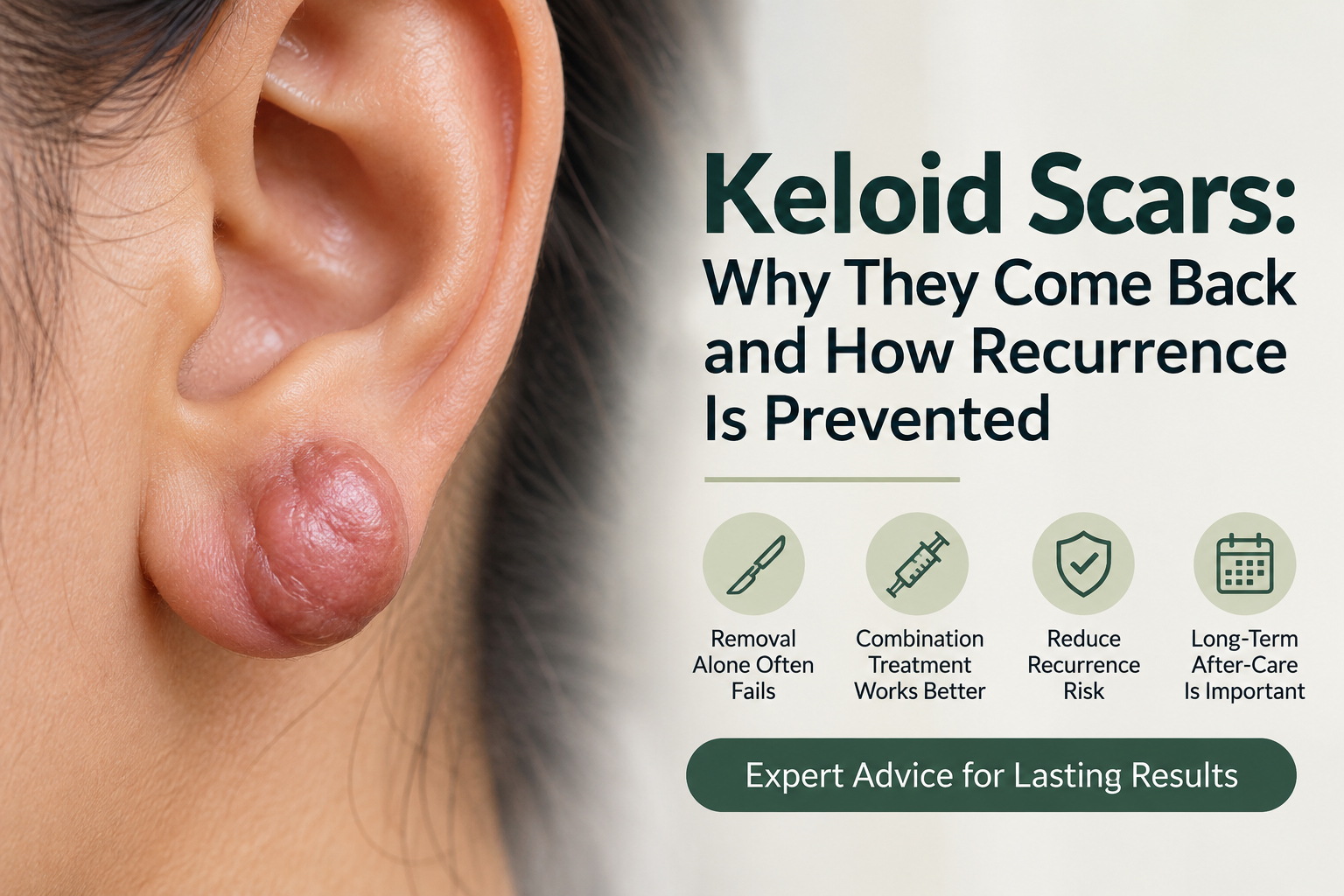
Keloids can return after removal because the skin continues producing excessive scar tissue during healing. Surgical removal alone has a high recurrence risk, so prevention usually requires a combination approach such as carefully selected surgery plus intralesional injections, silicone therapy, pressure therapy or other treatments followed by consistent after-care for several months.
This tendency to return is one of the most frustrating features of keloid scars. A patient may have a raised scar surgically removed, see a good early result and then notice that the scar gradually becomes thick, itchy or raised again.
Understanding keloid recurrence helps explain why simply cutting away the visible scar is often not enough.
What Is a Keloid and How Is It Different From a Normal Scar?
A normal scar forms as part of the body’s healing response after an injury. As healing progresses, collagen production usually settles and the scar gradually matures.
A keloid behaves differently.
Instead of remaining within the boundaries of the original injury, keloid tissue can continue growing beyond them. The scar may become raised, firm, itchy, painful or darker than the surrounding skin.
Keloids may develop after relatively minor skin injuries, including:
- ear piercing;
- acne;
- cuts and burns;
- surgery;
- vaccination or injection sites;
- tattoos or other skin trauma.
They are frequently seen on areas such as the earlobes, chest, shoulders, jawline, upper back and sternum.
This abnormal scar response is also the main reason treating a keloid is different from treating an ordinary scar.
Why Does a Keloid Return After Removal?
Patients often ask, “Why does keloid return even after it has been completely removed?”
The problem is not simply the piece of scar tissue that can be seen.
A person who forms keloids has an abnormal wound-healing response. Surgery removes the existing keloid, but surgery also creates a new wound. As that wound heals, the same excessive scar-forming response can begin again.
In some cases, the new keloid may become as large as or occasionally larger than the original scar.
This is why recurrence prevention needs to start as part of the original treatment plan rather than only after a new keloid appears.
Why Does Cutting a Keloid Out on Its Own Often Fail?
Surgical excision can immediately remove bulky keloid tissue, but excision alone does not correct the biological tendency to produce excessive scar tissue.
The surgical incision becomes another injury that needs to heal.
If healing is allowed to proceed without additional recurrence-control measures, excessive collagen production may restart around the incision.
Published medical literature reports widely varying recurrence rates after excision alone, with particularly high recurrence described in some keloid sites and patient groups. The exact risk varies considerably by location, size, previous treatments and follow-up period.
Therefore, surgery is generally considered one part of a broader treatment strategy when excision is appropriate.
For patients who have experienced a keloid coming back after surgery, the next treatment plan should consider both removal or flattening of the existing scar and prevention of another recurrence.
What Combination Protocol Helps Prevent Keloid Recurrence?
There is no single combination that guarantees a keloid will never return.
Treatment is individualised according to the keloid’s location, size, symptoms, previous treatments and the patient’s tendency to form scars.
A recurrence-control plan may combine:
Surgical excision: Useful for selected bulky or resistant keloids where reducing scar volume is necessary.
Intralesional injections: Medicines are injected directly into the keloid to suppress scar activity and help flatten the tissue. Corticosteroids are commonly used, sometimes with other agents depending on the clinical situation.
Silicone gel or silicone sheets: These may be used after wound healing to support scar management over an extended period.
Pressure therapy: Particularly useful in selected areas such as the ear, where pressure earrings or other devices can continuously compress the scar.
Other specialist treatments: Depending on the keloid and previous response, clinicians may consider cryotherapy, laser-based approaches or, in carefully selected recurrent cases, postoperative radiotherapy.
The important principle is that keloid recurrence prevention is usually an ongoing process rather than a single procedure.
Keloid Recurrence-Prevention Protocol by Site
The following table provides a practical overview. It is not a fixed prescription: treatment must be selected after examining the scar.
| Keloid Site / Size | Common First-Line Approach | What May Be Added to Reduce Recurrence | Typical Sessions* | Typical After-Care Period | Recurrence Risk |
|---|---|---|---|---|---|
| Small earlobe keloid | Intralesional injections or selected excision | Pressure earring + injections + silicone | Several injection visits may be required | Around 3–6+ months | Lower with consistent combination therapy, but recurrence remains possible |
| Large earlobe keloid | Excision in selected cases | Postoperative injections + pressure therapy + silicone | Multiple follow-ups/injections | 6–12 months may be advised | Moderate; varies with previous recurrence and adherence |
| Chest keloid | Intralesional treatment | Silicone; other modalities for resistant lesions | Multiple sessions often required | Several months | Moderate to high |
| Shoulder keloid | Intralesional treatment | Silicone and additional scar-control treatment when indicated | Multiple sessions | Several months | Moderate to high |
| Jawline keloid | Intralesional treatment ± selected surgery | Post-treatment injections and silicone; additional modalities in resistant cases | Individualised | Several months | Moderate |
| Back keloid | Intralesional treatment | Silicone and additional treatment when required | Multiple sessions | Several months | Moderate to high |
| Sternum keloid | Intralesional treatment | Silicone and multimodal therapy for resistant scars | Multiple sessions | 6+ months in many cases | High in difficult/recurrent lesions |
| Caesarean-section keloid | Injection or selected scar revision | Silicone ± postoperative injections | Individualised | Several months | Variable |
*There is no universal number of injection sessions. Frequency and total sessions depend on response, medication used, scar thickness, location and side effects.
These are risk bands rather than guaranteed percentages because recurrence estimates vary significantly among studies and treatment protocols.
Intralesional Injections for Keloids
Intralesional injections for keloid are among the most commonly used treatments for active raised scars.
Instead of giving medicine systemically, the clinician injects it directly into the scar tissue.
Corticosteroid injections can reduce collagen production and inflammation and may help soften and flatten a keloid. Some resistant scars are treated using combination injection protocols.
Treatment is generally performed over multiple visits rather than assuming that one injection will permanently eliminate the scar.
The interval between sessions depends on the medication, scar and response.
Can Injections Work Without Surgery?
Yes, in selected cases.
Small or moderately sized keloids may respond to injections without requiring surgical removal. This can be particularly useful when the main goals are reducing thickness, itching, tenderness or continued growth.
However, a very large or bulky keloid may not flatten sufficiently with injections alone.
The decision should therefore be based on the characteristics of the individual scar rather than an automatic “surgery first” approach.
How Many Injection Sessions Are Usually Needed?
There is no fixed number that applies to every keloid.
Several sessions are commonly required, often spaced weeks apart. The clinician evaluates changes in thickness, firmness, symptoms and scar activity between treatments.
Some scars respond relatively quickly, while resistant or recurrent keloids may need a longer treatment course or a combination of therapies.
Who Is at the Highest Risk of Keloid Recurrence?
Recurrence risk is influenced by several factors.
Keloids that have already returned after previous treatment can be more challenging. Large, longstanding or highly active scars may also require more intensive recurrence control.
Certain anatomical areas-including the chest, sternum, shoulders and upper back are well known for troublesome keloid formation.
Family history can matter as well. Keloid susceptibility appears to have a genetic component, although inheritance is complex rather than following one simple pattern.
People with darker skin pigmentation also have a higher population-level tendency to develop keloids, although anyone can develop them.
Are Keloids Hereditary?
There can be a familial tendency.
If several family members develop keloids after relatively minor injuries, this may indicate increased susceptibility. Genetics, skin biology, wound location and environmental factors all appear to contribute.
Having a family history does not mean every wound will develop a keloid, but it is useful information to tell your surgeon or dermatologist before elective procedures or piercings.
How Long Do I Need to Use Silicone or Pressure Therapy?
Keloid after-care is measured in months rather than days.
Silicone gel or sheets may be recommended for several months after the wound has healed sufficiently. Pressure treatment, particularly after earlobe keloid surgery, may also need to continue consistently for months.
Stopping after-care as soon as the wound looks good can be a mistake because scar remodelling continues long after the skin surface has closed.
Patients prescribed pressure garments for keloid management should follow the recommended duration and daily wear schedule rather than stopping treatment independently.
Will My Keloid Definitely Come Back After Surgery?
No.
Recurrence is possible, but it is not inevitable.
Risk depends on the location and size of the keloid, whether it has previously recurred, the surgical technique, additional treatment used after removal and how consistently after-care is followed.
No responsible treatment plan can promise a zero-recurrence result.
The goal is to choose a strategy that controls the existing keloid while reducing the biological conditions that allow another excessive scar to develop.
Why Did My Earlier Keloid Operation Not Work?
If a previous operation involved excision alone, recurrence may have occurred because removing the scar created another wound without sufficient postoperative scar suppression.
Recurrence can also happen despite combination treatment.
When assessing a recurrent keloid, the doctor needs to know what previous treatment was performed, whether injections were given, how many sessions were completed, whether pressure or silicone was used and how quickly the scar returned.
That information can influence the next treatment plan.
Keloid Treatment in Gujarat: What Should Patients Ask?
When seeking keloid treatment in Gujarat, ask about the entire recurrence-prevention plan rather than asking only how the keloid will be removed.
Useful questions include whether surgery is actually necessary, what treatment will begin after removal, whether injections will be required, whether silicone or pressure therapy is suitable and how long follow-up should continue.
Patients considering treatment at Elegance Clinic can learn more about keloid treatment in Surat and the available keloid recurrence prevention approaches before consultation.
Final Takeaway
The central lesson about keloid recurrence is simple: removing visible scar tissue does not remove a person’s tendency to form a keloid.
That is why excision alone can be followed by another raised scar.
Modern keloid management focuses on a planned combination of appropriate scar reduction or removal, postoperative scar-control treatment and long-term follow-up. Intralesional injections, silicone and pressure therapy can all play roles depending on the location and characteristics of the keloid.
If a keloid has already returned once, tell your treating doctor exactly what was done previously. A recurrence-prevention strategy should be planned from the beginning rather than waiting to see whether the scar grows back.
Frequently Asked Questions
Will my keloid come back after surgery?
It can. Surgery creates a new wound, and someone prone to keloids can develop excessive scar tissue again. Combination treatment and prolonged after-care are commonly used to reduce recurrence risk.
Why did my earlier keloid operation not work?
One possible reason is that the keloid was removed without adequate recurrence-prevention treatment. However, recurrence can occur even after appropriate treatment, particularly with difficult sites or previously recurrent keloids.
How many injection sessions are usually needed?
There is no fixed number. Multiple sessions are commonly needed, with the total determined by the scar’s response, thickness, location and the treatment being used.
Does an injection alone work without surgery?
It can for selected keloids, especially smaller lesions. Large or bulky scars may require a combination approach. Surgery is not automatically necessary for every keloid.
Are keloids hereditary?
Keloid susceptibility can run in families, suggesting a genetic contribution. However, family history does not mean that every injury will produce a keloid.
How long do I need to wear pressure or use silicone?
Treatment commonly continues for several months. The exact duration depends on the scar, its location, treatment response and the method being used. Follow the schedule recommended by your treating clinician rather than stopping as soon as the scar appears flat.

