

|
Getting your Trinity Audio player ready...
|
✓ Medically reviewed by Dr. Ashutosh Shah, Plastic, Reconstructive & Cosmetic Surgeon (M.Ch., DNB)
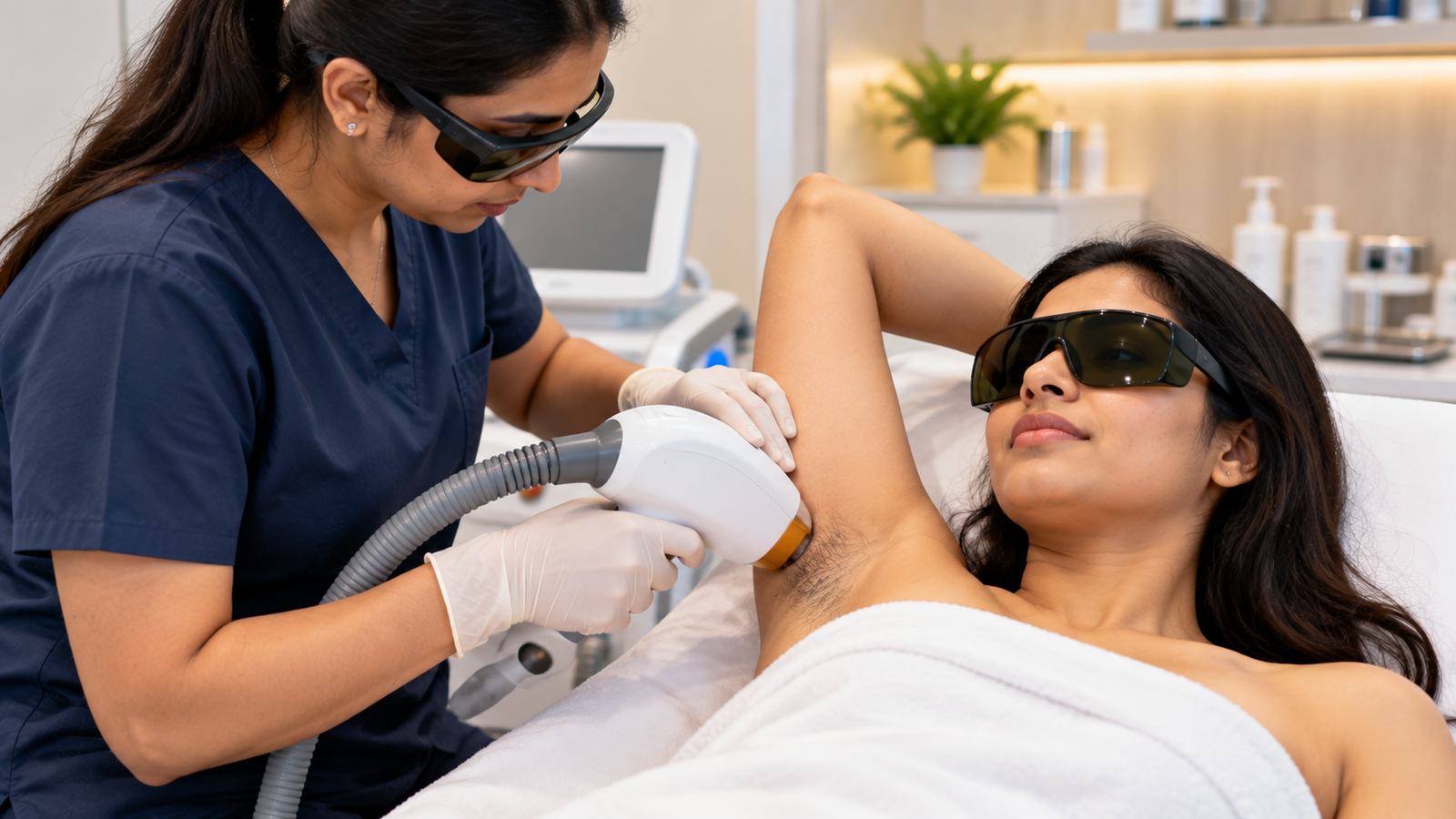
Laser hair removal usually requires a series of sessions because hairs grow through different phases at different times. Most people need several treatments spaced weeks apart, with the exact number depending on the treatment area, hair colour, hair thickness, skin tone and individual response. Maintenance sessions may be needed later because laser provides long-term hair reduction rather than a guarantee that every treated hair will never return.
Why Does Laser Hair Removal Need More Than One Session?
Laser hair removal works by directing light energy toward pigment in the hair and heating the follicle. It is most effective when the target hair is in a growth phase in which the follicle can absorb sufficient energy.
Not every hair on your body is growing at the same time.
That is why treating the same area once cannot target every follicle that may eventually produce a visible hair.
With repeated sessions, different groups of actively growing hairs can be treated. The result is usually a gradual reduction in the number and thickness of hairs rather than an instant removal of everything.
The American Academy of Dermatology notes that patients commonly need 2–6 laser treatments, although the number varies considerably from person to person. It also reports that many people see roughly 10–25% hair reduction after the first treatment.
The clinic’s own laser-hair-removal information similarly explains that multiple treatments are required and that maintenance treatments may be needed because laser hair removal rarely results in perpetual hair removal.
How Many Sessions Does Each Body Area Need?
There is no medically fixed number that applies to every person. The following is a general planning range, not a promised result.
| Treatment area | Typical number of sessions | Typical gap between sessions | Expected reduction after course | Maintenance sessions/year |
|---|---|---|---|---|
| Upper lip | 6–8 | 4–6 weeks | Often substantial reduction; hormonal regrowth can occur | 1–3 |
| Chin | 6–10 | 4–6 weeks | Substantial reduction is possible, but facial hormonal hair may need ongoing treatment | 1–4 |
| Full face | 6–10 | 4–6 weeks | Significant long-term reduction; response varies by facial hair and hormones | 1–4 |
| Underarms | 6–8 | 4–6 weeks | Often strong reduction with repeated treatment | 1–3 |
| Arms | 6–8 | 6–8 weeks | Significant reduction, with finer regrowth in many patients | 1–2 |
| Chest | 6–10 | 6–8 weeks | Significant reduction; dense or hormonal hair may need more sessions | 1–3 |
| Back | 6–10 | 6–8 weeks | Significant reduction, but dense male hair can require additional sessions | 1–3 |
| Bikini | 6–8 | 4–6 weeks | Often substantial reduction | 1–3 |
| Full legs | 6–8 | 6–8 weeks | Significant long-term reduction | 1–2 |
| Full body | 6–10+ | Area-dependent | Broad reduction across treated areas; each area responds differently | 1–3 |
These ranges should be adjusted after assessing your hair colour, hair thickness, skin type, treatment area and response to previous sessions. The AAD specifically notes that hair colour and thickness, treatment area, laser type and skin colour all affect results.
For example, facial hair can behave differently from leg hair. A person with coarse dark underarm hair may respond differently from someone treating fine facial hair.
How Long Should the Gap Between Sessions Be?
The gap is important because treating too frequently does not necessarily mean faster results.
The timing should allow another group of target hairs to reach an appropriate growth stage.
For many patients, sessions are scheduled roughly every 4-6 weeks, although some body areas may be treated at longer intervals as the course progresses. The AAD states that most patients can have laser hair removal approximately every 4-6 weeks, with the dermatologist determining the appropriate interval.
A typical pattern might therefore look like:
Session 1 → wait several weeks → Session 2 → wait several weeks → Session 3 → reassess response → continue according to regrowth
The interval may become longer when the remaining hairs grow more slowly or become less dense.
Your treatment provider should decide the timing rather than using the same calendar interval for every body area.
Why Does Laser Work Poorly on White, Grey and Very Fine Hair?
Laser hair removal relies heavily on pigment in the hair.
Dark, coarse hair contains more pigment that can absorb the laser energy. White and grey hairs contain little or no melanin, so conventional laser hair removal has a poor target.
The clinic specifically states that laser does not effectively remove white or grey hair and offers electrolysis as an alternative for these hairs.
Very fine or light-coloured hair can also be difficult because there may not be enough pigment for the laser to target effectively.
This is why a consultation should assess both:
- Hair colour
- Hair thickness
before deciding how useful laser treatment is likely to be.
If an area contains a mixture of dark and white hairs, the dark hairs may respond to laser while the white hairs remain.
Is Laser Hair Removal Permanent?
It is better to think of laser hair removal as long-term hair reduction, rather than promising that every hair will be permanently gone.
After a successful course, many people remain hair-free for months or years, and regrowth is often lighter, finer or less noticeable. Some patients need maintenance treatments to keep the area reduced.
The FDA definition used for devices cleared for permanent hair reduction refers to a long-term, stable reduction in the number of hairs regrowing after a treatment regimen, measured over time. That is different from saying that every treated follicle is permanently destroyed.
Hormonal factors can also influence regrowth, particularly on the face.
Therefore, if someone tells you that one course guarantees 100% permanent hair removal with no future sessions, that is an unrealistic promise.
Is Laser Hair Removal Safe on Darker Indian Skin Tones?
Laser hair removal can be performed on darker skin, but the treatment needs to be selected and adjusted appropriately.
The laser is interacting with pigment in both the hair and the skin. With darker skin, there is more melanin in the surrounding skin, so inappropriate settings can increase the risk of burns or temporary or permanent pigment changes.
The AAD notes that advances in laser treatment mean people with darker skin can be treated safely, but treatment needs to be performed carefully by someone experienced with the patient’s skin colouring.
The clinic also states that its laser settings are matched to skin tone and hair characteristics.
Before treatment, tell the clinician about:
- Your natural skin tone
- Any recent tanning
- Previous reactions to laser
- A tendency to develop raised scars
- Medicines you take
- Previous pigmentation problems
A recent tan is particularly important because increased skin pigmentation can alter the safety of treatment. The AAD recommends discussing recent tanning and other relevant medical history before laser hair removal.
How Many Sessions Will I Need If My Hair Is Coarse and Dark?
Coarse, dark hair is generally a favourable target because the laser can identify its pigment more easily.
However, good target hair does not mean that everyone will need exactly the same number of sessions.
Your final number can be affected by:
- Body area
- Hair density
- Hair thickness
- Skin colour
- Hormonal factors
- Laser technology
- Treatment settings
- Your individual response
The clinic’s current information states that treatment varies according to hair growth and skin type and that multiple sessions are required.
How Many Sessions Will I Need for Facial Hair?
Facial hair deserves separate consideration because hormones can affect both the density and persistence of regrowth.
Upper-lip and chin hair may need repeated sessions even after other body areas have responded well.
For some women, conditions associated with hormonal changes can contribute to persistent facial hair. In such cases, laser can reduce the existing hair, but addressing the underlying hormonal issue may also be important.
This is why a person having treatment for chin hair should not automatically expect the same session count as someone treating the legs.
Can I Shave Between Laser Hair Removal Sessions?
Yes. Shaving is generally compatible with laser hair-removal treatment.
The purpose of shaving is to remove the visible hair above the skin while leaving the follicle available as the treatment target.
By contrast, waxing, plucking or epilating removes the hair from the follicle and can interfere with the target for laser treatment.
Your clinic may give you specific instructions about when to shave before a session. Follow those instructions rather than assuming every laser system uses exactly the same preparation protocol.
Does Laser Hair Removal Hurt?
The sensation varies by treatment area, hair thickness, skin sensitivity and laser system.
Patients may describe the pulses as:
- A warm snap
- A pinprick
- A rubber-band-like sensation
- Brief heat
Cooling systems or cooling gel may be used to make treatment more comfortable.
The clinic describes patients as potentially feeling a heated pinprick along with a cold sensation from the cooling system.
After treatment, temporary redness and swelling around the follicles can occur. The AAD describes these as common short-term effects, usually lasting about 1–3 days.
What Maintenance Is Needed After the Course?
Completing the initial course does not necessarily mean you will never see another hair.
Some follicles may produce regrowth later, while hormonal changes can stimulate additional growth.
Maintenance sessions are therefore used when regrowth becomes noticeable.
A practical maintenance approach is:
- Complete the initial treatment course.
- Monitor how much regrowth occurs.
- Allow enough time between treatments for meaningful regrowth.
- Return for a maintenance session when advised.
- Reassess the treatment plan if the pattern of regrowth changes.
There is no universal rule that everyone needs exactly two or three maintenance treatments every year.
Some people may need only occasional top-ups, while others—particularly those with hormonal facial hair—may need more frequent maintenance.
What Should You Do Before Each Session?
Your preparation can affect both safety and treatment planning.
Tell your clinician if you have:
- A recent tan
- Sunburn
- A tendency to scar
- Previous keloids
- Cold-sore outbreaks
- New medicines
- Skin irritation or infection
- A previous reaction to laser treatment
The AAD recommends avoiding tanning and using broad-spectrum SPF 30+ sunscreen before treatment, alongside following the dermatologist’s specific instructions.
Do not change prescribed medicines without discussing them with your doctor.
What Happens If Hair Is Not Responding?
If an area is showing little improvement after several sessions, the answer is not necessarily to keep increasing the number of treatments.
The treatment should be reassessed.
Possible reasons include:
- Hair is too light
- Hair is too fine
- Incorrect treatment interval
- Hormonal regrowth
- Inadequate treatment settings
- Different growth cycles
- Another cause of excess hair growth
A medical review can determine whether the treatment should continue, be adjusted or whether another hair-removal method is more suitable.
For white or grey hair, for example, the clinic specifically describes electrolysis as an alternative because it does not depend on hair pigment.
What Results Should You Expect After the Course?
A successful course should be judged by reduction, not simply by whether every single hair disappears.
You may notice:
- Fewer visible hairs
- Slower regrowth
- Finer hairs
- Less frequent shaving
- Longer periods between hair-removal sessions
Results differ between areas and individuals.
The AAD notes that many patients experience substantial periods without visible hair after completing treatment, but regrowth can occur and maintenance treatments may be needed.
Frequently Asked Questions
How many sessions will I need?
Many people need a series of treatments rather than one session. A commonly used planning range is around 6-10 sessions, although some people respond with fewer and others need more. The exact number depends on the area, hair and skin characteristics and individual response.
How far apart are the sessions?
Many treatments are scheduled approximately 4-6 weeks apart, while some body areas may need longer intervals. The timing should follow the hair-growth pattern and your response rather than a fixed schedule.
Is laser hair removal permanent?
Laser provides long-term hair reduction rather than a guarantee that every hair will permanently disappear. Many patients remain hair-free for months or years, while some regrowth and maintenance treatment are expected.
Does it work on white or grey hair?
Conventional laser hair removal works poorly on white and grey hair because there is little or no pigment for the laser to target. Electrolysis is an alternative for white or grey hair.
Is it safe on darker Indian skin tones?
It can be safe when the appropriate laser, settings and precautions are used by an experienced medical professional. Darker skin requires careful treatment because pigment changes and burns are possible if treatment is not appropriately performed.
Can I shave between sessions?
Yes, shaving is generally suitable between sessions because it does not remove the follicle in the way waxing or plucking does. Follow the clinic’s specific preparation instructions before your next appointment.
Does it hurt?
Most patients feel brief heat, snapping or pinprick-like sensations. Cooling systems can make treatment more comfortable. Temporary redness and swelling can occur afterward.
The Number of Sessions Is Personal
There is no single session count that guarantees the same result for everyone.
The best treatment plan considers where the hair is, how thick and dark it is, your skin tone, the growth cycle, previous response and whether hormonal factors are involved.
Laser hair removal works through repeated treatment of suitable growing hairs, which is why sessions are deliberately spaced rather than performed every few days. Darker, coarser hair generally provides a better laser target, while white and grey hair require a different approach such as electrolysis.
If you are considering laser hair removal in Surat, a consultation can determine the appropriate treatment area, expected number of sessions, interval between appointments and likely maintenance schedule rather than relying on a fixed number from someone else’s treatment plan.

