

|
Getting your Trinity Audio player ready...
|
✓ Medically reviewed by Dr. Ashutosh Shah, Plastic, Reconstructive & Cosmetic Surgeon (M.Ch., DNB)
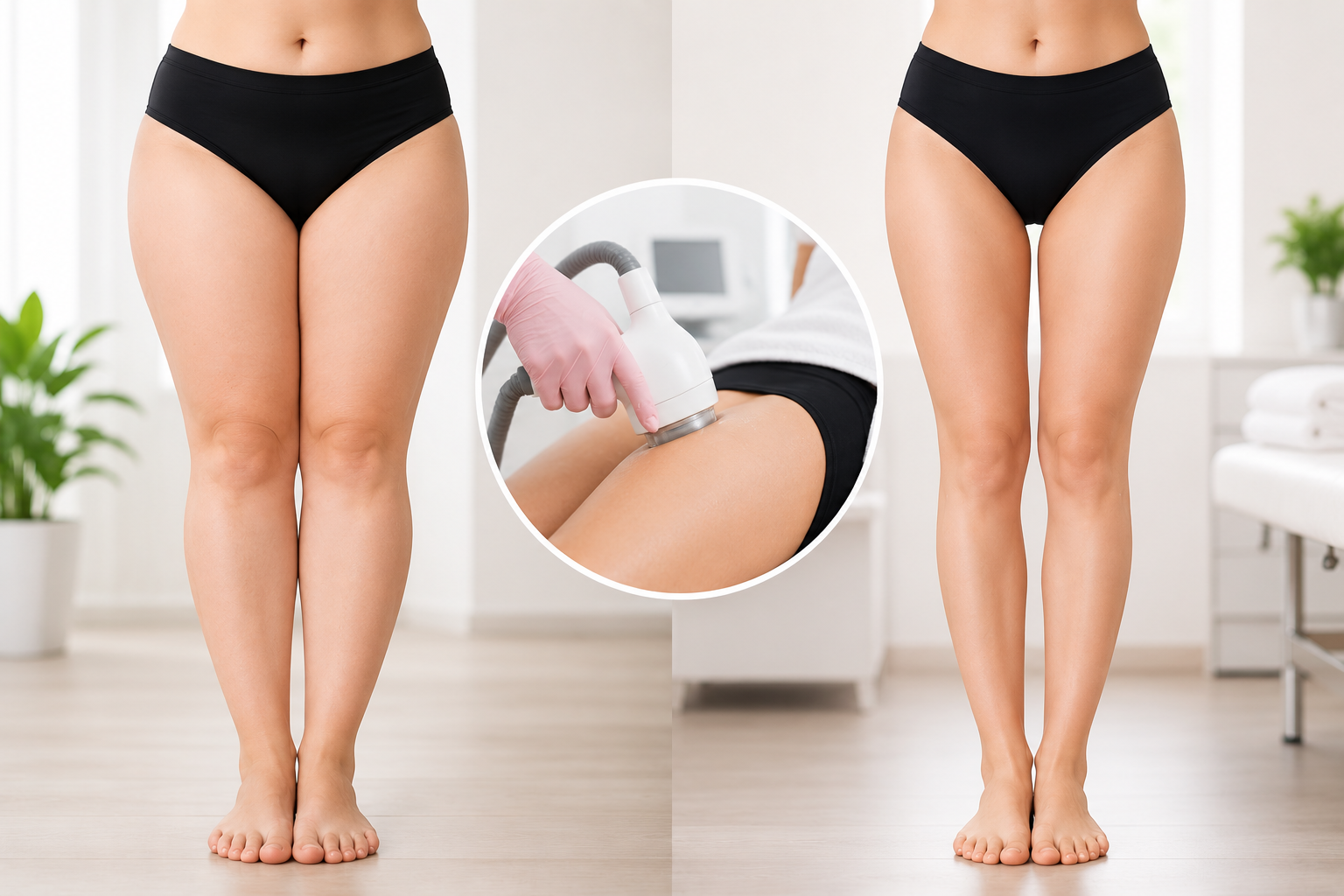
You can reduce thigh fat without surgery using cryolipolysis, radiofrequency or selected ultrasound treatments. These methods work best on small, localised fat deposits rather than large thigh bulges or loose skin. Results usually develop gradually over two to three months, and some patients need multiple sessions. For larger fat deposits, thigh liposuction may offer more predictable contouring.
Stubborn inner and outer thigh fat can remain noticeable despite regular exercise and a balanced diet.
Some people develop soft fat deposits along the inner thighs. Others notice outer-thigh fullness, commonly called saddlebags.
Although weight loss may reduce overall body fat, it cannot reliably target one specific area.
As a result, many patients explore fat freezing and other non-surgical body-contouring treatments.
However, these treatments have limitations. They cannot remove large amounts of fat, correct significant loose skin, or guarantee a thigh gap.
Before choosing a treatment, it is important to understand what each device can realistically achieve.
Can You Reduce Thigh Fat Without Surgery?
Yes. Several non-invasive body-contouring technologies can reduce selected fat deposits without incisions.
These treatments aim to change the shape of a localised area rather than produce significant weight loss.
The main options include:
- Cryolipolysis, also called fat freezing
- Radiofrequency body contouring
- Ultrasound-based fat reduction
Each method works differently.
For example, cryolipolysis uses controlled cooling to damage fat cells. Radiofrequency uses heat, while therapeutic ultrasound delivers sound-wave energy.
However, the effectiveness of these treatments depends on the device, treatment area, and the patient’s anatomy.
Patients with small fat bulges and relatively firm skin generally have more suitable treatment characteristics than those with large fat deposits or severe skin laxity.
Which Inner and Outer Thigh Fat Can Devices Treat?
Not every thigh contour concern comes from excess fat.
Some patients have localised subcutaneous fat. Others have loose skin, cellulite or naturally prominent thigh muscles.
Therefore, the first step is identifying the tissue responsible for the visible bulge.
Inner Thigh Fat
Inner thigh fat often creates fullness between the legs.
A small, soft fat deposit may respond to cryolipolysis when an appropriate applicator can safely capture the tissue.
However, treatment may not eliminate thigh contact or friction.
Outer Thigh Fat
Outer-thigh fullness may create a rounded contour below the hips.
Some people call these deposits saddlebags.
Outer-thigh fat can be relatively fibrous. Therefore, treatment suitability depends on the device and applicator design.
Loose Inner Thigh Skin
Loose skin may develop after weight loss, pregnancy or ageing.
Non-surgical devices cannot reliably remove significant excess skin.
Consequently, patients with substantial skin laxity may need a different treatment plan.
Cellulite
Cellulite causes dimples and uneven skin texture.
Although certain energy devices may temporarily improve its appearance, fat reduction alone does not reliably correct cellulite.
How Does Cryolipolysis for Thighs Work?
Cryolipolysis uses controlled cooling to damage selected fat cells beneath the skin.
During treatment, the provider positions an applicator over a suitable fat deposit.
Depending on the device, the applicator may draw tissue into a cooling cup or rest against the skin.
The controlled cooling affects fat cells, which the body gradually clears over the following weeks and months.
As a result, the treated fat layer may become thinner.
Does Fat Freezing Work on Inner Thighs?
Yes, selected cryolipolysis devices have demonstrated measurable fat reduction in suitable inner-thigh areas.
The US FDA cleared a CoolSculpting system for thigh fat reduction in 2014.
However, FDA clearance applies to specific devices and intended treatment areas. It does not mean every fat-freezing machine has the same clearance or performance.
A clinical study involving 42 patients who completed follow-up reported an average reduction of 2.8 mm in fat-layer thickness and 0.9 cm in thigh circumference after 16 weeks.
These figures describe the study group rather than guaranteed results for every patient.
What Size Fat Bulge Responds Best?
Fat freezing generally works best when the provider can identify a small, localised deposit that suits the applicator.
The tissue must also meet the device’s safety and treatment requirements.
A larger or widely distributed fat deposit may require several treatment areas or may be better suited to another approach.
Explore cryolipolysis and fat freezing for additional treatment information.
Fat Freezing Near Parle Point Surat: Who Is Suitable?
Patients considering fat freezing near Parle Point Surat should undergo an assessment of thigh fat thickness, skin elasticity and overall body contour.
The provider should examine the inner and outer thighs while the patient stands.
This helps identify the difference between localised fat, loose skin and natural body shape.
A suitable candidate generally has:
- Small, localised fat deposits
- A relatively stable body weight
- Adequate skin elasticity
- Realistic expectations
- No relevant cold-sensitivity disorder
- No contraindication to the selected device
However, fat freezing may not suit patients with significant loose skin, poor circulation in the treatment area or certain cold-related medical conditions.
The clinician should also confirm that the device and applicator suit the proposed thigh treatment.
Radiofrequency vs Ultrasound vs Fat Freezing
Different technologies affect tissue in different ways.
Therefore, patients should not assume that all non-surgical fat-reduction devices produce equivalent results.
1. Cryolipolysis
Cryolipolysis uses controlled cooling to reduce small fat deposits.
It generally suits localised bulges with sufficient tissue for the selected applicator.
Results develop gradually as the body clears affected fat cells.
2. Radiofrequency
Radiofrequency devices deliver controlled heat into tissue.
Depending on the device, treatment may reduce circumference, improve mild skin firmness or temporarily improve cellulite appearance.
However, not every RF device targets fat, and results vary.
3. Ultrasound-Based Fat Reduction
Therapeutic ultrasound uses sound-wave energy to affect tissue beneath the skin.
Certain devices can reduce localised fat.
However, treatment depth, eligibility and expected results depend on the technology.
Ultrasound devices can also cause burns or other injuries if providers use them incorrectly.
Device Comparison
| Treatment | Best Suited For | Typical Sessions | Result Timing | Main Limitation |
|---|---|---|---|---|
| Cryolipolysis | Small, localised fat bulges | Often 1–2 or more sessions or cycles per area | Around 2–3 months, sometimes longer | Limited fat reduction |
| Radiofrequency | Mild contour concerns or selected skin-texture problems | Often a series of sessions | Several weeks to months | Device-dependent results |
| Ultrasound | Selected localised fat deposits | Varies by device | Gradual improvement over weeks to months | Variable response |
| Thigh liposuction | Larger deposits needing surgical contouring | Usually one operation | Swelling settles over several months | Surgery and recovery |
| Thigh lift | Significant loose skin | Surgical procedure | Changes appear after healing and swelling reduction | Longer scars |
These are general expectations. Actual treatment schedules depend on the specific device and clinical assessment.
How Many Sessions Are Needed to Reduce Thigh Fat Without Surgery?
Patients often need more than one treatment cycle or session, particularly when both thighs require contouring.
However, there is no universal session count.
Cryolipolysis Sessions
Some small areas may respond after one session.
Other patients may need two or more sessions or treatment cycles per area.
The provider may also need separate applicator placements to address different parts of the thighs.
Repeat treatment intervals depend on the device and the response to the first session.
Radiofrequency Sessions
Many RF treatment plans involve multiple appointments.
However, the number varies according to the device, treatment goal and tissue response.
Ultrasound Sessions
Some ultrasound systems use a limited number of sessions, while others require a treatment series.
Therefore, patients should request a device-specific plan before starting treatment.
When Will Results Appear?
| Time After Treatment | Possible Changes |
|---|---|
| First few days | Temporary redness, swelling or tenderness |
| Weeks 2–4 | Early changes may begin, although many patients see little difference |
| Weeks 6–8 | Some patients notice gradual contour improvement |
| Months 2–3 | Fat-freezing results often become clearer |
| Months 3–4 | Further settling and assessment of treatment response |
A provider should compare photographs and measurements under similar conditions.
Importantly, body weight changes can make treatment results harder to assess.
What Are the Risks of Non-Surgical Thigh Fat Removal?
Non-surgical does not mean risk-free.
All energy-based body-contouring procedures can cause unwanted effects.
The risks depend on the technology, treatment settings and the patient’s medical history.
Common Fat-Freezing Side Effects
Patients may experience:
- Redness
- Bruising
- Swelling
- Temporary numbness
- Tenderness
- Tingling
- Local discomfort
These effects often improve without major intervention.
However, some symptoms can persist.
What Is Paradoxical Adipose Hyperplasia?
Paradoxical adipose hyperplasia, or PAH, is a rare but important complication of cryolipolysis.
Instead of shrinking, the treated fatty tissue enlarges.
The affected area may become unusually firm and develop a visible bulge.
PAH can appear several months after treatment.
Unlike ordinary postoperative swelling, it generally does not disappear on its own.
Some patients require surgery to correct the enlarged area.
The exact reported frequency varies between studies and surveillance methods. Therefore, patients should not rely on a single percentage as their personal risk.
Other Important Risks
Cryolipolysis may also cause persistent numbness, nodules or cold-related skin injury.
Meanwhile, RF and ultrasound devices can cause burns, skin-colour changes or tissue injury.
Patients with cold-sensitivity disorders, certain implants, poor circulation or active skin problems may need to avoid specific treatments.
A qualified clinician should review medical history and device contraindications before treatment.
Thigh Liposuction vs CoolSculpting: Which Works Better?
The choice depends on the amount of fat, skin condition and desired change.
Fat freezing offers gradual, modest reduction without surgical incisions.
In contrast, liposuction physically removes selected fat deposits through a cannula.
Therefore, liposuction may offer more predictable contouring when a patient has larger fat deposits or needs coordinated treatment across several thigh zones.
However, liposuction involves anaesthesia, recovery and surgical risks.
Thigh Treatment Decision Table
| Main Finding | Cryolipolysis | RF or Ultrasound | Thigh Liposuction | Thigh Lift |
|---|---|---|---|---|
| Small, pinchable fat bulge | Often suitable | May help with suitable device | Usually not first choice for a very small concern | Not indicated |
| Larger fat volume | Limited improvement | Usually limited | Often more suitable | Only if skin excess also requires correction |
| Loose skin | Does not remove skin | May offer modest tightening with selected devices | May worsen visible laxity if used alone | Consider for significant excess skin |
| Cellulite dimples | Not a reliable treatment | Selected devices may improve appearance | Does not reliably correct dimples | Not a primary cellulite treatment |
| Inner thigh chafing | May help if localised fat contributes | Uncertain benefit | May help selected patients | Consider if major skin excess contributes |
The best option depends on a clinical examination rather than a fixed treatment rule.
For a broader explanation, read what liposuction actually does to your body.
Can Fat Freezing Improve Inner Thigh Chafing?
Inner thigh chafing occurs when repeated friction irritates the skin.
Excess thigh fullness may contribute, but it is not the only cause.
Other factors include sweating, clothing, skin sensitivity and natural leg anatomy.
Fat freezing may reduce a small amount of inner-thigh fullness.
However, it cannot guarantee that the thighs will stop touching.
Therefore, patients should not consider cryolipolysis a reliable cure for chafing.
What Can Help With Chafing?
Practical measures include:
- Wearing moisture-wicking clothing
- Using suitable anti-chafing products
- Keeping irritated skin clean and dry
- Managing persistent rashes with medical advice
- Assessing whether excess fat or loose skin contributes significantly
If chafing remains severe, a clinician should evaluate the underlying cause.
Is Thigh Liposuction Better for Cellulite?
Not necessarily.
Cellulite develops partly because fibrous bands pull the skin inward.
Removing fat does not automatically release these bands.
In some patients, liposuction may even make skin irregularities more noticeable.
Therefore, patients whose main concern is cellulite should consider treatments that specifically target skin texture or fibrous bands.
Read more about cellulite treatment and its limitations.
How Long Do Fat-Freezing Results Last?
Cryolipolysis can produce lasting reduction in the fat cells affected by treatment.
However, remaining fat cells can enlarge if body weight increases.
Therefore, maintaining a relatively stable weight helps preserve the contour.
The treatment does not prevent future weight gain or natural changes in body shape.
Likewise, ageing and changes in skin elasticity may affect the appearance of the thighs over time.
Who Should Supervise Non-Surgical Thigh Fat Treatment?
Body-contouring devices require appropriate patient selection, safe settings, and trained operation.
Before treatment, the clinical team should assess:
- Fat distribution
- Skin elasticity
- Medical history
- Device contraindications
- Treatment-zone suitability
- Expected number of sessions
- Possible complications
- Follow-up requirements
At Elegance Clinic, treatment planning and medical review involve Dr. Ashutosh Shah, MBBS, MS, MCh and DNB, Plastic and Reconstructive Surgeon with over 22 years of experience. Patients should confirm which clinician will supervise their treatment, who will operate the selected device, and when the team will review their results.
Patients considering surgery can also explore the liposuction gallery to understand the range of contour changes that surgical treatment may achieve. Individual results will vary.
Frequently Asked Questions
1. Does CoolSculpting Work on Inner Thigh Fat?
Yes. Cryolipolysis can reduce small, localised inner-thigh fat deposits in suitable patients. However, results depend on fat thickness, applicator fit and individual response. It does not guarantee a thigh gap or remove significant loose skin.
2. How Many Cryolipolysis Sessions Do I Need for Thighs?
Some patients need one session, while others require two or more treatment sessions or cycles per area. The number depends on the device, size of the fat deposit and desired contour change. Results usually develop over several months.
3. Can Fat Freezing Stop Inner Thigh Chafing?
Fat freezing may reduce localised thigh fullness, but it cannot guarantee relief from chafing. Friction also depends on skin condition, sweating, clothing and natural anatomy. Patients with persistent irritation should seek an individual assessment.
4. Is Cryolipolysis Painful?
Patients may feel pulling, pressure, intense cold or temporary discomfort during treatment. Afterwards, bruising, tenderness and numbness may occur. Although many symptoms resolve, persistent pain or unusual swelling requires medical review.
5. Can I Have Thigh Fat Freezing Before a Wedding?
Patients considering fat freezing near parle point surat should ideally allow several months before an important event. Fat reduction develops gradually, and some patients need additional sessions. Treatment shortly before an event may leave temporary swelling or bruising.
6. Will My Thighs Look Uneven After Treatment?
Uneven results are possible because fat thickness and treatment response can differ between sides. Careful planning helps reduce this risk, but perfect symmetry cannot be guaranteed. A follow-up examination can determine whether further treatment is appropriate.
Conclusion
You can reduce thigh fat without surgery when the main concern is a small, localised fat deposit.
Cryolipolysis, radiofrequency and ultrasound-based treatments offer different approaches to body contouring. However, they cannot reliably remove large fat volumes or correct significant loose skin.
Fat freezing generally produces gradual changes over two to three months, and some patients require multiple sessions.
Meanwhile, thigh liposuction may provide more predictable contouring for larger deposits, although it involves surgery and recovery.
The most important step is identifying whether the concern comes from fat, loose skin, cellulite, or a combination of these factors.
