

|
Getting your Trinity Audio player ready...
|
✓ Medically reviewed by Dr. Ashutosh Shah, Plastic, Reconstructive & Cosmetic Surgeon (M.Ch., DNB)
Patients considering liposuction in Bharuch can plan an initial consultation at the local OPD, undergo surgery in Surat, and complete suitable recovery checks closer to home. Many limited-area liposuction procedures involve day-care treatment or an overnight stay. However, travelling home requires medical clearance, a responsible companion and a clear follow-up plan.
Travelling for cosmetic surgery can feel complicated when consultations, surgery and recovery take place at different locations.
For patients living in Bharuch, the main concerns are often practical: How many trips are necessary? Can blood tests be completed locally? Is travelling home after surgery safe? Who checks the wounds if a problem develops?
At Elegance Clinic, patients can discuss a coordinated treatment plan that separates the initial assessment, operation, and postoperative monitoring.
This guide explains how to organise each stage without compromising safety.
Why Do Bharuch Patients Travel for Liposuction?
Liposuction is a body-contouring procedure that removes selected deposits of subcutaneous fat using a suction-assisted technique.
It is not a treatment for obesity or a substitute for weight management.
People commonly consider liposuction for stubborn fat deposits affecting the abdomen, flanks, thighs, arms, or other suitable areas.
For patients seeking liposuction in Bharuch, access to a local consultation point may reduce unnecessary travel before surgery.
The actual operation requires an appropriately equipped surgical facility, trained staff, anaesthesia support, and postoperative monitoring.
Therefore, consultation and surgery do not always happen at the same location.
Patients can explore the clinic’s liposuction procedures before scheduling an assessment.
Liposuction Near Bharuch: Where Will Each Appointment Happen?
A coordinated plan may include an initial OPD assessment in Bharuch, surgery at the Surat centre, and selected postoperative reviews closer to home.
However, patients should confirm the current OPD schedule, available clinicians, and which postoperative services are offered before relying on a local appointment.
First Consultation at the Bharuch OPD
The initial consultation helps determine whether liposuction is appropriate.
The assessment may include:
- Medical history and previous operations
- Weight stability and body mass index
- Skin elasticity
- Fat distribution
- Current medicines and supplements
- Smoking and tobacco history
- Diabetes, blood pressure and other medical conditions
- Previous anaesthesia problems
- Personal or family history of blood clots
The surgeon may also explain whether liposuction alone can achieve the desired result or whether loose skin requires a different procedure.
Patients can find information about the Bharuch OPD centre.
Important: Confirm whether the operating surgeon personally attends the selected OPD session or whether an initial assessment is performed by another authorised clinician.
Which Tests Can Be Completed Before Surgery?
Preoperative investigations depend on the patient’s age, medical history, procedure extent, and anaesthesia plan.
Possible tests include:
- Complete blood count
- Blood glucose or HbA1c when indicated
- Kidney function tests
- Electrolytes
- Coagulation tests when clinically necessary
- ECG when appropriate
- Pregnancy testing when applicable
Not every patient requires every test.
Many routine investigations can be completed at a suitable local diagnostic laboratory.
However, the surgical and anaesthesia teams must review the reports and decide whether additional assessment is needed.
What Should You Bring to the Consultation?
Bring recent medical reports, prescriptions, previous operation details and a list of current medicines.
If you have undergone previous cosmetic procedures, provide those records as well.
Patients taking anticoagulants, diabetes medicines, or weight-management injections should discuss their treatment plan with the surgical team rather than stopping medication independently.
How Is Liposuction Surgery Day Planned in Surat?
After the consultation and preoperative assessment, the clinic schedules the operation.
The exact process depends on the planned treatment areas, expected fat-removal volume, anaesthesia, and medical risk.
Before Leaving Home
Patients should confirm:
- Surgery date and admission time
- Fasting instructions
- Medication instructions
- Required investigation reports
- Payment and admission documentation
- Compression garment arrangements
- Expected discharge timing
- Emergency contact details
A responsible adult should accompany the patient if sedation or general anaesthesia is planned.
What Happens During Surgery?
The surgeon marks the treatment areas and performs the procedure using the selected liposuction technique.
Anaesthesia may be local, sedation-assisted or general, depending on the case.
The surgical team monitors the patient during the operation and recovery.
After surgery, patients may experience swelling, bruising, temporary fluid drainage, and soreness.
These effects are common, but their severity varies.
Is Liposuction a Day-Care Procedure?
Many limited-area liposuction operations can be performed as day-care procedures.
Other patients require overnight monitoring.
Factors affecting discharge include:
- Number and size of treatment areas
- Anaesthesia used
- Fluid balance
- Blood loss
- Pain and nausea control
- Mobility
- Medical history
- Any unexpected complications
Same-day discharge should never be assumed before the operation.
The treating team decides when the patient is medically fit to leave.
Is the Drive Home Safe After Liposuction?
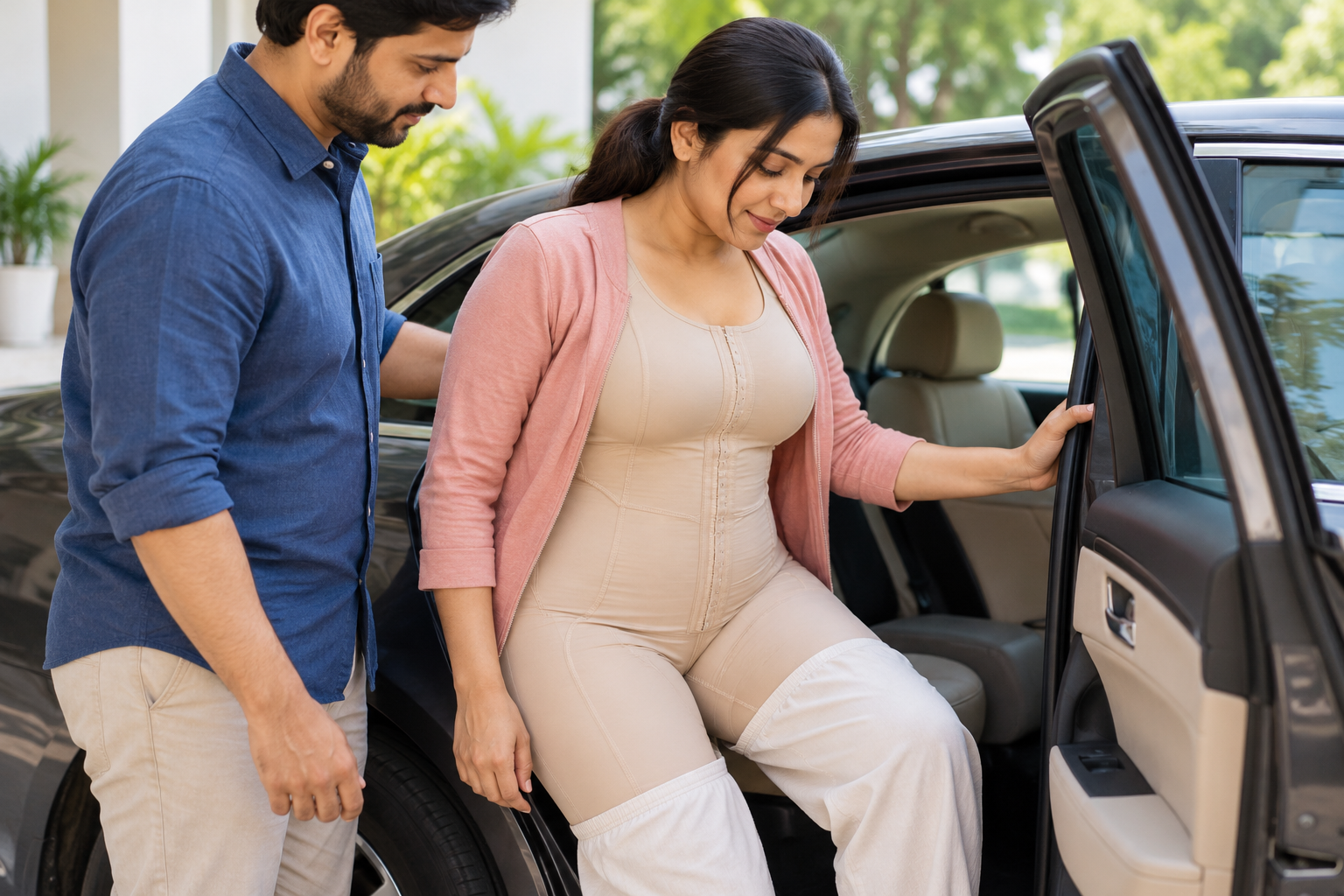
Travelling home after liposuction may be possible once the treating surgeon and anaesthesia team confirm that the patient is stable.
However, travelling too soon can increase discomfort and create avoidable risks.
Patients should not drive themselves after sedation or general anaesthesia.
Travelling Home by Car
For a journey of approximately 90 km, a private car with a responsible companion is often more practical than crowded public transport.
The patient should be able to sit comfortably, wear the prescribed garment and move safely.
Recommended precautions may include:
- Follow the surgeon’s discharge and mobility instructions.
- Wear the prescribed compression garment without excessive tightness.
- Avoid remaining motionless for long periods.
- When cleared to walk, take short walking breaks, often around every hour during a longer journey.
- Drink fluids as permitted by the medical team.
- Keep prescribed medicines and discharge papers accessible.
- Avoid lifting heavy luggage.
These measures support comfort and mobility but do not eliminate blood-clot risk.
Patients with a higher risk of venous thromboembolism may require additional precautions or a different travel schedule.
Should You Stay Overnight Before Returning?
An overnight stay may be advisable when the operation is extensive, the patient has undergone general anaesthesia, or the treating team wants further observation.
For some patients, travelling the next day may be more comfortable than leaving immediately after surgery.
However, waiting until the next day does not automatically make travel safe.
Medical clearance is still essential.
Liposuction Trip Planner for Bharuch Patients
The following table illustrates a possible treatment schedule. The final location and clinician for each visit must be confirmed when booking.
| Treatment Stage | Possible Location | Who Reviews You | What to Carry |
|---|---|---|---|
| Initial consultation | Bharuch OPD | Operating surgeon or authorised assessing clinician, subject to roster | Medical history, prescriptions, previous reports |
| Preoperative tests | Local laboratory or Surat centre | Surgical and anaesthesia teams review results | Test reports and medical records |
| Surgery day | Surat surgical centre | Operating surgeon and anaesthesia team | Admission papers, reports, companion |
| Day 5–7 check | Bharuch OPD or Surat, as arranged | Authorised postoperative clinician; surgeon reviews concerns | Discharge summary, medicines, garment |
| Week 4 review | Local OPD or Surat, if clinically appropriate | Treating surgeon or designated clinician | Recovery notes, relevant photographs |
| Month 3 review | Planned clinic visit or approved remote review | Treating surgeon or designated clinician | Progress photographs and symptom history |
The table is a planning example, not a confirmed OPD roster or guaranteed appointment schedule. The clinic should identify the operating surgeon, the clinician responsible for each review, and the process for escalating complications.
Which Follow-Ups Can Happen Locally?
Postoperative care is an essential part of successful liposuction treatment.
The exact schedule depends on the procedure and recovery.
First Week: Wound and Swelling Check
The first review may assess:
- Incision healing
- Swelling and bruising
- Pain control
- Fluid collections
- Signs of infection
- Compression garment fit
- Walking and daily activity
Some patients have absorbable sutures, while others require stitch removal.
Drains are not routinely necessary in every liposuction procedure.
If a drain is used, its removal should be performed by an appropriately trained clinician following the operating surgeon’s instructions.
Week Four: Recovery Progress
By approximately four weeks, many patients experience reduced bruising and improved comfort.
However, swelling may remain.
The clinician may assess contour changes, firmness, asymmetry and activity progression.
Month Three: Contour Assessment
At around three months, a substantial portion of swelling may have settled.
However, final contour changes can continue beyond this point.
The surgeon may review the result, discuss residual swelling and determine whether further follow-up is needed.
Who Is Responsible for Follow-Up Care?
Patients should know exactly who is responsible for their postoperative treatment.
At Elegance Clinic, Dr. Ashutosh Shah, MBBS, MS, MCh and DNB, is a plastic and reconstructive surgeon practising since 2004, with over 22 years of experience. Patients considering liposuction should confirm whether he will be their operating surgeon, which clinician will perform each local OPD review, and how urgent concerns will be communicated to the surgical team.
The operating surgeon should remain accountable for the surgical treatment plan, including instructions for wound care, activity, compression garments, and complication management.
Local postoperative checks should be coordinated with the surgical team rather than treated as unrelated appointments.
What Warning Signs Need Immediate Medical Attention?
Most patients experience some swelling, bruising, and soreness after liposuction.
However, certain symptoms require urgent evaluation.
Contact the Surgical Team Promptly For:
- Increasing redness or warmth around an incision
- Fever or chills
- Worsening pain
- Unusual or foul-smelling discharge
- Rapidly increasing swelling
- A new fluid collection
- Persistent vomiting or difficulty drinking fluids
Seek Emergency Medical Care For:
- Sudden shortness of breath
- Chest pain
- Fainting
- Coughing up blood
- New painful swelling in one leg
- Severe weakness or confusion
These symptoms may indicate serious complications, including a blood clot or other postoperative emergency.
Do not travel a long distance to the operating centre before seeking emergency care for potentially life-threatening symptoms. Attend the nearest appropriate emergency facility and inform the operating surgeon as soon as possible.
When Can You Return to Work After Liposuction?
Return-to-work timing depends on the physical demands of the job and the extent of surgery.
Desk-Based Work
Some patients return to light desk work within several days to approximately one week.
However, soreness, swelling, and fatigue may make longer leave necessary.
Industrial and Shift Work
Industrial jobs may involve prolonged standing, bending, lifting, climbing, or operating machinery.
These activities can place additional stress on healing tissues.
Patients should not assume they can return to full industrial duties within seven days.
A phased return or temporary light-duty assignment may be more appropriate.
Physically Demanding Work
Heavy lifting and strenuous exercise often need to be restricted for several weeks.
The surgeon should provide individual activity instructions based on the procedure and healing progress.
How Many Trips Are Usually Necessary?
The number of trips depends on the treatment plan.
A patient may need a preoperative assessment, a surgery visit, and one or more postoperative visits at the surgical centre.
Some follow-ups may be suitable for a local OPD or remote review.
However, unexpected complications, drains, delayed wound healing or concerns about the surgical result may require additional visits.
Patients should request a written follow-up schedule before booking surgery.
For broader travel planning, see the guide for patients visiting from afar.
Frequently Asked Questions
1. Where Can I Get Liposuction Near Bharuch?
Patients considering liposuction near bharuch can enquire at the Elegance Clinic Bharuch OPD about an initial consultation and a coordinated surgery plan. The operation is planned at the Surat surgical centre. Confirm the surgeon’s availability and postoperative services before booking.
2. Can I Travel 90 km Home by Car the Day After Liposuction?
Possibly, if your surgeon and anaesthesia team confirm that you are medically fit for discharge and travel. Use a companion, follow garment instructions and take walking breaks when permitted. Patients with complications or increased clot risk may need to delay the journey.
3. How Many Follow-Up Visits Are Needed After Liposuction if I Live in Bharuch?
The schedule varies. Common review points may include the first postoperative week, approximately four weeks and around three months. Some visits may take place locally if suitable clinical services are available, while others require assessment at the operating centre.
4. Can I Travel by Bus or Train After Liposuction?
A private car is often more convenient during early recovery. Bus or train travel may involve prolonged sitting, crowds and luggage handling. Discuss the proposed journey with your surgeon before booking tickets.
5. Who Removes the Stitches or Drain if I Live in Bharuch?
An appropriately trained clinician may remove stitches or a drain if the operating surgeon has authorised the arrangement. Confirm the exact appointment location and responsible clinician before discharge. Never remove a surgical drain yourself.
6. What If I Develop Swelling or Fever at Home?
Mild swelling is common, but fever, increasing redness, severe pain or rapidly worsening swelling requires prompt medical advice. Contact the surgical team. If symptoms are severe, seek immediate assessment at a nearby emergency facility.
7. Can Industrial Shift Workers Return to Work in a Week?
Some patients may return to light duties within a week, but physically demanding work may require a longer recovery period. The surgeon should assess your job requirements and provide appropriate restrictions.
8. Is a Relative Required to Stay With Me the First Night?
After sedation or general anaesthesia, a responsible adult is generally needed to accompany you home and stay with you for at least the first 24 hours, according to your discharge instructions. Additional assistance may be necessary after more extensive surgery.
Planning Your Liposuction Consultation
If you are considering liposuction in Bharuch, begin by confirming the consultation location, surgeon’s availability, and expected postoperative schedule.
Useful clinic resources include:
Before surgery, request written confirmation of the operating facility, responsible surgeon, discharge criteria, emergency contacts and follow-up arrangements.
Conclusion
Planning liposuction across two locations can be manageable when the surgical team coordinates each stage.
Patients may be able to attend an initial local consultation, complete suitable investigations close to home, undergo surgery at the designated centre, and return for selected postoperative checks locally.
However, convenience should never replace proper medical supervision.
For liposuction in Bharuch, the safest plan is one that clearly identifies where the operation takes place, who provides follow-up care, and what to do if complications develop.
A consultation at Elegance Clinic can help determine whether liposuction is appropriate and how travel and recovery should be organised.
